
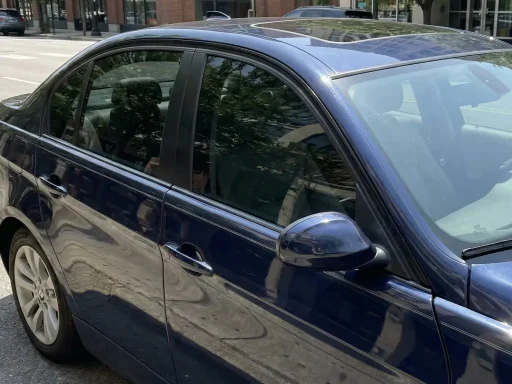
There is no more ubiquitous and misconceived option in the complicated aftermarket of car window tinting than the selection of the right tint. It is a choice that lies between aesthetics, thermal dynamics, and legal requirements. Out of the enormous range of different tint options, between the optically transparent 70 percent and the opaque “limo” style 5 percent, there has been a single percentage that has become the market equilibrium: 35 percent Window Tint VLT (Visible Light Transmission).
This discussion seeks to dismantle the utility of 35% window tint. We shall look into its performance parameters in terms of level of privacy and optical clarity, explore the mathematical facts of legal compliance, and assess the material technologies—such as ceramic window tint—that distinguish high-quality films from the regular cosmetic upgrades found at big-box retailers like Walmart stores.
Why is 35% Tint Considered the “Golden Standard”?
The concept of the “Sweet Spot” in automotive ergonomics is the first concept that one must comprehend to understand the dominance of 35% tint among car owners. There are usually two conflicting desires that drivers have. The first is the wish to be alone, to isolate the cabin atmosphere from the outside world, to ensure heat reduction, and to cut off curious glances. This drives the preference toward a darker tint. The second is the information need—the need to have a clear view of the road, hazards, and mirrors, especially in low-light conditions. This drives the demand for a lighter tint that allows a sufficient amount of light to pass through.
The best trade-off between these conflicting constraints is 35% car tint.
We categorize 50% tint in the industry as either purely cosmetic or strictly for sun protection; it provides no privacy. On the other hand, 5% tint produces a blackout effect, which, although providing complete privacy, seriously impairs situational awareness during the night.
The 35 percent standard has gained its prominence due to its ability to remove the “fishbowl effect,” in which the driver feels completely exposed to the external environment, without the blind driving effects of darker tint film. It gives the vehicle a modern look that indicates the car has been customized and refined, but it is not too dark, resembling a factory tint look or an OEM (Original Equipment Manufacturer) factory tint specification. It is the logical decision for the driver who values long-term functionality and a stylish look.
Visual Realism: What Does 35% Tint Actually Look Like?
Consumer anxiety regarding automotive window tint often stems from an inability to visualize the outcome. Static images can be misleading due to camera exposure settings. A factual, observational breakdown of the level of tint performance across different lighting conditions provides a more accurate expectation for best results.
Daytime Privacy: Can People See In?
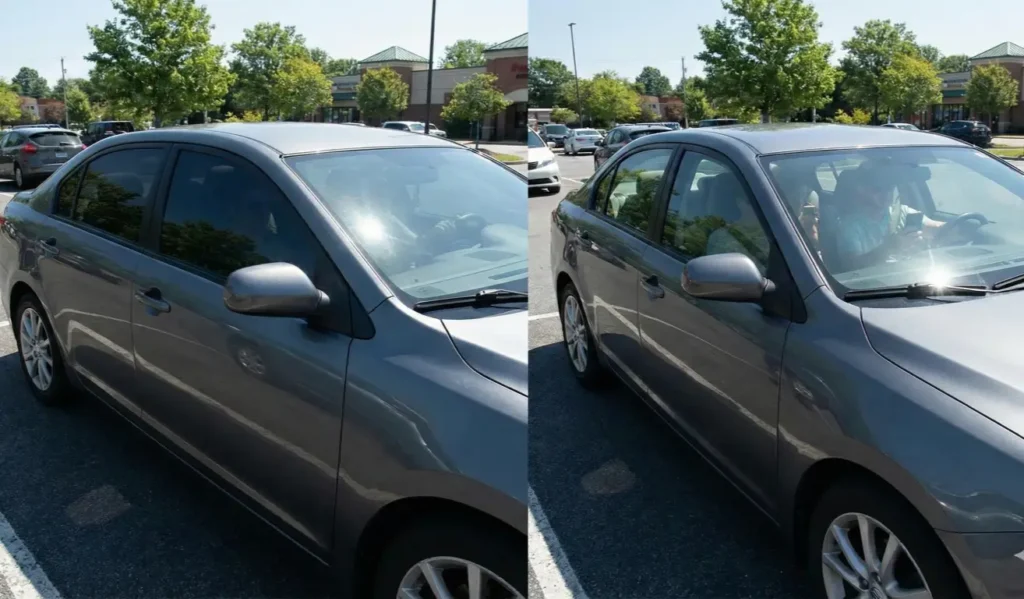
One should control expectations: 35% tint does not guarantee complete anonymity. In case you want to make sure that no one can see who is driving the car, 35 percent is not enough.
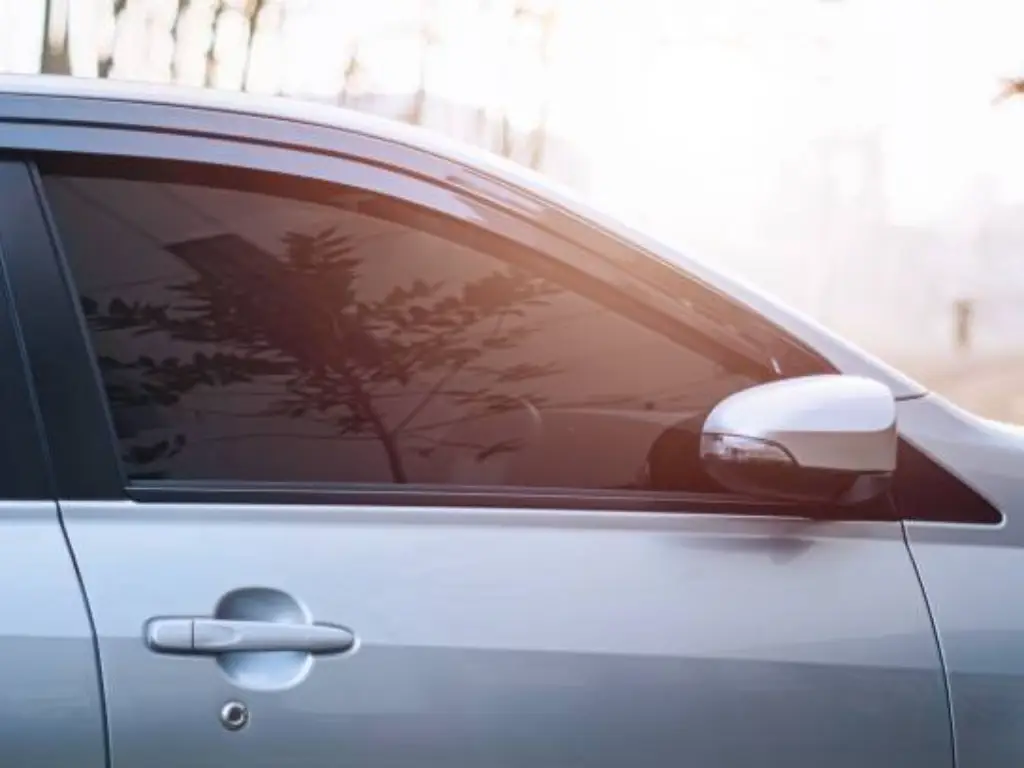
Nevertheless, it offers a considerable filtering effect. Externally, during daylight hours and on bright sunny days, 35% tint produces a clear silhouette effect. A viewer who is five feet away can tell that someone is in the car. They are probably able to determine the gender of the driver or notice grand gestures. Nevertheless, they are not able to differentiate fine details easily.
To illustrate, when you are sitting in a car with a moderate privacy tint of 35 percent, a person can notice that you are using a phone, but they cannot read the text on the screen and recognize the brand of the gadget easily. This is the degree of privacy that is commonly referred to as a “Classy Factory Look.” It resembles the privacy glass that is usually installed on the back windows of SUVs and minivans. It offers a feeling of seclusion and peace of mind without emitting the closed-off, aggressive look of a VIP transport or a security car.
Night Visibility: Can you see out?
This is the safety critical variable. The main disadvantage of 20% or 5% tint is that it drastically decreases the contrast sensitivity during the night, especially in the places where there are no streetlights.
The tint of 35% preserves most of the visual cues required to operate safely. The loss of transmission is significant enough to provide glare reduction from headlights in the rear-view mirror, but not so great that it removes shadow detail in the environment.
The real-life standard is inverting. A driver can reverse into a parking space or a driveway at night with 35 percent tint without necessarily rolling down the windows of a vehicle. The mirrors on the sides are still in use, and the driver is able to differentiate between the pavement, the curb, and the obstacles around it. Although the sight is significantly darker than clear glass, the brain becomes accustomed to such an amount of visible light rather fast, and the level of confidence in spatial awareness remains high.
In the video , notice how the driver maintains clear visibility of the road markings and surroundings despite the tinted windshield.
The Ultimate Showdown: 35% vs. 20% Tint
The most common decision-making paralysis occurs when choosing between 35% and 20% tint. While a 15% difference may seem mathematically marginal, the perceptual difference is significant. 20% tint represents a threshold where functionality begins to yield to privacy.
The following analysis compares these two popular standards across critical dimensions:
| Feature | 35% Window Tint | 20% Window Tint |
| Privacy Level | Moderate. Creates a silhouette. Features are obscured but occupancy is visible. | High. Difficult to see inside even during the day. Face recognition is nearly impossible from outside. |
| Night Visibility | Excellent. Retains shadow detail. No need to lower windows to park. | Reduced. Requires heightened focus. Drivers often must roll down windows to reverse in unlit areas. |
| Rain/Poor Weather | Safe. Good contrast retention even during heavy rain. | Challenging. Rain combined with dark tint can severely limit side-mirror visibility. |
| Aesthetic Style | Sophisticated/OEM. Looks like a factory upgrade. “Classy.” | Aggressive. Looks modified. “Limo” or “Sport” style. |
| Interior Heat | Good. (Highly dependent on material technology). | Better. (Assuming identical material type, darker absorbs slightly more visible light energy). |
| Legal Risk | Low. Legal on front windows in many jurisdictions. | High. Illegal on front windows in the vast majority of states. |
The Strategic Compromise:
The industry usually suggests a split configuration for drivers who cannot make a choice. This includes using 35 percent film on the front side windows (to ensure compliance with the law and visibility of the mirrors) and 20 percent on the rear windows and back windshield (to ensure the maximum amount of heat is rejected and the occupants/cargo have their privacy). This arrangement is a compromise between the functional needs of the driver and the comfort needs of the cabin.
The Hidden Math: Why 35% Film Could Be an illegal application
Another mistake that is usually made during the tinting process is the inability to consider the properties that are already present in the automotive glass. Most vehicle owners believe that they have a VLT of 100 since their windows appear clear. This is factually incorrect.
Nearly all automotive glass manufactured today has a slight tint, which is mainly because of the iron oxide present in the manufacturing process to give it basic UV protection and strength. Normal car windows that are of the clear type have a VLT of between 70 and 75 percent.
When you install an aftermarket film you are not replacing the existing VLT; you are multiplying it. This is the VLT Stacking concept.
The Calculation:
If you apply a 35% film (0.35 VLT) to a factory window that already has a 75% VLT (0.75), the calculation is as follows:
0.75(Factory Glass)x0.35(Film)=0.2625
The Result:
The actual Net VLT of your window will be approximately 26%.
This distinction is critical for legal compliance. If you reside in a state where the legal limit for front windows is strictly 35% (e.g., Maryland, Illinois, Oregon), applying a “legal” 35% film will actually result in a “non-compliant” net reading of 26%. To stay strictly within the 35% legal limit, a vehicle owner would theoretically need to apply a 50% film (resulting in approx. 37% net VLT).
Darker Does Not Mean Cooler: The Critical Role of Material
There is a long-standing myth that the tint is dark, which makes the cabin cool. It is a correlation that was true of older technologies but has been made obsolete by material science.
In regular Dyed Films, the heat rejection is attained mainly by absorbing the solar energy. The darker the dye, the more visible light it absorbs and thus prevents more heat. Nonetheless, this technology has low performance ceiling and is susceptible to fading.
In the Nano-Ceramic Films of today, the rejection of heat is not coupled with the transmission of visible light. Ceramic nanoparticles are designed to be specific to the Infrared (IR) spectrum, which is the part of the solar spectrum that causes the feeling of heat.
Thus, a 35% Ceramic film of high quality will block much more heat than a 5% Dyed film. The 5 percent dyed film prevents the visible light but allows the infrared heat to pass through; the 35 percent ceramic film permits the visible light to pass through but prevents the infrared heat.
Why High-Performance 35% Film Requires Superior Manufacturing
Producing a high-performance 35% ceramic film presents a specific engineering challenge. The manufacturer must infuse the polyester base with enough ceramic particles to achieve high Infrared Rejection (IRR) numbers, yet they must keep the film optically clear enough to meet the 35% VLT standard.
If the manufacturing process is imprecise, the high density of ceramic particles can cause light scattering. This results in two major defects:
- Low-Angle Haze: A milky appearance when the sun hits the window at a specific angle.
- Nighttime Scattering: A “starburst” effect around streetlights and headlights, reducing visual acuity.
Low-quality manufacturers often sacrifice optical clarity to chase high heat rejection numbers on paper. Superior manufacturing is required to balance these opposing forces.
The FlexiPPF Advantage: Redefining Performance Standards for 35% Tint
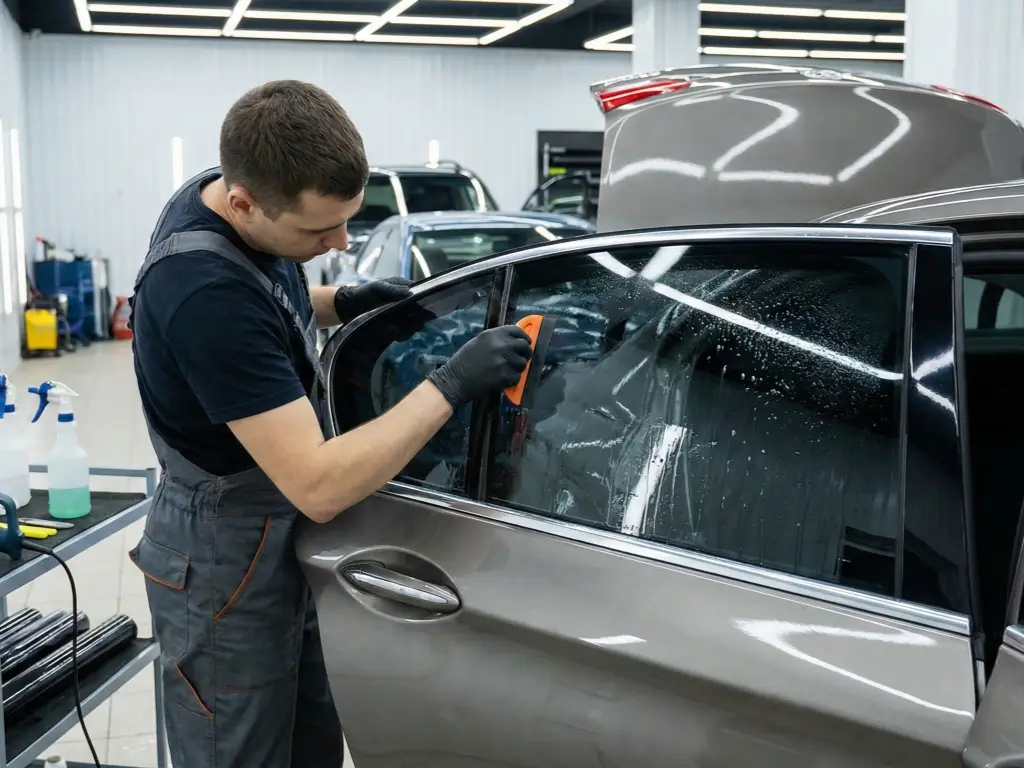
At FlexiPPF, we do not just treat the production of window film as an accessory, but as an optical instrument. We have learned the constraints of the conventional dyed films and the production difficulties of the ceramic technology, and thus we have vertically integrated our supply chain to address the particular pain points of 35% tint.
Our 35% Ceramic Series is designed to excel the market in three dimensions namely: Optical Clarity, Thermal Efficiency and Durability.
1. Optical Clarity: The German Engineering Difference.
In order to solve the problem of night haze and scattering, FlexiPPF uses German BASF polyester as our raw material. This base layer is manufactured on high-technology German Brunkner production lines and provides outstanding tensile strength and consistent optical clarity.
- The Findings: Our movie eliminates glare by as much as 55 percent without adding the hazy look of other poorer ceramic movies. FlexiPPF 35% tint is also safe because when driving at night, the view is clear and free of distortion, and comfort is never sacrificed.
2. Maximum Heat Rejection in a Lighter Colour.
By using a Nano Ceramic Coating that is supplied by the best suppliers in the world, we have separated darkness and heat rejection.
- The Performance: FlexiPPF 35% film blocks 99% of the harmful UV rays (UV400) and rejects more than 70% of the Infrared heat. This enables our lightweight, legal 35% film to provide thermal protection that is better than most of the 20% or 5% dyed films of our competitors. It forms a thermal barrier that lowers cabin temperature up to 65 percent, which greatly decreases air conditioning load.
3. Built to Last: The 10-Year Promise.
We use Ashland Adhesive, which is a USA product with low VOC emissions and high heat resistance (resistant to temperatures up to 80 o C).
- The Guarantee: FlexiPPF films are color-stable unlike regular films which turn purple because of unstable dyes. To support this, we offer a 10-Year warranty, which means that the film will not bubble, peel or yellow, even after 5000 hours of UV exposure.
In the case of our B2B partners, FlexiPPF has different supply chain benefits. Our 60,000m 2 factory that has SLOT DIE coating equipment will guarantee quick production. We also have Precise Pre-Cutting services on 100+ car models, which perfectly fit and save on time. We offer the flexibility and speed needed by professional tint shops and distributors with a promise of 48-hour custom design turnaround and spot inventory that can be shipped immediately (1-2 days).
Law Enforcement Reality & State Regulation Overview
Although the mathematical fact of the VLT Stacking is that a 35% film could technically fall below the legal limits, the reality of law enforcement is a different story.
Police officers are typically trained to seek out vehicles that pose a safety hazard. 5 percent “limo tint” on a front window does not allow an officer to see whether the driver is reaching a weapon or a license, and so it is a high-priority target of a traffic stop, a “Cop Magnet.”
By contrast, 35% tint is in a high tolerance zone. Since it can be used to view the silhouette of the driver and resembles the appearance of factory privacy glass, it hardly causes a primary enforcement response. In states where the limit is 35 or 30, the officers usually use discretion unless the tint is outrageously dark.
Regulatory Context:
- Strict States: California, New York, and Pennsylvania have traditionally strict laws on front window tint (usually 70 percent or none). In such jurisdictions, 35 percent is technically illegal but usually condoned more than 20 percent.
- Moderate States: Texas, Florida, and Arizona (warm climate states) typically permit about 25-35% on front windows, so 35% film is a safe universal option in these states.
Disclosure: This article is not legal advice. Before application, always confirm your local state or provincial laws.
Conclusion: Is 35% Window Tint Right for You?
The selection of 35% window tint is a vote for balance. It is the choice for the driver who values a sophisticated aesthetic over an aggressive one, and who prioritizes nighttime safety over total daytime anonymity.
35% is the ideal solution for:
- The Daily Commuter: Who drives in varying light conditions and needs reliable visibility.
- The Luxury Owner: Who wants to enhance the vehicle’s look without straying from an OEM appearance.
- The Risk-Averse: Who lives in jurisdictions with tint laws and wishes to avoid unnecessary attention from law enforcement.
However, if you are still debating whether 35% provides enough privacy for your specific needs, or if you are considering pushing the limit with 20% or 5%, it is helpful to see the full spectrum of options.
Still not sure if 35% is dark enough for you? Compare it side-by-side with 20% and 5% in our Ultimate Window Tint Percentages Comparison Guide.
For those ready to proceed with the balanced choice, the quality of the film matters as much as the shade. whether you are a vehicle owner seeking the best heat rejection or a distributor looking for a reliable manufacturing partner.
Take the Next Step:
Explore the FlexiPPF product catalog to view detailed specification sheets for our Ceramic Series, or contact our team today to request a sample book. Experience the difference that German engineering and American adhesive technology can make in your driving experience.
 English
  Spanish
  Dutch
Dutch  Japanese
  Russian
  Arabic