
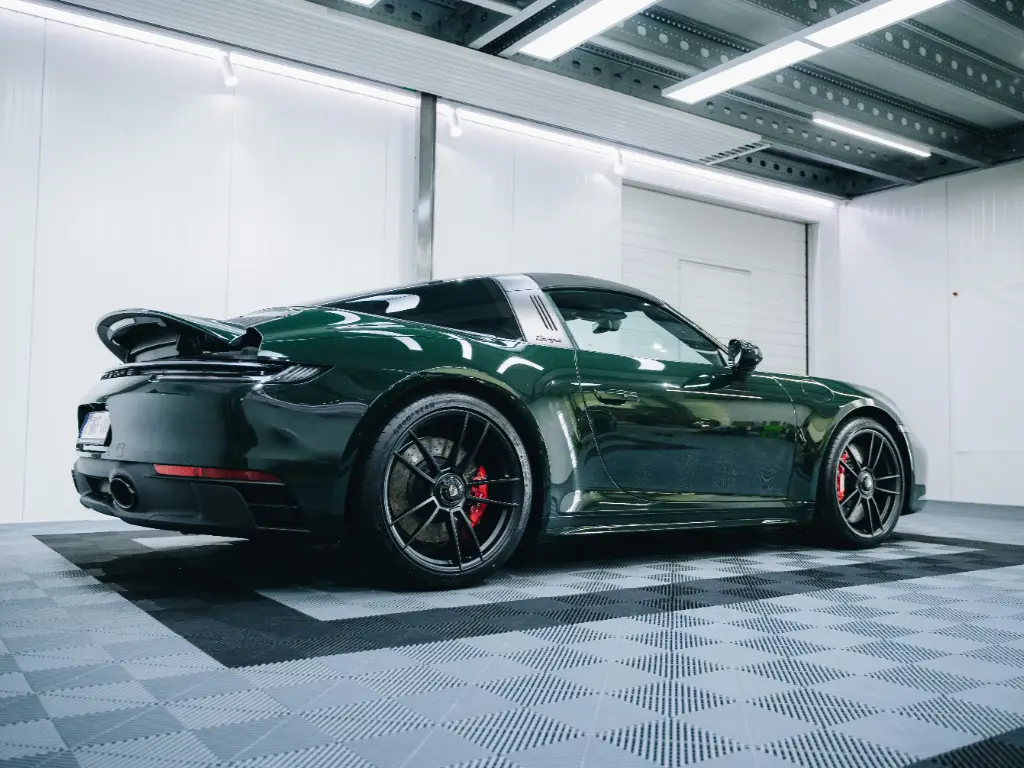
The Hard Truth About Car Paint Protection
Let’s not waste time and get straight to the biggest illusion in the auto detailing industry today: If you are clicking on this article hoping that a few hundred dollars spent on a ceramic coating will save your front bumper from rock chips at 80 mph, please close this page now. It simply will not happen.
We see countless car owners and dealership buyers manipulated by exaggerated marketing claims, confusing “scratch resistance” with “impact defense.” To make a smart investment, you must understand the fundamental baseline of automotive protection: think of your car’s factory paint as your skin.
“Paint Protection Film (PPF) is your Kevlar body armor. Ceramic Coating is an ultra-premium, high-tech raincoat. The body armor can stop a bullet but still gets dirty; the raincoat keeps you perfectly dry, but it won’t stop a knife.”
— Marcus, Auto Detailing Director (18 Years of Experience)
Both products are exceptional at what they do, but they serve entirely different physical purposes. Let’s break down the actual science before you spend thousands of dollars.
Core Mechanisms: Solid Armor vs. Liquid Shield
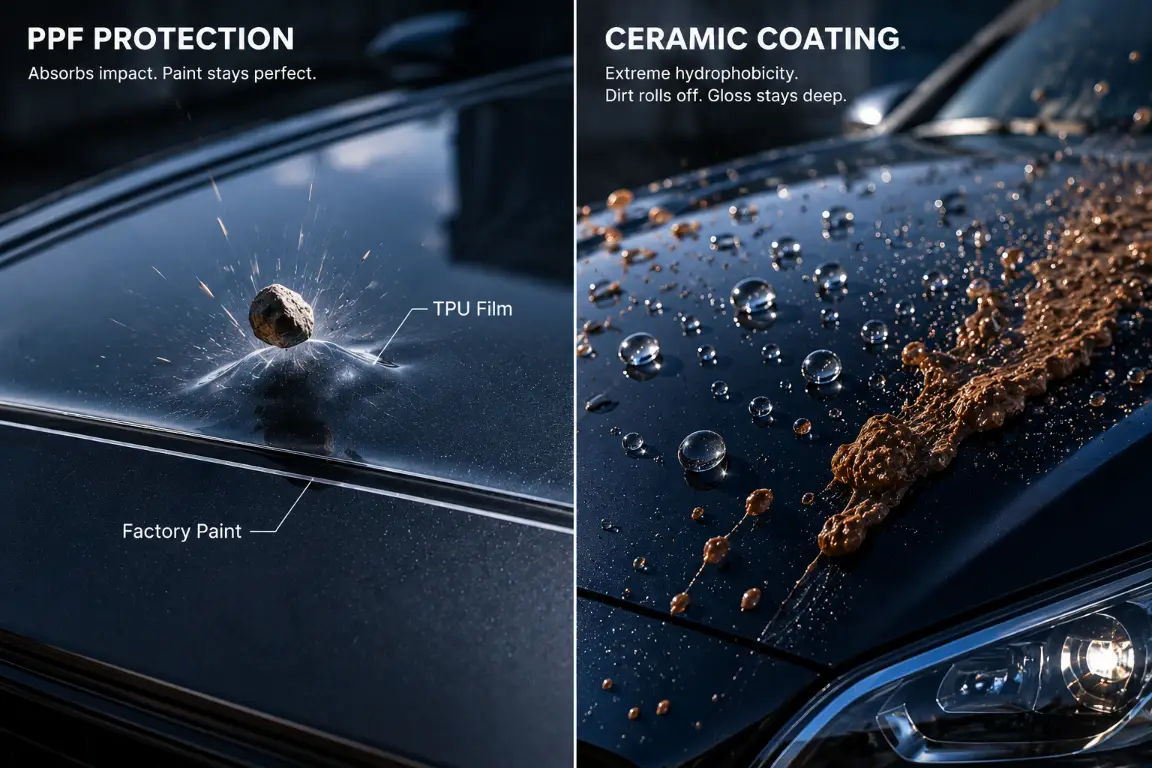
To truly grasp the value of either option, we must look at them under a microscope. The fundamental difference lies in their physical state: one is a solid, energy-absorbing barrier, while the other is a liquid, surface-altering nanotechnology.
Paint Protection Film (PPF): The Thermoplastic Shield
PPF is a tangible, multi-layered polyurethane film applied directly over your vehicle’s clear coat. Its primary superpower lies in kinetic energy absorption. When a rock strikes your car on the highway, the flexible TPU (Thermoplastic Polyurethane) acts like a microscopic trampoline, dispersing the concentrated impact force across a wider area and preventing the rock from piercing through to the factory paint.
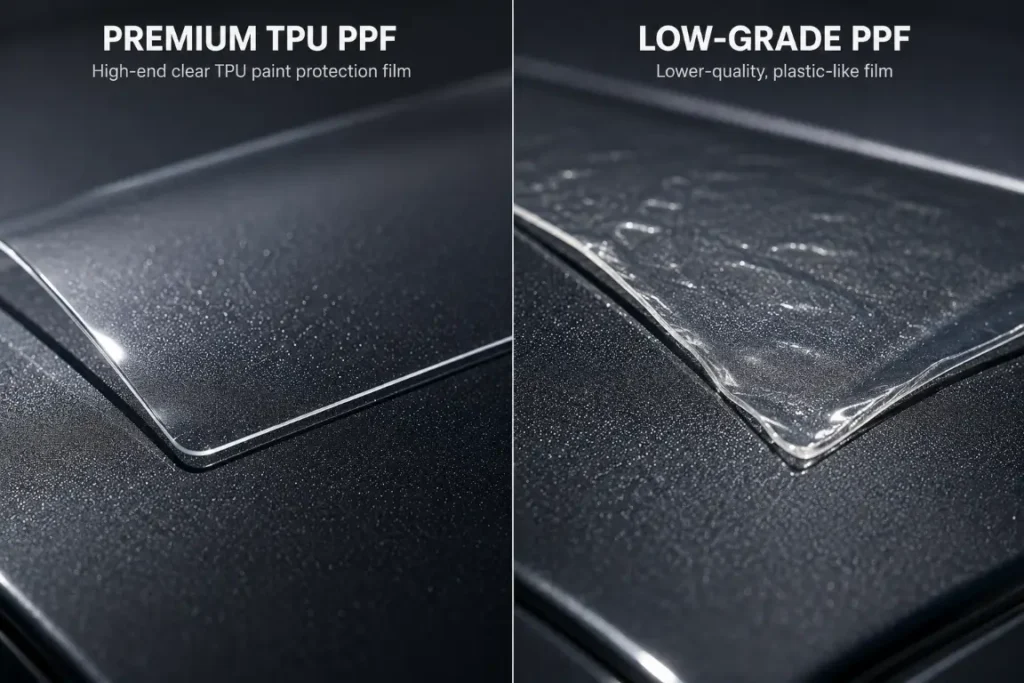
However, the industry holds a dark secret: not all PPF is created equal. Cheap PVC (Polyvinyl Chloride) or Aromatic TPU films will inevitably turn yellow and crack under sun exposure. For a true “install and forget” experience, professional installers insist on Aliphatic TPU.
Technical Standards & Longevity Anchor
How do you know if a film will actually last? Look at the manufacturing baseline. Premium PPF suppliers, such as FlexiPPF, set the industry standard by utilizing advanced SLOT DIE coating equipment and German Brückner polyester film production lines. A true high-end film must pass rigorous stress tests—surviving 5000 hours of intense UV irradiation and withstanding temperatures up to 80°C without yellowing or degrading. When you invest in materials backed by a 10-year warranty from a 60,000m² manufacturing facility, you are paying for guaranteed chemical stability, not just a brand name.
Ceramic Coating: The SiO2 Hydrophobic Layer
If PPF is thick (typically 150-200 microns), Ceramic Coating is microscopically thin—usually just 1 to 2 microns. Under a microscope, your car’s factory clear coat looks like a rugged, uneven lunar landscape. Dirt, tree sap, and water easily get trapped in these microscopic valleys.
Ceramic coatings utilize nanotechnology. The liquid polymer chemically bonds (forming covalent bonds) with the factory paint, filling in those microscopic pores to create a perfectly flat, glass-like surface. This drastically lowers the surface tension.
The Insider Metric: A genuine, professional-grade ceramic coating should contain an effective SiO2 (Silicon Dioxide) or SiC (Silicon Carbide) concentration of 70% or higher. Do not confuse true ceramic coatings with the cheap polymer sealants often thrown in for “free” by car dealerships.
Head-to-Head Performance Matrix
How do these two solutions perform in real-world scenarios? Let’s put them in the arena for a one-on-one comparison.
Physical Defense & Self-Healing (Rock Chips & Scratches)
| Threat Level | PPF Performance | Ceramic Coating Performance |
|---|---|---|
| Highway Rock Chips | Winner: Absorbs impact, paint remains flawless. | Fails: Rock chips will instantly penetrate to bare metal. |
| “Door Dings” (Parking Lot) | Winner: Film may scuff, but factory paint is saved. | Fails: Offers zero impact cushioning. |
| Key Scratches / Swirl Marks | Winner: Self-healing topcoat (recovers under 60°C heat/sunlight). | Partial: Reduces minor wash swirls, but cannot self-heal deep scratches. |
Imagine returning to your car in a crowded mall parking lot to find someone has carelessly bumped their door into yours. With PPF, you might see a scuff on the film, but once removed or heated, the clear coat beneath is pristine. With a ceramic coating, you are looking at an expensive trip to the body shop.
Chemical Resistance & Aesthetic Gloss (UV, Sap & Water)
Here is where the tables turn. While PPF dominates in physical combat, Ceramic Coating is the undisputed champion of chemical resistance and aesthetics.
Even top-tier PPF has a weakness: if highly acidic bird droppings or tree sap are left baking on the film in the summer sun, they can permanently etch the top layer. Ceramic coatings, however, are highly resistant to chemical degradation.
Furthermore, the extreme hydrophobic properties of a ceramic coating make daily maintenance incredibly easy. Using the two-bucket wash method and a high-pressure hose, dirt simply slides off the surface. You can often dry the car completely using a touchless forced-air blower, entirely eliminating the friction that causes wash swirls. If a deep, wet, candy-like gloss is your ultimate goal, ceramic is the answer.
The True Cost and ROI Analysis (What Shops Don’t Tell You)
The commercial investigation phase always comes down to numbers. Let’s look at the true lifecycle costs associated with both protective measures.
| Protection Type | Initial Investment (Est.) | Expected Lifespan | Primary Value Proposition |
|---|---|---|---|
| Full Body PPF | $4,000 – $7,000+ | 7 to 10 Years | Maximum resale value preservation (Factory Paint Intact) |
| Professional Ceramic | $1,000 – $2,500 | 2 to 5 Years | Ease of maintenance and flawless aesthetic gloss |
Why is PPF so much more expensive? A significant portion of the cost isn’t just the material—it’s the intense manual labor and the risk of material waste during installation. Hand-cutting film on a vehicle requires a master’s touch, and the slightest mistake can score the clear coat.
The Smart B2B & Enthusiast Solution: Precise Pre-Cutting
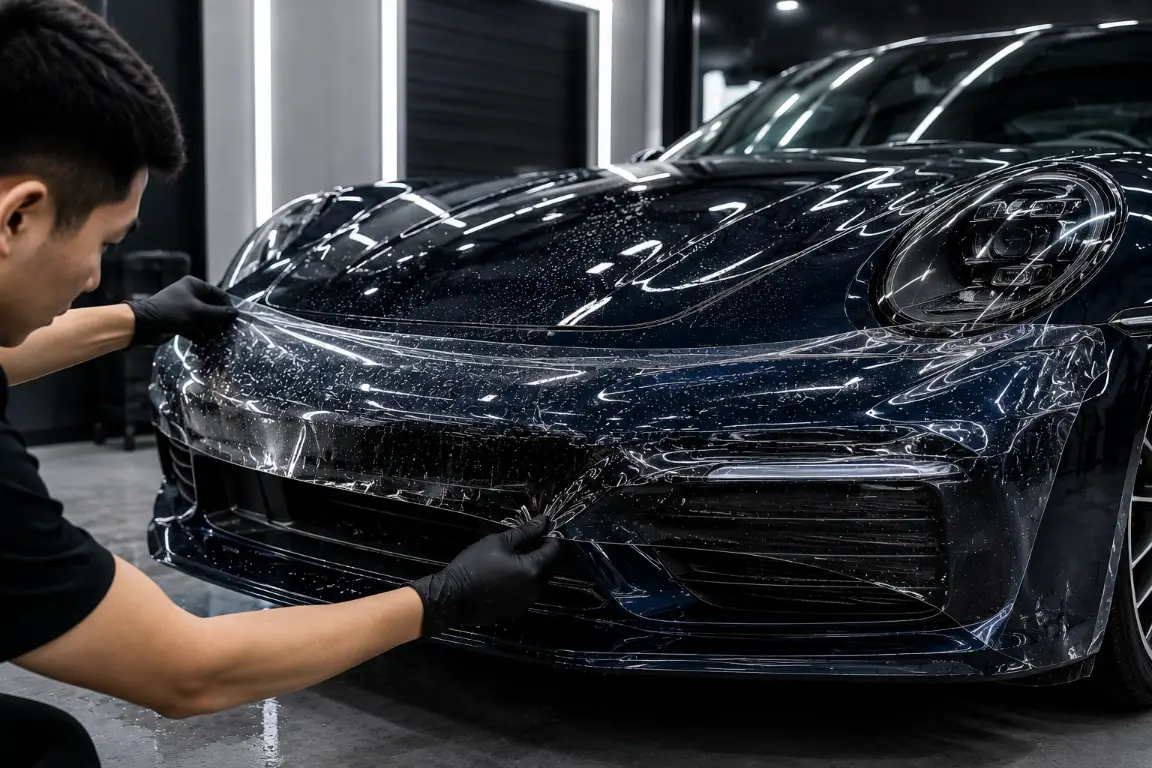
To eliminate these astronomical labor costs and installation risks, smart auto shops and meticulous car owners are turning to advanced Precise Pre-Cutting systems. Suppliers like FlexiPPF offer pre-cut templates that provide perfect fits for every car model. This seamless application process ensures zero blades touch your vehicle’s paint, drastically reducing installation time.
Furthermore, ROI is only real if it is guaranteed. By choosing a comprehensive supplier that offers a 10-Year Warranty and 7×24 hour technical support, you ensure that your $5,000+ investment is fully protected against manufacturer defects, allowing your car’s resale premium to easily offset the initial cost.
The Ultimate Solution: The “Best of Both Worlds” Combo
What if you want Kevlar armor and a waterproof raincoat? For owners who demand absolute perfection, the industry consensus points to a hybrid approach. You don’t have to choose just one.
- Step 1: The Armor. Apply PPF to the “High-Impact Areas” (Front bumper, hood, fenders, and side mirrors). This stops the devastating rock chips where they happen 90% of the time.
- Step 2: The Shield. Apply a specialized, flexible Ceramic Coating over the entire vehicle, including on top of the PPF.
This combination mitigates the PPF’s vulnerability to bird droppings while ensuring the whole car is effortless to wash. By avoiding full-body PPF, you can typically keep the total budget around $2,500 – $3,500, achieving the perfect balance of ROI and elite protection.
Decision Tree: Which Route is Right for You?
Stop overthinking. Find your profile below and make your decision:
- Scenario A: The Highway Warrior / Track Enthusiast. You commute daily at high speeds, facing a constant barrage of gravel, or you take your car to the track.
👉 Verdict: You MUST get PPF (at least a full front package). Anything less is financial negligence. - Scenario B: The Weekend Show Car. Your vehicle spends most of its life in a climate-controlled garage. You only drive it on sunny Sundays and obsess over the deepest possible gloss.
👉 Verdict: Multi-layer Professional Ceramic Coating. Let that paint shine. - Scenario C: The Leased Vehicle / Short-term Owner. You plan to return the car in 3 years and just want to avoid the dealership’s penalty fees for minor paint degradation, without investing in someone else’s asset.
👉 Verdict: Entry-level Ceramic Coating or a basic front-bumper-only PPF pre-cut kit.
Ready to Protect Your Investment?
Whether you need bulk rolls for your detailing shop with flexible MOQs, or precision pre-cut PPF templates backed by a 10-year warranty, we have the manufacturing power and expertise to deliver.
Explore Advanced Protection Solutions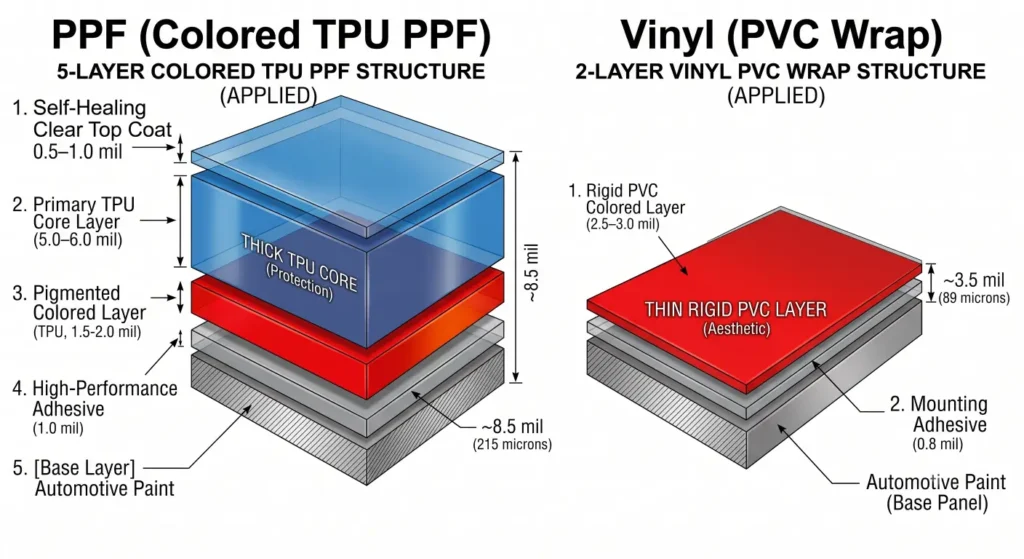
 English
  Spanish
  Dutch
Dutch  Japanese
  Russian
  Arabic