
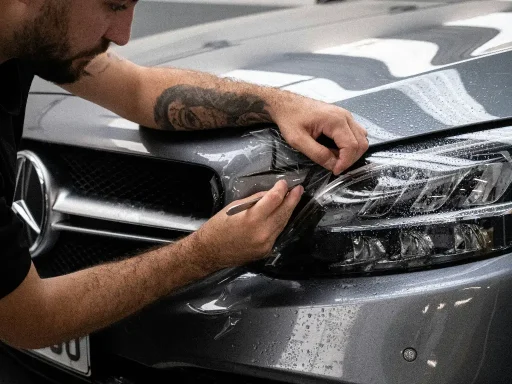
Your car is worn out, scratched, or even of the wrong color. You ask, “How much to paint it?” Many car owners ask this. The thing is, you are posing the wrong question.
A car paint job does not have a single price tag. Rather, the range of possible results is enormous, and the cost of painting may vary between several hundred dollars and more than $20,000. The quotation you get is not just for the auto paint, it is for a complicated, laborious painting process in which labor, rather than paint, is the major expense.
Do you want to hide the blemishes in a hurry, or are you ordering a functional art work? In this case, we are going to break down the question, examine the real car painting costs, and examine contemporary options such as vinyl wraps and PPF that could make the whole issue of car painting irrelevant.
The 3 Tiers of Car Paint Costs (Basic to Showroom)
Price is a direct reflection of one thing: labor. Specifically, the amount of labor dedicated to prep work. A paint shop’s quote is their estimate of how many hours it will take to do the job right—or how many corners they can cut to do it fast.
Tier 1: The Basic Respray ($500 – $1,500)
It is the special that is advertised and budget-driven. This is the advertised, budget-driven basic paint job. It is, nearly, without exception, a bad decision.
This level is associated with minimal prep work. This is referred to as a “scuff and shoot.” The store will simply lightly sand the already visible surfaces, mask the trim (which is often in poor condition), and spray a single coat of paint using a single-stage enamel paint or low-end urethane.
What you get: A uniform color, applied quickly.
What you don’t get: Durability, detail, or longevity.
The reality: This paint finish will often fade, peel, or chip within a year or two. Such areas as door jambs, the engine bay, and the trunk interior will not be considered, producing a two-tone effect, when any door is opened. This level is there to present a car as passably good to sell within a short time, and even there, a keen buyer will see it at a glance.
Tier 2: The Standard Professional Job ($2,000 – $5,000)
This is the level that most rational consumers are and should be seeking. This is what a good paint job that is durable and good-looking costs from professional painters.
At such a price, labor comes into the limelight. This includes:
- Prep: Sanding of the whole vehicle.
- Minor Repair: This is to deal with minor dings, dents, and surface blemishes.
- Quality Materials: Multi-stage system: primer, sealed base coat (color) and several coats of paint (a protective clear coat).
- Detailing: Stripping of trim, bumpers, and lights to make sure the paint gets into all crevices and avoids overspray. Door jambs are frequently provided.
This is a true respray. This car’s paint job is expected to last 5-10 years and will be very similar to a factory finish in terms of durability and shine. The difference of $3,000 in this level is reduced to the size of the vehicle, the complexity of the paint, and the labor rate of the region where the shop is located.
Tier 3: The Showroom & Concours Finish ($8,000 – $20,000+)
This is not a typical car painting project. This is car restoration.
This level is limited to high-value classic cars, show cars, or a complete repaint job. It is a painstaking, devastating and incredibly time-consuming process.
- The Procedure: The car is dismantled to bare metal. Every panel is removed. The engine is often pulled.
- Perfection: All the imperfections, even to the sub-millimeter level, are filled and metal-finished.
- Painting: The painting is done in dozens of layers, each layer is wetted with a primer, color, clear, and the surface is made perfectly flat and free of distortion by sanding it by hand (wet-sanded). The last car’s finish is finished to a depth and clarity which factory finishes, with their “orange peel” feel, can never equal.
The price is astronomical since the man-hours are astronomical, and they can be in the 400-500 hour range. This is the art of automotive spray painters, and it is sold accordingly.
Key Factors That Determine Your Final Cost
The leap between $500 and $20,000 is attributed to some important variables.
- Preparation Work (90%)
This is the great divider. A Tier 1 job may have 5-8 hours of prep. A Tier 3 job can allocate 300 hours to extensive prep work. Prep is the real quality work. Sanding, stripping, filling (especially for deep scratches), and, most importantly, rust-fighting, are its processes. When the condition of your car includes a rusty background, then all is lost. Rust is cancer. It cannot be “painted over.” It should be cut off, repaired and replenished with new metal. Any quotation or precise estimates you receive prior to a shop having examined your rust condition is a dream.
- Vehicle Size and Complexity
This is simple physics. The surface area of a Chevrolet Suburban (one of the larger vehicles) is three times that of a Mazda Miata (one of the smaller cars). The size of your vehicle involves increased material, increased sanding time, and increased spray time. Moreover, the type of your vehicle plays a big role; a car that has complicated curves, vents and aerodynamic components takes an extremely long time to mask and sand detail in comparison with a car with large flat panels.
- Paint Type and Color
The type of paint is a major factor. Not every painting is the same.
- Single-Stage: A color-and-gloss coating, often acrylic paint. It is much cheaper and quicker to apply, but much less durable.
- Two-Stage: The contemporary norm. A color base coat with a strong clear coat on top of it to give it gloss and protection against the sun.
- Color: The cheapest are standard colors like solid, non-metallic white or black. The moment you introduce metallic flakes, pearl effects (pearlescent), or even a triple-coat (a base, a translucent mid-coat and a clear), the bigger cost of the material and the difficulty of the application process will increase exponentially. Matte finishes are infamously costly not due to the paint, but due to the fact that they cannot be repaired; a single scratch means that the whole panel will have to be repainted.
DIY vs. Professional: A Cost Breakdown
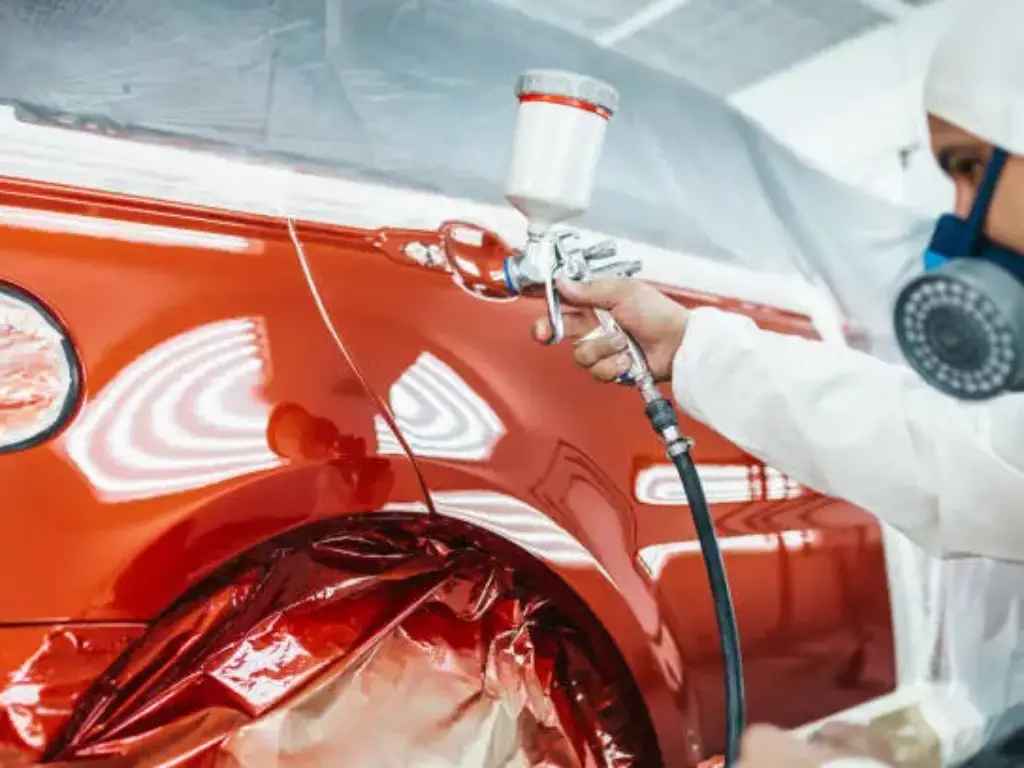
The immediate reaction to a $4,000 quote is often, “I’ll do it myself.” This is, for 99% of people, a catastrophic miscalculation.
The enthusiast sees a few cans of spray paint and a sander. The professional sees the reality.
The True Cost of a “Cheap” DIY Paint Job:
- HVLP Spray Gun (decent): $150 – $300
- Air Compressor (sufficiently large): $300 – $600
- Safety: Professional respirator (non-negotiable): $50 – $100
- Consumables: Sandpaper (multiple grits), masking tape/plastic, tack cloths, solvents, and many a clean towel: $200
- Materials: Primer, base coat, clear coat, hardener, reducer: $500 – $1,200
- Total Initial Outlay: $1,200 – $2,400
This $2,400 investment gets you entry-level materials and assumes you have a large, clean, well-ventilated garage storage space (which you don’t). Your first attempt will be defined by failures: “orange peel” (a bumpy texture), “runs” (dripping paint), and “fish-eyes” (craters caused by microscopic dust or oil contamination).
The Professional’s $4,000 Cost:
- Materials: ~$1,000
- Labor, Shop Costs, and Expertise: ~$3,000
You are not paying $3,000 for “labor.” You are paying for the technician’s 10,000 hours of experience. You are paying for the $100,000 heated, downdraft spray booth that guarantees a dust-free environment and handles fumes, as many paints contain a volatile organic compound. You are paying for insurance that if they do create a run, they will fix it. And you are paying for the 80+ hours of your own time that you get to keep.
DIY painting is not a cost-saving measure. It is a hobby, and an extremely expensive and frustrating one at that.
Paint Alternatives: Is Vinyl Wrap Better?
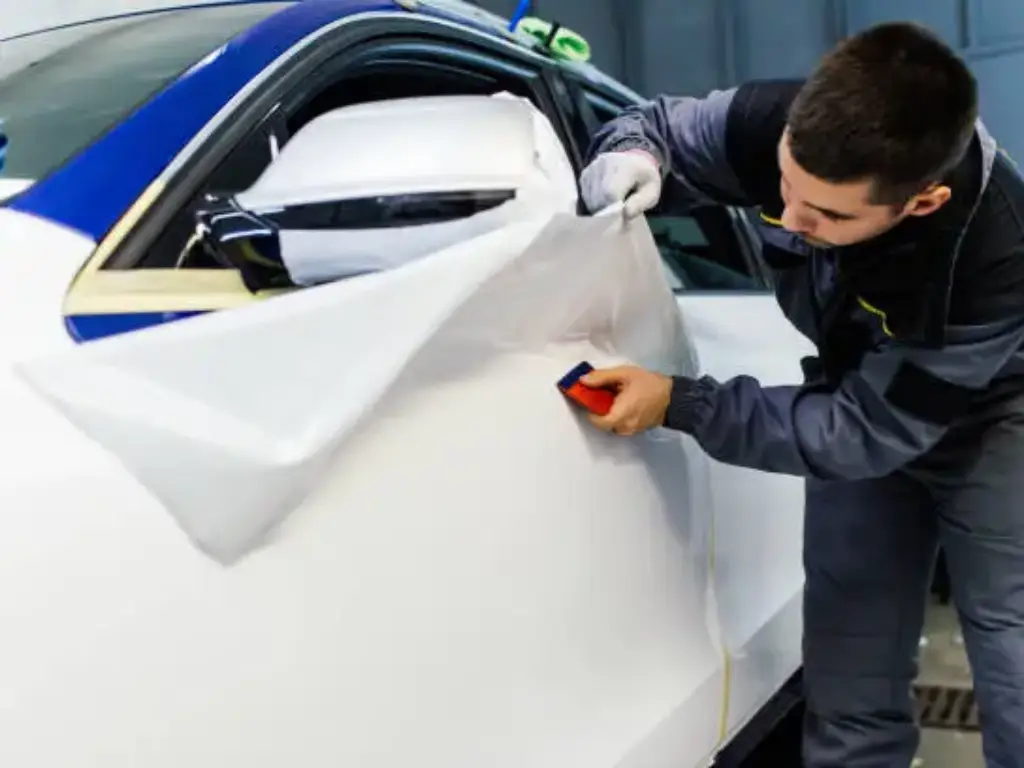
This leads to the essence of the contemporary dilemma. This is the biggest choice today. When the paint of your car is not peeling, not rusting, but you just dislike the color, then you should not paint it.
Vinyl wrap is the 21st-century solution.
A good wrap done by a professional wrapper is between $2,500 and $6,000, which is a good cost comparison to a paint job of the Standard (Tier 2) category. But its benefits are deep.
- Reversibility: The killer feature. A wrap is not permanent. It can be peeled off in 5-7 years or when you are tired of the color and the factory paint is left untouched and in perfect condition. This one fact alone plays a significant role in the beneficial effect on the resale value of your car.
- Protection: The wrap itself is a sacrificial coating, a durable film that shields the paint underneath against stone chips, light scratches, and environmental damage like acid rain.
- Time: A car can be covered within 2-4 days. It takes 1-3 weeks to do a quality paint job.
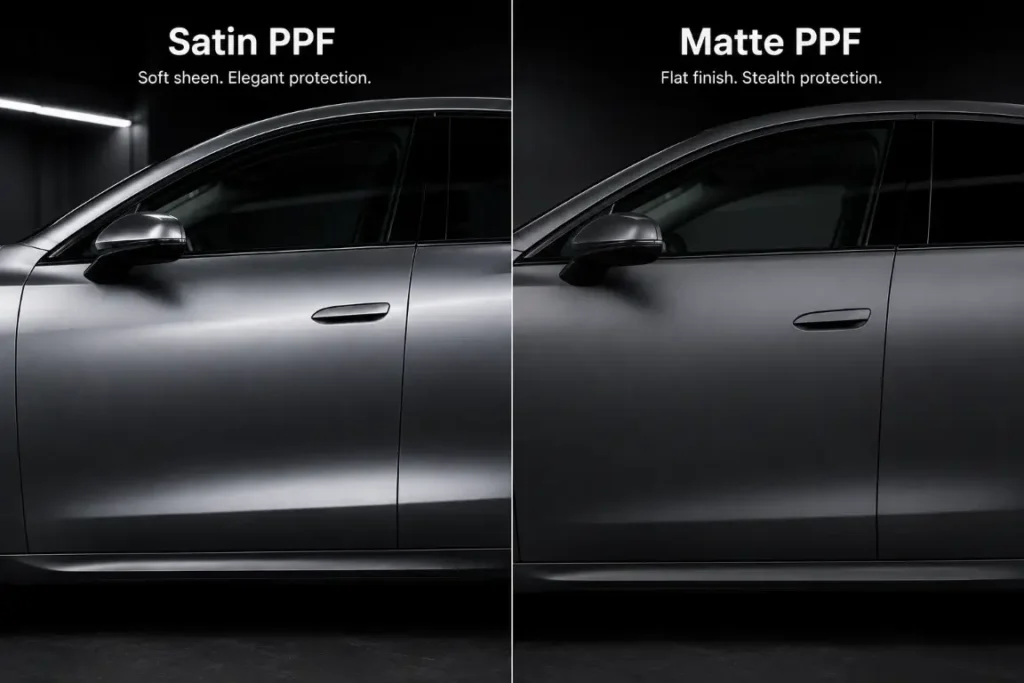
- Customization: This is the area in which paint is unable to compete. You do not have to work with a list of paint chips. Advanced suppliers allow you to get finishes such as brushed aluminum, satin, matte, chrome or even custom-printed graphics. It can be customized; high-end suppliers can provide small-run customization and an enormous variety of textures and colors, which can be combined to make a truly unique finish. Even professional designers can produce and render a custom design within a short time of 48 hours.
Wrapping is the smart option of aesthetic transformation. Painting a car a new color is an irreversible change that can be a value-destroying move.
| Feature | Professional Paint (Tier 2) | High-Quality Vinyl Wrap |
| Average Cost | $2,000 – $5,000 | $2,500 – $6,000 |
| Process | Permanent, chemical application of new color. | Adhesive film laid over existing paint. |
| Reversibility | Permanent. Requires a full repaint to change. | Fully Reversible. Can be removed to reveal original paint. |
| Protection | Is the new surface; offers no protection to itself. | Sacrificial Layer. Protects factory paint from chips & scratches. |
| Installation Time | 1 – 3 weeks (due to prep, spray, and curing) | 2 – 4 days |
| Durability | 5 – 10+ years (if well-maintained) | 5 – 7 years |
| Customization | Limited to paint catalog. Matte/pearl are very costly. | Near-infinite. (Matte, satin, chrome, textures, custom graphics). |
| Resale Value | Often lowers value. Non-factory paint is a red flag. | Protects value. Original paint is preserved underneath. |
Protecting Your Investment: The Role of PPF
This reveals the last, important, part of the puzzle. Whether you have a fresh paint job from a $20,000 showroom-finish, just purchased a new car with a flawless factory finish, or just wrapped your car… it is vulnerable.
The highway is an unfriendly place. Rocks, gravel, sand, bird droppings and UV rays are all plotting to ruin that smooth, shiny surface. Even automatic car washes can be harsh.
Some car owners opt for additional services like a ceramic coating, but Paint Protection Film (PPF) is the real answer.
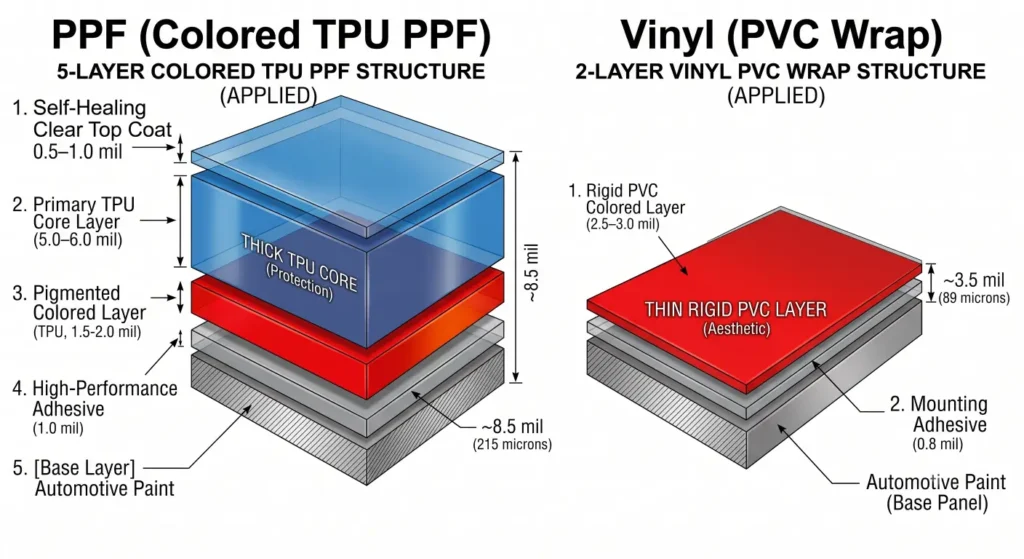
PPF is not an aesthetic accessory. It is an inalienable aspect of vehicle maintenance. This is a self-healing, transparent, and thick urethane film that can be verifiably used to prevent a rock chip.
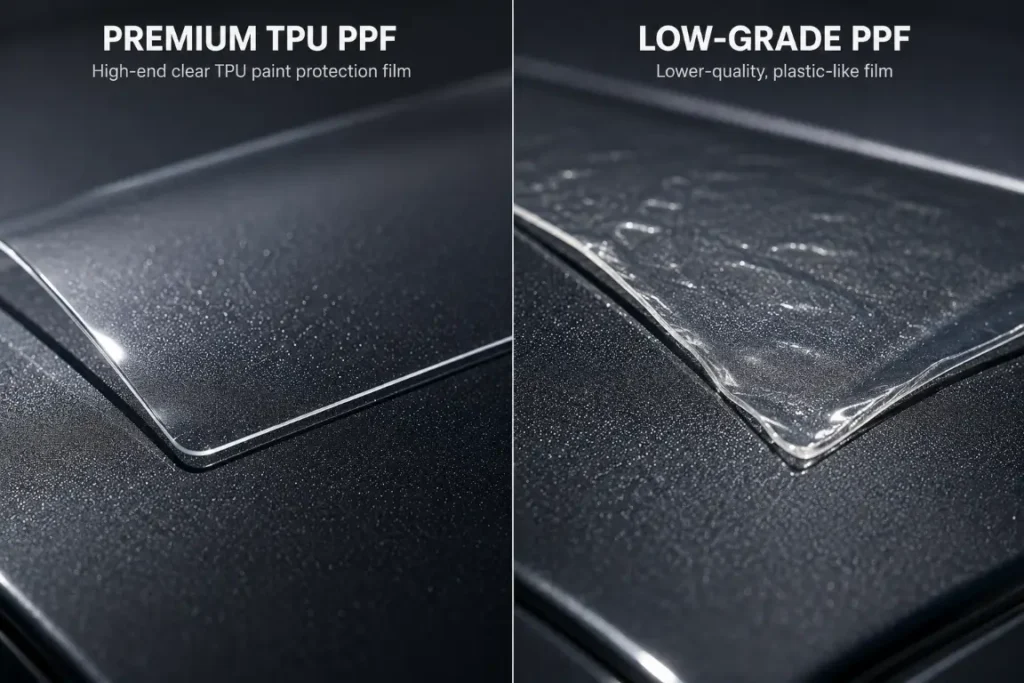
But not all PPF is the same. The market is inundated with substandard movies that will turn yellow, crack and peel. The most important thing is to choose a good, engineered film. This is where the technology of the supplier comes in as a determining factor.
- Material Science: The best PPF, such as our FlexiPPF, is created out of the best raw materials, such as Ashland adhesives and BASF substrates. It is designed with a ceramic top coating that gives it hydrophobic (anti-stain), superior chemical resistance, and most importantly self-healing properties. Small scratches and swirls fade away with the heat of the environment.
- UV and Weatherproofing: A low-end film will turn yellow in the sun. An excellent movie is meant to be anti-yellowing and extreme weather resistant, and can withstand temperatures up to 80 o C. The paint under our film does not fade because it blocks 98 percent of harmful UV rays, which is way beyond industry standards.
- Strength and Guarantee: A good product is supported by a true guarantee. The premium PPF is warranted at 10 years, which ensures its performance. Its useful life is frequently more than this.
- Manufacturing and QC: Find a supplier that has control over its production. We have high-tech German magnetic sputtering machines and 13 production lines that guarantee complete consistency. Our plants are of high ISO standards, and they test on all aspects such as light transmittance to weatherability.
This is the final safeguard. The only method of preserving paint is to keep it new. You can also use a car cover for protection, but the best method of protecting the value of PPF is through installation in a new car or a new paint job.
Is Repainting Your Car a Good Investment?
Let us be unequivocal: Repainting a car is almost never a good financial investment.
A car is a depreciating asset. You are not “investing,” you are “spending.” The goal is to spend intelligently.
- The Bad Investment: A Tier 1 ($1,000) paint job actively lowers your car’s resale value. A savvy buyer will see the overspray, the mismatched jambs, and the cheap finish, and they will correctly assume you are hiding more serious problems.
- The Neutral Investment: A Tier 2 ($4,000) paint job on a $15,000 car will not add $4,000 to its price. It may, however, make the car car easier to sell at the top of its private-party value range. You will, at best, recoup $1,000 – $1,500 of the cost. You are spending $4,000 to make the car “correct,” not to make it “more valuable.”
- The Emotional Investment: A Tier 3 ($20,000) job is financially catastrophic unless it is part of a concours-level restoration on a six-figure classic. For 99% of cars, this is pure passion. The ROI is zero, but the emotional return is, perhaps, priceless.
The only “investment” that consistently provides a positive financial return is preservation. Protecting the original factory paint with PPF, or opting for a reversible vinyl wrap, are the only moves that protect the car’s future value.
Our Verdict: When to Paint, Wrap, or Protect
Your decision should not be “how much,” but “why.” This requires finding the right balance for your needs.
You should PAINT your car if:
- The current paint is failing (peeling, fading, clear-coat failure).
- The body has significant rust that must be repaired. This requires additional preparation work.
Our Recommendation: A Tier 2 ($2,000 – $5,000) professional job. This is a functional repair to restore the vehicle’s integrity. The choice of paint quality here is key to getting quality results. Immediately after, you must protect this new paint with PPF.
You should WRAP your car if:
- The current paint is in good condition.
- You are bored with the color and want an aesthetic change.
- You value customization, speed, and protecting your resale value.
Our Recommendation: A high-quality vinyl wrap. This is the modern, intelligent, and reversible solution for cosmetic change. As a one-stop-shop supplier, we offer a massive range of over 100 films, from color-change vinyl to architectural films, with flexible MOQs (from 1 roll to 100) and expert design support. We also offer more environmentally friendly paint options and films, as the quality of the paint and materials is our priority.
You should PROTECT your car with PPF if:
- You just bought a new car.
- You just had your car painted.
- You love your car’s current finish and want it to look new, forever.
Our Recommendation: A premium, self-healing PPF. This is the only true defense against the reality of the road.
Before you commit to the permanent, costly, and time-consuming process of painting, consider the superior modern alternatives. For the owner seeking a new identity, our extensive line of customizable vinyl wraps offers a reversible, protective, and cost-effective solution. For the owner who wishes to preserve perfection, our industry-leading PPF, backed by a 10-year warranty and advanced self-healing technology, is the ultimate in surface protection.
Contact our specialists. With 24-hour pre-sales support, we can provide expert recommendations based on your climate and vehicle, ensuring you get the right solution, delivered fast.
 English
  Spanish
  Dutch
Dutch  Japanese
  Russian
  Arabic