
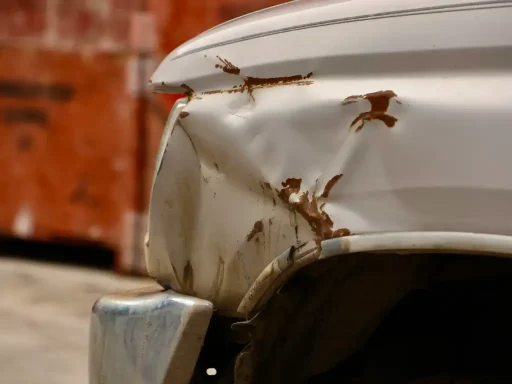
The aesthetic value of a car is not just a question of vanity, but a serious issue in the management of assets. To the vehicle owner, a scratch is a direct loss of value and a violation of the structural protection of the car exterior. Although the market is flooded with quick-fix products that promise miraculous results, the actual restoration process needs a basic knowledge of the physics of automotive surfaces and the financial aspects of repair and protection.
This manual offers a strict system of assessing the damage of paint, performing technical maintenance, and comprehending the economic advantages of changing the reactive repair model to the proactive protection approach through Flexippf solutions.
The Diagnostic Framework: The Fingernail Test
The severity of the defect should be properly diagnosed before the materials are bought or the body shop contacted. The current automotive paint is a composite system, with a total thickness of 100 to 180 microns. It is made up of three main layers:
- The Primer: This is the bonding material that secures the substrate (metal or plastic).
- The Base Coat: This is the layer that has pigment and metallic flakes.
- The Clear Coat: This is the top layer which is made of urethane and gives gloss and UV protection.
The severity of the abrasion defines the repair procedure. The Fingernail Test is the most valid technique of assessment.
How to Perform the Test
Lightly scratch the scratch perpendicularly with your fingernail. The data required in making decisions is the tactile feedback.
- Scenario A: The Nail Glides Smoothly.
- Diagnosis: Clear Coat Defect.
- Examination: The injury is superficial. It has not diffused through the pigment layer. The white look is merely the clear coat being broken resulting in scattering of light instead of reflecting.
- Solution: This can be fixed through DIY polishing or wet sanding.
- Scenario B: The Nail Catches a Little.
- Diagnosis: Deep Clear Coat / Base Coat Interface.
- Analysis: The scratch has exposed the thickness of the clear coat and it could have been in contact with the top of the color layer. It will not be completely removed by simple polishing, but it can be reduced to a minimum.
- Repair: Needs vigorous wet sanding or professional touch-up kit.
- Scenario C: The Nail Clicks or Falls into a Groove.
- Diagnosis: Primer or Substrate Exposure.
- Analysis: When the paint system has failed, you will see gray (primer) or silver/bare metal. The panel is now subjected to oxidation (rust).
- Action: It is necessary to seal the metal immediately. DIY repair cannot be mixed to perfection; professional respray will be a good choice in aesthetics restoration.
Technical Protocol: DIY Repair for Clear Coat Defects
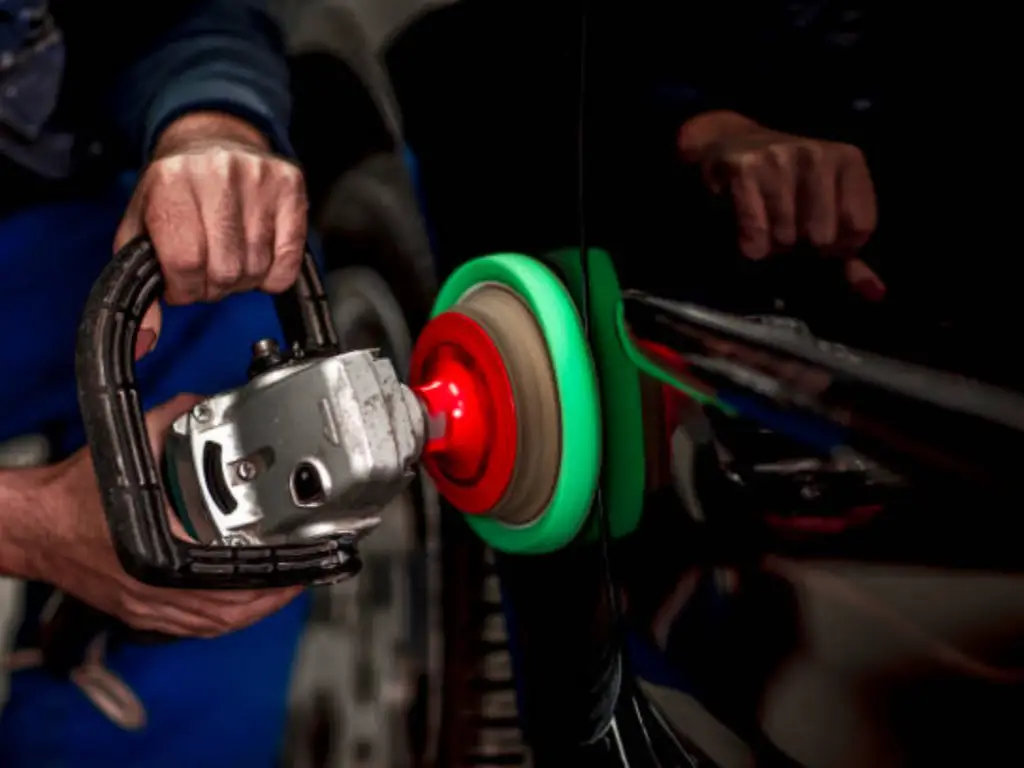
In case the diagnostic test shows that there is a clear coat defect (Scenario A), a DIY solution is economically reasonable, but one must follow a strict technical procedure. The goal is optical leveling, which is to decrease the height of the surrounding clear coat to the depth of the scratch until the surface becomes smooth.
Phase 1: Surface Decontamination
The repair area should be chemically neutral. Normal washing is inadequate.
1. Clean: Wipe the particular panel using automotive detergent to get rid of particulate matter.
2. Degrease: Rub the site using Isopropyl Alcohol (IPA) that is diluted to 15-25 percent. This eliminates waxes, silicone sealants, and oils which would not allow the abrasive compounds to work uniformly.
Phase 2: Abrasive Leveling (Wet Sanding)
This is the most essential step. One should not peel material all the way through the clear coat.
1. Hydration: Wet 2000-grit and 3000-grit automotive sandpaper in water, 15 minutes. The water is used as a lubricant and removes the abraded clear coat slurry.
2. Execution: Sand across the scratch with a backing pad (never use bare fingers which form uneven points of pressure). Use light pressure.
3. Check-up: Wipe the place often. The paint will appear unglamorous and flat. This is expected. Keep doing it until the scratch is no longer seen with the naked eye in the matte region.
Phase 3: Compounding and Polishing
Sanding leaves micro-scratches (3000-grit marks) which need to be polished to give a glossy finish.
1. Compounding: Rub a microfiber pad or a dual-action polisher with a compound. The compound has abrasive particulates which disintegrate during working, eliminating the sanding marks.
2. Finishing: Use a finishing polish. This liquid has smaller abrasives that replenish the refractive index of the clear coat returning the wet appearance.
Phase 4: Chemical Checking
Again wipe the area with IPA so that you are sure to have wiped away the scratch instead of filling it with polishing oils. In case the scratch has disappeared, a sealant or wax should be applied immediately to ward off the thin clear coat.
The Economics of Professional Repair
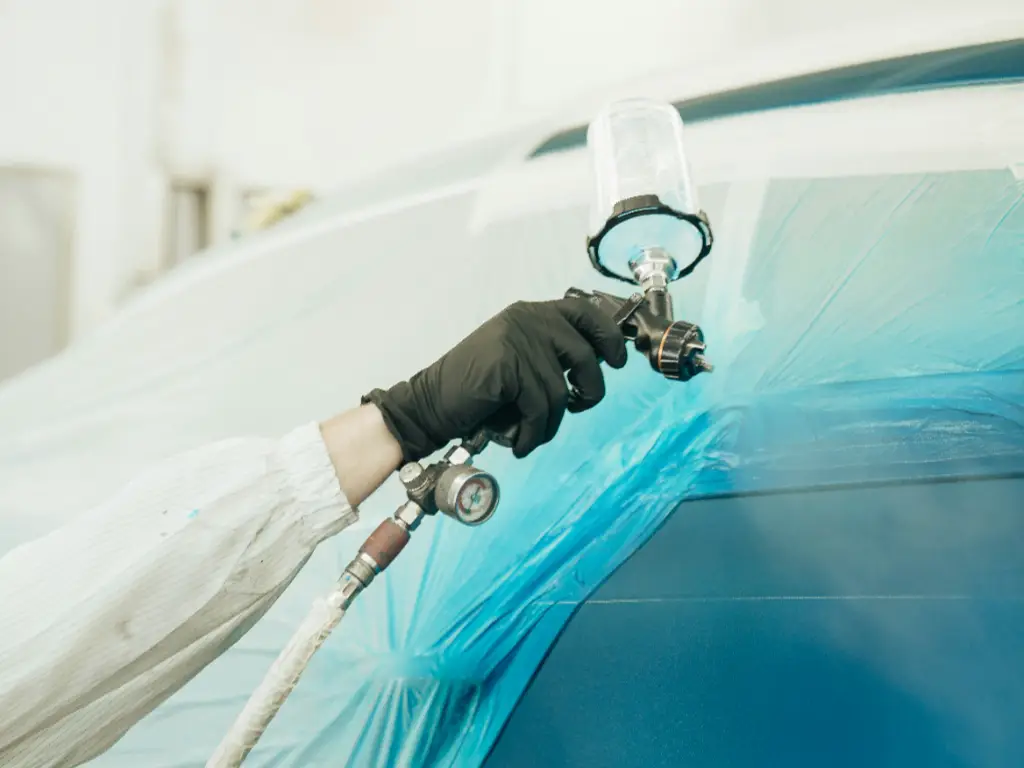
When the damage exceeds the capacity of DIY leveling—specifically when the base coat or primer is breached—professional repair becomes necessary. However, the cost structure of professional auto body work is often misunderstood by consumers.
One does not pay merely for the application of paint; one pays for the recreation of a factory-controlled environment.
The Cost Breakdown ($150 – $1,500+)
- Labor Intensity: A proper spot repair requires masking the entire vehicle to prevent overspray, sanding the panel, priming, blocking (leveling the primer), painting, clear coating, and finally buffing. A “simple” bumper scuff represents 3 to 6 hours of skilled labor.
- Material Complexity: Modern automotive finishes are rarely simple pigments. They are often metallic or pearlescent (containing mica).
- The Metamerism Problem: A color that matches under fluorescent shop lights may look completely different in direct sunlight. Professionals use spectrophotometers to analyze the specific variant of the car’s color code, which changes based on the batch and UV exposure history.
- Blending: To make a repair invisible, a technician cannot just paint the scratch. They must paint the repair area and then “blend” the clear coat out into the surrounding panel. This increases material usage and labor time significantly.
Market Average Costs (2026 Estimates):
- Touch-up Service: $150 – $300 (Visible improvement, not perfection).
- Bumper Respray: $400 – $800.
- Door/Panel Respray: $600 – $1,500 (Dependent on tri-coat or pearl finishes).
The Hidden Cost: The Depreciation Cycle of “Repair”
While professional repair restores aesthetics, it introduces a long-term liability that is often overlooked in the initial cost-benefit analysis.
The Clear Coat Thickness Problem
Factory clear coat is finite. It is applied by robots with electrostatic precision to a specific thickness (often roughly 40-50 microns). Every time you polish a scratch or sand a defect, you are removing microns of this protective layer.
- The Limit: Once the clear coat is reduced by roughly 25-30%, the UV inhibitors are compromised. This leads to premature clear coat failure (delamination or peeling).
- The Reality: You can only “repair” a panel a finite number of times before it requires a total respray, which is exorbitantly expensive.
The Resale Valuation Impact
In the secondary vehicle market, “original paint” is a primary determinant of value. Professional buyers and dealerships use paint depth gauges to detect repainted panels.
- Inconsistency: A repainted door will have a different thickness (usually thicker) than the factory fender next to it.
- Market Perception: Non-factory paint suggests previous accident damage. Even if the repair was purely cosmetic, it introduces information asymmetry, forcing the buyer to assume the worst. This can devalue a luxury vehicle by 10% to 20%.
Therefore, the traditional model of “Damage -> Repair -> Damage -> Repair” is financially inefficient. It solves the immediate aesthetic problem while degrading the long-term asset value.
The Paradigm Shift: From Reactive Repair to Flexippf Protection
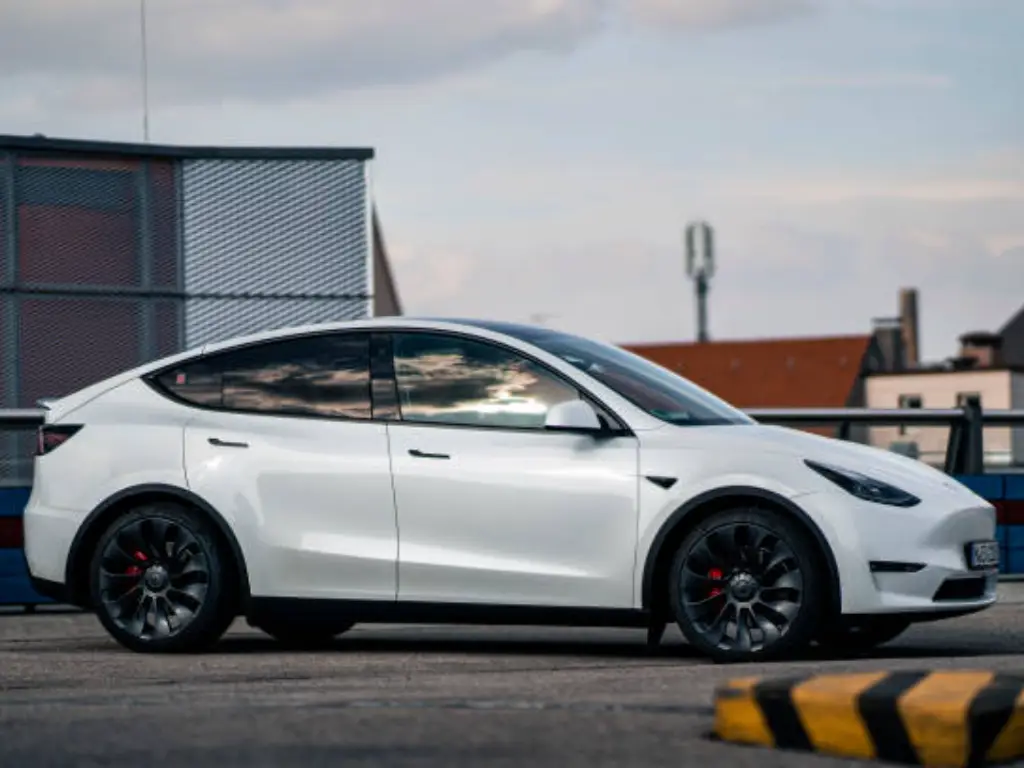
The only possible alternative is Prevention due to the economic and technical constraints of the traditional repair.
Rather than controlling the degradation of the clear coat, the best approach is to keep the factory finish totally isolated to the environment. This is the purpose of Paint Protection Film (PPF). Flexippf is the industrial equivalent of this technology, where the emphasis is not on how to repair, but rather how to maintain.
The Engineering of Flexippf
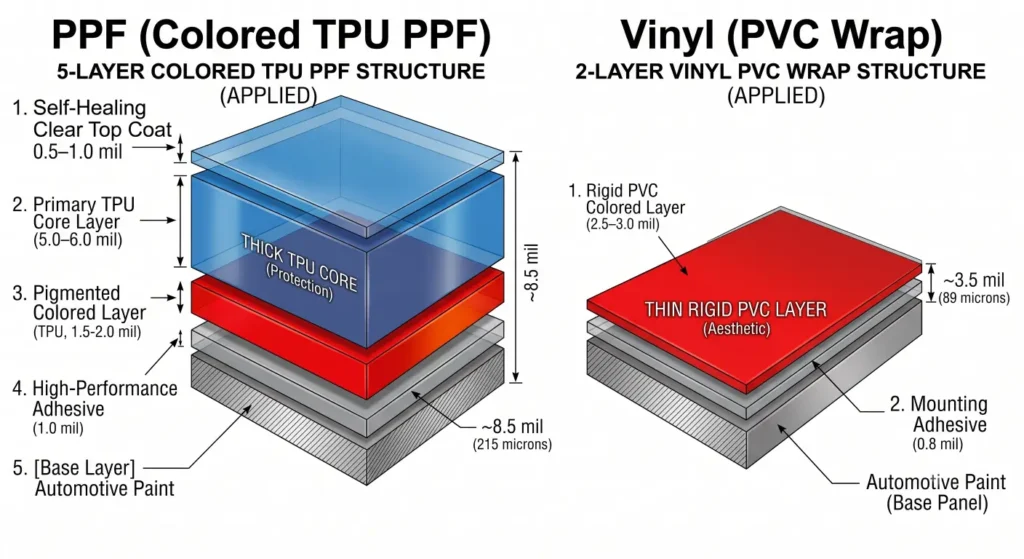
Flexippf is not a wax or a ceramic coating (a chemical liquid); it is a physical barrier a thermoplastic polyurethane (TPU) film of approximately 150-200 microns.
1. Self-Healing and Thermodynamics.
The main benefit of Flexippf in comparison to clear coat is that it has elastomeric properties. In case of scratching, the molecular bonds are broken forever when standard clear coat is scratched. On scratches of Flexippf, the chains of the polymer are simply repositioned.
- The Mechanism: When heat (sunlight, warm water, or engine heat) is applied, the TPU has a kind of a memory that causes the polymer chains to go back to their original structure.
- The Conclusion: Swirl marks, wash scratches, and light abrasions are physically removed without mechanical polishing. The surface regenerates, making the Fingernail Test obsolete.
2. UV and Chemical Resistance
Ordinary clear coats oxidize and turn yellow with time. Flexippf employs an exclusive top-coat technology which blocks 98 percent of UV rays.
- Durability Data: Our films are tested in 5,000 hours of accelerated weathering tests (QUV testing) to guarantee that there is no yellowing or hydrolysis. This will enable us to provide 10-year warranty, which is much longer than warranty of a professional paint job.
3. Impact Absorption
Flexippf is designed to absorb kinetic energy as opposed to paint which is hard and brittle. Due to the effect of the road debris, the energy does not concentrate in one location of fracture but is spread out across the flexible surface area. This eliminates the stone chips that are bound to cause rust.
The Industrial Benefit: Why Professionals prefer Flexippf
In the case of describing businesses and automotive distributors, a PPF supplier is a supply chain decision. Flexippf is a One-Stop Manufacturer.
- Capacity of Production: Our production facilities covers 60,000 square meters with 13 Leybold production lines and 4 extrusion lines that are imported to the country of South Korea and Germany. This is not re-labeling, this is prime production.
- Inventory Logic: We address the issue of stockout risk. On regular orders, we have the capacity to deliver within 1-2 days. We provide a list of more than 100 types of films such as automotive PPF, window tints as well as architectural films.
- Scalability: The supply chain is vertically integrated to ensure maximum efficiency and minimum unit cost whether the client needs a single roll to do a boutique project or a container load to do regional distribution.
Comparative Analysis: Repair vs. Prevention
To make a rational decision, one must compare the long-term trajectory of the vehicle’s finish under the three available methodologies.
| Metric | DIY Repair | Professional Respray | Flexippf Protection |
| Immediate Cost | Low ($20 – $100) | High ($400 – $1,500) | Moderate Investment |
| Technical Risk | High (Risk of burn-through) | Moderate (Color mismatch risk) | Zero (Non-invasive) |
| Asset Impact | Thins the Clear Coat | Alters Factory Originality | Preserves Factory State |
| Longevity | Temporary | Vulnerable to new damage | 10 Years |
| Function | Correction | Restoration | Self-Healing & Barrier |
The Conclusion: The Proactive Standard
The analysis of automotive paint repair reveals a clear hierarchy of efficiency.
- DIY repair is a necessary stopgap for minor surface flaws but carries technical risks.
- Professional repair is a costly necessity for structural paint failure but degrades the vehicle’s status as “original.”
- Flexippf installation is the only method that arrests the depreciation cycle.
By installing Flexippf, you are effectively “freezing” the condition of the vehicle’s paint. You are no longer concerned with the depth of a scratch because the scratch is occurring on a sacrificial, self-healing layer, not on the irreversible factory substrate.
For the car owner, this means the preservation of aesthetic value. For the installer and distributor, partnering with Flexippf means accessing a global standard of material science and supply chain reliability. The question is not how to repair the next scratch, but how to ensure the paint never requires repair again.
 English
  Spanish
  Dutch
Dutch  Japanese
  Russian
  Arabic