
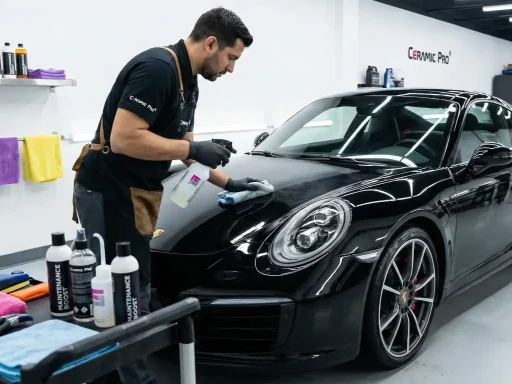
There is a lot of information asymmetry in the automotive detailing market. The owners of vehicles frequently show contradictory information: one source states that a ceramic coating is a lifetime solution, whereas the other one states that it deteriorates in a year. This discrepancy leaves a gap of hesitation for consumers who are trying to determine the return on investment (ROI) of ceramic coating longevity and paint protection.
The fact is that a ceramic coating product is not a two-polar substance that either works indefinitely or fails instantly. It is a chemical solution that is prone to physical and environmental factors. Its life is a conditional offer, regulated by a certain formula: Life Span = Quality of the Product + Application Quality + Maintenance Discipline.
This discussion will break down the marketing hyperbole of ceramic protection. We will look at the chemical lifespan of various levels of products, the exact factors that increase the rate of degradation, and the economic feasibility of the investment. In addition, we will examine the boundary of liquid protection and the point at which physical protection, namely Paint Protection Film (PPF), should commence to ensure the highest level of protection.
The Honest Timeline: Spray vs. DIY vs. Pro Coatings
To accurately predict longevity, one must first categorize the product. The term “ceramic” is often used loosely to describe three chemically distinct categories of surface protection. Each category possesses a different molecular density and bonding capability, which dictates its durability.
Spray Sealants & Boosters (3-6 Months)
These products act more as surface tension modifiers rather than structural protective layers. Although common protectants usually contain Silicon Dioxide (SiO2), it is in low concentration and is usually suspended in a heavy solvent or water base with polymer additives. The main purpose of a ceramic spray is to provide immediate hydrophobic properties and a glossy finish. They are not permanently covalently bonded with the clear coat. Rather, they are placed on the surface, supported by weaker physical bonds. As a result, these layers are easily destroyed by harsh chemicals, environmental detergents, heat, and friction. They should be used as maintenance top coats for existing finishes and not as long-term protection.
DIY Ceramic Coating Kits (1-3 Years)
Coatings of consumer grade are a compromise. These products are designed to be easy to use, requiring a chemical compromise. To ensure the coating cures at a rate where an amateur can level it without needing professional application help, manufacturers add more solvent and less solid concentration of SiO2 or TiO2 (Titanium Dioxide). An effective DIY coating is usually hardened to 9H (pencil scale) and can last 1-3 years. The lifespan is, however, grossly dependent on the environment where the curing takes place. The average cure period rangessignificantly based on humidity; without the regulated environment and infrared curing of the liquid polymer found in professional shops, the cross-linking density is reduced. Consequently, the quality of the coating suffers, making it more prone to chemical abrasion with time.
Professional-Grade Finishes (2-5+ Years)
Best coatings of professional grade vary in terms of solid content and application guidelines. These formulations usually have solid concentrations of over 50-70% and need professional training to be applied without high spots or streaking. The durability of these finishes (2 to 5 years or longer) is attained by multi-layering (a base coat to allow adhesion and a top coat to provide water repellency) and infrared (IR) curing. IR lamps speed up the cross-linking process, and the ceramic coat becomes as hard and chemically resistant as possible.
A Note on “Lifetime” Warranties: Lifetime Warranty claims should be taken with a grain of salt by consumers. These warranties act like a subscription model in economic terms. The small print nearly always stipulates that the customer should go back to the installer for regular upkeep and have an annual service performed on the product at a fee. Failure to take this service results in the cancellation of the warranty. Thus, the lifetime period is not an intrinsic characteristic of the chemical, but a consequence of the maintenance that is enforced by a contract.
The 4 Hidden Factors That Kill Your Coating Early
If a five-year coating fails in two years, it is rarely due to a defect in the liquid itself. It is almost always the result of external variables that interrupt the coating’s bond or physical integrity.
Preparation is Key
The most important variable in the longevity equation is determined before the bottle is opened. A ceramic coating needs a naked and clean clear coat to bond in a covalent bond. Unless the paint is corrected (polished), chemically decontaminated (degreased), and treated with a clay bar to remove embedded particles, the coating is attaching itself to surface contaminants, wax residue, or oxidation and not to the car’s paint itself. As the contaminant on the vehicle’s surface releases, it carries the coating along. According to industry analysis, about 90 percent of premature coating failures can be explained by common mistakes in paint correction and panel preparation.
Environmental Stress
The environment of a coating tests its chemical durability.
- Acid Rain and Bird Droppings: Ceramic coating is not impervious, although it is more resistant to etching than wax. The molecular structure may eventually be weakened by high acidity when left to dwell.
- Road Salt: In lower temperatures magnesium chloride and sodium chloride de-icing salts are corrosive agents. Unless washed away, these salts hasten the decomposition of the hydrophobic layer.
- UV Exposure: UV rays promote oxidation. Although the best products are made with UV inhibitors, when subjected to extreme sun or a salty beachside breeze, the resin structure will wear out sooner than in cooler conditions due to airborne contaminants.
Wash Techniques
The automatic car wash is the factor that accelerates the process of coating degradation the most. Tunnel washes have abrasive nylon brushes that hold dirt from previous vehicles. These brushes act like sandpaper, increasing the risk of scratches. Although the coating is chemically resistant, it is physically thin (in microns). Micro-scratches (swirl marks) are caused by repeated mechanical abrasion of automatic washes. This abrasion eventually removes the layer of protection physically. One run through a rough tunnel wash can deprive the equivalent of six months of hydrophobic performance.
Layering Myths
The investment in layering has a diminishing effect. Others installers or DIYers think that the more layers applied, the more protection will be achieved. This is not chemically correct.
After the clear coat is saturated and the first layer has hardened, the succeeding layers find it hard to bond to the highly slick and hydrophobic surface of the previous layer. Overlaying may result in solvent scouring (with the solvent of the new layer dissolving the previous one) or optical hazing, which makes the finish less clear but does not provide any quantifiable durability.
Is It Failing or Just Clogged? How to Tell
A common misconception is equating the loss of hydrophobicity with total coating failure. In many instances, the coating is structurally intact but functionally masked.
Visual Signals: Beading vs. Sheeting
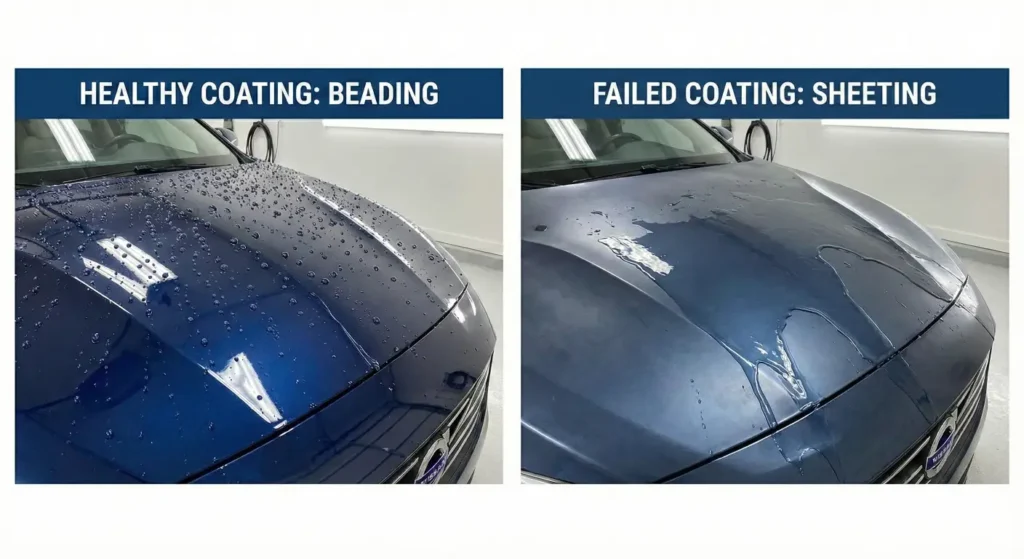
The primary indicator of a healthy coating is high surface tension, resulting in water beading (contact angles >100 degrees). When a coating appears to fail, water will begin to “sheet” or pool flat on the surface. This often indicates that the hydrophobic top layer is obstructed by a film of road film, iron fallout, or mineral deposits.
Tactile Signals
A fresh coating feels distinctively slick, akin to glass. As contaminants embed themselves into the surface, the coefficient of friction increases. If the paint feels “grabby” or rough to the touch after washing, it indicates contamination rather than the absence of the coating.
Revival Techniques
Before assuming the coating is dead, a decontamination wash is required. Standard pH-neutral soaps cannot remove mineral deposits or embedded iron.
- Iron Remover: Dissolves metallic fallout (brake dust).
- Water Spot Remover (Acidic Wash): A mild acid wash helps break down mineral deposits clogging the coating’s pores.
Often, this chemical decontamination restores the surface tension, revealing that the coating underneath is still functional.
The Cost-Per-Day Analysis: Is It Worth the Investment?
To determine if ceramic coating is a rational purchase, we must analyze the amortized cost and the opportunity cost of alternatives.
Consider a professional ceramic coating package costing $1,000 with a conservative lifespan of 3 years (1,095 days).
Cost Per Day = $1,000/1,095 =$0.91
For less than one dollar per day, the vehicle remains protected. Now, compare this to the alternative: Traditional Waxing.
- Labor Cost: High-quality waxing requires re-application every 6-8 weeks.
- Opportunity Cost: If a vehicle owner values their time at $50/hour, and a wash/wax process takes 2 hours, the “cost” of DIY waxing is $100 per session. Over three years (approx. 18 sessions), the implicit cost is $1,800—significantly higher than the upfront cost of the coating.
Furthermore, the “Easy to Clean” effect of ceramic coating reduces the time required for routine maintenance washes by approximately 50%, yielding further time-savings dividends over the ownership period.
Ceramic Coating vs. PPF: Which Lasts Longer?

While ceramic coatings offer excellent chemical resistance and gloss, there is a fundamental limitation to liquid chemistry that no amount of marketing can overcome: Physical Hardness.
The “Hardness” Limitation of Ceramic Coating
Ceramic coating is rated on the pencil hardness scale (e.g. 9H). They are very thin, although hard, usually 1 to 3 microns. To put it into perspective, a normal piece of paper is about 100 microns in thickness.
Since the layer is very thin, it has zero shear strength against high-velocity impacts. It cannot prevent:
- Rock Chips: Stones striking the bumper at highway speed.
- Deep Scratches: Scraping or scraping on concrete by accident.
- Abrasion: Deep bush pinstriping.
- In the case of physical damage, the life of a ceramic coating is practically zero.
Why PPF is the Longevity King
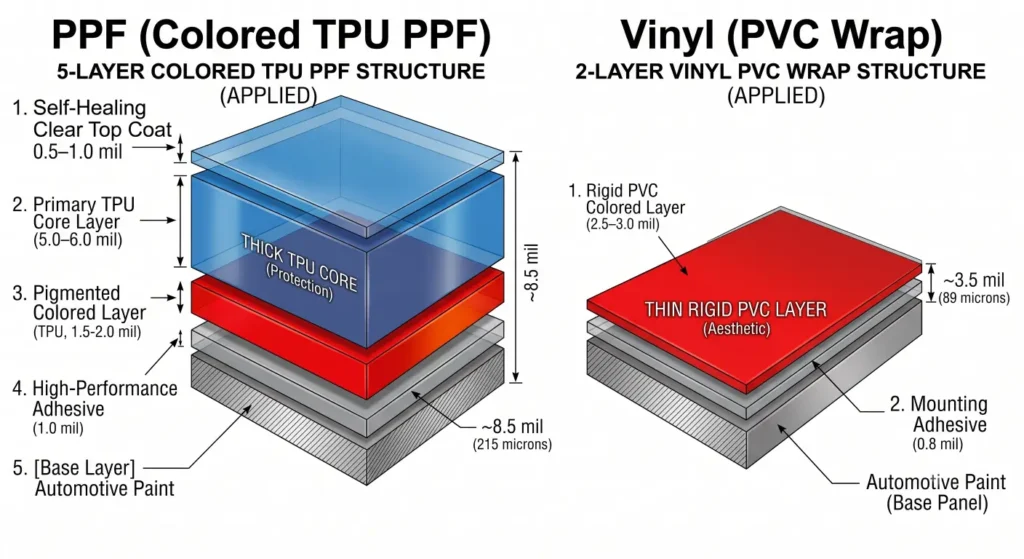
Paint Protection Film (PPF) is a better asset to vehicle owners who focus on the absolute longevity and physical preservation. PPF is a thick, elastomeric urethane film (usually 6-8 mils thick) that is a sacrificial barrier, unlike a liquid that hardens into a thin shell.
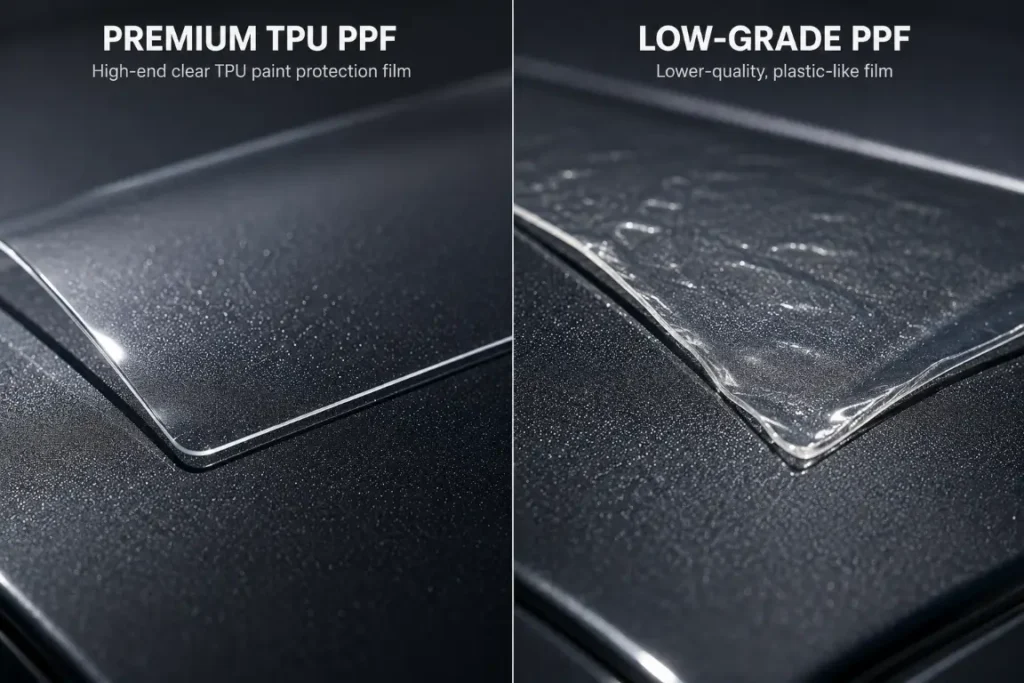
FlexiPPF shows the possibilities of the modern manufacturing in this industry. FlexiPPF uses the base materials of BASF TPU (Thermoplastic Polyurethane) produced in Germany and Ashland adhesives produced in the USA to create a product that is fundamentally superior to liquid coatings in durability.
- Physical Longevity: FlexiPPF has a 10 year warranty. It is not a service contract, but a warranty of material stability- no yellowing, cracking or delamination.
- Self-Healing Mechanics: FlexiPPF elastomeric polymers can reorganize themselves at high temperatures. Swirl marks and light scratches fade away when they are exposed to the sun or hot water, something that ceramic coating cannot achieve.
- Industrial Customization: FlexiPPF offers factory-direct customization, as it understands that preservation requirements differ by climate. Depending on the needs of a client, such as high-temperature resistance (up to 80°C) in desert conditions or particular UV-blocking levels, the R&D department can modify the TPU formulation and manufacture through 13 Leybold production lines. This enables tailored Visible Light Transmission (VLT), textures and thicknesses over a 48 hour design time frame.
Comparative Analysis: Which Solution Fits Your Strategy?
To make an informed economic decision, one must weigh the cost against the specific type of protection required. Below is a breakdown of the three primary protection tiers available to vehicle owners.
| Feature | Ceramic Coating (Liquid Protection) | FlexiPPF (Physical Protection) | The Hybrid (PPF + Ceramic Coating) |
| Primary Function | Chemical resistance, gloss, and ease of cleaning. | Impact resistance (rock chips) and scratch prevention. | Maximum impact protection combined with extreme hydrophobicity. |
| Lifespan | 2 – 5 Years | 10+ Years | 10+ Years (Film) / Coating maintained periodically |
| Rock Chip Protection | Zero (Too thin to absorb impact) | High (Absorbs and disperses energy) | High (Film absorbs impact) |
| Self-Healing | No | Yes (Heat-activated recovery) | Yes (Underlying film heals) |
| Maintenance Effort | Low (Requires washing) | Low (Requires washing) | Lowest (Dirt slides off effortlessly) |
| Cost Investment | $ (Moderate) | $$(Significant) | $$$ (Premium) |
Recommendation Guide: Choosing Your Tier
1. The Aesthetic Driver (Select Ceramic Coating)
When you are mostly in the city, when you hardly go on the highway, or when you are operating on a tight budget and need a showroom finish, then Ceramic Coating is the rational decision.
- Verdict: It is a solution to the keeping it clean problem but not to the chipped paint problem.
2. The Daily Commuter & Long-Term Owner (Select FlexiPPF).
Physical film is not negotiable in case you intend to retain the vehicle over 5 years, use it on highways where rock chips are unavoidable, or you wish to maintain the resale value of original factory paint.
- Conclusion: FlexiPPF offers the required physical protection that liquid chemicals are unable to offer. The 10-year warranty is in line with the ownership cycle of most current vehicles.
3. The “Perfectionist” (Choose The Hybrid: PPF + Ceramic)
The Hybrid approach is the best when it comes to luxury assets, exotic cars, or owners who require the highest possible quality.
- Decision: You apply FlexiPPF to protect the paint, and then apply a layer of ceramic over the film. This does not allow the film itself to get dirty and beads off the surface of the water. It is the final fusion of “Arguing” and “Slickness.”
Essential Maintenance Tips to Extend Lifespan
The Two-Bucket Approach: To eliminate the possibility of swirl marks caused by the wash, always keep the so-called rinse water and the so-called soap water apart. Use a high-quality microfiber towel or microfiber cloth to dry. This mechanical separation will make sure that dirt that has been removed off the car is not reintroduced into the paint.
- Temperature Control: Always ensure you keep the car cool during the car bath; never wash in direct sunlight.
- Toppers & Boosters: Spray silica sealant (SiO2 spray) after every 3 to 4 months. Whether you use boutique products or mainstream brands like Chemical Guys, this serves as a sacrificial coating that absorbs the bulk of the environmental abuse and protects the costly base coating below.
- Regular Inspections: An engine needs an annual checkup, and so does a coating. Regular maintenance and inspections are required to unclog pores and determine hydrophobicity.
Conclusion
The question “How long ceramic coating lasts?” does not have a single integer answer. It is a dynamic value based on chemical quality, application accuracy, and proper maintenance practices. A professional coating is a reliable way to use a vehicle between 2-5 years, which will be an effective ROI in terms of time and aesthetic value.
Nevertheless, one should not overestimate expectations based on physics. Liquid coating is not a force field.
- When you want to achieve gloss enhancement, ease of cleaning and chemical resistance, a high quality Ceramic Coating is the efficient option.
- When you are aiming at long-term preservation of assets, resistance to impact, and ten years of longevity, liquid chemistry cannot help you. You need the physical obstacle of PPF.
Call to Action
To those who want to have the long-term value of their inventory or personal vehicles, trust established supply chains. Order samples of our 10-year warranty Paint Protection Film, which is sourced by BASF, by contacting FlexiPPF today. No matter what type of standard roll you need or what kind of OEM solution you need, our factory can supply your vehicles with the ultimate physical armor against the elements.
 English
  Spanish
  Dutch
Dutch  Japanese
  Russian
  Arabic