
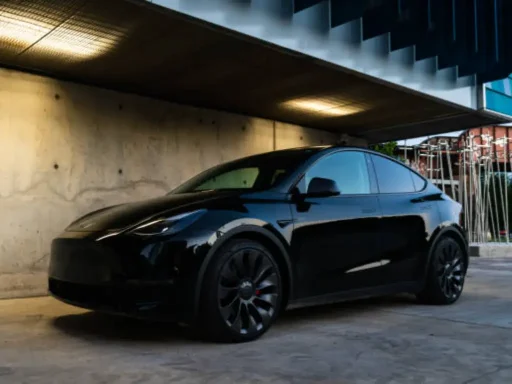
Taking delivery of a Tesla represents more than just a vehicle purchase; it is an entry into a world of cutting-edge industrial design and unique engineering trade-offs. While the minimalist aesthetic is iconic, the reality of maintaining its appearance presents specific challenges that many owners only discover after their first long-distance highway commute. This technical audit explores the intersection of material science, financial risk management, and the practicalities of preserving your vehicle’s factory finish over a ten-year horizon.
The Vulnerability of Tesla Paint: A Physical Reality Check
To properly diagnose why a Tesla requires a fundamentally different strategy for tesla paint protection than a legacy internal combustion engine (ICE) vehicle, we must look past the minimalist aesthetics and into the molecular reality of contemporary automotive manufacturing. The “soft paint” reputation that has shadowed Tesla since the early production days of the Model S is not merely anecdotal evidence from frustrated owners; it is a verifiable byproduct of rigid industrial engineering constraints and aggressive global environmental compliance. When you take delivery of a new Tesla, you are assuming ownership of a clear coat that is chemically and physically distinct from the high-solvent finishes of the 1990s, making tesla’s paint particularly susceptible to external stress.
The Molecular Weakness: California VOC Constraints & Water-Based Resins
Tesla’s primary production lines, specifically the Fremont Gigafactory, operate under the jurisdiction of the California Air Resources Board (CARB), which enforces some of the most stringent Volatile Organic Compound (VOC) limits on the planet. To achieve these green benchmarks, Tesla utilizes a specialized water-based paint system. From a material science perspective, water-based clear coats often possess a lower cross-linking density during the critical curing phase compared to traditional solvent-heavy paints. This means the polymer chains are less tightly interwoven, resulting in a finish that is objectively lower on the Mohs scale of mineral hardness. While a traditional German luxury clear coat might test at a 4H or 5H pencil hardness, many Tesla factory finishes oscillate between 2H and 3H. This increased “softness” makes the surface highly susceptible to “marring”—where even a clean microfiber towel used with excessive pressure can leave permanent micro-abrasions known as swirl marks.
Aerodynamic Stagnation Points: The “Sandblasting” Physics
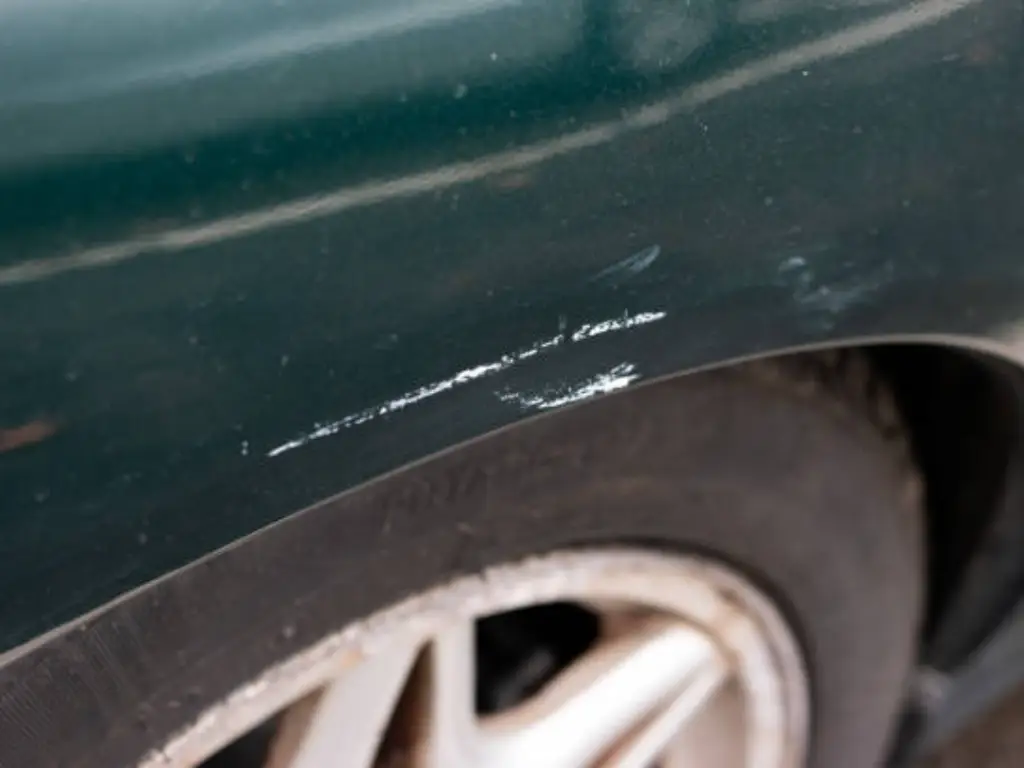
Beyond chemical composition, the physical architecture of the Model 3 and Model Y creates an unprecedented risk profile. Tesla’s design language prioritizes a low drag coefficient (an industry-leading measure of aerodynamic efficiency) to maximize battery range. This results in a “closed-loop” front fascia—a monolithic, flat vertical surface that lacks the energy-dispersing grilles of traditional cars. In fluid dynamics, this flat surface creates a “stagnation point” where air pressure—and any debris carried by that air—reaches its maximum velocity and force upon impact. When you are traveling at 75 mph, a single grain of road salt or a 2mm pebble strikes this stagnation point with the kinetic energy of a small projectile. Because the factory clear coat is thin—averaging only 100 to 110 microns—there is virtually no structural “buffer” to absorb the energy. The impact doesn’t just scratch the surface; it causes a microscopic fracture that reaches the primer, creating a gateway for oxidation and clear coat failure.
PPF vs. Ceramic Coating: Deciphering the Protection Matrix
The single most pervasive myth circulating in Tesla forums is the belief that a ceramic coating provides the ultimate physics of tesla paint protection against road debris. While a coating is an exceptional maintenance tool, many experts agree that the best way to protect tesla paint is treating it with a proactive layer of Paint Protection Film (PPF). To make an informed procurement decision for your $50,000+ asset, you must understand the diverging physics of these two layers at a nanoscale and microscale level.
The Kinetic Energy Dissipation of TPU Armor
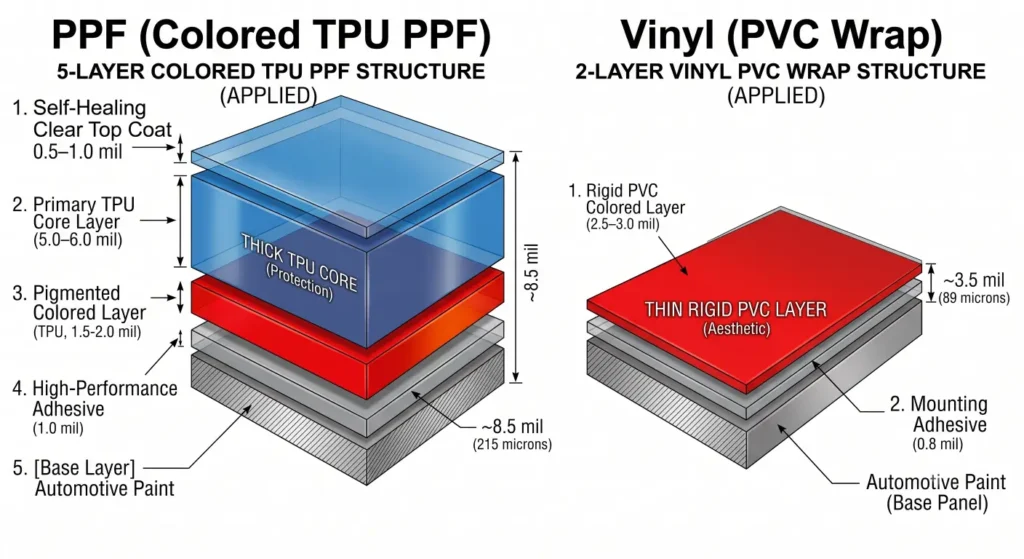
Paint Protection Film (PPF) is an 8-mil (203-micron) high-performance layer of Thermoplastic Polyurethane (TPU). Its primary engineering function is the dissipation and redirection of kinetic energy. When a stone strikes a PPF-protected Tesla, the TPU’s long-chain elastomeric properties allow it to compress and rebound, spreading the localized force across a wider surface area. This prevents the energy from concentrating and shattering the brittle clear coat beneath. Furthermore, modern PPF features a specialized topcoat polymer that exists in a semi-solid state. When micro-scratches occur, the polymer chains “flow” back into their original alignment when triggered by ambient heat (sunlight or warm water), a process known as self-healing. This is the only technology on earth capable of physically stopping a 70 mph rock chip from damaging your factory paint.
The Hydrophobic Shield: Ceramic Coating’s Chemical Niche
In contrast, a ceramic coating is a liquid polymer typically composed of Silicon Dioxide (SiO2) or Silicon Carbide (SiC) that cures into a sacrificial layer measured in nanometers, not microns. A professional-grade coating is approximately 1 to 2 microns thick—less than 1/100th the thickness of PPF. Its water contact angle (typically exceeding 110°) provides extreme hydrophobicity, which is excellent for repelling acid rain, tree sap, and industrial fallout, effectively minimizing the risk of paint damage. However, because it lacks the physical mass and tensile elasticity of TPU, a ceramic coating has near-zero impact resistance. If your primary commute involves highways or construction zones, relying on a coating to stop rock chips is like wearing a high-end waterproof windbreaker into a hailstone storm. It will keep you dry, but it will not stop the bruising.
Decoding PPF Materials: The Ultimate Buyer’s BOM Checklist
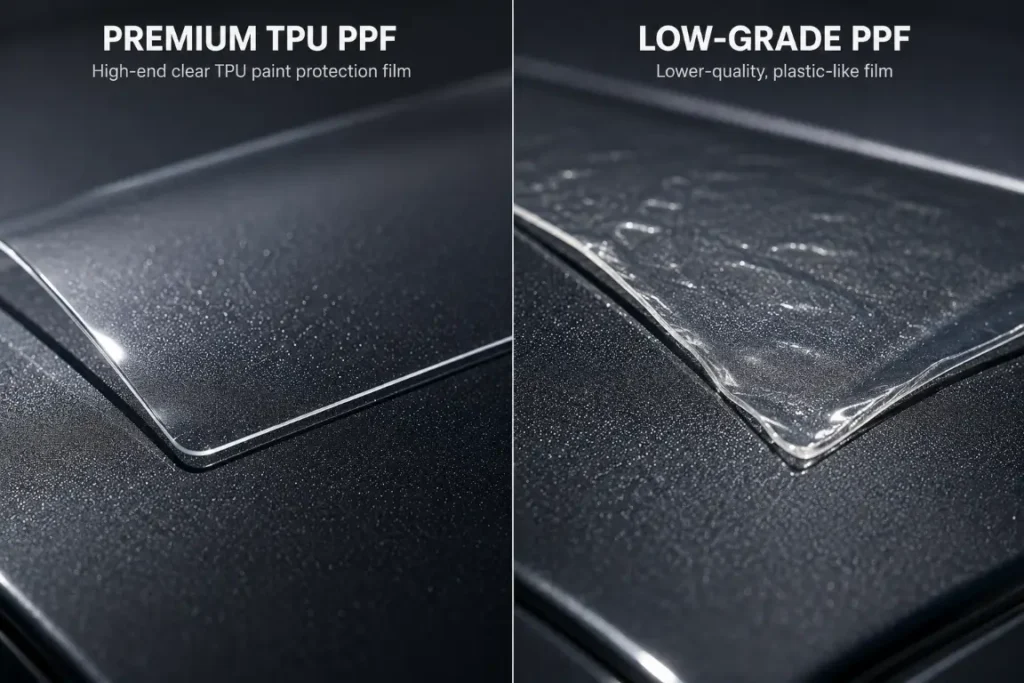
For the discerning Tesla owner or fleet manager looking for the best way to protect tesla paint, the brand name on the box is secondary to the Bill of Materials (BOM). The global PPF market is currently flooded with low-cost “aromatic” films that utilize inferior PVC or polyester bases. These materials are destined for rapid failure, yet they are often marketed under the same “premium” umbrella as top-tier films. Identifying the raw material origin is the only way to ensure a 10-year lifespan for your investment.
Aliphatic vs. Aromatic TPU: The Battle Against UV Degradation
The greatest threat to a white or silver Tesla is “yellowing,” a phenomenon caused by the chemical breakdown of the film’s polymer structure when bombarded by uv rays. Inferior PPFs utilize Aromatic TPU, which contains benzene rings in its molecular backbone. When exposed to the high-energy UV photons of the sun, these rings oxidize, causing the polymer to lose its transparency and turn yellow—a process that is irreversible. To avoid this, you must insist on Pure Aliphatic TPU. This molecular chain is inherently UV-stable, maintaining optical clarity even in high-exposure environments like Arizona or Florida. Furthermore, ensure the film is not polyester-based, as polyester is prone to “hydrolysis”—a reaction where moisture breaks the polymer chains, leading to a cloudy or “milky” appearance within 3 years of installation.
The FlexiPPF Engineering Audit: At FlexiPPF, we believe in total supply chain transparency as a proxy for quality. Our films are manufactured using BASF Polycaprolactone-based Aliphatic TPU from Germany. Unlike standard polyester TPU, polycaprolactone structures offer extreme resistance to water-induced degradation and acid rain. We pair this world-class substrate with Ashland (USA) Acrylic PSA (Pressure Sensitive Adhesive). This specific adhesive chemistry is engineered for low initial tack (allowing the installer to achieve perfect alignment without stretching the film) and a high-stability long-term bond that leaves zero “adhesive ghosting” or residue when removed a decade later.
Aesthetic Upgrades: Converting Gloss to Stealth/Matte
While physical armor is the primary engineering objective, PPF has evolved into the most sophisticated aesthetic tool in the automotive industry. Tesla’s factory color palette is intentionally limited to 5 or 6 standard options to maintain production efficiency. This lack of variety often leaves owners wanting a custom look, but traditional vinyl wraps present significant trade-offs that many are unwilling to accept.
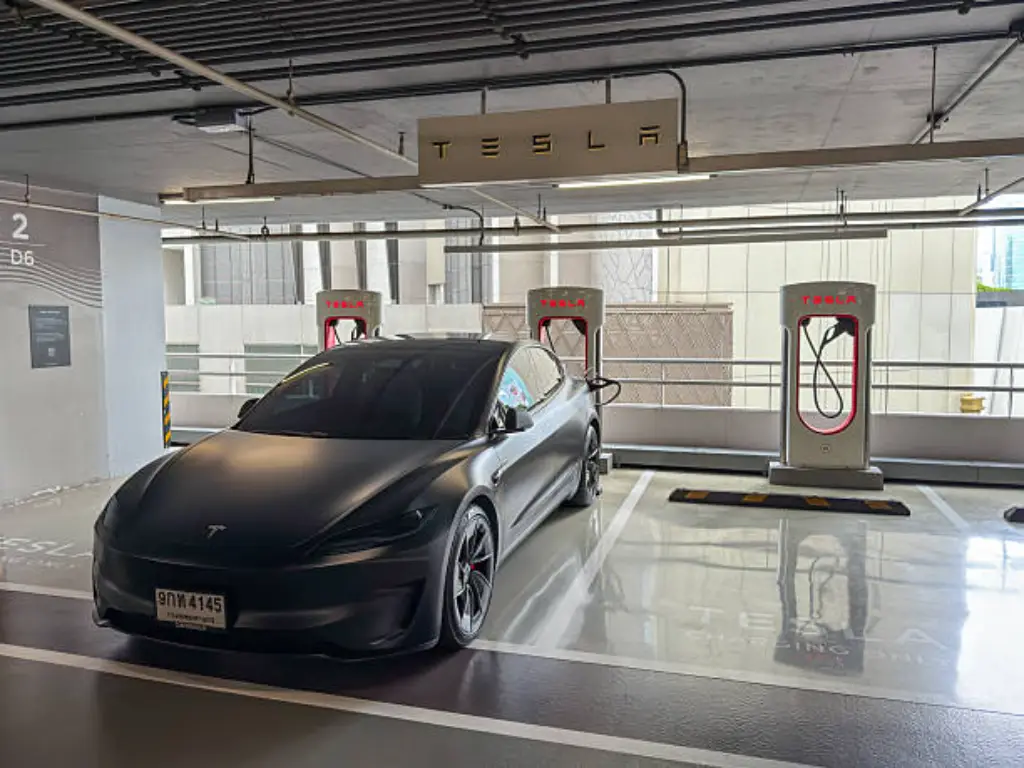
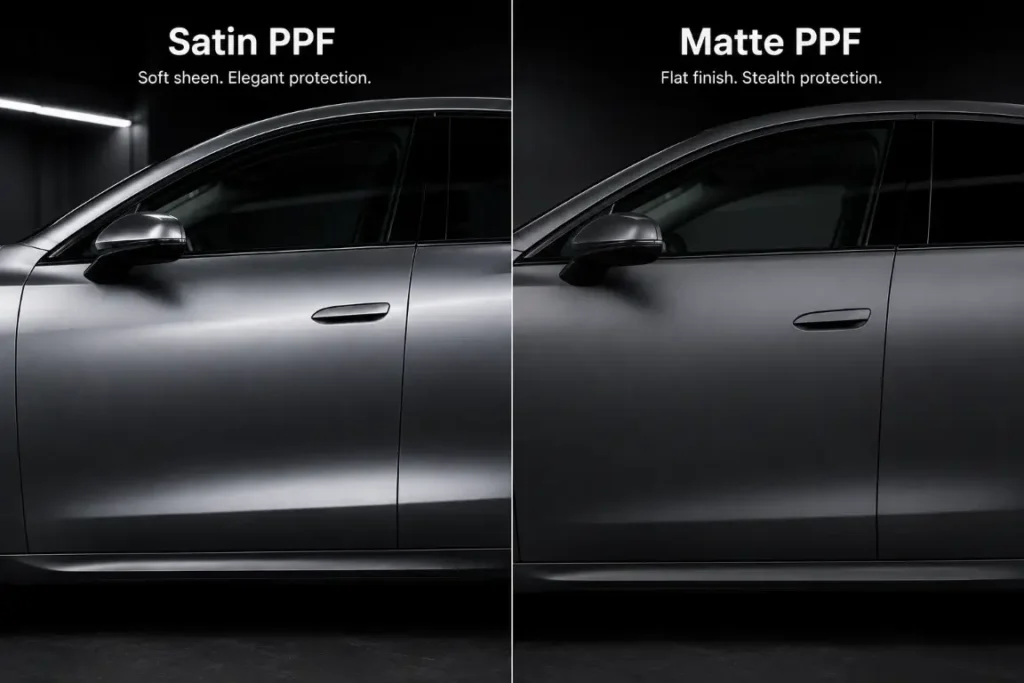
Standard PVC vinyl wraps are thin (usually 2.5 to 3 mils) and provide virtually zero protection against rock chips. More importantly, they have a limited lifespan of 3 to 5 years before they begin to crack and bake onto the paint. Stealth (Matte) PPF represents a paradigm shift. It provides the same 8-mil (203-micron) impact resistance as our clear film but utilizes a specialized frosted top-layer that scatters light reflections. This allows you to transform a standard factory gloss color—such as Midnight Silver or Deep Blue—into a sophisticated, satin-frosted finish. Because the base is still high-performance Aliphatic TPU, you retain all the self-healing and protective properties. It is the ultimate “dual-purpose” investment: you achieve a custom aesthetic that rivals a $10,000 boutique paint job, while simultaneously doubling the thickness of your vehicle’s defensive shell.
Strategic Coverage Options: Where to Invest Your Budget
While a full-body PPF wrap is undeniably the “gold standard” for asset preservation, a targeted approach based on the Pareto Principle—the 80/20 rule—often provides the highest return on investment for the pragmatic Tesla owner. By analyzing three years of documented “strike zone” data across the Tesla fleet, we can categorize coverage into specific risk-mitigation tiers. This ensures that your capital is allocated to the areas most susceptible to high-velocity kinetic energy impacts.
Tier 1: The “Highway Shield” (Full Frontal Defense)
This is the non-negotiable baseline for any Tesla owner who conducts more than 20% of their driving on interstates. The package includes the front bumper, the entire hood, front fenders, and side mirrors. On a Tesla, these specific panels account for nearly 95% of all documented rock chip damage. Because the Tesla front end is effectively a flat wall of paint moving through a soup of debris, the “peppered” look (hundreds of tiny white primer-exposing chips) occurs almost exclusively on these forward-facing surfaces. Protecting these areas prevents the catastrophic visual degradation that significantly devalues a car during professional appraisals.
Tier 2: The “Track Pack” & Wide-Body Vulnerabilities
The “Track Pack” adds protection to the rocker panels and the lower portion of the doors. This is particularly critical for the Model Y and the Model 3 Performance. Due to the flared design of the rear wheel arches, the “hips” of a Tesla act as a massive catch-all for stones and road salt kicked up by the front tires. In many cases, we observe “sandblasting” damage on the lower rear doors within the first 5,000 miles of ownership. By extending coverage to these high-abrasion zones, you maintain the structural integrity of the clear coat in areas that are notoriously difficult and expensive to respray without visible color blending issues.
Tier 3: The “Pristine Asset” (Full Vehicle Armor)
For owners seeking absolute peace of mind or those choosing a Stealth/Matte finish, every painted surface—including the roof pillars, trunk, and rear bumper—is sealed. This is the only way to ensure 100% color consistency over a 10-year lifespan. It also provides total immunity from “environmental etching” caused by acid rain, bird droppings, and the harsh alkaline chemicals used in automated car washes. If your exit strategy involves a private-party sale to an enthusiast, a full-body wrap is a powerful value-multiplier that allows you to demand a premium over the standard market value.
The Financial Audit: Real Costs, Resale ROI, and the Carfax Trap
In the world of high-value automotive assets, “Original Factory Paint” is the single most significant determinant of resale value. In the long run, investing in tesla paint protection is effectively the best way to protect tesla paint and hedge against a massive Depreciation Liability. When you leave your Tesla unprotected, you are effectively self-insuring against a risk that is statistically guaranteed to occur: the erosion of your vehicle’s equity through Diminished Value (DV).

The Hidden Liability: Quantifying “Diminished Value”
In major markets, the vehicle history report (Carfax, HPI, or Autocheck) is the ultimate arbiter of truth. Consider this common scenario: your Tesla suffers a minor, non-structural stone chip that necessitates a professional respray of the hood to maintain its appearance. That incident, if processed through insurance or a certified shop, is permanently logged. When it comes time to sell, a savvy buyer or a dealership’s appraisal software will flag the “Non-Factory Paint” or “Minor Collision” entry. Even if the repair is visually perfect, the mere existence of that record triggers an automatic 10% to 15% reduction in the vehicle’s valuation. On a $50,000 Tesla, that is a $5,000 to $7,500 financial hit purely due to paperwork. FlexiPPF prevents the need for resprays, keeping your history report “Pristine” and your equity intact.
| Risk Category | Unprotected | FlexiPPF Proactive |
|---|---|---|
| Initial Outlay | $0 | $2,200 (Asset Hedge) |
| Paint Correction | $1,500 – $2,500 | $0 (Self-healing) |
| Carfax Devaluation | -$4,500 to -$7,500 | $0 (Factory Paint) |
| Total Impact | -$6,800 to -$11,500 | -$2,200 (Fixed Cost) |
The data is unequivocal: a premium front-end protection package is a highly leveraged financial tool. By pre-allocating a small fraction of the car’s MSRP into a physical defense layer, you are locking in your future trade-in value. You are essentially pre-paying for a guaranteed “top-tier” appraisal when you eventually upgrade to the next-generation Tesla architecture.
The Installation Trap: Why “Millimeter Precision” is a Myth
The most catastrophic mistake an owner can make is purchasing world-class film only to have it ruined by archaic installation methods. Many shops market “millimeter-precise 3D scans” as the ultimate solution, but this is a fundamental misunderstanding of polymer physics and the unique compound curves of Tesla body panels. A 1:1 digital scan of a car does not translate to a perfect installation; in fact, it often leads to catastrophic “Adhesive Disturbance” and edge failure.
The Physics of TPU Deformation: Elongation & “Silvering”
Thermoplastic Polyurethane is a highly elastic material with an elongation at break of up to 400%. During a professional installation, the film must be manually stretched to conform to the parabolic surfaces of a Tesla front bumper. If a pattern is cut exactly to the dimensions of the car (a 1:1 ratio), the act of stretching will cause the film to “grow,” resulting in overhangs or internal tension. If an installer tries to force a non-calculated pattern onto a curve, they create “Silvering”—microscopic fractures in the adhesive layer that appear as white, hazy streaks.
The FlexiPPF Technical Moat: True precision is not about scanning; it is about Calculated Stress Distribution. FlexiPPF’s proprietary 3D database maps the specific “stretch coefficient” for every individual Tesla panel. Our digital templates include engineered Tension Relief Cuts and precise Wrapped Edge Offsets. We factor in the 0.3-inch “draw” of the film across the hood, allowing the material to be tucked behind the panel edges without excessive tension. This ensures that the installation is literally invisible and remains securely bonded for the full 10-year warranty period.
Post-Accident Reality: Will Auto Insurance Cover Your PPF?
A common source of “sunk-cost anxiety” for Tesla owners is the fear of losing their PPF investment in a collision. However, from a legal and insurance perspective, premium PPF is a documented aftermarket enhancement that adds verifiable value to the insured asset. You are not “throwing away money” if an accident occurs, provided you follow a specific documentation protocol that transforms your PPF from a “detail” into an “insured accessory,” ensuring tesla paint protection remains financially secured.
The “Supplementary Coverage” Protocol
Beyond simple reimbursement, sophisticated owners should understand the legal framework of “Certified Pre-Loss Condition.” In most insurance jurisdictions, the insurer is required to restore the vehicle to its exact state prior to the loss. Because FlexiPPF is a non-permanent but semi-permanent physical addition, it qualifies as an insured upgrade. By maintaining a forensic record of your installation—including the film’s BOM (Bill of Materials) and serial numbers—you provide the insurance adjuster with irrefutable evidence of the vehicle’s superior protection level.
Upon completion of your FlexiPPF installation, you should immediately submit the itemized invoice to your agent and request to add the film under your Custom Parts and Equipment (CPE) Coverage. This ensures that in the event of an accident—whether you are at fault or the victim—the insurance payout will include the professional re-application of the film on the replaced panels.
Long-Term Maintenance: Protecting Your Protection

While FlexiPPF is engineered for extreme industrial durability, its 10-year lifespan is contingent upon a specific chemical maintenance protocol to keep the car in pristine condition. Treat your vehicle’s armor with the same calculated precision used to engineer it. Maintaining the self-healing properties and optical clarity of the TPU is the best way to protect tesla paint and requires a basic understanding of pH-neutral chemistry and polymer cross-linking. Improper care can “choke” the topcoat, leading to premature dulling or loss of hydrophobicity.
- The 72-Hour Molecular Anchoring Window: Immediately after installation, the pressure-sensitive adhesive (PSA) undergoes a critical cross-linking process to anchor itself to the clear coat. Avoid washing the car or exposing it to heavy rain during this phase. Any moisture ingress at the edges before the adhesive is fully set can compromise the long-term bond, leading to “lifting” in high-stress areas.
- Thermal Reactivation of Topcoats: The “self-healing” functionality of FlexiPPF is a thermoplastic response. If you notice micro-scratches from improper washing, you can manually trigger the polymer flow. Pouring warm water (approx. 50°C) over the area will instantly smooth the surface, restoring the original high-gloss finish without the need for abrasive polishing compounds that would thin the film.
- Chemical Hygiene & pH Neutrality: Never use petroleum-based solvents, high-alkaline degreasers (pH > 9.5), or harsh acid-based wheel cleaners near the film edges. Stick to pH-neutral (pH 7.0) automotive shampoos and ceramic-infused detail sprays to maintain the film’s slickness and surface energy, thereby preventing paint damage from tree sap or other biological contaminants.
 English
  Spanish
  Dutch
Dutch  Japanese
  Russian
  Arabic