
If you have spent any time around car forums, detailing shops, or new-car delivery conversations, you have probably heard the term "PPF" tossed around. It sounds technical. It sounds expensive. And most of all, it sounds like something you are supposed to want — without anyone explaining what it actually is.
This article fixes that. By the time you finish reading, you will know exactly what PPF is, how it works, what makes one film better than another, what it costs, and whether it is actually worth it for your car.
What Is PPF (Paint Protection Film)?
PPF — short for Paint Protection Film — is a transparent, thermoplastic polyurethane film applied to a vehicle's painted surfaces to shield them from physical damage. If you have heard the term "clear bra," that is the same thing: a nearly invisible protective layer that sits on top of your factory paint.
The technology has an unexpected origin. During the Vietnam War, 3M developed a polyurethane film for the U.S. military to protect helicopter rotor blades from flying shrapnel and debris. The logic was simple: replace a sacrificial film instead of an entire rotor blade. The military adopted it quickly, and the technology eventually trickled down — first to motorsports teams protecting race-car paint schemes, then to consumer vehicles (Wikipedia).
Modern PPF is a different animal from that early military film. Today's versions are thinner (6–8 mil, roughly twice the thickness of a sheet of paper), optically clearer, and capable of something that sounds almost like magic: they can heal their own scratches when exposed to heat.
How Does PPF Protect Your Car?
PPF is not a single sheet of plastic. It works through a three-layer system, each layer playing a distinct role. Think of it less like a screen protector and more like a laminated windshield — different materials bonded together to do different jobs.
The 3-Layer Structure of PPF
![3D cross-section view of Paint Protection Film structure]](https://www.flexippf.com/wp-content/uploads/2026/07/ChatGPT-Image-2026年7月2日-15_02_19.webp)
Every quality PPF consists of three functional layers:
- Top Coat — The outermost layer. This is a clear, UV-resistant coating that handles chemical defense: bird droppings, tree sap, acid rain, and road salt. It is also the layer responsible for self-healing and hydrophobic (water-beading) properties. On premium films, the contact angle — a measure of how well water beads up and rolls off — reaches 105° or higher.
- TPU Layer — The core. Thermoplastic polyurethane is an elastomer: it stretches and rebounds. When a rock or piece of road debris hits the film, this layer absorbs and dissipates the impact energy rather than transferring it to the paint underneath. TPU tensile strength on quality films runs 20–36 MPa, with elongation at break exceeding 300% (ASTM D412).
- Adhesive Layer — The bottom layer. This is a pressure-sensitive adhesive engineered to hold the film firmly in place for a decade, yet release cleanly when the film is eventually removed. Industry-standard peel adhesion runs 8–12 N per 25 mm — strong enough to stay put at highway speeds, but not so aggressive that it pulls up factory clear coat on removal.
Self-Healing: How Heat Fixes Scratches
The self-healing claim sounds like marketing hype, but the physics behind it is straightforward.
The top coat contains elastomeric polymers whose molecular chains have a "memory" of their original arrangement. When something lightly scratches the surface — a car-wash brush, a fingernail, road grit — those polymer chains are physically pushed aside, not broken. Apply heat (sunlight on a warm day, a splash of hot water, or a few seconds with a heat gun), and the molecules gain enough thermal energy to relax back into their original positions. The scratch disappears.
Activation temperature is typically 40–60°C — easily reached by direct sunlight on a parked car. Recovery takes 20–30 minutes in the sun, or 2–5 minutes with a heat gun. A critical caveat: this only works for shallow scratches confined to the top coat. If something cuts through the TPU layer itself, no amount of heat will fix it.
Protection Beyond Rocks and Scratches
A rock flying off the highway is the most obvious threat to car paint. But the daily damage that degrades paint over years comes from less dramatic sources. UV radiation slowly oxidizes clear coat, causing fading and loss of gloss — quality PPF blocks at least 98% of it. Bird droppings and bug acid can etch into clear coat within hours on a hot day, but the top coat is chemically inert to these acids. Tree sap and road tar bond aggressively to bare paint, yet a hydrophobic top coat prevents them from getting a strong grip. Automatic car washes leave micro-swirls from rotating brushes that the self-healing layer absorbs and recovers from. Road salt and de-icing chemicals accelerate corrosion in winter climates — PPF provides a physical barrier that salt cannot penetrate.
Important: PPF's self-healing only repairs shallow top-coat scratches. Deep cuts that penetrate the TPU layer are permanent. The film protects your paint — but it is not indestructible.
Types of PPF: Materials and Finishes
Shopping for PPF essentially means answering two questions: what material grade do you want, and what surface finish matches your car?
Material grade determines protection quality and longevity. Surface finish is purely about how your car looks. Below is how the options stack up.
Material Comparison
| Material | Characteristics | Lifespan | Best For |
|---|---|---|---|
| TPU (Thermoplastic Polyurethane) | Self-healing, high elasticity, excellent UV/yellowing resistance. Premium substrate used by all major brands. | 7–10 years | Long-term owners seeking maximum protection |
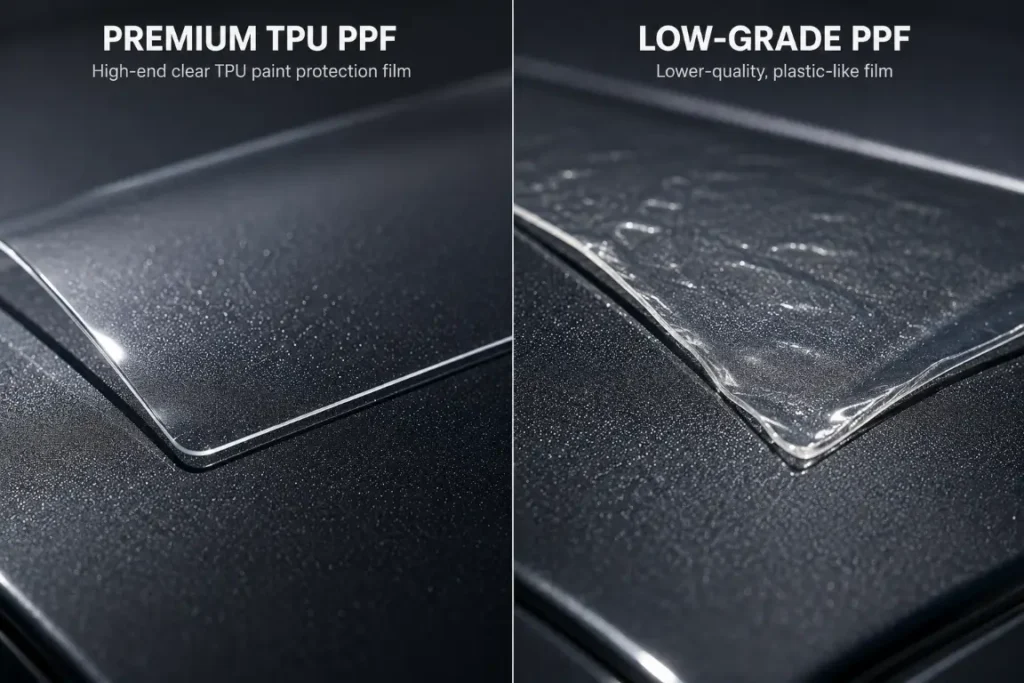
| TPH (Modified Polyolefin) | Moderate flexibility, no true self-healing, lower durability. Often marketed as "budget PPF." | 3–5 years | Short-term use, lease vehicles on a tight budget |
| PVC (Polyvinyl Chloride) | Least expensive, prone to cracking and yellowing. Not recommended for paint protection — better suited to short-term color-change wraps. | 1–3 years | Temporary cosmetic changes only |
The short version: if you care about protection, stick with TPU. TPH and PVC save money up front but cost more in the long run — through earlier replacement and, potentially, paint damage from degraded adhesive.
Surface Finish Comparison
| Finish | Look | Maintenance | Best For |
|---|---|---|---|
| Gloss | Amplifies factory shine, mirrors clear coat | Shows water spots easily; needs frequent washing | Owners who want maximum gloss and depth |
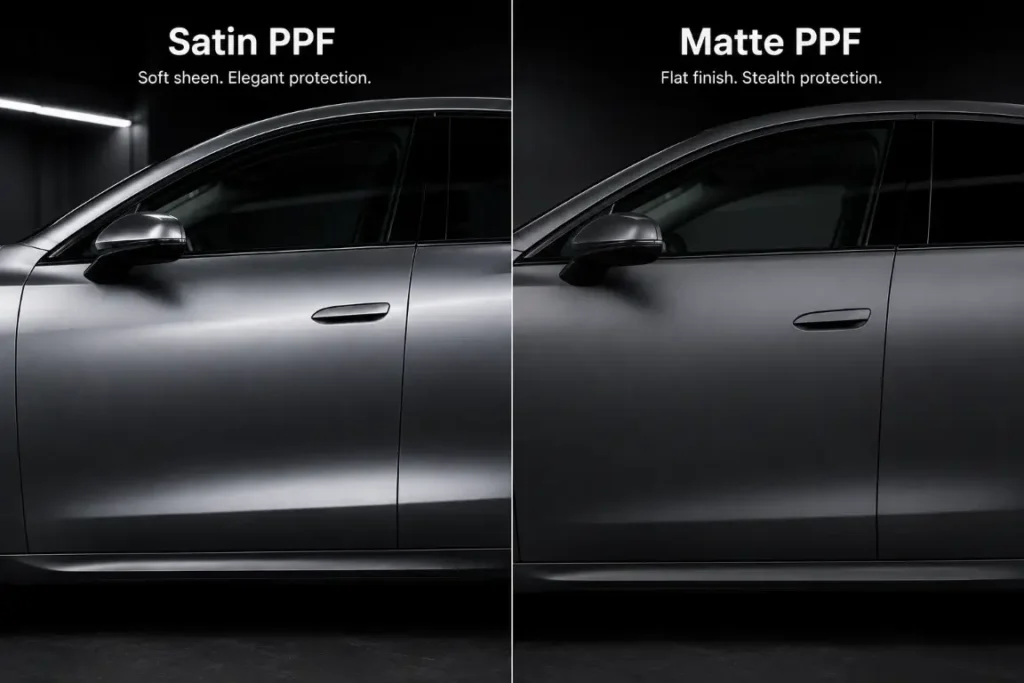
| Matte | Zero reflections, flat/satin look | Shows fingerprints; requires matte-specific cleaners | Distinctive "stealth" aesthetic |
| Satin | Middle ground: soft luster, preserves body lines | Easier than matte, hides light dirt better than gloss | Low-key premium look with manageable upkeep |
| Colored PPF | Changes body color while protecting | Depends on finish; PPF-safe products only | Owners who want protection + reversible color change |
PPF vs Ceramic Coating vs Vinyl Wrap
These three products are frequently confused because they all involve "putting something on your paint." But they solve fundamentally different problems — and they are complementary, not competitive.
| Dimension | PPF | Ceramic Coating | Vinyl Wrap |
|---|---|---|---|
| Primary purpose | Physical impact protection | Chemical protection + easy cleaning + gloss | Color change / aesthetics |
| Stops rock chips? | ✅ Yes (absorbs impact) | ❌ No (too thin) | ❌ Minimal |
| Self-healing? | ✅ Heat-activated | ❌ No | ❌ No |
| Hydrophobic / easy clean? | Only if ceramic-coated on top | ✅ Core feature | Only if coated |
| UV protection? | ✅ Built-in inhibitors | ✅ Good | ⚠️ Limited |
| Thickness | 6–8 mil (150–200 μm) | < 1 micron | 3–4 mil (75–100 μm) |
| Lifespan | 7–10 years | 2–5 years | 3–7 years |
| Changes color? | Clear (or colored PPF available) | No (clear only) | ✅ Wide variety |
The best setups often combine them. A common high-value configuration: full-front PPF on the impact zones (hood, bumper, fenders, mirrors) plus a ceramic coating over the entire car. The PPF handles the rocks; the ceramic coating makes everything easy to wash and adds gloss.
Think of it this way: PPF = a phone's tempered glass screen protector (impact defense). Ceramic coating = the oleophobic coating on top (fingerprint resistance). Vinyl wrap = a phone case that changes the color. You can use all three at once.
What Determines PPF Quality? A 3-Point Checklist
Most PPF guides hand you a list of brand names and send you on your way. This one is different. By the end of this section, you will have a framework for judging any PPF yourself — no brand loyalty required. Three things determine quality: raw materials, manufacturing standards, and the warranty that backs it all up. Learn these, and you will know more than 90% of PPF shoppers walking into a detailing shop.
Raw Materials: What Your PPF Is Made Of
Virtually every PPF brand on the market starts with TPU raw material from one of three chemical companies: Lubrizol (USA, makers of Estane® TPU), BASF (Germany), or Covestro (Germany). These firms do not make PPF — they produce the base TPU pellets that PPF manufacturers extrude into film. Think of them as the "chip suppliers" of the PPF world.
What makes one TPU better than another? It comes down to molecular structure. Premium TPU grades use polycaprolactone-based polyurethane, which offers superior elastic recovery and hydrolysis resistance compared to standard polyester-based TPU. This is why two films can both claim "TPU" yet perform completely differently over a decade.
The adhesive matters almost as much. Most quality PPF uses pressure-sensitive adhesive from Ashland (USA), engineered to hold firm for years without leaving residue when removed. Cheap adhesives are the #1 cause of "PPF horror stories" — films that peel, bubble, or take factory paint with them on removal.
When talking to an installer or supplier, ask three questions: "Whose TPU is this made from? Whose adhesive? Can you show me the raw-material certification?" If the answers are vague, you are probably looking at TPH being sold as TPU.
From Factory Floor to Your Car: How PPF Is Made
Same Lubrizol TPU pellets. Same Ashland adhesive. Why does one factory's PPF outperform another's by years?
It comes down to manufacturing execution. Quality PPF production involves four main steps: TPU pellet extrusion → film casting (calendering) → top-coat application → slitting and inspection. Precision matters at every stage.
When evaluating where a PPF comes from — and the majority of global PPF production happens in China, particularly in Guangdong, Shanghai, and Jiangsu provinces — three factory metrics tell you more than any marketing brochure:
- Cleanroom class. Dust is the enemy of optical clarity. A single particle embedded in the TPU layer creates a visible "fish eye" defect. Quality factories operate at Class 10,000 (ISO 7) or better — meaning no more than 10,000 particles ≥ 0.5 microns per cubic meter of air.
- Coating line count and source. Three or more coating lines signals serious production scale. Top factories run Korean-imported coating machines, which offer tighter tension control and more uniform top-coat deposition than older domestic equipment.
- QC lab equipment. A legitimate factory tests every batch with a spectrophotometer (color/gloss), haze meter (optical clarity), adhesion tester (peel force), and contact-angle goniometer (hydrophobicity). If a supplier cannot name their QC instruments, they are likely a trading company, not a manufacturer.
Note: China accounts for the majority of global PPF production — not because of low cost alone, but because the country has built a complete supply chain from TPU raw materials to finished film. The key distinction is not "where" but "which factory and to what standard."
3 Things to Verify Before You Buy
Ask "Whose TPU? Whose adhesive?" — Lubrizol, BASF, or Covestro TPU with Ashland adhesive are the gold standard. Vague answers usually mean TPH sold as TPU.
Look for Class 10,000+ cleanroom, 3+ coating lines, and Korean-imported equipment. If the supplier can't name their QC instruments, they're likely a trading company — not a manufacturer.
Check the yellowing threshold (ΔE ≤ 2), whether the warranty transfers to the next owner, and if labor is included. A "10-year warranty" with no specific coverage is an empty promise.
Top Coat Technology and Warranty: The Final Filter
The top coat is the PPF's face to the world. It determines three things: self-healing quality, stain resistance, and long-term yellowing resistance.
- Hydrophobic top coats (contact angle ≥ 105°) bead water aggressively — dirt slides off more easily, but hard-water spots can be more visible.
- Hydrophilic top coats spread water into a thin sheet that dries without spots — better for areas with hard water.
- Ceramic-infused top coats (the highest tier) embed nano-ceramic particles into the coating for both hydrophobicity and chemical resistance.
On warranties: the number of years matters less than what the fine print actually covers. A "10-year warranty" is meaningless if it excludes yellowing, does not specify a color-change threshold (look for ΔE ≤ 2, the point at which the human eye can perceive a difference — per ASTM D2244), or requires annual "maintenance inspections" you will never schedule. Also check: does the warranty transfer to the next owner? Film warranties that follow the car (not the original buyer) signal real manufacturer confidence.
How Much Does PPF Cost?
PPF pricing varies by coverage level, vehicle size, film brand, and installer expertise. Below are the ranges you can expect from a professional shop (prices include labor — materials alone account for roughly 30–40% of the total).
| Coverage Level | What Is Covered | Typical Price Range |
|---|---|---|
| Partial Front | Front bumper, leading 18–24" of hood, side mirrors | $800–$1,800 |
| Full Front | Full hood, full front bumper, full fenders, mirrors, headlights | $2,200–$3,200 |
| Full Front + Extended | Full front + door edges, door cups, rocker panels, A-pillars | $3,000–$4,200 |
| Full Body | Every painted exterior panel | $5,500–$8,000+ |
Three factors drive the price: vehicle size (an SUV needs more film than a sedan), the film series (premium ceramic-topcoat TPU costs more than standard TPU), and installer skill (certified installers charge more — and generally deliver better results).
A mid-size sedan requires roughly 15–20 meters of film (at a standard 1.52 m width) for full-body coverage. Installation takes 1–2 days for a full front, or 3–5 days for a full car.
Full-front PPF costs roughly 30% of a full-body wrap but covers the areas that take over 70% of rock impacts — the front bumper, hood, fenders, and mirrors.
For most daily drivers, this is the highest-ROI configuration.
So, Is PPF Worth It?
The honest answer depends on how you use your car.
PPF is likely worth it if: you plan to keep the car 5+ years, you drive highways regularly, you bought a new vehicle with factory-fresh paint you want to preserve, your car has dark paint (scratches and swirls show 5–10× more visibly on black or dark blue than on white), or you care about resale value — original paint is a premium selling point.
You might be better off starting with a ceramic coating if: you are on a shorter ownership timeline, most of your driving is low-speed city commuting, your car is white or silver (imperfections are far less visible), or your budget is tighter.
The smart middle ground: Full-front PPF. For roughly 30% of the cost of a full-body wrap, you protect the areas that take 70%+ of rock impacts — the front bumper, hood, fenders, and mirrors. This is the highest-ROI configuration for most daily drivers.
Whatever you choose, walk into the conversation prepared. Ask your installer about TPU source, factory standards, and warranty specifics. The person who knows what they are buying rarely buys the wrong thing.
If you apply the three-point quality checklist from this article to a real-world manufacturing operation, you will find that facilities checking all the boxes do exist — they just are not household names. A real-world example of modern PPF manufacturing standards can be seen at FlexiPPF's 60,000 m² production base in Shenzhen, which runs eight Korean-imported coating lines across three Class 10,000 cleanrooms and sources TPU exclusively from Lubrizol and BASF. The point is not the name — the point is that the checklist works. Use it.
Protect Your Investment With Confidence
Get a free consultation and quote tailored to your vehicle
GET FREE QUOTE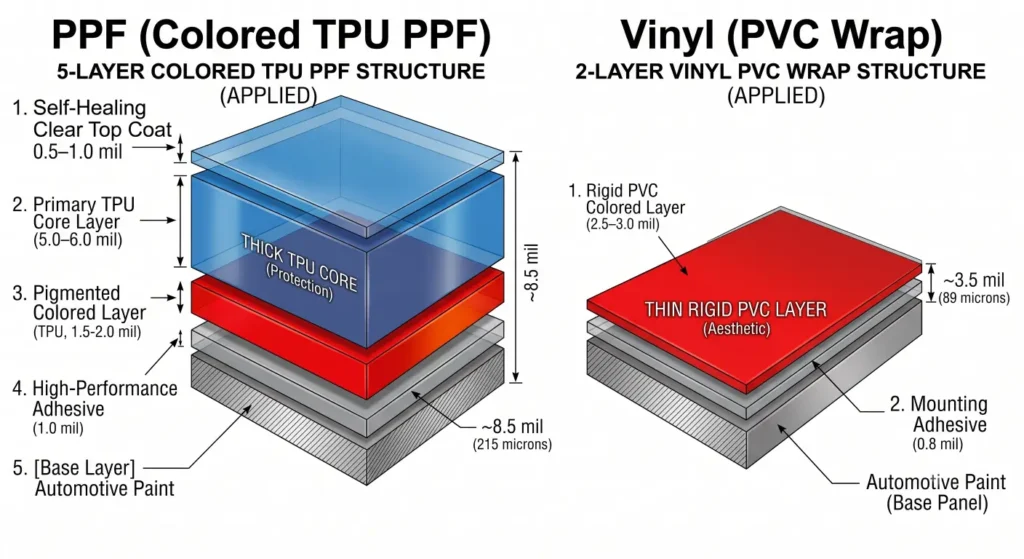
 English
  Spanish
  Dutch
Dutch  Japanese
  Russian
  Arabic