
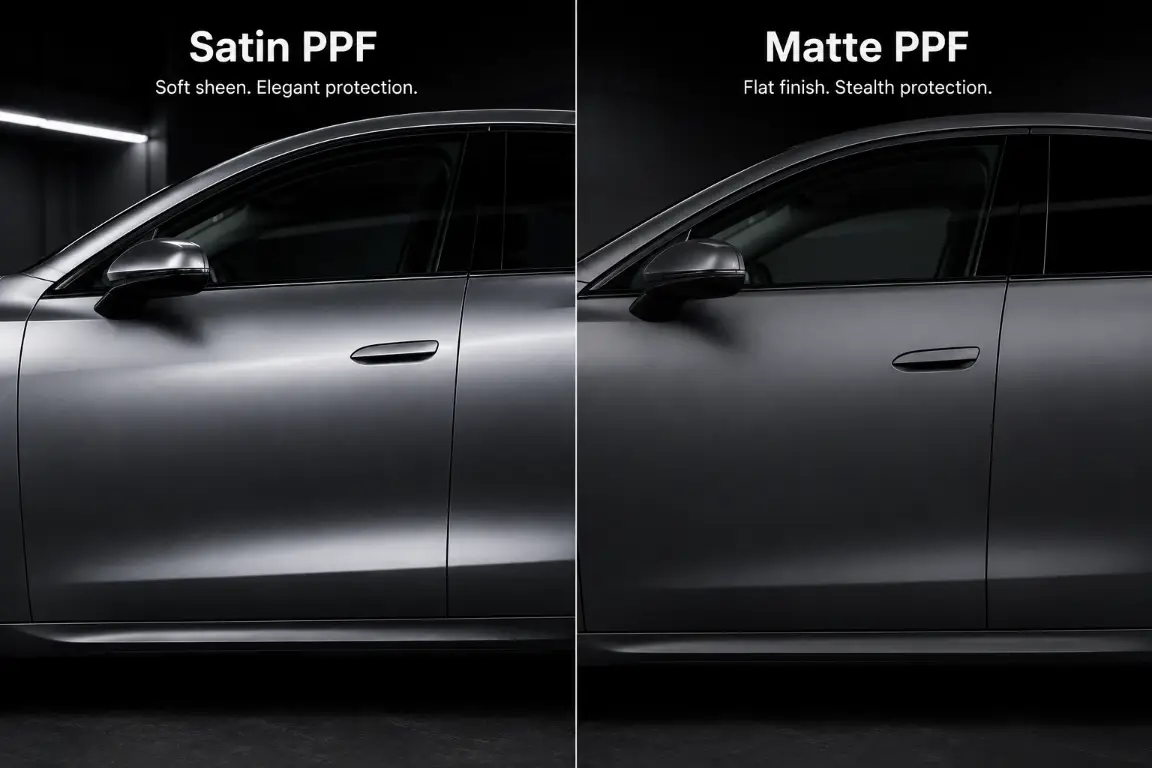
The Terminology Truth — What “Matte PPF” Actually Means
If you’ve spent any time on car forums researching paint protection film, you’ve probably seen this argument: “Matte PPF doesn’t actually exist.”
A PistonHeads forum member who ordered samples from several manufacturers put it bluntly: “Not a single one is a rough, true matte finish — they are all a satin finish. From the side you get a very flat diffused look, but from a shallow angle you get a semi-gloss sheen.”
This isn’t a bait-and-switch. It’s the reality of TPU manufacturing, and it’s actually good news for you as a buyer.
Matte PPF Is Actually Satin — and That’s Good News
Here is what the numbers tell us. In the paint and film industry, gloss is measured in Gloss Units (GU) at a 60° measurement angle. Traditional gloss PPF lands between 85–95 GU: essentially a mirror finish. True dead-matte automotive paint sits at 0–5 GU, absorbing nearly all light like a chalkboard. What the industry calls “matte PPF”? It measures around 20–30 GU. That is right in the satin range, producing a soft, diffused glow rather than a complete absence of reflection.
The reason true dead-matte TPU film is nearly impossible to manufacture comes down to the polymer itself. Achieving a 0-GU surface on thermoplastic polyurethane requires a micro-texture so fine and fragile that it would degrade under the same UV exposure and physical abrasion the film is designed to resist. A satin-level surface, by contrast, is durable enough to carry a 5–10 year warranty while still delivering the stealth aesthetic buyers want.
This is genuinely good news. True matte paint, the kind found on a BMW Frozen or Mercedes Designo Magno finish, is notoriously difficult to maintain. Bird droppings etch within hours. Minor scratches cannot be polished out without creating glossy patches. The satin-level finish you actually get from “matte PPF” sidesteps most of these headaches while delivering 90% of the visual impact.
Decoding the Marketing Vocabulary
Brands do not make this any easier. Here is how the major players label their low-gloss PPF:
| Brand | Term Used | Actual Finish |
|---|---|---|
| XPEL | Stealth | Satin (~25–30 GU) |
| STEK | Matte | Satin (~20–25 GU) |
| SunTek | Matte | Satin (~20–25 GU) |
| LLumar | Matte | Satin (~22–28 GU) |
| 3M | Satin | Satin (~25–30 GU) |
The takeaway is not that brands are misleading you. It is that the entire industry has settled on “satin” as the practical sweet spot between visual impact and real-world durability. When someone tells you they have matte PPF on their car, they almost certainly mean satin. When a shop recommends “matte PPF,” they are recommending satin.
Why This Matters Before You Compare
Understanding this terminology quirk changes how you evaluate your options. You are no longer choosing between “shiny” and “not shiny.” You are deciding how much softness you want in the light reflection, and more importantly, how much maintenance work you are willing to sign up for. The visual differences exist, but they live on a much narrower spectrum than the marketing labels suggest.
The matte PPF you’ve been researching is actually satin — and that means easier maintenance than you expected. The finish that looks bold and aggressive on a showroom floor is, in reality, a durable satin surface you can live with daily.
Visual Identity — How Each Finish Transforms Your Car’s Look
Think of it this way: the difference between satin and matte PPF is not about which one looks better. It is about three objective dimensions: gloss level, light behavior, and body line definition. Once you understand these three, you can visualize how either finish will look on your car, in your color, under your lighting conditions.
Gloss Levels and Light Behavior — The Measurable Difference
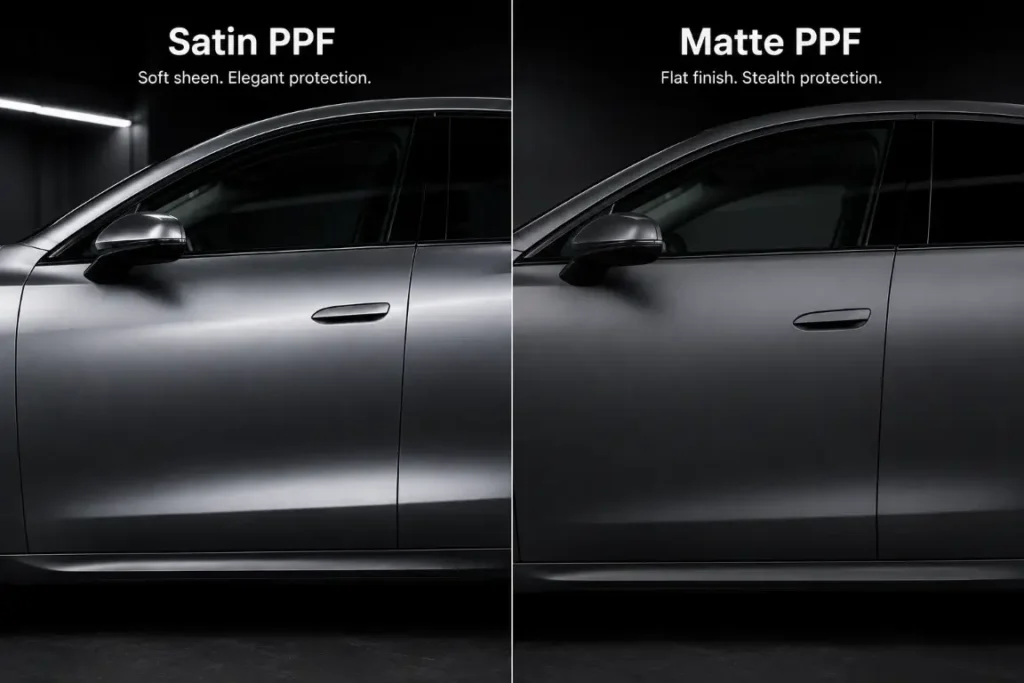
At the most basic level, the difference is about how light interacts with the film surface. Gloss PPF acts like a mirror: light hits the surface and bounces back at the same angle (specular reflection). That is why glossy finishes show sharp, defined highlights. Satin PPF in the 20–30 GU range scatters incoming light in multiple directions (diffuse reflection). The result is a soft glow that wraps around curves rather than creating sharp hotspots. Traditional “matte” PPF at the lower end of this range, closer to 20 GU, pushes this scattering effect further. Reflections are minimized to the point where body panels take on an almost sculptural appearance.
A useful mental model: think of your phone screen. Gloss PPF is the bare glass. Every light source is visible as a distinct, sharp point. Satin PPF is like a high-quality matte screen protector. Light sources soften into diffuse halos, colors deepen slightly, and fingerprints become less visible. The lower-GU end of the satin spectrum is closer to paper: nearly complete diffusion, with color appearing as a field rather than a reflection.
Which Finish Works Best for Your Car Type and Color
There are no absolute rules, but strong patterns are worth knowing before you commit.
For car body shape, angular and boxy vehicles tend to benefit from the lower-GU end of the satin spectrum. Pickups, off-road SUVs, and modern supercars with sharp creases all fall into this category. The flatter finish emphasizes geometric lines by eliminating competing reflections, making every crease and angle read more clearly to the eye. Curvier cars work differently. Luxury sedans, grand tourers, and sports coupes often look best at the higher-GU end of satin, where the soft glow traces the body’s curves without flattening them.
For paint color, dark colors show the most dramatic transformation with satin or matte PPF. Black, dark blue, deep green, and graphite all shift character dramatically. On a gloss black car, adding a satin finish changes the entire personality of the vehicle. A conventional luxury sedan suddenly looks custom-built. Light colors produce a more subtle effect. White, silver, and champagne read as “interesting paint” rather than “wrapped” from a distance. If you drive a white car and want maximum visual impact from your PPF investment, go with the lowest-GU satin option available. The contrast between the expected gloss-white and the delivered satin-white is what creates the effect.
What Owners Actually See After 6 Months
The showroom effect and the driveway effect are two different things. Forum owners who have lived with satin PPF for 6+ months consistently report the same pattern: the initial excitement about “how different the car looks” evolves into a quieter appreciation. One Rivian owner with full XPEL Stealth wrote: “People compliment the ‘paint’ without even knowing it’s PPF. That’s exactly what I wanted.”
Matte PPF owners at the ~20 GU end report stronger reactions, both positive and cautionary. A Land Cruiser owner with 5 years on XPEL Stealth noted: “Grime gets into the finish more easily than paint, but it washes up well. No problem with buffing a spot to gloss — it doesn’t ever need buffing.” The consistent thread is clear. Satin PPF owners rarely regret their choice. Matte PPF owners love the look but universally mention the maintenance as the price of admission.
The Real Differentiator — Maintenance Burden and Why Your Installer Matters
Most comparison articles gloss over an uncomfortable truth: the difference between satin and matte PPF is not primarily about how they look. It is about how you will live with them. The gap between “I wash my car every two weeks with whatever is in the garage” and “I hand-wash weekly with dedicated matte-safe products” is where most finish regret is born.
Cleaning Frequency, Products, and the Cost of Getting It Wrong
| Maintenance Factor | Satin PPF (~25–30 GU) | Matte PPF (~20 GU) |
|---|---|---|
| Wash frequency | Every 2–3 weeks | Every 1–2 weeks |
| Wash method | Hand wash or touchless automatic | Hand wash only |
| Soap type | pH-neutral (6.0–8.0), standard car soap OK | Matte-specific, zero gloss enhancers |
| Forbidden products | High-shine waxes, sealants, polishes | All waxes, all sealants, all polishes, standard car soap, detail sprays |
| Water spot visibility | Moderate | High — must dry thoroughly |
| Cost of a mistake | Uneven sheen, correctable with proper wash | Permanent glossy patches, film replacement required |
The risk asymmetry is what matters. Use the wrong soap on satin PPF, and you will notice a slight sheen inconsistency. Wash it properly next time, and it returns to normal. Use the wrong soap on matte PPF — anything containing gloss enhancers, wax, or silicone-based conditioners — and you have permanently altered the surface. Glossy streaks on matte PPF do not wash out. They are there until you replace the panel.
Think of it like footwear. Gloss PPF is polished leather: wipe it down and it looks good. Satin PPF is like quality suede. It needs a specific brush and spray, but it is forgiving. Matte PPF is raw nubuck: beautiful when pristine, and one wrong product away from permanent damage.
A wrong-product mistake on satin PPF is correctable. A wrong-product mistake on matte PPF is permanent — those glossy streaks will not wash out, and the only fix is panel replacement. If you are unsure about your commitment to a dedicated maintenance routine, satin is the safer choice by a wide margin.
Why Installation Quality Is Magnified on Non-Gloss PPF
This is the factor that almost no comparison article mentions, yet experienced installers will tell you it matters more than which finish you choose.
Non-gloss PPF amplifies every installation imperfection. Three specific issues to watch for:
Edge visibility. When a shop uses pre-cut templates, the film stops 2–5mm short of each panel edge, leaving a thin strip of exposed gloss paint. On gloss PPF, this gap is nearly invisible. On satin or matte PPF, the contrast between the painted edge and the filmed surface draws the eye to every panel gap like a highlighter. Shops that wrap edges eliminate this problem entirely. They extend the film 8–12mm past the panel edge and tuck it underneath. Ask your installer: “Do you wrap edges or use pre-cut templates?”
Stretch marks. TPU film can stretch up to 150–200% of its original dimensions during installation. But satin and matte PPF surfaces begin to deform at around 120% stretch. The micro-texture that creates the low-gloss effect gets pulled apart, producing shiny streaks visible under angled light. A skilled installer working on a complex curve knows to use heat and technique rather than brute-force stretching. Ask: “How do you handle complex curves without over-stretching the film?”
Relief cuts. When an installer cannot get film to conform to a complex contour, they will make a small cut to relieve tension. On gloss PPF, these cuts are subtle. On satin or matte PPF, every relief cut is a visible seam that collects dirt and draws the eye. Top-tier installers avoid relief cuts on non-gloss PPF entirely. They would rather spend an extra 45 minutes on a bumper than leave a visible seam. Ask: “Can I see your satin or matte PPF work from 6+ months ago, specifically on complex panels?”
Do you wrap edges or use pre-cut templates?
How do you handle complex curves without over-stretching the film?
Can I see your satin or matte PPF work from 6+ months ago, on complex panels?
Climate, Driving Habits, and the Maintenance Equation
Make this personal before you make it permanent. If you live in a rainy climate, satin PPF is the safer bet. Water spots show dramatically on lower-GU matte surfaces and need immediate attention. If you drive on dusty or gravel roads regularly, satin wins again. Dust particles settle into matte PPF’s micro-texture and require more aggressive, riskier cleaning to remove. If you park in a garage and only drive on weekends in fair weather, matte PPF becomes a realistic option. The controlled environment minimizes the exposure that makes maintenance difficult.
The simplest decision filter: if your car is a daily driver that sees rain, dust, and automatic car washes, choose satin. If it is a garage-kept weekend car you enjoy hand-washing, matte PPF will reward your effort with a look that turns heads every time you pull it out.
Durability, Warranty & Cost — The Ownership Equation at a Glance
On the dimensions that determine how long your investment lasts, satin and matte PPF are nearly identical. Both use the same TPU substrate. Both self-heal minor scratches when exposed to heat above 40°C (104°F). And both carry comparable warranty coverage from any reputable manufacturer.
| Factor | Satin PPF | Matte PPF | What This Means |
|---|---|---|---|
| Self-healing | ✅ Full | ✅ Full | TPU polymer chains return to original configuration above 40°C — identical across both finishes |
| UV / yellowing resistance | ✅ Strong | ⚠️ Slightly more vulnerable | Matte PPF’s micro-textured surface traps more environmental contaminants; long-term yellowing risk is marginally higher in high-UV climates |
| Warranty coverage | 5–10 years | 5–10 years | Same brand, same warranty terms. Check that yellowing, cracking, bubbling, and delamination are all covered |
| Material cost | $28–70/m² | $28–70/m² | Satin may carry a 10–20% premium due to more complex surface treatment during manufacturing |
| Full vehicle installation | $4,000–$8,000 | $4,000–$8,000 | Total cost is installation-dependent, not finish-dependent. Complex vehicles cost more regardless of finish |
In objective performance terms, satin and matte PPF are functionally identical. The differences that matter live entirely in the subjective: appearance preference and maintenance tolerance. If you have been hoping for a technical reason to pick one over the other, there is not one. That is actually freeing. It means you can make this decision based on how you want your car to look and how much time you want to spend caring for it, without worrying that you are compromising on protection.
Making Your Choice — The 3-Question Decision Framework
By now, you have all the information you need. The only thing left is to apply it to your specific situation. Answer these three questions honestly, and your decision will make itself.
Question 1: “How much do I actually enjoy washing my car?”
If hand-washing your car on a Saturday morning with a dedicated set of products is genuinely satisfying, not a chore you tolerate but something you look forward to, then matte PPF will deepen that ritual. Each careful wash leaves the finish looking better than before. If your ideal car care routine is “spray it off and go,” satin PPF is the choice you will not regret. Satin forgives casual maintenance. Matte punishes it.
Question 2: “What statement do I want my car to make?”
Both finishes say “this car is protected.” But they say it at different volumes. Satin PPF whispers. It is the finish people notice on their second or third look, the one that makes them think “there is something different about that car” without immediately knowing what. Matte PPF announces itself. It is the finish that makes people stop and ask, “What did you do to your paint?” Neither is better. One is bolder. Choose based on which reaction you would prefer from the valet, the client, or the stranger at the gas station.
Question 3: “Who is installing it — and have I seen their non-gloss work?”
This question matters more than any finish comparison. A poorly installed satin PPF job looks worse than a perfectly installed matte PPF job, and vice versa. Before you commit to either finish, find an installer who can show you their own work on satin or matte PPF from at least 6 months ago. Walk up to those cars. Look at the edges, the complex curves, the places where panels meet. If the installer cannot or will not show you this, find another installer. The best PPF film in the world, applied poorly, looks cheap. A mid-range film applied by a craftsman looks expensive. In the satin vs matte decision, the installer is the tiebreaker.
When comparing satin and matte PPF options, look for manufacturers who produce both finishes under consistent specifications and warranty terms. This signals genuine production capability rather than outsourced finishing. FlexiPPF, for example, manufactures satin and matte PPF using Lubrizol TPU with a 5-layer ceramic top coat construction across its product line, with custom finish specifications available for buyers who need OEM-level consistency. FlexiPPF PPF product specifications
References
- Lubrizol Engineered Polymers. “Expanding PPF Possibilities Through Materials Science Innovation.” lubrizol.com
- ChemQuest Group / Victoria Scarborough, Ph.D. “Can Paint Films Disrupt Traditional Coatings?” 2025. chemquest.com
- XPEL Inc. “STEALTH™ Paint Protection Film.” xpel.com
 English
  Spanish
  Dutch
Dutch  Japanese
  Russian
  Arabic