
You want to change your car’s color. Maybe you’re tired of the factory white, or you want something that turns heads without committing to a $10,000 paint job. Either way, you’ve landed on two options: colored PPF and vinyl wrap.
They both change how your car looks. But that’s where the similarity ends.
One is an 8-mil-thick piece of engineering that stops rocks, heals its own scratches, and lasts a decade. The other is a 3-mil cosmetic skin that looks great on day one but starts a countdown clock the moment it leaves the shop.
Here’s what actually separates them — beyond the marketing claims.
What Are Colored PPF and Vinyl Wraps Made Of?
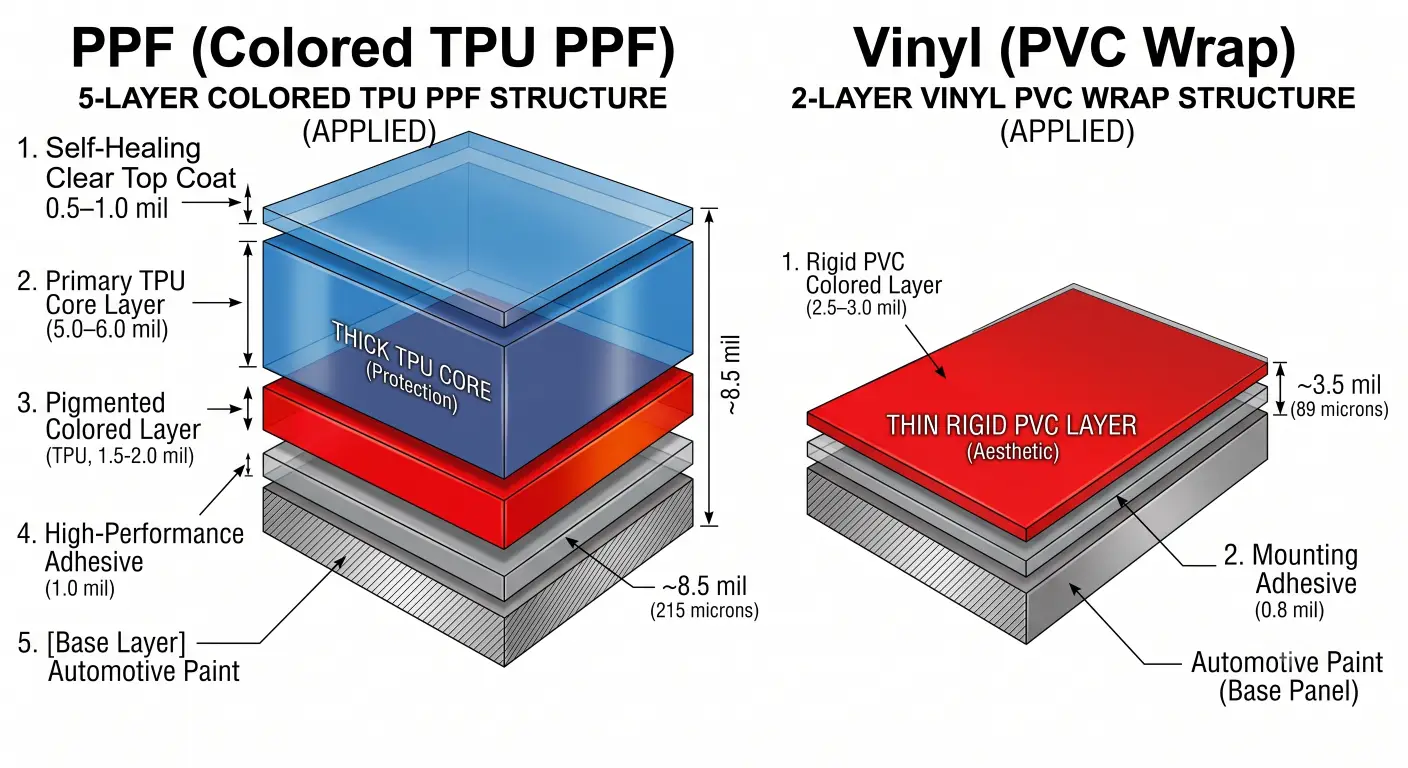
Before comparing performance, you need to understand what you’re actually putting on your car. Colored PPF and vinyl wrap are not just “thick film vs thin film.” They are fundamentally different materials with different engineering purposes.
| Dimension | Colored PPF | Vinyl Wrap |
|---|---|---|
| Base Material | TPU (Thermoplastic Polyurethane) | PVC (Polyvinyl Chloride) |
| Chemical Family | Elastomer — stretchy, energy-absorbing | Rigid thermoplastic — needs plasticizers to become flexible |
| Primary Engineering Purpose | Impact absorption + surface protection | Aesthetic color change |
| Typical Thickness | 7–9 mil (175–230 microns) | 3–4 mil (75–100 microns) |
| Layer Structure | 5 layers: top coat → TPU base → TPU substrate → adhesive → PET liner | 2–3 layers: colored PVC → optional laminate → adhesive → liner |
Think of it this way: TPU is like a silicone phone case — thick, elastic, and designed to absorb impact. PVC is like a phone skin — thin, decorative, and provides zero drop protection. Both change how the device looks, but only one changes what happens when it hits the ground.
The key difference is in the chemistry. TPU has a glass transition temperature around -40°C to -30°C, which means it stays flexible even in extreme cold. PVC relies on added plasticizers for flexibility — and those plasticizers migrate out over time. That’s why vinyl wraps become brittle, shrink, and crack after a few years, while PPF stays pliable for its entire service life.
Durability & Protection: How Do They Actually Perform?
This is the question that brought you here: which one actually protects your car?
Protection isn’t one thing — it’s a pyramid. At the base is scratch resistance (what you deal with every day). In the middle is impact protection (rare but expensive). At the top is weathering (the slow grind of sun, salt, and time). Colored PPF wins at every level, but it wins for different reasons.
Scratch Resistance & Self-Healing
The most visible difference between PPF and vinyl is what happens after someone brushes against your car in a parking lot.
TPU has what polymer scientists call “elastic shape memory.” When heat is applied — from summer sun hitting your parked car (surface temperatures easily reach 60–70°C) or from warm water poured over a scratch — the polymer chains above the damage site reorganize themselves. The scratch disappears. Vinyl cannot do this because PVC forms rigid chain segments; a scratch is permanent plastic deformation, not a temporary displacement.
In practical terms: light swirl marks, car-wash micro-scratches, and parking-lot brushes disappear from PPF within minutes of sun exposure. On vinyl, they accumulate until the entire surface looks dull. Actual durability testing backs this up — when DIYWrapClub ran a metal brush across both materials and applied heat, the PPF surface returned to near-flawless condition while the vinyl showed permanent trench-like scratches (DIYWrapClub, 2025).
One important caveat: self-healing works on the top coat layer (typically 0.5–1.0 mil thick). Deep cuts that penetrate through the top coat into the TPU substrate will not heal — so PPF is scratch-resistant, not scratch-proof.
Impact & Chip Protection
PPF was originally invented by 3M for a specific purpose: protecting helicopter rotor blades from stone and debris strikes during the Vietnam War. It migrated through NASCAR (where 200-mph debris is a constant threat) before reaching consumer cars. That military origin story tells you everything about what TPU is engineered to do.
When a rock hits PPF at highway speed, the TPU elastomer absorbs the kinetic energy — stretching up to 400% of its original length before breaking — and converts it into heat and elastic deformation. The rock bounces off. When the same rock hits vinyl, the rigid PVC sheet tears, and the underlying paint takes the full impact.
The industry standard for testing this is SAE J400, a gravelometer test that fires standardized projectiles at film samples and rates the resulting damage on a 0–10 scale. PPF formulations are engineered to pass this test. Vinyl wrap formulations are not even submitted for it — because protection was never the design goal.
In real-world terms: if you drive on highways, gravel roads, or anywhere with winter road salt mixed with sand, PPF is the difference between your paint surviving and your paint looking like it was sandblasted.
UV & Weather Resistance Over Time
Here’s the part most buyers overlook: what happens in year three.
Vinyl looks great on installation day. But PVC degrades through two parallel mechanisms. First, UV exposure breaks down the polymer chains, causing color fading and surface chalking. Second — and more importantly — the plasticizers that make PVC flexible gradually migrate out of the material. This is why three-year-old vinyl wraps become brittle, shrink at the edges, and develop an orange-peel texture that wasn’t there before.
PPF uses aliphatic TPU — a specific chemical variant whose polymer backbone lacks the conjugated double bonds that absorb UV and trigger yellowing. Combined with UV stabilizers in the top coat, this gives colored PPF its 7–10 year service life with no significant color shift (ΔE < 3 in accelerated QUV testing at 3,000–5,000 hours). Aromatic TPU, which costs 30–40% less, yellows visibly within 1–2 years — and is exactly what low-end “PPF” products use.
Climate multiplies these differences. In Dubai or Arizona, where summer surface temperatures exceed 80°C, vinyl can start showing degradation within 12–18 months. In Calgary or Scandinavia, where winter temperatures drop below -30°C, vinyl becomes brittle enough to crack from a car-wash jet. PPF handles both extremes because its flexibility is built into the polymer backbone, not borrowed from additives that eventually leave.
Finish, Texture & Color Options — The Look Factor
Let’s be honest: for many buyers, appearance matters more than protection specs. Here’s where each product shines — and where each falls short.
| Aspect | Colored PPF | Vinyl Wrap |
|---|---|---|
| Gloss Depth | 95–98 GU — deep, liquid, paint-like | 80–85 GU — bright but shallower |
| Orange Peel | Minimal (TPU flows evenly during casting) | Noticeable on calendered vinyl; cast vinyl better |
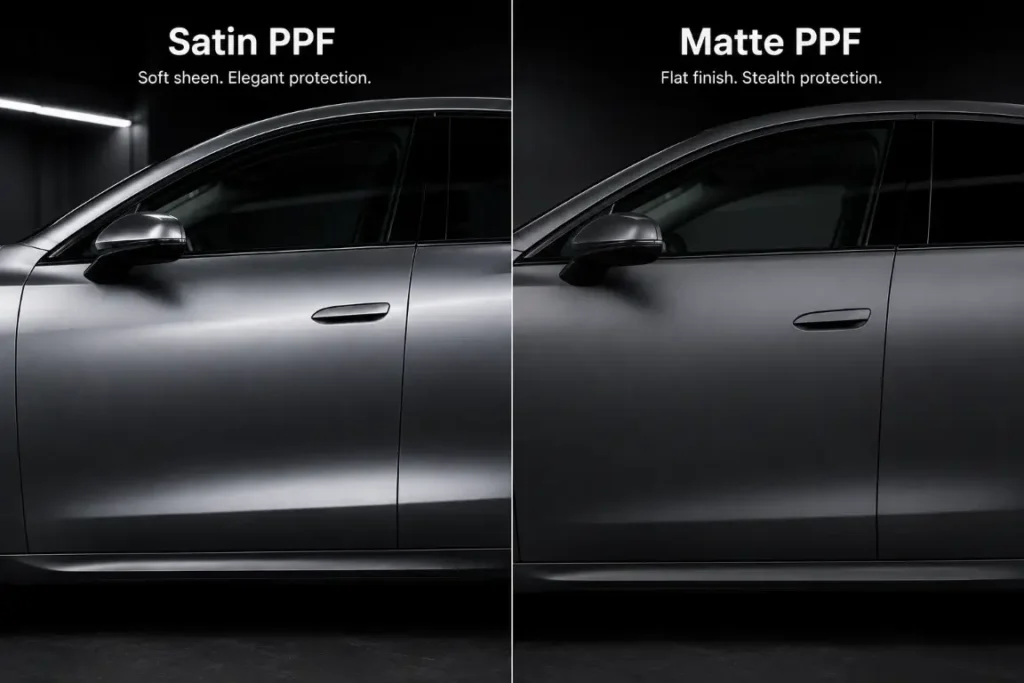
| Matte/Satin | Available, natural-looking | Available, wide range |
| Color Range | Growing fast (~50–100 colors per brand) | Massive (thousands of colors + custom prints) |
| Specialty Finishes | Color-shift, metallic | Chrome, brushed metal, carbon fiber, custom graphics |
| Color Accuracy | Factory paint match quality | Good but finish-dependent |
The headline: colored PPF produces a deeper, more paint-like gloss because the TPU top coat flows and levels during manufacturing — think of it as a factory clear coat. Measured at a 60° gloss angle, quality PPF hits 95–98 GU, comparable to or exceeding factory paint (typically 85–90 GU). Vinyl, even high-grade cast vinyl, lands in the 80–85 GU range and carries a subtle “plastic” look that experienced eyes can spot.
But vinyl wins decisively on variety. If you want a chrome finish, a carbon-fiber texture, or a custom-printed graphic, PPF simply doesn’t offer those today. The color PPF market is expanding fast — most major brands now offer 50–100+ colors including color-shift and metallic — but it will likely never match vinyl’s infinite customization. For a bespoke look that changes every two years, vinyl remains the better canvas.
One quality note that matters: not all vinyl is equal. Cast vinyl (where liquid PVC is poured onto a casting sheet and cured) is thinner, more dimensionally stable, and has less orange peel. Calendered vinyl (where PVC is squeezed through rollers like dough) is cheaper but shrinks more and shows more texture. If you choose vinyl, insist on cast — the price difference is worth it.
Cost Breakdown: Upfront Price vs Long-Term Value
Price is vinyl’s biggest advantage. It’s also the number that most misleads buyers.
Current U.S. Market Pricing (Full Car, Professional Installation)
| Vehicle Type | Vinyl Wrap | Colored PPF |
|---|---|---|
| Compact / Mid-Size Sedan | $2,500–$4,500 | $5,500–$7,500 |
| SUV / Crossover | $3,500–$6,500 | $6,500–$9,500 |
| Full-Size Truck / Large SUV | $4,000–$8,000 | $7,500–$10,000 |
| Luxury / Exotic | $5,500–$10,000+ | $8,000–$12,000+ |
The gap is real: colored PPF costs roughly 1.5× to 2.5× more upfront. But upfront price is the wrong number to anchor on.
Here’s the math that changes the equation: vinyl wraps last 3–5 years. Colored PPF lasts 7–10 years. Over a 10-year ownership period, vinyl typically needs replacement 2–3 times. Take a mid-size sedan: $3,500 × 3 replacements = $10,500. The same car with colored PPF: $6,500 once = $6,500. Add vinyl removal costs ($500–$1,500 per removal), and the 10-year vinyl cost can comfortably exceed a single PPF installation.
There’s a second hidden cost: resale value. Used-car platforms like CarMax and Carvana explicitly value original factory paint. A car that spent 10 years under PPF reveals pristine original paint at trade-in — a direct value add. A car that spent 10 years under vinyl? The buyer can’t see the paint, and assumes the worst. In the high-end market, “full PPF from new” has become a seller’s bragging point, not unlike “full service history.”
This is also where the supply chain matters more than most buyers realize. A significant portion of PPF’s retail price — often 40–60% — is brand markup layered on top of manufacturing cost. The same TPU film, made to the same specifications, costs dramatically different amounts depending on whose logo is on the box. For buyers willing to look past the brand name on the invoice, the price gap between PPF and vinyl narrows considerably.
| Cost Item | Vinyl Wrap (3 replacements) | Colored PPF (1 install) |
|---|---|---|
| Initial install | $3,500 | $6,500 |
| Removal between replacements (×2) | $1,000 | $0 |
| Second install (year 4) | $3,500 | $0 |
| Third install (year 7) | $3,500 | $0 |
| Paint correction at trade-in | $800–$1,500 | $0 |
| 10-Year Total | $12,300–$13,000 | $6,500 |
What Makes a Quality Colored PPF? — The Manufacturing Truth
Here’s what nobody in the top 20 search results tells you: not all colored PPF is created equal, and the differences are hiding in three layers most buyers never think about. If you’re going to spend $6,000+ on a product, you should know what separates the film that still looks flawless in year eight from the one that yellows in year two.
The TPU Layer — Not All TPU Is Created Equal
Every PPF starts as TPU pellets — tiny plastic beads that get melted, extruded, and stretched into film. The quality of those pellets determines the ceiling of everything else.
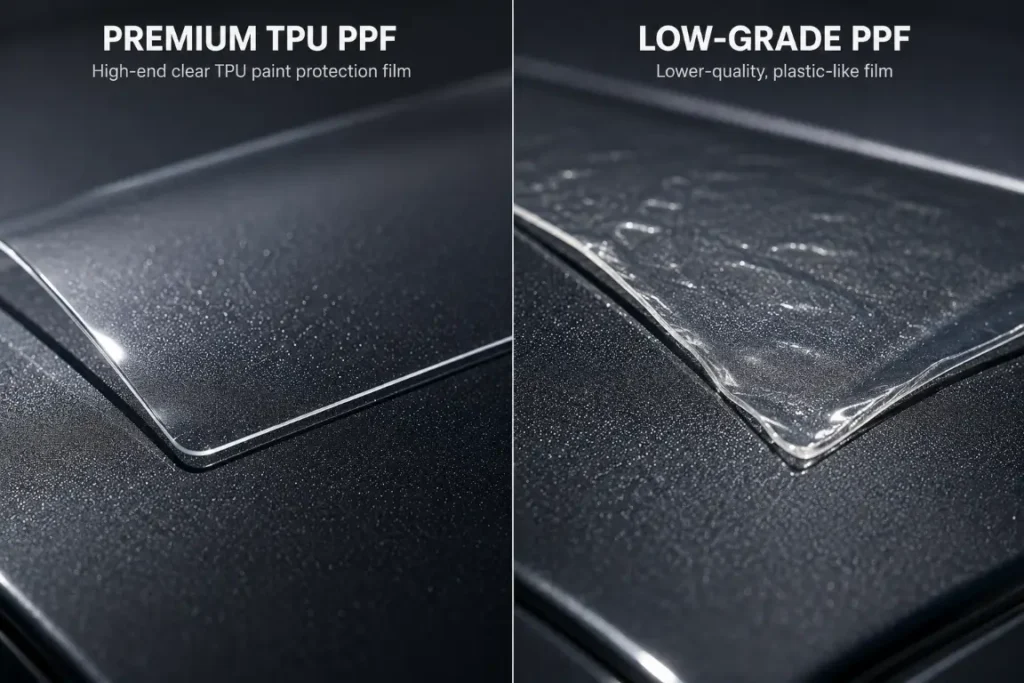
The critical distinction is aliphatic versus aromatic TPU. Aliphatic TPU uses isocyanate chemistry that produces no conjugated double bonds in the polymer backbone — which means UV light passes through without triggering the molecular reactions that cause yellowing. It costs $8–12 per kilogram. Aromatic TPU uses cheaper MDI/TDI-based chemistry ($4–6/kg) but contains benzene-ring structures that absorb UV and gradually degrade into yellow-brown chromophores. This is the single biggest reason some “PPF” turns yellow within 18 months: it was never aliphatic to begin with.
TPU pellet suppliers matter because they control the polymerization process that determines film clarity, elasticity uniformity, and weathering baseline. The global tier-one suppliers — Lubrizol (Ohio, USA), BASF (Ludwigshafen, Germany), and Covestro (Leverkusen, Germany) — produce aliphatic TPU grades specifically engineered for automotive surface protection. Tier-two and domestic suppliers are closing the gap, but batch-to-batch consistency remains the biggest differentiator. When an installer tells you they’ve had “bad rolls” of a certain brand, inconsistent TPU feedstock is usually the root cause.
Think of it like cooking: the same recipe produces very different results with olive oil versus vegetable oil. TPU pellets are the olive oil — the raw ingredient quality sets the ceiling.
Top Coating Technology — The Self-Healing & Stain Shield
The top coat is the layer you actually see and touch. It’s also the layer that determines whether bird droppings etch permanent marks into your film or bead up and wipe away.
Quality PPF top coats fall into two categories. Traditional polyurethane clear coats provide good self-healing but moderate chemical resistance and modest hydrophobicity (water contact angle around 80–90°). Modern nano-ceramic top coats — incorporating SiO₂ or TiO₂ nanoparticles — push the contact angle past 100°, meaning water beads roll off carrying dust and contaminants with them. They also resist staining from bug acids, bird droppings, and tree sap far better than traditional formulations.
The application method matters too. Immersion coating — where the entire film passes through a liquid coating bath — produces the most uniform layer but costs more. Roll coating is faster and cheaper but can leave microscopic striations that show up under certain lighting. Most premium films use immersion coating for the top coat layer.
A simple quality test any buyer can do: ask the installer to apply a Sharpie mark to a sample swatch. On a quality ceramic-coated PPF, the ink beads up and wipes clean with minimal residue. On a lower-grade top coat, it stains.
Adhesive & Construction — What Keeps It On (and Lets It Come Off)
Adhesive is the most underrated component in any PPF. Nobody thinks about glue until their film starts lifting at the edges — or worse, pulls factory paint off during removal.
The gold standard is pressure-sensitive adhesive (PSA), specifically formulated for automotive film. Unlike solvent-based acrylic adhesives that bond aggressively on contact and leave residue on removal, PSA is designed with a controlled initial tack — low enough that the installer can lift and reposition the film during installation, then building to full bond strength over 24–48 hours. The dominant global supplier is Ashland (Kentucky, USA), whose automotive PSA formulations target a peel strength of 12–18 N/25mm — enough to hold through car washes and highway speeds, but cleanly removable with heat when the time comes.
The physical construction matters equally. Quality PPF uses a micro-structured adhesive layer with air-release channels — tiny grooves that let trapped air escape during squeegee application. Without these channels, every installation would be a bubble-fest. The full 5-layer stack — nano-ceramic top coat / aliphatic TPU substrate / TPU base layer / pressure-sensitive adhesive / PET release liner — is what separates a film that installs clean, stays flat, and removes cleanly from one that fights the installer at every step.
This is where manufacturing scale makes a tangible difference. A facility operating multiple extrusion lines inside Class 10,000 cleanrooms — where airborne particle counts are strictly controlled — produces film with defect rates an order of magnitude lower than general-purpose production environments. When you’re applying a transparent film to a glossy black hood, even a single visible dust speck is a reject. Full-scale manufacturing with dedicated PPF production lines, multi-stage QC labs, and in-house weathering chambers is the structural reason some films install flawlessly while others fight the installer with contamination spots and inconsistent stretch behavior. A few manufacturers globally operate at this level — one example is FlexiPPF, whose 60,000m² Shenzhen facility runs four extrusion lines and eight Korean-imported coating machines across three dedicated cleanrooms, with a seven-instrument QC lab testing every production batch for gloss, haze, adhesion, and weathering performance — a setup that delivers the manufacturing consistency professional installers depend on (FlexiPPF Manufacturing, FlexiPPF Factory).
Installation, Maintenance & Removal — The Ownership Experience
Once the film is on your car, your daily experience with it matters more than the spec sheet. Here’s how the two compare across the ownership lifecycle.
| Aspect | Colored PPF | Vinyl Wrap |
|---|---|---|
| Installation Method | Wet application (slip solution for positioning) | Dry or wet (varies by film type) |
| Install Time (Full Car) | 3–5 days professional | 2–4 days professional |
| Installer Skill Required | High — TPU stretch behavior demands experience | Moderate-High — complex curves still challenging |
| Daily Washing | Easy — hydrophobic top coat sheds water and dirt | Careful — harsher chemicals can damage film |
| Ceramic Coating Compatible | Yes — can be applied on top for extra protection | Sometimes — check with manufacturer |
| Edge Lifting Risk | Low — stable adhesive system | Moderate — plasticizer migration shrinks film over time |
| Removal (Professional) | Heat to 60–80°C, peels clean, no residue | Heat to 60–80°C, may tear if aged/brittle |
| Paint Safety on Removal | Excellent — PSA adhesive leaves no residue | Good when new; risky when aged |
The day-to-day experience difference comes down to this: PPF’s hydrophobic top coat means rain cleans your car. Water beads roll off, carrying dust with them. Vinyl requires more attentive washing because the surface is less slick and more prone to holding contaminants. Neither is high-maintenance in absolute terms, but PPF earns its premium in the “forget it’s there” factor.
One warning about vinyl removal: aged vinyl that has lost its plasticizers becomes brittle and tears into small pieces during removal rather than peeling off in large sheets. This can turn a 4-hour removal into a 12-hour ordeal, and the labor cost reflects it. PPF, because its flexibility is intrinsic to the TPU backbone rather than added plasticizers, maintains consistent removal behavior throughout its service life.
Colored PPF vs Vinyl Wrap — Which One Is Right for You?
You’ve now seen the material science, the performance data, the costs, and the manufacturing reality. The right answer depends entirely on your situation. Before reading the scenarios below, answer three quick questions:
- How long do you plan to keep this car? (< 3 years → lean vinyl; > 5 years → lean PPF)
- Where does your car sleep? (Garage → vinyl is fine; Outdoors → PPF strongly preferred)
- What matters most? (Color variety → vinyl wins; Protection + gloss → PPF wins; Both → colored PPF is the only option that delivers)
The Daily Driver & Long-Term Owner
You drive to work every day. Your car sits in the office parking lot, the grocery store lot, and occasionally under a tree. You plan to keep this car for 6–10 years.
Recommendation: Colored PPF.
The math is straightforward: over a decade of daily driving, your car will face thousands of small threats — highway gravel, parking-lot door dings, bird droppings, tree sap, UV exposure, winter road salt. Colored PPF neutralizes all of them. Vinyl protects against none of them. And as we showed in the cost section, the 10-year total cost of PPF is often lower than three vinyl replacements. Your daily driver is a tool, not a toy — tools need to be durable.
The Enthusiast & Frequent Style Changer
You treat your car as a canvas. You love the idea of switching from matte green this year to satin blue next year. Car shows, photoshoots, and Instagram are part of the equation.
Recommendation: Vinyl wrap (with a caveat).
Vinyl’s infinite color palette and lower per-install cost make it the better medium for creative exploration. If you’re genuinely going to change colors every 2–3 years, vinyl’s shorter lifespan is a feature, not a bug — you were going to redo it anyway. The caveat: if your car lives outdoors, consider a clear PPF overlay on the front end (hood, bumper, mirrors). It adds $1,500–$2,500 but prevents the heartbreak of a rock chip tearing through your fresh wrap on day three.
The Premium / Luxury Owner
You own a Porsche, a BMW M car, a Mercedes-AMG, or something even more special. The factory paint — especially if you optioned a $6,500–$12,000 Paint-to-Sample color — is part of the car’s value.
Recommendation: Colored PPF, no question.
Luxury and exotic cars face an asymmetric risk: a single rock chip on a Porsche Paint-to-Sample hood isn’t a $200 touch-up — it’s a “blend the entire front end” situation that can run into the thousands. PPF buys you immunity from that risk while simultaneously giving you a color change. And when it’s time to sell, “full PPF from new, original paint untouched” is a line that adds real money to the transaction. Vinyl on a luxury car, by contrast, hides the paint — and in the high-end market, hidden paint is assumed to be damaged paint. If you bought the special color, protect it. If you want to change the color too, colored PPF is the only product that does both.
The choice between colored PPF and vinyl wrap ultimately comes down to whether you’re optimizing for the installation day photo or the year-seven photo. Both will look good on day one. Only one will still look good — and still be protecting your paint — when the calendar turns to 2033.
 English
  Spanish
  Dutch
Dutch  Japanese
  Russian
  Arabic