
You’ve probably seen the glossy Instagram ads: a car so immaculate it looks wet, captioned with something about “self-healing paint protection.” Or maybe your detailer pitched you on PPF when you brought your new car in for tint. Either way, you’re here because you want the real story — not the marketing.
Paint protection film sits at a strange intersection: it’s one of the most expensive things you can do to a car that adds zero horsepower, zero curb appeal (it’s invisible), and zero bragging rights at cars and coffee. So why do people spend thousands on it? And more importantly, should you?
Let’s walk through exactly what PPF does, what it costs — in money and in hidden tradeoffs — and how to decide if it’s right for your car.
What Paint Protection Film Actually Is (And How It Works)
At its simplest, paint protection film is a transparent thermoplastic polyurethane (TPU) layer, typically 6.5 to 10.5 mils thick, applied to your car’s painted surfaces. Think of it as a sacrificial layer — it takes the damage so your paint doesn’t have to.
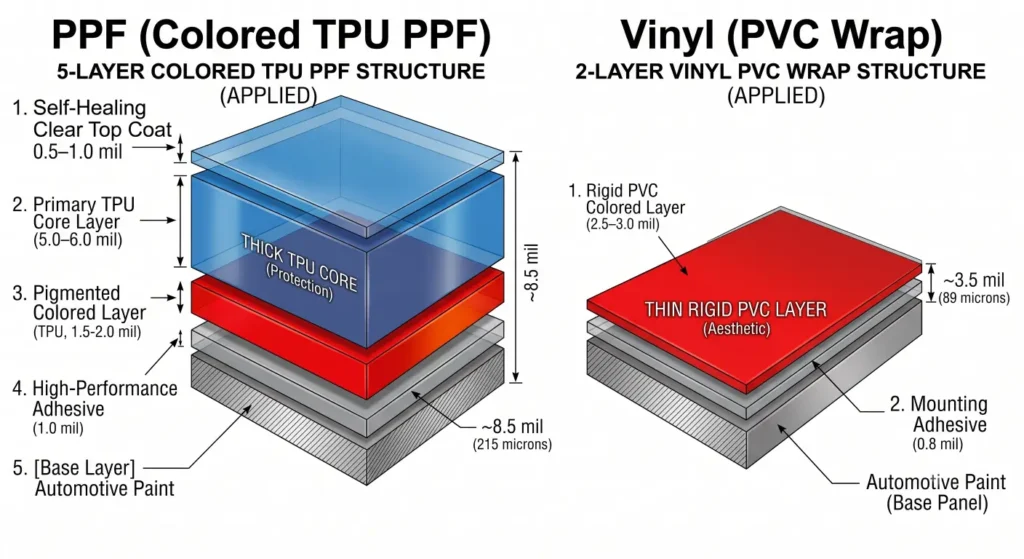
Modern PPF has a three-layer structure. The top coat is a self-healing clear layer embedded with elastomeric polymers. Underneath that sits the polyurethane impact absorption layer — the part that actually disperses the energy from a rock strike. The bottom layer is a pressure-sensitive adhesive that bonds to your clear coat.
The concept is similar to a phone screen protector, but the engineering is several orders of magnitude more sophisticated. A screen protector prevents scratches. PPF prevents scratches, absorbs impacts, blocks UV radiation, and — on premium films — actually repairs its own surface damage when heated.
The Real Benefits — What PPF Does for Your Car
PPF delivers value across four dimensions: physical protection, chemical and optical defense, financial return, and daily convenience. Here’s how each one plays out.
Impact and Scratch Protection — The Daily Armor
This is the headliner. PPF is the only paint protection method that provides physical impact resistance. Wax doesn’t do it. Ceramic coatings don’t do it. Only a physical polymer layer can absorb the kinetic energy of a pebble hitting your hood at 60 mph.
Consider three everyday scenarios. Scenario one: you’re on the highway behind a semi-truck, and you hear that distinctive ping of gravel hitting your front end. Without PPF, each ping leaves a tiny crater in your clear coat. With PPF, the film’s TPU layer — which has a tensile strength above 20 MPa and elongation at break exceeding 400% — stretches on impact and disperses the energy across a wider surface. The rock bounces off. The film may show a minor mark, but your paint underneath is untouched.
Scenario two: a shopping cart rolls into your door in a parking lot. Scenario three: winter driving on roads treated with sand and salt. In each case, PPF is the difference between a paint chip and nothing.
A quality 8-mil PPF can absorb impacts from debris up to roughly 3 mm in diameter at highway speeds. It won’t stop a fist-sized rock or a door ding that deforms the metal — but for the daily barrage of road debris, it’s remarkably effective.
Self-Healing, UV Resistance, and Chemical Protection
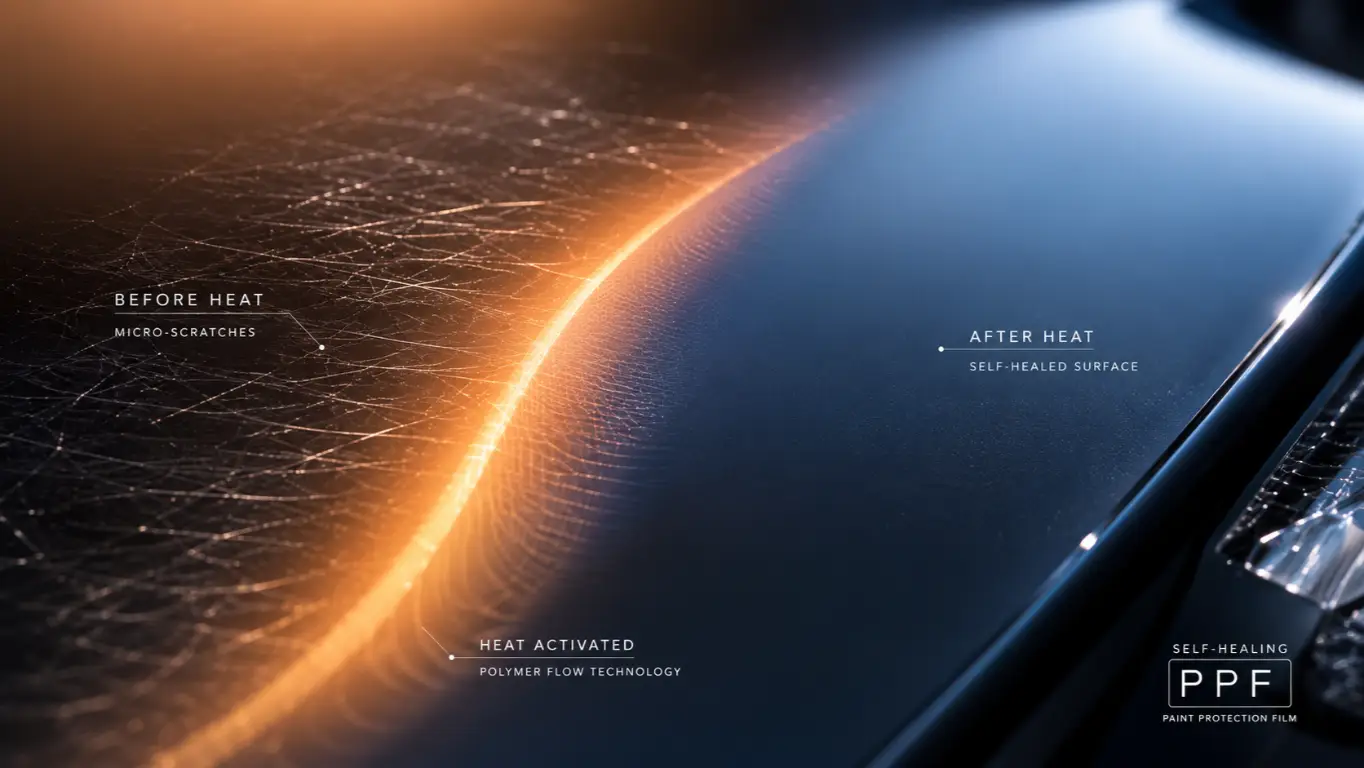
Three properties that share the same underlying mechanism: the top coat’s chemical design.
Self-healing is the feature everyone talks about, and it works — within limits. The elastomeric polymers in the top coat have a “memory effect.” When the film reaches 60–70°C (140–160°F) — easily achieved by parking in direct sun or pouring warm water over the surface — the polymers relax and return to their original flat state, erasing light scratches and swirl marks. What it doesn’t do: heal deep scratches that penetrate through the top coat, repair cuts, or fix impact damage that goes beyond the surface layer. Think of it like a memory foam pillow — it bounces back from pressure, but it won’t mend a knife cut.
UV resistance is the less glamorous but arguably more important benefit. Premium PPF blocks up to 98% of UV radiation, the primary cause of paint oxidation and fading. The industry benchmark for yellowing resistance is the QUV-A accelerated weathering test: entry-level films survive about 1,000 hours before yellowing, while top-tier films push past 5,000 hours. For context, 5,000 hours of QUV-A exposure simulates roughly a decade of real-world sun exposure.
Chemical protection is the daily unsung hero. Bird droppings, bug splatter, tree sap, and acid rain all etch into unprotected clear coat within hours to days. PPF’s top coat has a low surface energy — water contact angle typically ≥ 105° — which means contaminants struggle to bond. They sit on top of the film rather than eating into it.
Preserving Resale Value — The Financial Upside
In January 2026, XPEL published the results of a survey conducted by Atomik Research in June 2025. They interviewed 300 decision-makers at U.S. light-duty automobile dealerships. The headline finding: PPF can add up to 15% to a vehicle’s resale value.
The details are worth reading closely. 96% of dealers said PPF applied to all exterior surfaces helps retain value over the ownership period. 92% said vehicles with full PPF applied when new would have a higher resale value as pre-owned inventory. And 70% said even front-end-only coverage contributes to value retention.
Now, the crucial context these surveys rarely emphasize: the 15% uplift applies primarily to higher-value vehicles. On a $50,000 car, a $6,000 full-body PPF wrap that helps you sell for $57,500 is a net positive. On a $20,000 used car, spending $6,000 on PPF hoping for a $3,000 resale bump is bad math.
The real financial argument for PPF is subtler. When a buyer inspects your five-year-old car and sees a hood covered in stone chips, they don’t just deduct the cost of repainting — they wonder what else you neglected. Factory-original paint is a trust signal. PPF preserves that signal. The buyer may never know the film was there; they only see the result.
Easier Maintenance and Day-to-Day Convenience
PPF changes your relationship with car washing. The hydrophobic top coat means water beads and rolls off, carrying loose dirt with it. Bird droppings and bug guts don’t bond to the surface the way they do to bare clear coat. A pressure washer and pH-neutral soap — that’s often all you need.
More importantly, PPF reduces the mental overhead of car care. Without PPF, every trip through an automatic car wash is a gamble on whether the brushes have been changed recently. Every hand-wash is an exercise in the two-bucket method and grit-guard discipline. With PPF, you still need to wash your car — but the consequences of imperfect technique are far lower. Use pH-neutral soap (pH 6–8), avoid automatic washes with hard nylon brushes, and wash every two to four weeks. The film handles the rest.
The Drawbacks Nobody Talks About — PPF’s Hidden Tradeoffs
Every PPF installer will tell you about the benefits. Far fewer will volunteer the full picture on the drawbacks. Here’s what you actually need to know before writing the check.
The Cost Reality — It’s More Than You Think
Let’s talk real numbers for 2026. A partial front package (front bumper, partial hood, side mirrors) runs $900 to $1,800. A full front package — full hood, full fenders, bumper, mirrors, headlights — costs $2,000 to $3,500. Full-body coverage on every painted panel will set you back $5,500 to $8,000, and that number climbs past $10,000 for large SUVs and exotic vehicles.
Why so expensive? The film itself accounts for only about 30–40% of the total cost. A premium TPU film costs roughly $15–35 per square meter at wholesale — a full car uses about 15–20 square meters. The rest is labor. A full-body installation takes two technicians 25 to 35 hours, working in a climate-controlled cleanroom. You’re paying for expertise, not raw materials.
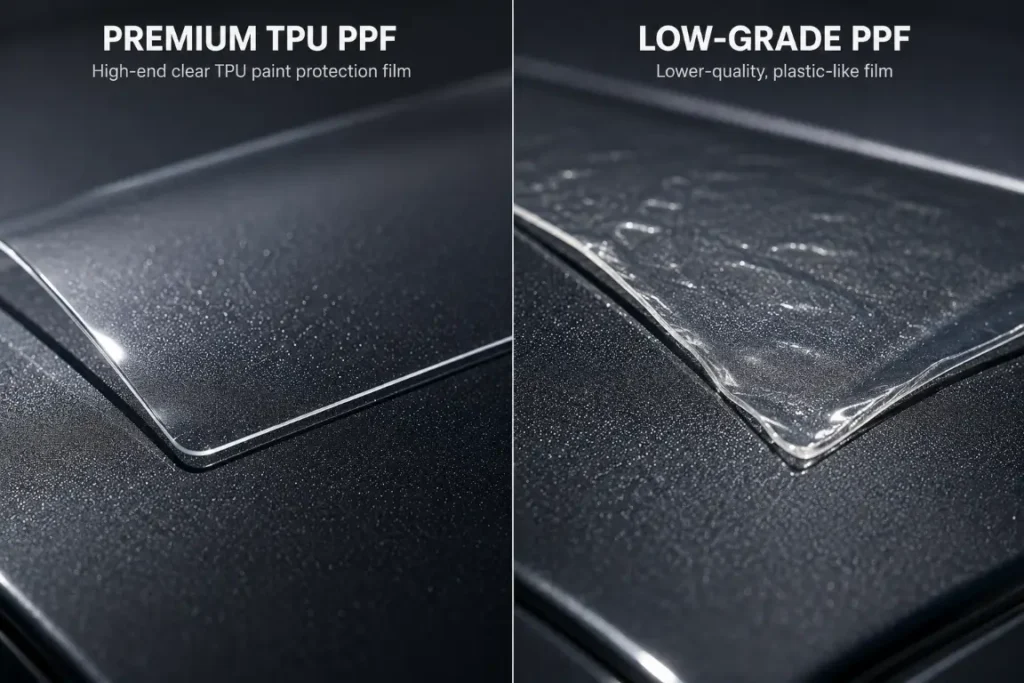
And here’s what the cheap options cost you: a $500 full-car PPF job uses PVC or TPH blended film — not true TPU. It will begin yellowing within 12–18 months. It will crack, peel, and leave adhesive residue that costs more to remove than the film cost to install. Cheap PPF is worse than no PPF.
Professional Installation Is Non-Negotiable — And That’s a Problem
If there’s one thing the automotive forums agree on, it’s this: installation quality matters more than film brand. A $2,000 roll of premium PPF installed badly will look terrible and fail prematurely. A mid-range film installed by a master technician will look invisible and last a decade.
DIY installation is not realistic. The process requires: complete paint decontamination and correction before application (any swirl marks or contaminants get permanently sealed under the film), a dust-free environment with temperature held at 15–25°C and humidity below 65%, and precision cutting with a tolerance of 2–3%. Get any of these wrong, and you’ll see the results every time you walk up to your car.
The most common installation failures have names in the industry. “Silvering” is a frosty, milky appearance caused by microscopic air pockets trapped under the film. Stretch marks appear when an installer over-stretches the film to fit a complex curve — the polymer chains deform permanently. Edge lifting happens when film edges aren’t fully wrapped around panel gaps, creating a dirt-catching seam that grows over time.
Perhaps most alarming: some low-cost installers cut the film directly on the vehicle with a blade. One slip, and your factory paint has a permanent knife mark sealed under a $6,000 protective film. The irony is hard to miss.
Long-Term Risks — Yellowing, Peeling, and End-of-Life Costs
PPF is not permanent. Most quality films come with a 10-year warranty, but that warranty covers manufacturing defects — not the labor to remove and replace aged film. When PPF reaches the end of its useful life, you face a decision: remove it and enjoy your preserved paint, or replace it and pay again.
Removal is not free. Taking off a full-car PPF wrap takes 8 to 16 hours of labor. If the adhesive has degraded — common on films exposed to extreme heat and UV — it may leave residue that requires chemical removal and paint correction. In extreme cases, such as a car that spent years parked outdoors in Arizona or Southeast Asia, old PPF can essentially bake onto the paint. Removal costs in these scenarios can reach 50–80% of the original installation price.
Yellowing risk depends almost entirely on the film’s base chemistry. Aliphatic TPU — used in premium films — resists yellowing for 8–10 years. Aromatic TPU, found in mid-range films, may show subtle discoloration after 3–5 years, especially on white or light-colored cars. PVC and TPH blends, common in budget films, begin yellowing within a year. If your car is white, silver, or any light color, do not compromise on film chemistry.
PPF vs. Ceramic Coating vs. Wax — What’s the Right Choice?
No single protection method is “best.” Each solves a different problem at a different price point. Here’s how they compare:
| Protection Dimension | PPF | Ceramic Coating | Wax / Sealant |
|---|---|---|---|
| Physical impact resistance | ✅ Core function | ❌ None | ❌ None |
| Scratch & swirl resistance | ✅ Self-healing | ⚠️ Limited | ❌ None |
| UV protection | ✅ Up to 98% | ✅ Strong | ⚠️ Weeks only |
| Hydrophobic / easy-clean | ✅ Good | ✅ Excellent | ⚠️ Fades quickly |
| Gloss enhancement | ⚠️ Film-dependent | ✅ Deep shine | ⚠️ Temporary |
| Lifespan | 5–10 years | 2–5 years | 2–6 months |
| Full-vehicle cost | $5,500–$8,000+ | $1,000–$3,000 | $50–$200/app |
| Maintenance | pH-neutral hand wash | Wash + booster | Reapply regularly |
The enthusiast community has largely converged on a hybrid approach: PPF on high-impact zones (full front end, mirror caps, rear fender hips) and ceramic coating over everything, including on top of the PPF. This gives you physical protection where you need it most, plus the gloss and easy-cleaning properties of ceramic everywhere else — at roughly 40–50% of the cost of full-body PPF.
Wax and sealants still have their place. If you’re driving a $15,000 daily commuter and plan to sell it in two years, spending $6,000 on PPF makes no sense. A $30 bottle of quality sealant applied every three months will keep the paint looking presentable. The right tool for the right job.
How to Choose Quality PPF — Film, Brand, and Installer
This is where most “PPF pros and cons” articles stop — they tell you the benefits and drawbacks but leave you with no framework for making a decision. Here’s the missing piece.
PPF quality comes down to two independent variables: what’s in the film, and who’s installing it. The best film with the worst installer is wasted money. The best installer with the cheapest film will produce a beautiful result that turns yellow in three years. You need both.
Material Quality — What’s Inside the Film Matters
PPF quality starts with the chemistry. There are three tiers:
Top tier — Aliphatic TPU. The gold standard. The molecular structure of aliphatic TPU is inherently UV-stable, meaning it resists yellowing at the chemical level rather than relying on UV-blocking additives that can degrade over time. Raw material comes from a handful of global chemical companies: Lubrizol (USA), BASF (Germany), and Covestro (Germany) are the names to look for. Films built on aliphatic TPU with a ceramic-infused top coat and Ashland-brand adhesive represent the current ceiling of PPF technology.
Mid tier — Aromatic TPU. Cheaper to produce but less UV-stable. These films rely on UV absorbers in the top coat to prevent yellowing. When those absorbers get exhausted — typically after 3–5 years of sun exposure — the underlying TPU begins to discolor. Acceptable for darker-colored cars where yellowing is less visible; risky for white, silver, or light-colored vehicles.
Bottom tier — PVC / TPH blends. Not real PPF in any meaningful sense. These films are essentially thick vinyl with a clear coat sprayed on. They offer minimal impact protection, zero self-healing, and guaranteed yellowing within 12–24 months. Avoid entirely.
When you’re talking to an installer, ask three questions: “What TPU does this film use — aliphatic or aromatic?” “Whose adhesive is on the back?” “Can I see the QUV-A test report?” If they can’t answer the first question, walk away.
For those sourcing PPF at a commercial scale — whether you’re a distributor, a detailing shop, or a dealership — the same material standards apply, plus an additional layer: manufacturing certifications. Look for IATF 16949 (the automotive industry’s quality management gold standard), ISO 9001, and REACH/RoHS compliance for the European market. Manufacturers like Shenzhen-based FlexiPPF, who build their films on Lubrizol and BASF TPU substrates with Ashland adhesive layers and ceramic top coats, and back them with a documented 10-year warranty, represent the kind of supply chain transparency that separates industrial-grade PPF from commodity film. Their product specifications are publicly available for comparison against the benchmarks above. (FlexiPPF PPF product line)
Finding a Qualified Installer — The Make-or-Break Factor
A great installer will make a mid-range film look invisible and last a decade. A bad installer will make the most expensive film on the market look like something you regret every time you walk up to your car.
Here are four questions to ask any shop before you hand over your keys:
1. “Which PPF brands are you certified to install?” Major manufacturers — XPEL, SunTek, STEK, 3M, LLumar — all run certified installer programs. Certification means the shop’s technicians have been trained and tested by the film manufacturer. It also means the manufacturer will stand behind the warranty. If a shop installs a brand without certification, the warranty may not be valid.
2. “Can I see your recent work — especially edges and corners on a dark-colored car?” Dark paint exposes every flaw: visible seams, misaligned edges, dust trapped under the film. A shop that’s proud of its work will have a portfolio. Look at the door edges, mirror housings, and bumper corners — these are the hardest areas to wrap cleanly.
3. “What are your shop conditions?” The installation environment should be climate-controlled (15–25°C, <65% humidity) and positively pressurized to keep dust out. If the shop looks like a regular garage with a roller door open to the street, your PPF will have dust permanently embedded under it.
4. “What’s your workmanship warranty — and what exactly does it cover?” Film manufacturers warrant the product against yellowing and cracking. The installer should separately warrant their workmanship — covering edge lifting, bubbling, and silvering — for at least one year.
Is Paint Protection Film Worth It for You? — A Decision Framework
After everything we’ve covered, the answer comes down to three variables: how long you’re keeping the car, what it’s worth, and where you drive it.
You should strongly consider PPF if: your car is new or nearly new, worth more than $40,000, and you plan to keep it for five or more years. Especially if your daily commute involves highways, construction zones, or winter road treatments. In this scenario, a full front package ($2,000–$3,000) pays for itself in avoided paint repairs and preserved resale value. Add ceramic coating over the entire vehicle for the best combination of protection and appearance.
PPF is probably not worth it if: you’re driving a sub-$25,000 daily commuter, you plan to sell within two to three years, or your car already has significant paint damage that would need correction first. In these cases, a quality ceramic coating ($800–$1,500) or even regular waxing will serve you better.
The middle ground: if you want some protection without the full commitment, start with the minimum viable package — front bumper, the leading 18–24 inches of the hood, and mirror caps. This typically costs $500–$900 and protects the areas that take 80% of the stone hits.
At its core, PPF is like insurance: you’re paying for something you hope you never need. The difference is that PPF delivers value every single day — every rock that bounces off, every bird dropping that wipes away without etching, every time you wash your car in 20 minutes instead of an hour. It won’t make your car faster or louder or more impressive at a stoplight. What it will do is keep your car looking the way it did the day you bought it — and for the right owner, that’s worth every dollar.
References
- Atomik Research / XPEL, Inc. “New Dealership Survey Finds Paint Protection Film (PPF) Can Add up to 15% to a Vehicle’s Resale Value.” January 28, 2026. Link
- Gilroy Blackout. “PPF Guide 2026: Complete Paint Protection Film Buyer’s Guide.” 2026. Link
- AlukoVinyl. “Paint Protection Film Cost Breakdown.” 2025–2026. Link
- FlexiPPF. “Paint Protection Films — Product Line.” Link
- FlexiPPF. “Quality, Support & Warranty.” Link
- FlexiPPF — Homepage. Link
 English
  Spanish
  Dutch
Dutch  Japanese
  Russian
  Arabic