
Cut through the marketing noise. Discover the physical differences, real-world heat rejection metrics, and true return on investment before upgrading your vehicle’s window film.
The Core Mechanisms Behind Modern Window Tints
When upgrading your vehicle’s window tint, the first step is to discard cheap, dyed films that fade and bubble within a year. The real debate for savvy car owners and professional installers boils down to two heavyweights: Carbon and Ceramic. The price gap between them isn’t arbitrary; it is rooted deeply in how each material interacts with the solar spectrum at a physical level.
How Carbon Tint Manipulates Light
Carbon tint is manufactured by infusing carbon particles directly into the film’s layers. Its primary aesthetic advantage lies in its deep, matte-black finish. Because it relies on true carbon particles rather than synthetic dyes, it utilizes color-stable technology. This means a high-quality carbon film will not turn purple or fade over its typical 5 to 7-year lifespan.
Think of carbon tint as wearing a premium, heavy-duty black t-shirt on a sunny day. It effectively blocks a significant amount of visible light and provides decent heat reduction, but its primary mechanism is absorption. It acts like a sponge for solar energy, absorbing the heat to keep it out of the cabin, which naturally has an upper performance limit in extreme climates.
The Nanotechnology of Ceramic Tint
Ceramic tint represents a paradigm shift in manufacturing, utilizing advanced nanotechnology. Instead of relying on dark pigments, it is embedded with non-conductive, microscopic ceramic particles that are smaller than the wavelength of visible light. This allows the film to perform extraordinary thermal regulation regardless of how dark or light the tint appears.
If carbon tint is a black t-shirt, ceramic tint is a high-end vacuum-insulated thermos. Rather than merely absorbing heat, these nano-ceramic particles are engineered to specifically target and reflect infrared rays—the primary source of solar heat. This targeted spectral filtering allows ceramic films to provide extreme heat rejection even in lighter shades (like 50% or 70% VLT), maintaining crystal-clear visibility.
Heat Rejection Showdown: IRR vs TSER Explained
The most pressing question for any buyer is, “Which one actually keeps my car cooler?” To answer this, we must look beyond vague marketing terms like “maximum heat rejection” and examine the two critical metrics that define thermal comfort.
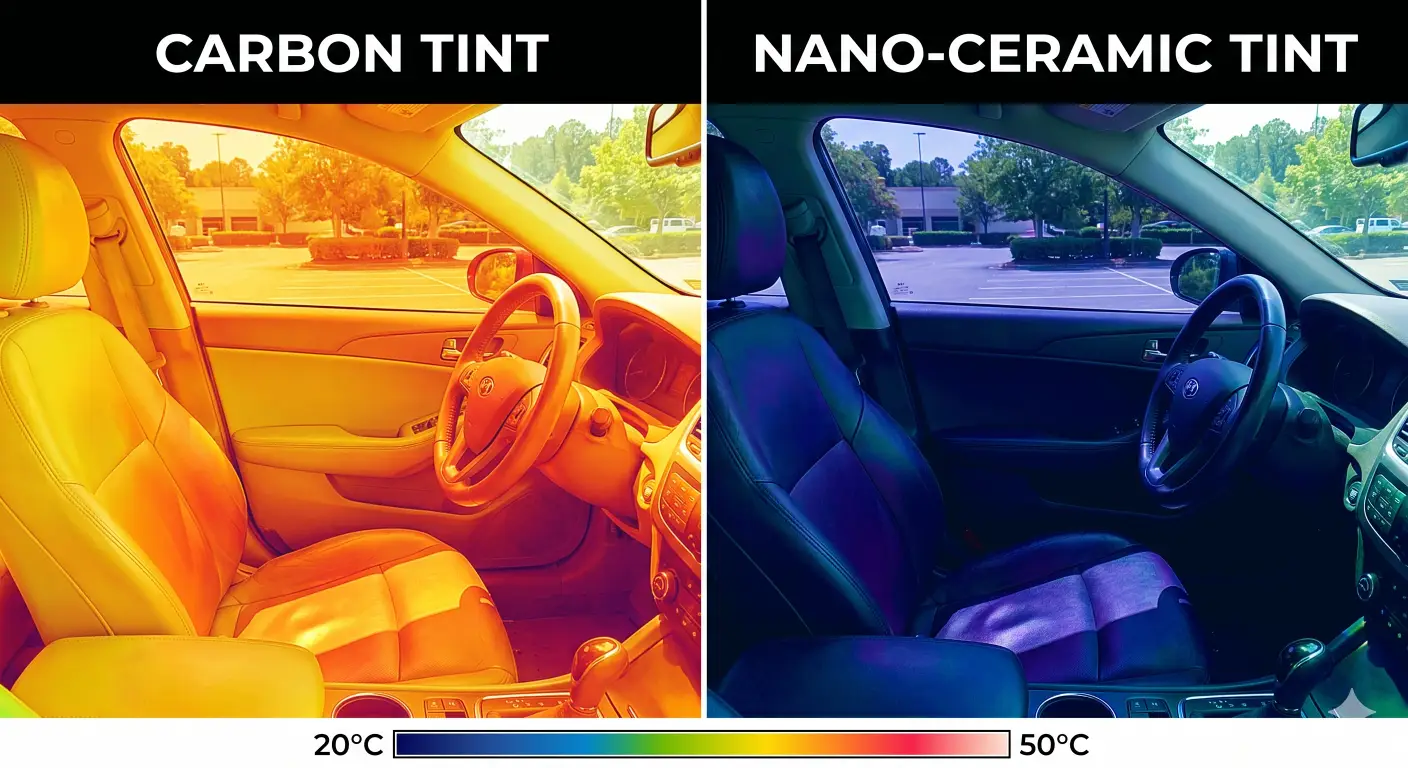
Infrared Rejection (IRR): The “Baking” Sensation
Infrared radiation is the invisible part of the solar spectrum responsible for that intense, burning sensation on your skin and the baking heat radiating from your dashboard. When you place your hand on a steering wheel at noon in mid-July, IRR is the metric that dictates your comfort.
Standard Carbon Tint generally offers an IRR ranging from 40% to 50%. It takes the edge off the heat, making the cabin warm but manageable. Premium Ceramic Tint, however, pushes IRR to staggering heights—often between 85% and 98%. Under a high-quality ceramic film, that same steering wheel remains remarkably cool to the touch, drastically altering the driving experience.
Total Solar Energy Rejected (TSER): The True Metric
While IRR is crucial, it’s only one piece of the puzzle. The International Window Film Association (IWFA) recognizes TSER as the ultimate standard for evaluating window film performance. TSER measures the total amount of solar energy (combining Visible Light, Infrared, and Ultraviolet) that is blocked from passing through the glass.
Some brands boast a 95% IRR, but their TSER might only sit at 60%. If a supplier refuses to publish their TSER numbers, they are hiding the complete picture of their film’s performance.
| Tint Technology | Average IRR % | Average TSER % | Heat Comfort Level |
|---|---|---|---|
| Premium Carbon Tint | 40% – 50% | 35% – 45% | Moderate (Noticeable relief) |
| Nano-Ceramic Tint | 85% – 98% | 55% – 70%+ | Extreme (Cool touch, fast AC cooling) |
Visibility and Clarity: The Night Driving Test
Many vehicle owners make their tint decisions based entirely on daytime aesthetics, ignoring the critical factor of nighttime visibility. To achieve adequate heat rejection with carbon tint, drivers often have to opt for much darker shades (such as 5% or 15% VLT). At night, this dark absorption layer makes checking side mirrors or navigating poorly lit streets highly strenuous.
Furthermore, the automotive film industry has a technical parameter known as Low-Angle Haze (LAH). Cheaply manufactured ceramic films with unevenly dispersed particles can create a milky, white haze across the glass when driving into the sunset or under bright streetlights. Top-tier nano-ceramic films eliminate this issue, boasting exceptional optical clarity. They allow drivers to maintain excellent heat rejection at lighter shades (like 35% VLT), achieving the ultimate goal: absolute privacy from the outside, with unimpeded, high-definition visibility from the inside.
UV Protection and Signal Interference: Debunking the Myths
Navigating the window tint market requires separating factual engineering from inflated sales pitches. Two common misconceptions often mislead buyers into spending more than necessary.
The 99% UV Block Standard
A frequent sales tactic is pushing ceramic tint strictly for its UV protection. The objective truth is that this is a tie. Whether you choose a high-quality carbon film or a premium ceramic film, both provide an SPF equivalent of 1000+, effectively blocking over 99% of harmful UVA and UVB rays. If your sole objective is to prevent interior fading, dashboard cracking, or skin sun damage, a reliable carbon tint achieves this flawlessly without the ceramic premium.
Radio Frequency (RF) and 5G Compatibility
Historically, older metallized tints caused severe disruptions to radio and cell signals. Today, both carbon and ceramic technologies are completely devoid of metallic particles. You can confidently install either option without fearing interference with your GPS, 5G cellular data, Apple CarPlay, Bluetooth, or Toll/ETC transponders.
Durability and Lifespan: Which Tint Outlasts Your Car?
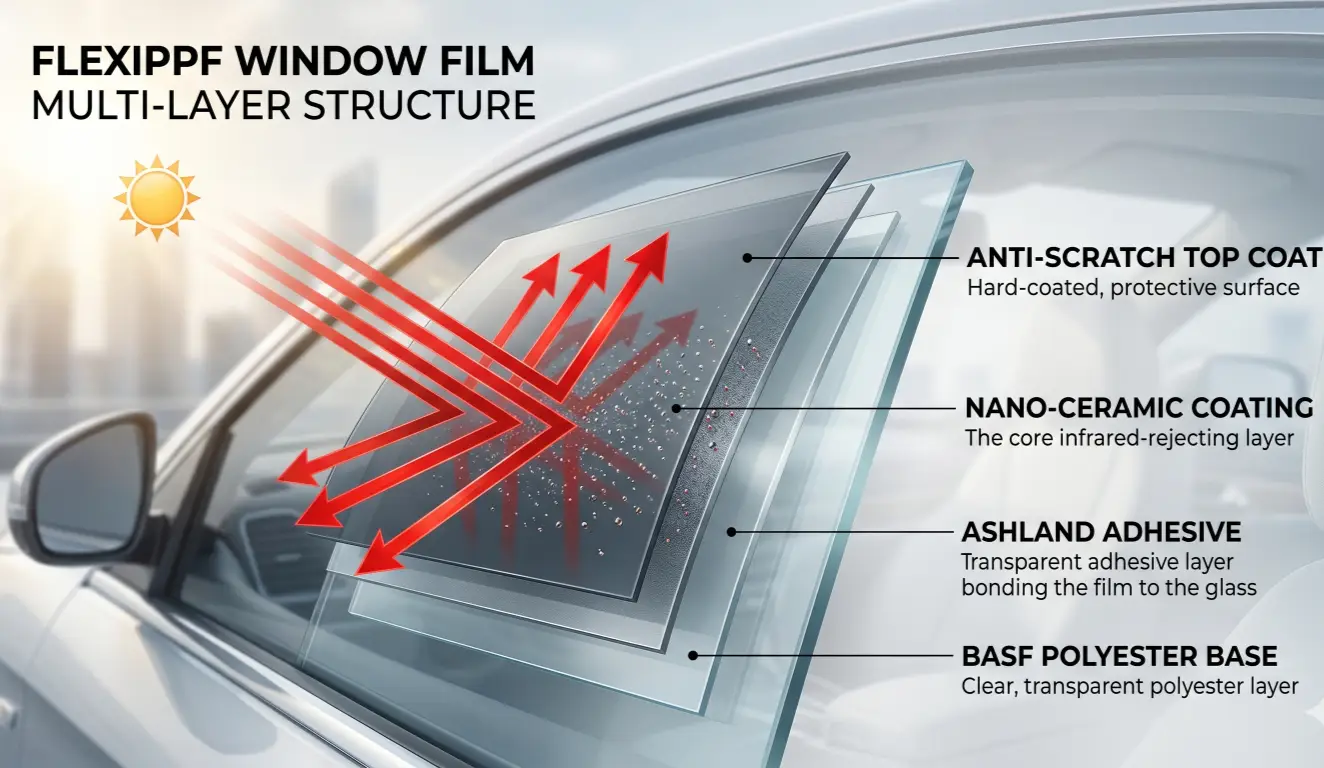
Evaluating the cost of window tint requires a long-term ROI perspective. The most common point of failure for inferior tints is not color fading, but adhesive failure—resulting in the unsightly bubbling and peeling that ruins a vehicle’s appearance. This degradation accelerates exponentially under intense solar heat.
To secure a truly lasting investment, the underlying supply chain and raw materials are paramount. For instance, industry-leading solutions from FlexiPPF utilize a superior German BASF polyester base, delivering exceptional tensile strength and optical stability. This is paired with premium Ashland adhesive from the USA, which guarantees strong bonding performance, low VOC emissions, and unparalleled heat resistance. Capable of withstanding 80°C heat and over 5,000 hours of intense UV exposure without yellowing, these architectural and automotive films confidently boast a lifespan of over 10 years. When amortized over a decade, investing in top-tier material chemistry proves to be the most cost-effective decision.
True Cost Analysis: Upfront Price vs. Long-Term ROI
Let’s talk numbers. The price gap between carbon and ceramic window tint is the primary reason car owners hesitate. However, evaluating this as a one-time expense rather than a long-term investment is a common pitfall.
The Upfront Investment
For a standard 4-door sedan, a high-quality Carbon Tint installation typically ranges from $200 to $400. It is an accessible price point for immediate privacy and moderate heat relief.
Upgrading to a premium Nano-Ceramic Tint usually pushes the price tag to $400 to $800+ (depending on the vehicle’s glass surface area and the film’s specific grade). That is effectively double the initial cost.
The ROI (Return on Investment) Calculation
Why pay the $300-$400 premium for ceramic? The return on investment manifests in three distinct ways:
- Energy Efficiency & EV Range: By rejecting over 70% of total solar heat (TSER), ceramic tint drastically reduces the load on your vehicle’s air conditioning. For electric vehicles (EVs), less AC usage directly translates to extended battery range. Over 5 to 7 years, these energy savings alone can offset the initial premium.
- Interior Preservation Value: While both films block UV rays, ceramic’s superior heat rejection prevents the extreme cabin baking that accelerates the degradation of premium leather seats and sophisticated dashboard electronics, protecting your vehicle’s resale value.
- Replacement Frequency: A mid-tier carbon film might require replacement after 4-5 years if the adhesive begins to fail under extreme summer heat. In contrast, premium ceramic films—especially those utilizing top-tier materials like Ashland adhesives and German BASF bases—are designed to outlast your ownership of the car, completely eliminating secondary installation costs.
The Financial Takeaway: If you plan to sell or trade your vehicle within 3 years, save your money and opt for Carbon. If this is your long-term daily driver, a family vehicle, or a high-end EV, Ceramic is not an expense—it is a cost-saving protective asset.
The Glass Fracture Risk: A Warning for EV and Panoramic Roof Owners
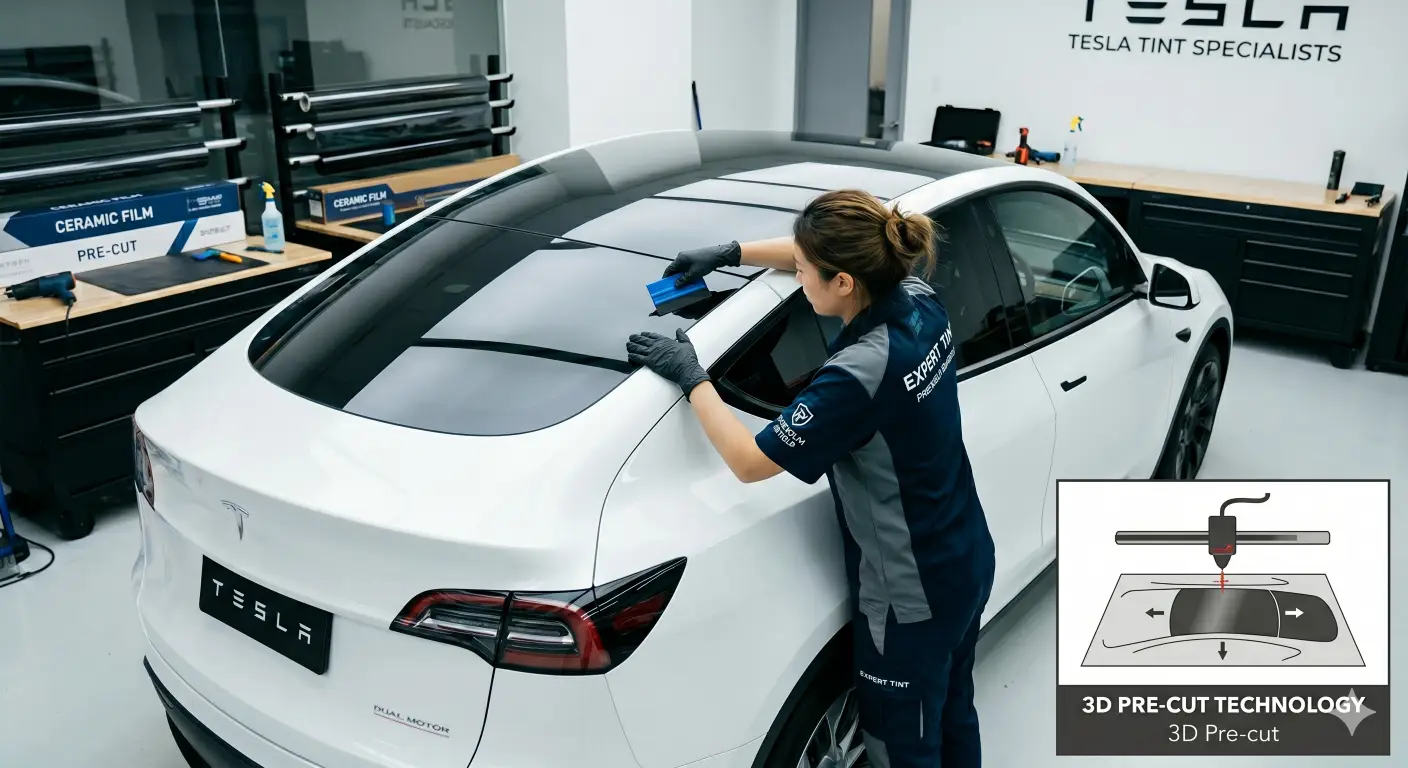
Modern electric vehicles, particularly Tesla models, feature massive laminated panoramic sunroofs. This architectural shift introduces a critical engineering risk: Thermal Stress Breakage. Every pane of glass has a specific Heat Absorption Rate.
If an installer applies a highly absorptive carbon film or a dense, low-quality ceramic film to a large panoramic roof, the film acts as a thermal trap. It absorbs immense solar radiation without the ability to dissipate it. During a hot summer day, with the sun baking the exterior and the AC blasting the interior, the severe temperature differential can cause the glass to expand unevenly and shatter completely. For EV owners, selecting a premium nano-ceramic film with a high Total Solar Energy Rejected (TSER) and high reflectivity—rather than high absorption—is not an upgrade; it is a structural safety requirement.
The Final Verdict: Decision Matrix for Your Vehicle
Choosing the right window tint is a strategic decision balancing budget, geography, and vehicle architecture. Here is the definitive guide to making your selection.
When Carbon Tint is the Smart Choice
- Budget-Conscious Upgrades: Ideal for a price range of $200–$400 for a full vehicle.
- Moderate Climates: Perfect for regions that do not experience relentless, extreme summer heat.
- Aesthetic Priorities: Excellent for drivers seeking a deep, matte-black finish for privacy and style.
- Short-Term Ownership: The most rational investment if you plan to sell or trade the vehicle within 3 to 5 years.
When Ceramic Tint is Mandatory (And How to Get It Right)
- Extreme Heat Environments: Essential for regions where AC systems struggle against relentless infrared heat.
- EV & Panoramic Roofs: Critical for protecting large glass surfaces from thermal stress and reducing battery load to maximize driving range.
- Night Driving Enthusiasts: Necessary for those who demand high heat rejection without compromising nighttime optical clarity.
Elevate Your Installation Standards with FlexiPPF
Whether you are a discerning car owner demanding absolute perfection or an installation business aiming to eliminate rework, the precision of application is just as vital as the film itself. FlexiPPF’s advanced nano-ceramic coating blocks 99% of UV rays and rejects over 70% of infrared heat, while their precise pre-cutting process utilizing 3D scanning technology ensures a flawless, edge-to-edge fit without the risk of blade scratches on the glass.
For B2B partners, FlexiPPF offers unparalleled flexibility: 1-2 day rapid dispatch, no rigid minimums (1 roll MOQs), and a comprehensive 10-year warranty backed by global standards.
Explore FlexiPPF Custom Tint Solutions
 English
  Spanish
  Dutch
Dutch  Japanese
  Russian
  Arabic