
If you’ve searched for “black ppf cost” and walked away more confused than when you started, you’re not alone. The numbers are staggeringly wide: $400 a roll on one site, $9,000 on another, and $2,800 to $8,500 for a single-vehicle installation depending on which shop you call. What’s actually driving these numbers? And more importantly: what should you be paying?
This guide breaks down black PPF pricing across all three tiers — DIY material, professional installation, and wholesale sourcing — so you can benchmark any quote you receive against real market data.
What Makes Black PPF Different from Clear PPF?
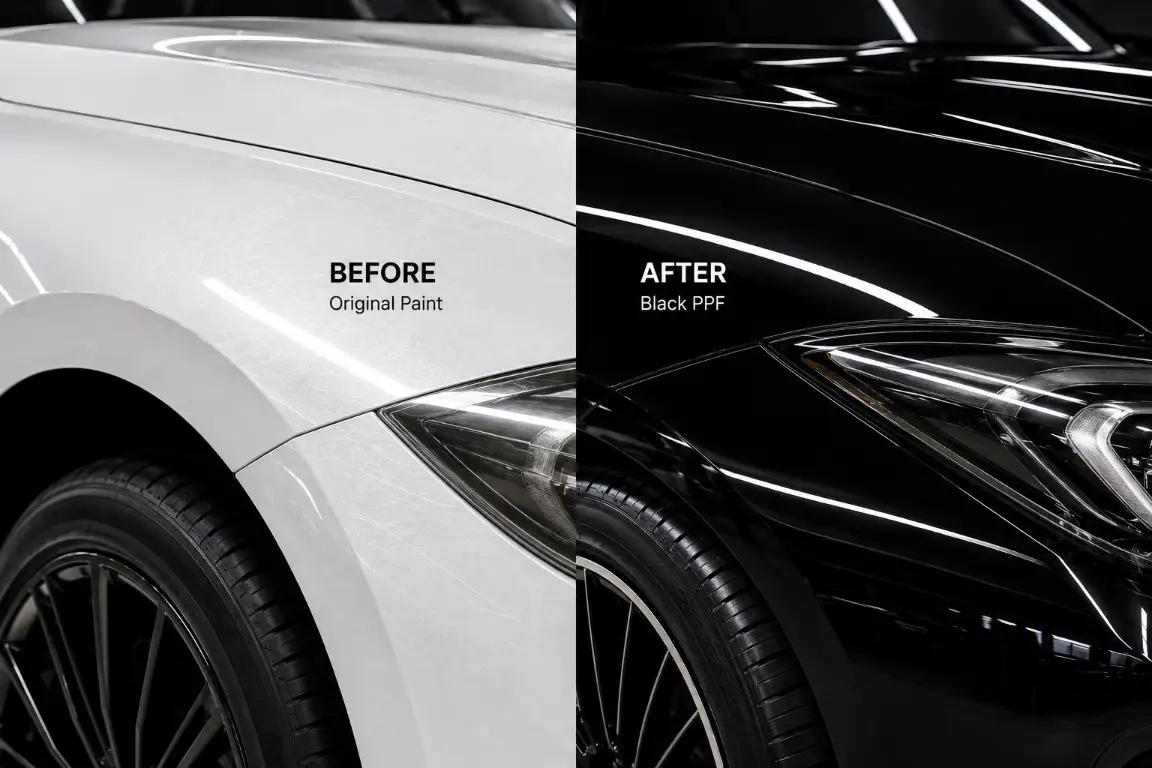
Before we get to the numbers, it helps to understand what you’re actually buying. Black PPF isn’t just “clear PPF with pigment added.” It’s a distinct product category with its own manufacturing requirements and market dynamics.
Clear PPF exists to be invisible: its job is to protect the paint underneath while preserving the factory color. Black PPF does double duty — it’s both a protective film and a color-change material. When applied to a vehicle, it transforms the exterior color to black while providing the same impact resistance, UV protection, and self-healing properties as premium clear film. For a car owner, this means getting the look of a custom black paint job with the protection of PPF, without the $3,000 to $8,000 paint shop bill.
The dual function matters for cost because it changes the manufacturing equation. Black PPF requires pigment dispersion that won’t fade under 5,000+ hours of UV exposure, complete opacity to hide the original paint color, and the same 95+ gloss rating that premium clear films are judged by. Carbon black pigments (the industry standard for UV-stable black coloration) add material cost, but the bigger expense is the additional quality control: every roll needs to be checked for color consistency, opacity uniformity, and pigment migration resistance on top of the standard clarity and thickness checks. This dual-identity nature — protector and transformer — is the thread that runs through every pricing tier below.
The Real Cost Drivers Behind Black PPF
If you’ve ever wondered why two rolls of “black PPF” can differ in price by a factor of 20, the answer sits in three layers: the raw material stack, the physical specifications, and the manufacturing economics. Here’s how each layer builds on the last.
TPU Substrate and Adhesive — The Cost Floor
The single largest cost variable in any PPF roll is the thermoplastic polyurethane (TPU) at its core. Not all TPU is created equal, and the brand name on the resin bag sets the cost floor before a single meter of film is produced.
Lubrizol’s ESTANE TPU has been the industry reference standard for over 30 years. Lubrizol literally invented TPU in 1959, and its aliphatic TPU grades (purpose-built for PPF applications) command a premium that reflects decades of formulation refinement. BASF entered the PPF-specific TPU market more recently, launching its RODIM TPU line in 2022. Both are legitimate high-performance options, but the price gap is real: Lubrizol-grade aliphatic TPU pellets cost roughly $8 to 12 per kilogram at industrial volumes, while BASF equivalents run about $7 to 10/kg. Chinese domestic TPU producers offer significantly lower pricing at $4 to 7/kg, but with wider batch-to-batch variation in key properties like yellowing resistance and tensile strength consistency.
The adhesive layer tells a parallel story. Ashland’s acrylic pressure-sensitive adhesive (specifically formulations like Aroset 951059) is the default choice for premium PPF because it balances low initial tack for easy repositioning during installation with high long-term bond strength. Ashland-grade adhesive adds roughly 15 to 25% to the adhesive-layer cost compared to generic alternatives. Installers notice the difference immediately: generic adhesives tend to be less forgiving on complex curves and more prone to edge lift in the first 48 hours after application.
The combination matters more than either material alone. A film using Lubrizol TPU with Ashland adhesive represents the highest-cost material stack, and the one most installer communities recommend by name. Manufacturers like Flexippf that use this combination across their product range effectively lock in the premium material tier as their cost baseline, which flows through to wholesale pricing.
Thickness and Top-Coat Technology — The Cost Ceiling
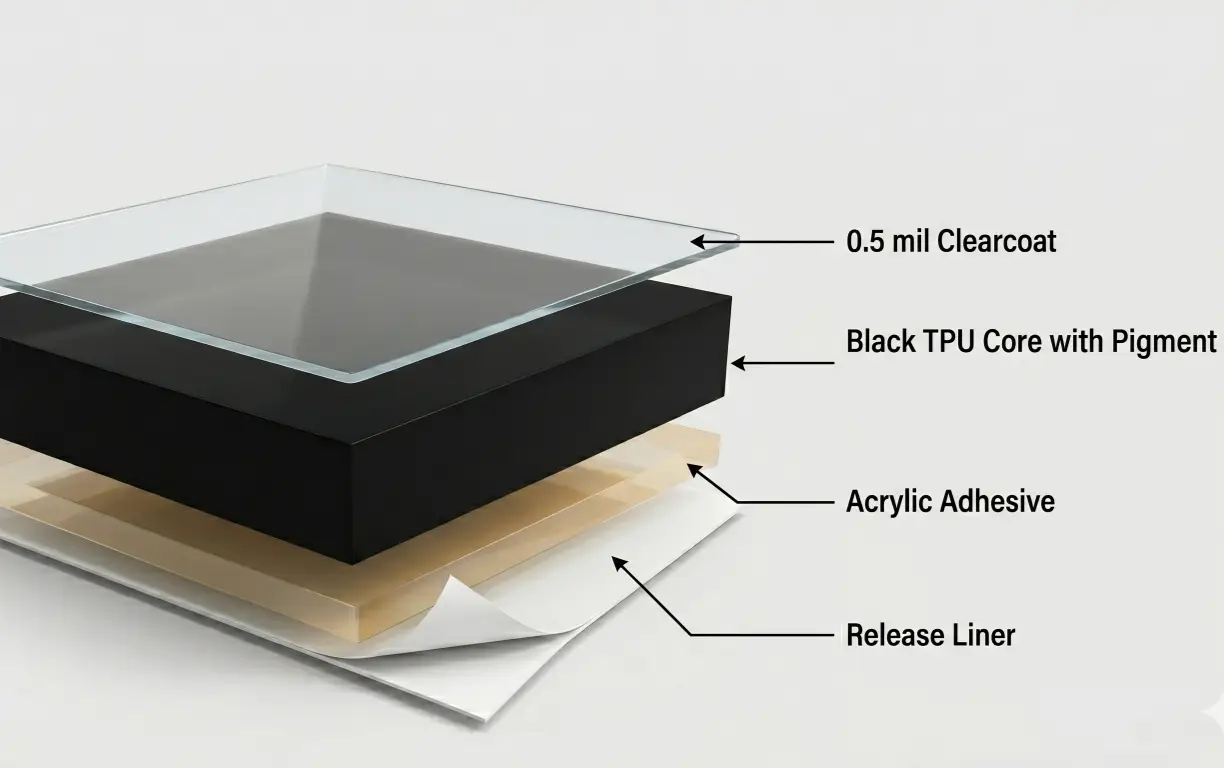
Once the TPU and adhesive are chosen, two more variables determine where a given film lands within its material-tier price band.
Thickness is the more intuitive one. Standard PPF runs 6.5 to 8 mils. Every additional mil of TPU thickness adds roughly 12 to 15% more raw material per square meter. An 8.5 mil film costs about 25 to 30% more in materials than a 6.5 mil version; a 10.5 mil film pushes that premium toward 50 to 60%. But thickness alone isn’t a quality signal — a 10.5 mil film on complex door mirrors creates installation problems that a 7.5 mil film doesn’t. The installer’s ability to wrap compound curves without relief cuts matters as much as the material thickness for the final result.
The top-coat layer is where manufacturing investment most visibly separates budget from premium. Chris DiMinico, Product Manager at XPEL, detailed PPF construction in a 2023 Forbes interview. He explained that the clearcoat is only about 0.5 mils thick but shoulders the heaviest performance burden: UV resistance, chemical resistance, stain resistance, and self-healing capability all live in this sub-millimeter layer. Immersion-coated ceramic topcoats (where the entire film passes through a coating bath rather than being spray-applied) require significantly more capital equipment than spray-coated fluorocarbon alternatives. The cost difference passes through to the roll price at roughly 10 to 15%.
A useful shorthand: the price difference between two films from the same TPU family almost always comes down to thickness × top-coat technology. If you see a 10.5 mil Lubrizol-based film with immersion ceramic coating at a premium, the math checks out. If you see a 6.5 mil film with an unspecified topcoat at the same price, keep looking.
Manufacturing Scale and Geography — The Hidden Multiplier
The third cost layer is the one most buyers overlook: where and at what scale the film was actually made.
A factory running four production lines in a 60,000-square-meter facility with dedicated Class 10,000 cleanrooms has a fundamentally different cost structure than a single-line operation renting floor space in an industrial park. Fixed costs (equipment depreciation, cleanroom maintenance, quality control lab staffing) get spread across output volume. A facility producing 3 million square meters per year might have per-roll fixed cost amortization of $15 to 25; a facility producing 300,000 square meters per year might see $50 to 80 per roll. That $35 to 55 difference is pure manufacturing economics — the film itself could be identical.
Geography introduces the second multiplier. A roll leaving a Shenzhen factory at $400 FOB (Free On Board) picks up sea freight ($2,500 to 3,500 per 20-foot container, or roughly $5 to 15 per roll depending on container utilization), insurance, and import duties before it reaches a US warehouse. At current tariff rates, the landed cost can be 25 to 60% above FOB depending on the product classification and country of origin documentation. From there, the importer adds their margin (typically 30 to 50%), the distributor adds theirs, and the installer marks up the material cost again before quoting the final customer.
This supply-chain multiplication effect is the main reason the same specification of black PPF can cost $400 factory-direct and $1,500+ from a domestic distributor. It’s also why “what should I pay?” doesn’t have a single answer — it depends entirely on which tier of the supply chain you’re buying from.
Black PPF Pricing: What You’ll Pay at Each Tier
Now that the cost drivers are clear, here’s what the numbers actually look like. Use this table to locate your tier. But first, identify what kind of buyer you are:
- Car owner → Tier 1 (installed price, labor + material bundled)
- Detail shop / installer → Tier 2 (retail roll price, buy for inventory)
- Distributor / private-label brand → Tier 3 (factory-direct wholesale)
| Tier | Target Buyer | Typical Price | Key Takeaway |
|---|---|---|---|
| 1: Pro Install | Car Owners | $2.8K – $8.5K (Full Car) | Labor makes up ~70% of cost. Compare quotes based on same TPU brand & coverage map. |
| 2: Retail Roll | DIYers / Shops | $900 – $10K (Per Roll) | You’re buying raw material. Verify “Lubrizol” claims; watch for high single-roll shipping fees. |
| 3: Factory FOB | Distributors | $350 – $800 (FOB) | FOB isn’t final cost. Always calculate sea freight + tariffs, and order samples first. |
The pricing logic changes at each level. At Tier 1, you’re paying primarily for skilled labor — the film itself might be 20 to 30% of the invoice. At Tier 3, you’re paying for raw materials and manufacturing; labor is the smallest line item. Understanding which tier you’re in is the single most important step to knowing whether a quote is fair.
Black PPF vs. Clear PPF: Why the Price Gap Exists
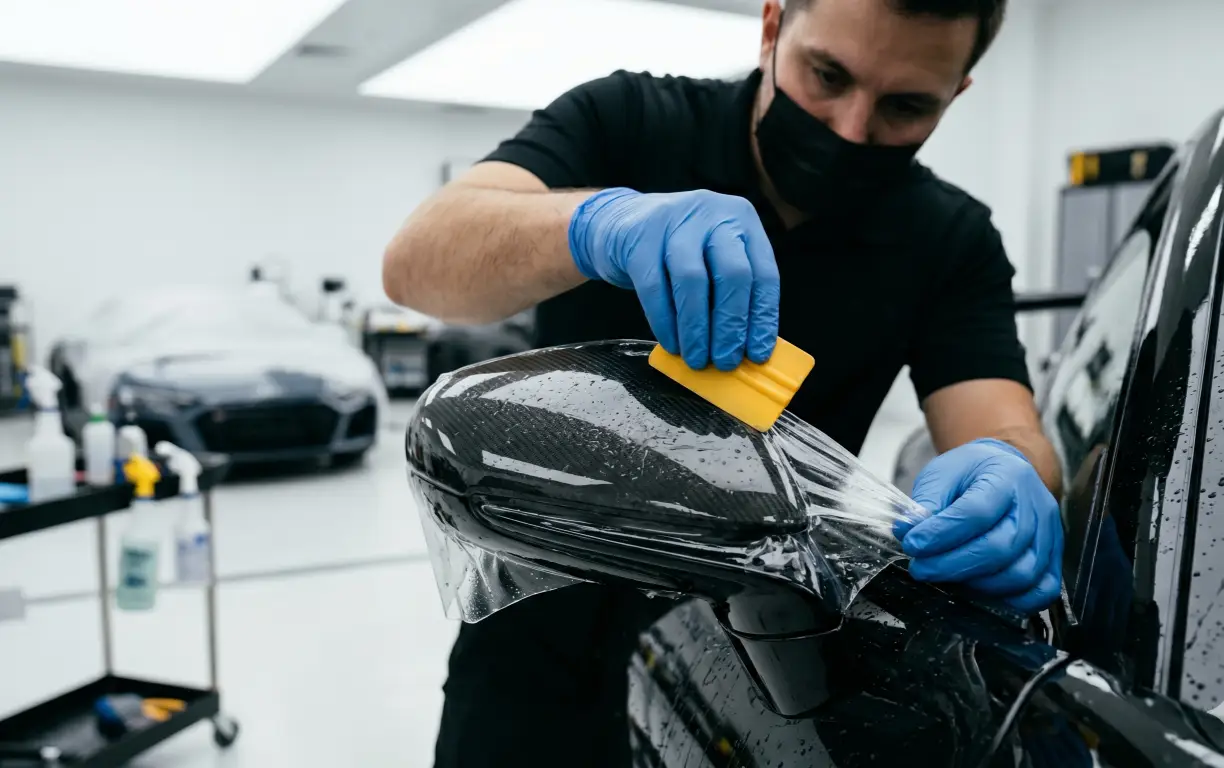
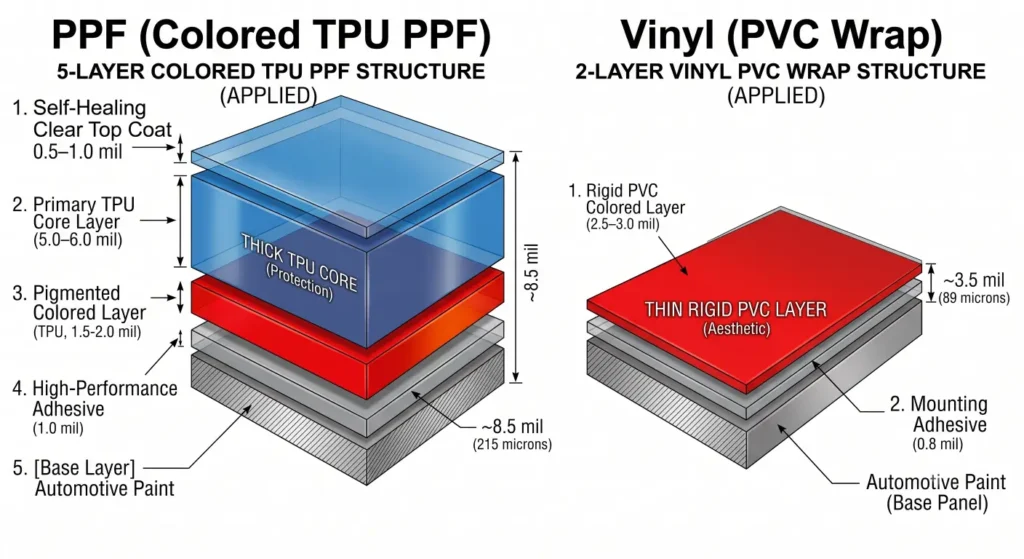
One of the most common questions in PPF forums, and one of the least answered anywhere online, is whether black PPF actually costs more to produce than clear PPF. If so, by how much? The answer has two layers that are rarely separated.
Material Cost Delta — What the Factory Actually Pays
At the manufacturing level, the cost difference between black and clear PPF of the same specification is real but modest. The carbon black pigment added to the TPU compound (typically 2 to 5% by weight) adds roughly $0.30 to 0.60 per square meter in raw pigment cost. The larger expense is process-related: achieving uniform pigment dispersion requires twin-screw extrusion rather than single-screw (a setup that costs $200,000 to 500,000 more in capital investment), and the additional quality control checkpoint for color consistency pushes the first-pass yield rate 3 to 8% below an equivalent clear PPF line.
Net result: at factory FOB, black PPF costs about 5 to 15% more to produce than clear PPF of the same specification. On a $400 roll, that’s $20 to 60. Not nothing, but not the $500 to 2,000 premium seen at retail.
Market Dynamics — Why Retail Pricing Defies Material Cost
The gap between factory cost and retail price is where market forces take over, and this is where most buyers get the story wrong.
Black PPF occupies a much smaller market than clear PPF: color films represent less than 10% of the estimated $680 to 960 million global PPF market. Smaller production batches mean more frequent line changeovers, higher per-unit overhead, and less price competition among manufacturers. But the bigger factor is how black PPF is priced, not how it’s costed. Retailers don’t anchor black PPF pricing to “clear PPF + pigment cost.” They anchor it to the value of the alternative: a factory black paint option ($500 to 3,000 from most automakers) plus clear PPF on top ($2,000 to 5,000 installed). Combined, that’s $2,500 to 8,000 — exactly where most black PPF install quotes land.
This is classic value-based pricing, not cost-plus, and it explains why black PPF install quotes and clear PPF install quotes for the same coverage area can differ by $1,000 or more despite near-identical material costs at the factory level.
The good news for buyers: competition is arriving. XPEL launched its Ultimate Plus Black line in 2024, signaling that the largest brand in PPF sees color films as a growth category. Chinese manufacturers are also expanding color PPF production capacity, which should narrow the clear-to-black price gap at Tiers 2 and 3 by an estimated 15 to 25% over the next 12 to 18 months. If you’re sourcing black PPF today, knowing this trajectory puts you in a stronger negotiating position.
How to Buy Black PPF at the Right Price
You’ve seen the cost drivers, the pricing tiers, and the market dynamics. Here’s how to turn that knowledge into a better purchase decision, whether you’re buying one installation or a container load of rolls.
- Know your tier before you negotiate. Nothing undermines a negotiation faster than comparing prices across tiers. If you’re a car owner, the Alibaba FOB price of a roll is irrelevant to your installer — your quote is 70% labor, not 70% material. If you’re a distributor, the install price a shop charges end customers tells you nothing about your landed cost. Use the three-tier table above to anchor your expectations in the right column.
- Verify the material claims. When a supplier says “Lubrizol TPU,” ask for proof. Lubrizol maintains a public ESTANE co-branding partner network; if a manufacturer is genuinely using Lubrizol resin, they’re typically listed. For Ashland adhesive claims, ask for the specific product designation (Aroset 951059 or equivalent). Suppliers who can’t or won’t provide this level of detail are almost certainly using generic materials regardless of what the spec sheet says.
- Calculate true landed cost (Tier 3 buyers). The formula is straightforward: (EXW price + sea freight + insurance + import duties) ÷ roll count. A 20-foot container from Shenzhen to the US West Coast runs approximately $2,500 to 3,500. Import duties depend on the current tariff schedule and product classification — get a customs broker to quote this before you commit. And always order a sample roll ($350 to 420 including air freight) before placing a volume order. The best Alibaba supplier rating in the world doesn’t tell you how that specific black PPF will look and feel in your hands.
- Align quotes on the same specification. When comparing install quotes, confirm that every quote is for the same: TPU brand, film thickness in mils, warranty duration and terms, and coverage map (which panels are included). A $2,800 quote for 6.5 mil generic-TPU black PPF on a partial front is not competing with a $5,000 quote for 8.5 mil Lubrizol-based film on a full front. They’re different products. Get the specs aligned, then compare the numbers.
Some manufacturers make the verification step easier by design. Flexippf, for example, operates a dedicated OEM program at flexippf.com/oem with transparent material sourcing (Lubrizol and BASF TPU, Ashland adhesive), a 1-roll minimum order quantity for stock films, and 48-hour custom design turnaround. These three data points — material transparency, MOQ flexibility, and design turnaround time — make a useful quick-filter before you even request a quote.
The black PPF market is still young enough that pricing opacity is the norm, not the exception. But the information asymmetry that benefits sellers is eroding as more manufacturers publish their specs, more buyers share their quotes on forums, and more distributors enter the category. Whether you’re paying Tier 1, 2, or 3 prices, the best defense against overpaying is knowing which tier you’re in, and what questions to ask when the numbers don’t add up.
 English
  Spanish
  Dutch
Dutch  Japanese
  Russian
  Arabic