
01 How UV Radiation Damages Your Car’s Paint
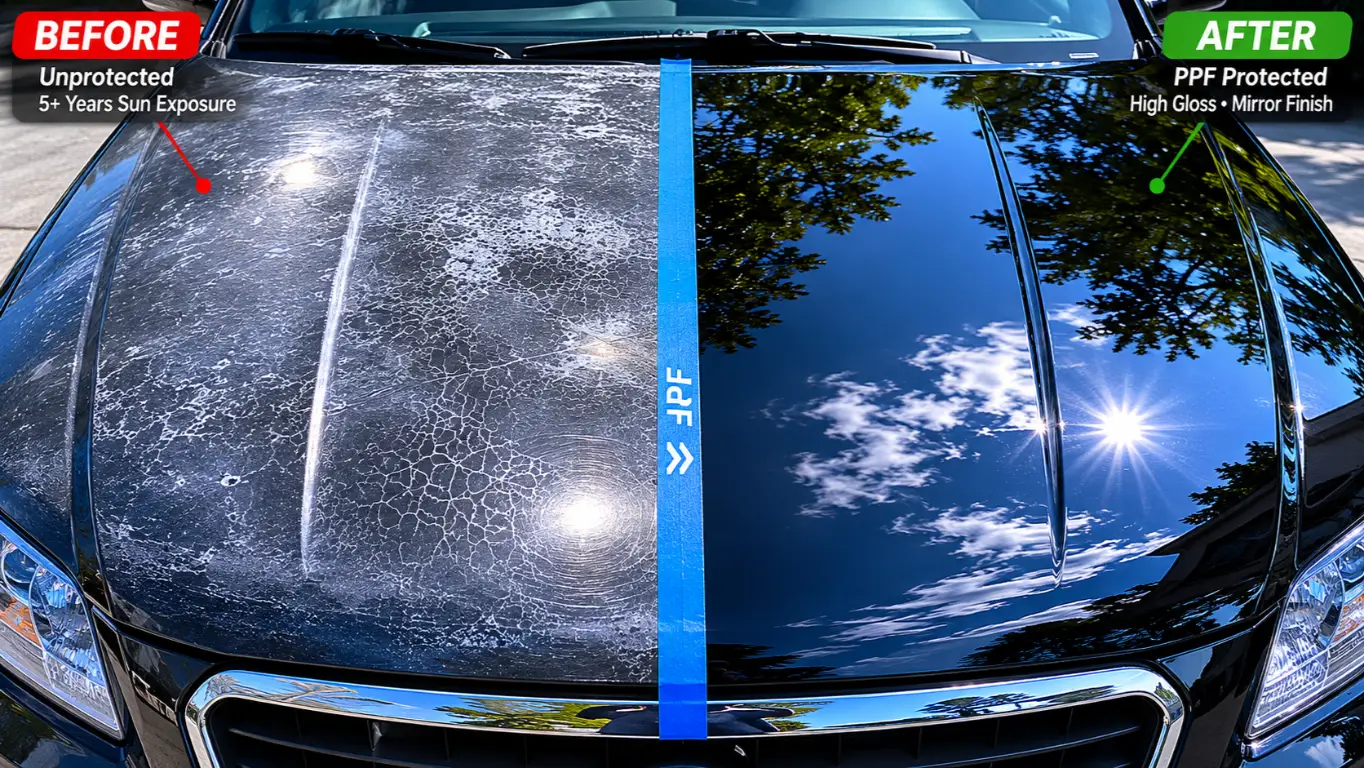
Every parked car is under silent attack. The sun’s ultraviolet radiation — specifically UV-A (315 to 400 nanometers), which penetrates deepest, and UV-B (280 to 315 nanometers), which carries higher energy — bombards your car’s clear coat continuously. That clear coat is only 30 to 50 microns thick, roughly the diameter of a human hair. And within it, the chemical stabilizers that came from the factory don’t last forever.
Here’s what happens. UV photons strike pigment molecules in the paint layer and break their chemical bonds — a process called photodegradation. The clear coat’s own hindered amine light stabilizers, or HALS, work to neutralize the free radicals this creates. But in an unprotected car parked outdoors, those stabilizers are largely depleted within three to five years. After that, the damage becomes visible: color loses saturation and depth, the clear coat oxidizes into a chalky haze, and micro-cracks spread across the surface like a dried lakebed.
Think of it like a plastic garden chair left in the sun for three summers. What starts out glossy and flexible turns brittle and chalky. Your car’s paint is going through the same process — just slower and more expensively.
So the question isn’t really “does the sun damage car paint.” It does, absolutely and measurably. The question is: can a thin transparent film actually stop it?
02 How Paint Protection Film Blocks UV Rays
Paint protection film, or PPF, doesn’t block UV the way a curtain blocks light. It’s not about thickness. A typical PPF is 6.5 to 10.5 mils — roughly 0.2 millimeters — and physically shading the paint accounts for almost none of its UV-blocking ability. Instead, PPF works as a chemical defense system embedded inside the film’s polymer structure. Think of it as permanent sunscreen for your car — but one whose effectiveness depends on three layers of chemistry working together. If any one of them fails, the whole system degrades.
UV Absorbers — The First Line of Chemical Defense
The primary workhorses inside PPF are UV absorbers, organic molecules dispersed throughout the thermoplastic polyurethane, or TPU, layer. When a UV photon hits one of these molecules, the absorber doesn’t just bounce it away — it catches the photon’s energy, briefly jumps to an excited electronic state, and then releases that energy as a negligible amount of heat as it relaxes back to its ground state. Picture a spring catching a ball: it compresses for a split second, then the energy dissipates as a tiny vibration, and the spring is ready for the next one.
Premium PPF formulations use a blend of absorber types, most commonly benzotriazoles, which achieve greater than 95 percent absorption efficiency in the 300 to 385 nanometer range, combined with benzophenones for broader coverage. No single absorber type covers the entire UV spectrum from 280 to 400 nanometers, so the best films stack two or three different chemistries.
The distribution matters too. If UV absorbers were concentrated only in the top layer, UV radiation penetrating deeper into the film would degrade the inner TPU layers, eventually causing inter-layer delamination. That’s why absorbers are compounded throughout the full TPU substrate.
HALS — The Self-Repairing Shield That Keeps Working
UV absorbers have a weakness: they’re consumable. Over years of exposure, the absorbers themselves slowly degrade. That’s where the second line of defense comes in — hindered amine light stabilizers, more commonly known as HALS.
When UV radiation slips past the absorbers and strikes the polymer chains, it generates free radicals. These highly reactive molecules attack polymer backbones, breaking them apart. The chain reaction produces yellow-brown chromophores — the compounds responsible for visible yellowing. Left unchecked, this cascade can turn a clear film amber within two to three years.
HALS interrupt this process through what chemists call the Denisov cycle, named after the Russian scientist Evgeny Denisov who characterized it. A HALS molecule captures a free radical, converts itself into a nitroxyl radical in the process, neutralizes a second radical, and — critically — regenerates back to its original form. One HALS molecule can cycle through this sequence over a thousand times before deactivating. It’s not a consumable shield; it’s a catalyst that keeps working.
Together, UV absorbers and HALS form a two-tier defense. The absorbers catch most UV photons before they can do damage. HALS clean up whatever radicals still form. Budget films often skimp on one or both — cutting HALS entirely or using low-molecular-weight variants that migrate out of the film over time. This is the invisible difference between a PPF that lasts three years and one that lasts ten.
The Multi-Layer Structure — Why PPF Isn’t Just a Sheet of Plastic
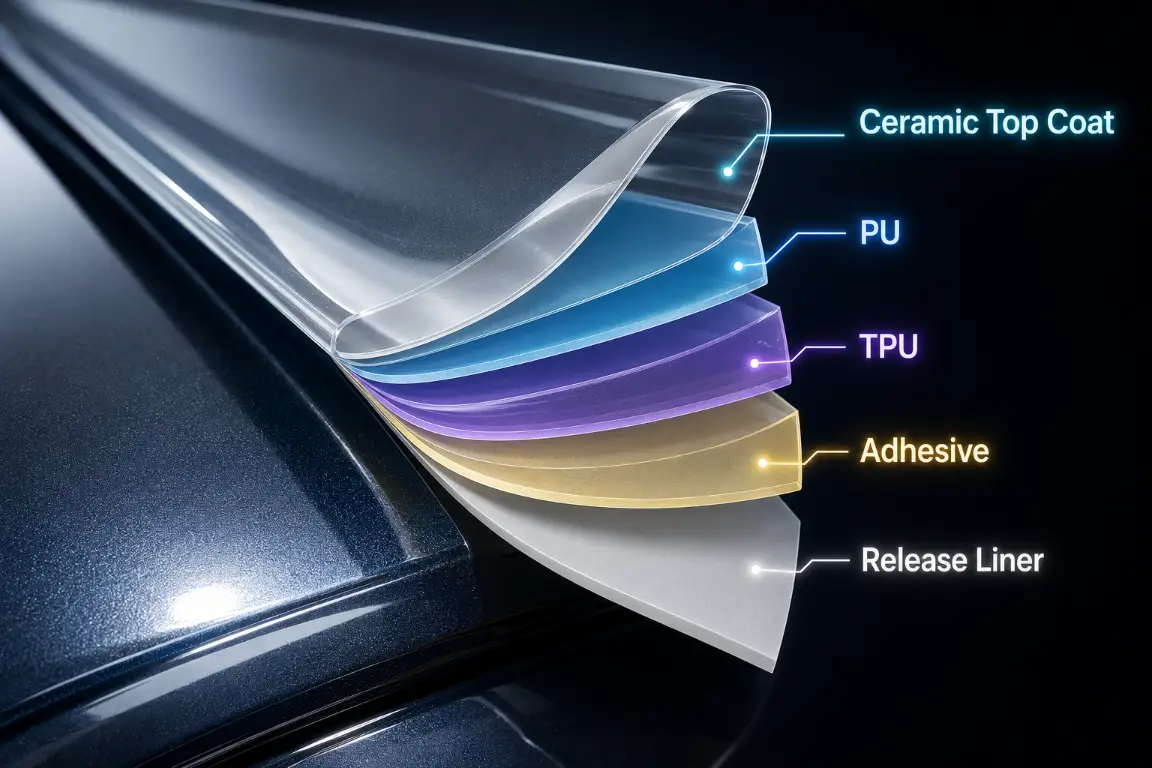
All of this chemistry is organized into a physical architecture. A quality PPF isn’t a single homogeneous layer — it’s a stack of five distinct strata, each contributing differently to UV defense.
At the top sits an elastomeric or ceramic clear coat, just 0.5 to 1.5 microns thick. It’s the thinnest layer but carries the highest concentration of UV absorbers, directly intercepting sunlight before it reaches deeper. Below that, a self-healing polyurethane layer provides impact absorption and hosts a high density of HALS. The TPU substrate beneath — accounting for roughly 60 to 70 percent of total film thickness — forms the structural backbone and carries the bulk of the UV absorber load.
Then comes the adhesive. This layer is easy to overlook, but it’s critical: a pressure-sensitive acrylic adhesive bonds the film to the clear coat. If this adhesive isn’t UV-stable — meaning its cross-linking density isn’t high enough — it will degrade under sun exposure, lose bond strength, and leave stubborn residue when the film is eventually removed. The bottom-most layer is a PET release liner, peeled away during installation.
Not all PPF on the market has all five layers. Entry-level products often eliminate the independent top coat, mixing UV absorbers directly into the TPU substrate instead. That cuts cost but also cuts protection — without a concentrated absorber layer at the surface, more UV reaches the adhesive and the paint beneath it.
03 Not All PPF Is Equal
Knowing that PPF blocks UV is one thing. Understanding why some PPF yellows in two years while other PPF stays crystal clear for a decade — that’s a different question entirely. The answer sits at the molecular level, and it has nothing to do with brand names or price tags. It’s about whether the TPU backbone contains a benzene ring.
Aliphatic TPU — Why Premium PPF Stays Clear for a Decade
Aliphatic TPU is built from isocyanates like HDI — hexamethylene diisocyanate — or H12MDI, hydrogenated diphenylmethane diisocyanate. Both have saturated carbon-carbon backbones: no benzene rings, no conjugated double bonds. Without those molecular structures, there’s nothing in the polymer for UV radiation to oxidize into a chromophore. The film stays transparent because, chemically, there’s nothing that can turn yellow.
This is why manufacturers of premium PPF openly name their raw material sources: Lubrizol Estane and BASF Elastollan are the two dominant suppliers of PPF-grade aliphatic TPU globally. A manufacturer who uses these resins will typically state it on their product page — it’s a signal of quality, not a secret.
Under standardized accelerated weathering — 5,000 hours of xenon arc exposure, roughly equivalent to five years of Florida outdoor sunlight — aliphatic TPU films typically show a yellowing index delta, or ΔYI measured per ASTM E313, of less than 2. That’s below the threshold of human perception. For context, ΔYI between 2 and 5 is considered acceptable. Above 5, the yellowing is visible and the film has failed.
Aromatic TPU — The Hidden Risk Behind Budget Paint Protection Film
Aromatic TPU costs significantly less — raw resin prices run roughly 30 to 50 percent below aliphatic grades — but the savings come from a fundamental chemical compromise. Aromatic isocyanates like MDI, diphenylmethane diisocyanate, contain benzene rings. Under UV exposure, those rings undergo photo-oxidation and rearrange into quinone-imide structures. Quinones are chromophores: they absorb visible light in the blue-green range, which makes the film appear progressively more yellow to the human eye.
Adding UV stabilizers to aromatic TPU helps, but only temporarily. Stabilizers delay the oxidation, they don’t eliminate the benzene rings that make oxidation inevitable. After 1,000 hours of QUV accelerated aging, aromatic TPU can show a ΔYI of 8 to 15 — substantially above the visible threshold — while aliphatic TPU under the same conditions stays below 2.
Here’s a practical test: if a product description or salesperson says “TPU” without specifying “aliphatic,” it’s likely aromatic. Manufacturers who pay for aliphatic resin advertise it. Those who don’t, don’t.
To be fair, aromatic TPU has its place. On a dark-colored vehicle kept for only two to three years, the yellowing may never become cosmetically objectionable. On a white or silver car intended for long-term ownership, it’s the wrong choice.
PVC and TPH — When Cheap PPF Costs More in the Long Run
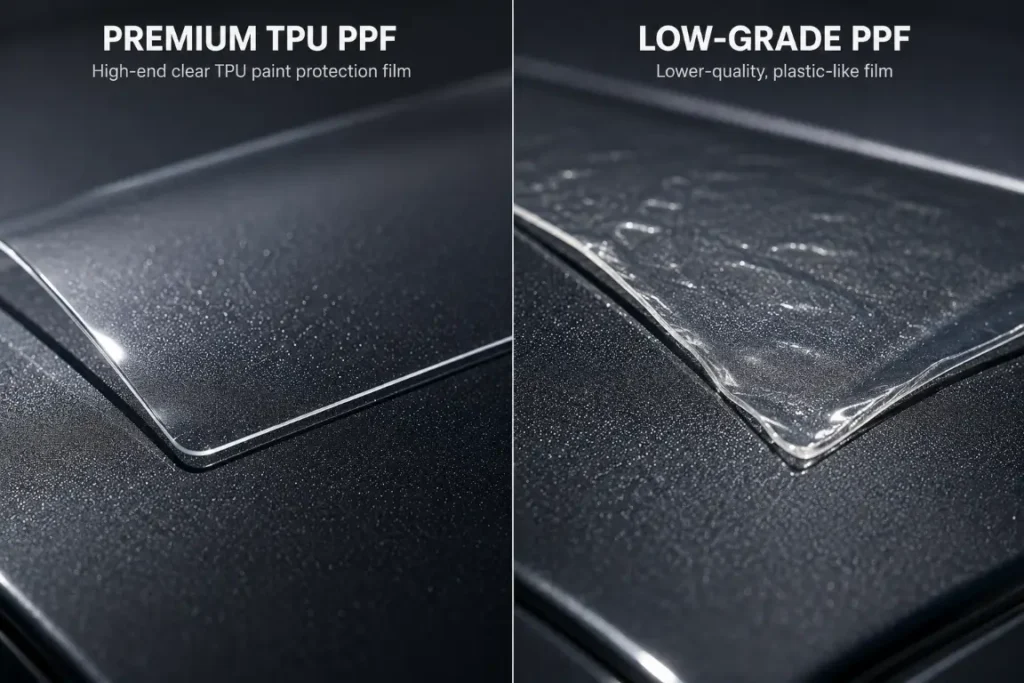
Below even aromatic TPU sits an entirely different class of materials. PVC-based films — sometimes labeled as PPF but fundamentally different — rely on phthalate plasticizers for flexibility. Under UV and heat, those plasticizers migrate out. The film shrinks, turns brittle, and yellows catastrophically. When removal is attempted, adhesive residue remains on roughly 30 to 50 percent of the surface area.
TPH — thermoplastic polyolefin hybrid — is a loosely defined category that some manufacturers use to suggest a product sits between PVC and TPU. There is no industry standard for what “TPH” means. Some TPH products are functional for short-term use on dark vehicles. Others are barely rebranded PVC.
The reliable red flags: a chemical “pool smell” when the release liner is peeled back — that’s plasticizer off-gassing. A film that doesn’t spring back when stretched — that’s the absence of TPU’s elastic memory. And a full-front PPF quote below about $500 for materials alone — at that price point, the base film is almost certainly PVC or TPH.
04 PPF vs Ceramic Coating vs Window Tint
All three products claim UV protection. They all deliver it to some degree. But they protect different things, through different mechanisms, for different durations.
| Protection Method | UV Blocking | Physical Impact Protection | Typical Lifespan | Best For | Key Limitation |
|---|---|---|---|---|---|
| PPF (aliphatic TPU) | Up to 98–99% | Yes — absorbs rock chips and scratches | 7–10 years | Paint that needs both UV and impact defense | Highest upfront cost; requires professional installation |
| Ceramic Coating | Moderate to high (via SiO₂/TiO₂ UV scattering) | None | 2–5 years | Enhancing gloss and water beading with moderate UV shielding | Micron-thin layer; wears away and UV protection diminishes |
| Window Tint | Up to 99% (for glass) | None | 5–10+ years | Protecting cabin interior and occupants from UV through glass | Does nothing for exterior paint |
The takeaway is straightforward. If your only concern is UV protection for the paint, ceramic coating applied every few years offers the best cost-to-protection ratio. If you also want rock chip defense, scratch resistance, and a single application that lasts the better part of a decade, PPF is the only option that delivers all four.
The ideal setup isn’t one or the other — it’s both. PPF on high-impact areas for physical and UV protection, with a ceramic coating layered on top for hydrophobicity and gloss. This is the standard recommendation among professional detailers, and it’s what most high-end installers offer as a packaged service.
05 What Happens to Your Paint After 5 to 10 Years With and Without PPF
New car paint, measured at a 60-degree angle with a gloss meter, typically reads 90 to 95 gloss units. That’s the deep, liquid shine that makes a new car look new.
Without PPF, the timeline goes like this. In the first one to two years, changes are subtle — micro-swirls from washing, a barely measurable drop in gloss that only a spectrophotometer would catch. By years three to five, the clear coat’s factory stabilizers are depleted. Gloss drops into the 60s. On dark colors, the oxidation becomes visible as a whitish haze at the edges of horizontal panels — hood, roof, trunk lid. Years five through ten are where the real cost lands. Gloss can fall below 50 GU. The clear coat may begin peeling at panel edges. At this point, a full respray is the only fix.
With PPF, the paint underneath stays isolated from UV and abrasion. After five years, a gloss meter on the PPF surface reads close to the film’s original spec — typically 90 GU or higher. After seven to ten years, the film itself may show minor wear — swirl marks that self-heal with heat, slight reduction in hydrophobic performance — but the paint beneath it is untouched. When the film is eventually removed, the factory finish underneath looks the way it did on delivery day.
Most PPF discussions skip the economics. Here they are. A professional full-body respray costs between $3,000 at an independent shop and upwards of $10,000 at a dealership — and repainted panels never match the adhesion, uniformity, and corrosion resistance of factory electrocoat. Full-body PPF costs $5,000 to $8,000 installed. It’s not a consumption expense. It’s a prepaid alternative to a future repaint.
Once, 10yr protection
Per incident, variable
Every 2–5yr
06 How to Verify a PPF Supplier’s UV Protection Claims
Any manufacturer can write “blocks 99 percent of UV” on a website. The gap between a marketing claim and a verifiable fact is where most PPF buyers get burned. Here’s how to close that gap.
Key Certifications and Test Standards That Actually Mean Something
Not all certifications are relevant. ISO 9001, for example, certifies that a factory has a quality management system — it says nothing about whether the film resists UV. What you’re looking for are product performance test standards, not company process certifications.
ASTM G155 is the relevant standard for automotive exterior materials. It uses a xenon arc lamp with optical filters to reproduce the full solar spectrum — UV, visible, and infrared — under controlled temperature and humidity cycles. This is what automakers like Ford, GM, and Volkswagen reference in their own paint and trim durability specifications. SAE J2527 is the automotive-specific variant of the same methodology. Both are far more meaningful than generic “UV tested” language.
For yellowing specifically, ASTM E313 defines how ΔYI — yellowing index delta — is measured. When a manufacturer claims “5,000-hour xenon aging,” ask for the ΔYI result, not just the test duration. A film that survived 5,000 hours but shows a ΔYI of 8 hasn’t passed — it’s failed more slowly than a worse film.
If a supplier mentions TUV Rheinland or SGS testing, that’s a positive signal — both are credible third-party laboratories. But check which specific test they performed. A TUV-tested film could mean TUV verified its UV aging performance, or it could mean TUV verified it doesn’t contain restricted heavy metals under ROHS. Those are not the same thing.
Questions to Ask Before Choosing a PPF Supplier
Five questions that separate suppliers who know their product from those who don’t:
1. “Is your PPF made from aliphatic or aromatic TPU?”
The correct answer is “aliphatic” followed by the raw material brand — Lubrizol, BASF, Covestro, or Huntsman. If the answer is vague or the salesperson doesn’t know what you’re asking, the TPU is almost certainly aromatic.
2. “Do you have a UV aging test report, and what standard was it tested to?”
Look for ASTM G155 or SAE J2527 with specific ΔYI and gloss retention numbers. A supplier who won’t share the report or claims it’s “internal only” is hiding something.
3. “What does your yellowing warranty cover, and for how long?”
Ten years is the industry benchmark for premium aliphatic PPF. Check whether the warranty is full replacement or pro-rata — the latter decreases in value each year and may be nearly worthless by year seven or eight.
4. “Does your film have an independent top coat, or are the UV inhibitors mixed into the TPU layer?”
A separate top coat with concentrated UV absorbers is the superior architecture. Mixed-in absorbers are cheaper to manufacture but less effective over time.
5. “Can you show me examples of your film on cars in a climate similar to mine?”
A supplier serving global markets should be able to reference installations in comparable sun exposure conditions. If they only have examples from mild climates, their film’s UV performance in your environment is unproven.
Red Flags — When to Walk Away from a PPF Deal
07 Is Paint Protection Film Worth It for UV Protection Alone?
Here’s the honest answer. If UV protection is the only thing you care about, PPF is the most expensive way to get it. A high-quality ceramic coating reapplied every two to three years, combined with regular waxing, blocks UV effectively at roughly half the five-year cost. For a garage-kept weekend car that sees 3,000 miles a year, that’s probably the rational choice.
But UV protection almost never stands alone as a purchase motivation. The cars that need UV protection most — daily drivers parked outdoors in sun-intensive climates — are also the cars eating rock chips on the highway, accumulating parking lot scratches, and degrading in ways that ceramic coating can’t prevent.
PPF is the only product that bundles UV blocking, physical impact absorption, scratch self-healing, and decade-scale durability into a single application. When you price out those four functions separately — ceramic coating for UV, paint correction for swirl marks, touch-up respray for rock chips, and reapplication every few years — the standalone PPF cost starts looking less like a premium and more like a bundle discount.
A practical decision framework: if your car lives in a garage, sees light mileage, and you’re comfortable with periodic maintenance detailing, ceramic coating gives you the UV protection you need at a lower price. If your car sleeps outside, faces daily highway commutes, and you plan to own it for more than five years, PPF pays for itself by making a future respray unnecessary.
Recommendation: Ceramic Coating
Cost: ~$1K–3K every 2–5yr
Recommendation: PPF
Cost: ~$5K–8K one-time, 10yr protection
So, does PPF protect against UV? Absolutely — and at a level that rivals anything else on the market. But asking whether PPF blocks UV is like asking whether a Swiss Army knife can open a bottle. Yes, it does that — and about six other things that, taken together, are why you buy it.
References
- Infinita Lab. “UV Weathering Test Advantages — ASTM G154 & G155.” 2025. https://infinitalab.com/blog/uv-weathering-test-advantages/
- Infinita Lab. “Solar Radiation Testing Guide — Xenon Arc, UV & ASTM G155 Methods.” 2025. https://infinitalab.com/blog/solar-radiation-testing-methods-standards-and-weathering/
- AB Newswire. “What Type of TPU Material Should Be Used for Paint Protection Film (PPF)?” April 2026. https://kvoa.marketminute.com/article/abnewswire-2026-4-24-what-type-of-tpu-material-should-be-used-for-paint-protection-film-ppf
- UPPF USA. “PPF Cost Guide: Full Vehicle Coverage Cost and Packages Explained.” 2025. https://www.uppf-usa.com/blogs/post/full-ppf-cost-guide-and-packages-explained
- RGBG Films. “PPF Pricing Benchmarks 2025 (U.S.): Definitive Rates Guide.” 2025. https://rgbgfilms.com/ppf-pricing-benchmarks-us-2025/
- FlexiPPF. “Paint Protection Films — Product Line.” https://www.flexippf.com/automotive-films/paint-protection-films/
- FlexiPPF. “Quality, Support & Warranty.” https://www.flexippf.com/quality-support-warranty/
- FlexiPPF. Homepage. https://www.flexippf.com/
 English
  Spanish
  Dutch
Dutch  Japanese
  Russian
  Arabic