
If you have spent any time researching paint protection, you have seen the claims. “9H hardness.” “5-year durability.” “Graphene-infused.” The language has become so inflated that separating real performance from bottle copy takes work.
This guide takes one thing off the table first: coatings are not films. A paint protection coating is a liquid that cures to form a protective layer bonded to your clear coat. Paint Protection Film (PPF) is a pre-manufactured urethane sheet with adhesive — a different category, a different purpose. If you are weighing coating against PPF, the short version: coating handles chemistry (UV, acid rain, bird droppings, swirl marks); PPF handles physics (rock chips, road debris). Both have their place. This article focuses on coatings — what makes one actually better than another, and how to choose.
Types of Paint Protection Coatings — Know What You’re Buying
The market uses terms like “ceramic,” “nano,” and “graphene” with varying accuracy. But the fundamental product categories — the ones that differ in chemistry, not just marketing — are straightforward.
| Type | What It Is | Typical Durability | Best For | Key Limitation |
|---|---|---|---|---|
| Ceramic Coating (SiO₂) | Liquid silicon dioxide polymer; chemically bonds to clear coat | 1–5 years (consumer); 5–9 years (professional) | Daily drivers, long-term owners wanting chemical protection and easy maintenance | Does not protect against rock chips; prep-intensive application |
| Graphene Coating | Ceramic base infused with graphene particles; enhanced thermal and friction properties | 3–7 years (claimed) | Hot climates, those wanting maximum slickness and reduced water spotting | Higher cost; many products use trace graphene for marketing only |
| Synthetic Sealant | Polymer-based liquid protection; physically adheres rather than chemically bonds | 6–12 months | Budget-conscious owners, lease vehicles, DIY beginners, short-term protection | Shortest durability among synthetic options; no chemical bonding |
| Carnauba Wax | Natural wax from Brazilian palm; sits on surface as sacrificial layer | Weeks to 2 months | Enthusiasts who enjoy frequent detailing; show cars; those wanting deep warm gloss | Minimal durability; zero chemical resistance; requires constant reapplication |
The key distinction: ceramic and graphene coatings form a chemical bond with your clear coat. Sealants and waxes sit on top. The chemical bond is why a ceramic coating lasts years while wax lasts weeks — and why ceramic application requires meticulous surface preparation.
What Makes a Coating “Best” — The Technical Specs Decoded
A coating is not “good” or “bad” in the abstract. It performs across independent dimensions, and no product maxes out all three. The one that is best for you is the one that leads in the dimension you care about most.
Hardness and Scratch Resistance — The Pencil Test and Beyond
Every coating brand quotes a pencil hardness rating, usually “9H.” The test itself is real: the ASTM D3363 standard drags calibrated pencils across a surface under a 750g load. A 9H rating means the hardest pencil did not scratch the coating — under those specific, controlled conditions. It does not mean scratch-proof. It means it resisted a particular type of light abrasion.
The nuance that matters: pure high-hardness ceramic is brittle. It resists light marring but cracks under impact. The best coatings balance hardness with elastomeric flexibility — a property the pencil test does not measure at all. Independent testing also consistently finds that most “9H” coatings test closer to 6H–7H in third-party labs. The number is directionally useful, not precise. When a brand cannot produce an ASTM test report, their hardness claim is marketing, not engineering.
Hydrophobicity, UV Resistance, and Chemical Defense
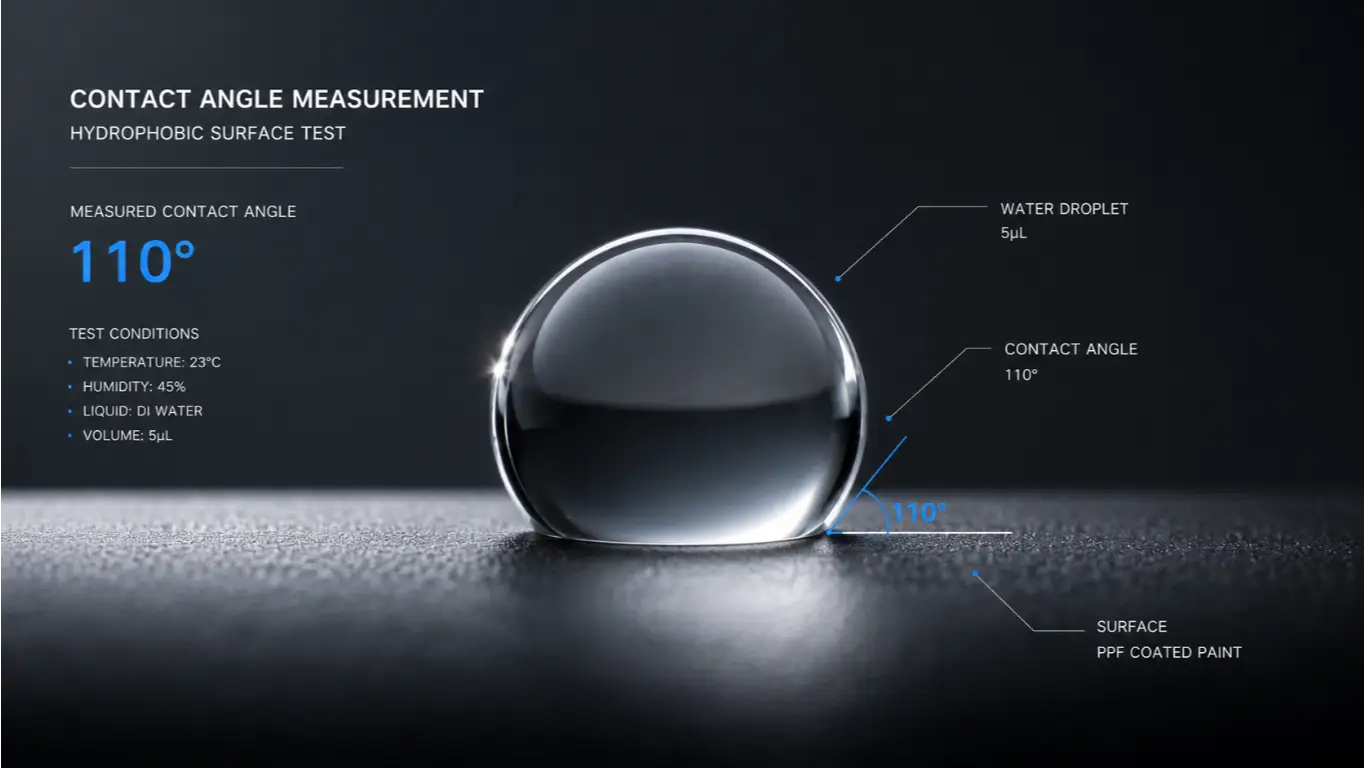
The daily threats to your paint are chemical, not mechanical. Acid rain, bird droppings (pH ~3.5), tree sap, and UV radiation degrade clear coat steadily over years. A coating’s job is to intercept these before they reach the paint.
Hydrophobicity is measured by contact angle — the angle a water droplet makes when sitting on the surface. Above 100° is hydrophobic (water beads and rolls). Above 110° is super-hydrophobic (water practically flees). Why it matters: water that beads carries dirt and contaminants with it as it rolls off. A 110° coating effectively self-cleans in the rain.
UV resistance is the quiet killer. Oxidation from ultraviolet exposure is the number one cause of clear coat failure. Top-tier coatings block 95–98% of UV radiation. This is verified through QUV accelerated weathering — 5,000+ hours in a controlled chamber simulating years of sun exposure. If a coating does not publish UV blockage percentage or QUV test duration, assume it has not been rigorously tested.
Chemical resistance comes from the cross-linked polymer network that forms during curing. This network prevents acidic contaminants from penetrating to the clear coat. The coating sacrifices itself so the paint does not have to — which is why coating longevity directly determines how long your paint stays protected.
Solid Content, Curing, and What Determines Longevity
Every coating claims durability. But the number that actually predicts how long a coating will last is its solid content — the percentage of the liquid that remains on the paint after the carrier solvent evaporates.
When you apply a coating, most of what goes on the paint is solvent that evaporates. What stays behind — the solids — is the actual protection. A professional-grade ceramic coating typically has solid content above 80%. Consumer-grade kits sit at 30–50%. That difference alone explains most of the gap between a $150 DIY kit lasting 18 months and a $1,200 professional application lasting 5 years.
The other half of durability is cross-link density — how tightly the polymer chains bind together during curing. Higher density means better chemical resistance and longer life. Both numbers live on the product’s Technical Data Sheet (TDS). If a brand does not publish a TDS, or the TDS omits these numbers, they are choosing not to let you compare.
Ceramic vs Graphene vs Professional Sealants — Real-World Performance
No single coating technology wins everywhere. Each has a performance profile that makes it the right answer in a specific set of conditions. Here is where each one justifies its cost.
Ceramic Coating — The Balanced Workhorse
Ceramic coatings own the market for a reason. They hit the widest sweet spot in the price-performance-durability triangle. A professional-grade ceramic with solid content above 80% delivers 3–5 years of chemical resistance, UV protection, and hydrophobic self-cleaning — at a cost that, while not cheap, makes sense for a vehicle you plan to keep.
The catch, and it is a big one, is surface preparation. Ceramic bonds at the molecular level. Apply it over swirl marks or oxidation and you permanently seal those defects under silicon dioxide. Most professionals will tell you that 90% of what gets called a coating failure was actually a preparation failure. The coating was fine. The surface wasn’t ready.
For a daily-driven car parked outside, professional ceramic coating is the highest-ROI paint protection decision available. It will not stop a rock chip. But it will keep the paint looking newer for years longer than unprotected clear coat — and cut wash time in half.
Graphene Coating — The New Contender
Graphene is the most interesting development in coatings since ceramic went mainstream. The genuine advantages are real: higher thermal conductivity helps the surface dissipate heat faster, reducing water spotting in hot climates. A lower coefficient of friction — typically below 0.1, compared to 0.15–0.20 for ceramic — means less dirt adhesion and a slicker feel.
The reason to be skeptical: many “graphene” products contain graphene particles in concentrations so low they offer no measurable difference from standard ceramic. A genuine graphene coating will have a subtle grey or dark tone in the bottle — graphene itself is deep grey to black. Crystal-clear “graphene” coatings are a red flag. The price premium for genuine graphene runs 30–50% over equivalent ceramic. In hot sunny regions, the thermal advantage justifies it. In cooler climates, the benefit shrinks.
Professional-Grade Sealants — The Underrated Option
Sealants get overlooked in the ceramic hype cycle, and that is a mistake. A high-quality synthetic sealant — especially the newer SiO₂-hybrid formulations — delivers roughly 70% of a ceramic coating’s performance at 20% of the cost. Professional application runs $100–300. Durability is 6–12 months rather than years. But for a lease vehicle you will return in 24 months, or a daily driver you are not emotionally attached to, or a DIY beginner learning the craft — sealant is often the smarter choice. It is also forgiving: application mistakes do not require professional removal.
The sealant’s limitation is not performance quality, it is performance duration. If you are willing to reapply annually, you can maintain near-ceramic levels of protection indefinitely at a lower annual cost. If you want to apply once and forget about it for 3+ years, ceramic is the answer.
| Best For | Durability | Chemical/UV Protection | Ease of Application | Approx. Cost (Pro) |
|---|---|---|---|---|
| Ceramic Coating Daily drivers, long-term owners | 3–5 years | Excellent | Difficult (requires prep) | $500–$2,000 |
| Graphene Coating Hot climates, premium finish | 3–7 years | Excellent+ | Difficult | $800–$3,000 |
| Synthetic Sealant Lease vehicles, budget, DIY | 6–12 months | Good–Very Good | Easy | $100–$300 |
| Carnauba Wax Show cars, enthusiasts | 2–8 weeks | Minimal | Very Easy | $50–$150 |
DIY vs Professional Application — The Invisible Half of Performance
A $1,500 ceramic coating applied to poorly prepared paint performs worse than a $60 sealant applied to a perfectly corrected surface. This is not an exaggeration — it is the most consistent finding across the detailing industry.
The preparation sequence is non-negotiable: wash → chemical decontamination (iron remover) → mechanical decontamination (clay bar) → paint correction (polish out swirls) → IPA wipe-down (70% isopropyl alcohol to strip all oils) → coating application. The IPA step is the most commonly skipped — and the most catastrophic. Residual polishing oils prevent the coating from bonding. It fails within weeks.
The DIY-vs-professional question is less about skill and more about infrastructure. A professional shop has a dust-controlled environment (airborne dust on uncured coating = permanent defects), paint correction equipment, and the space to keep the vehicle indoors for 12–24 hours while the coating cures. If your car is over two years old and has never had paint correction, the prep alone justifies professional application. If the car is new, you have a clean garage, and you are methodical — a high-quality consumer ceramic kit is viable.
90% of coating failures are prep failures. The coating itself is rarely the problem — the surface underneath was not ready. Skip the IPA wipe-down, and you have sealed polishing oils under silicon dioxide. The coating fails within weeks, and the warranty won’t cover it.
How to Choose — A Practical Decision Framework
After all the technical detail, the path to a decision comes down to four questions. Answer them in order.
1. What condition is your paint in? New car → ceramic or graphene works immediately. Used car with 2+ years of wear → budget for paint correction first ($300–$800), then decide. The correction cost may change your total budget.
2. Where do you park? Outdoor and unshaded in a hot climate → prioritize UV resistance and hydrophobicity. Graphene’s thermal advantage becomes relevant. Garage-parked → gloss depth matters more; ceramic is usually sufficient.
3. What is your realistic budget? Under $300 → high-quality synthetic sealant or consumer ceramic kit with careful DIY. $500–$2,000 → professional ceramic coating (the sweet spot). Over $2,000 → professional graphene coating or, if physical impact protection matters to you, consider whether you should be researching PPF instead.
4. How long will you keep the vehicle? Under 2 years → sealant or consumer ceramic is the rational choice. Do not over-invest. 3–5 years → professional ceramic coating delivers the best value. 5+ years or a vehicle you consider a long-term asset → invest in the best coating (or coating + PPF combination) you can afford.
Answer the fourth question, and the first three snap into a recommendation. The framework works because it starts with your situation, not a product catalog.
For Businesses — How to Evaluate a Coating Supplier
If you run a detailing shop, a dealership, or a distribution business, you are not buying one coating. You are choosing a supply chain partner. The question shifts from “which product is best for this car” to “which manufacturer will deliver consistent quality over years of repeat orders.”
Here is a five-point evaluation framework that separates manufacturers from traders.
1. Certifications. ISO 9001 is the baseline for quality management systems. IATF 16949 — the automotive-specific standard — is a stronger signal. Ask for certificate numbers and verify them. A manufacturer unwilling to share certification details is not one you want upstream.
2. Technical transparency. A legitimate manufacturer sends you a Technical Data Sheet (TDS) and Safety Data Sheet (SDS) before you order. These documents contain the numbers that matter: solid content percentage, viscosity, curing time, pencil hardness per ASTM D3363, and adhesion per ASTM D3359. A product catalog with no TDS is a warning.
3. Sample testing. Order 30–100ml samples before committing to volume. Test on your own panels, in your environment: application feel, cured gloss, and hydrophobic performance after one week. A coating that looks flawless in a demo video can behave completely differently in your climate.
4. Flexibility and customization. Can the manufacturer adjust the formulation to match your climate — faster drying for humidity, higher gloss for your market? Can they do private-label packaging? What is the design turnaround? The gap between a 48-hour proof and a one-week wait reveals how seriously they treat OEM partnerships.
5. Warranty and support. Read the exclusions harder than the promises. Nearly all coating warranties exclude failure from improper preparation or application — which is exactly how most coatings fail. The real value is access to technical support: can you reach someone who understands coating chemistry, or are you routed through a sales rep who forwards your question to an inbox you’ll never see?
A growing number of manufacturers have built their operations around flexibility rather than volume. Some, like FlexiPPF, offer minimum order quantities as low as a single unit, with 48-hour design proofs and dedicated OEM lines — an approach that changes the inventory risk equation for smaller shops and distributors testing a new market. You can see the scope of what that looks like at FlexiPPF’s OEM and custom formulation process.
The framework applies regardless of which manufacturers you put on your shortlist. The goal is not one recommendation — it is the ability to tell a manufacturing partner from a middleman. In an industry where the product is invisible once applied, your supply chain is your reputation.
References
- ASTM International. “ASTM D3363-22: Standard Test Method for Film Hardness by Pencil Test.” 2022. https://www.astm.org/d3363-22.html
- ASTM International. “ASTM D3359-23: Standard Test Methods for Rating Adhesion by Tape Test.” 2023. https://www.astm.org/d3359-23.html
- FlexiPPF. “OEM & Customization Services.” https://www.flexippf.com/oem/
- FlexiPPF. “Homepage.” https://www.flexippf.com/
 English
  Spanish
  Dutch
Dutch  Japanese
  Russian
  Arabic