
Ten years ago, protecting a car’s paint meant a tin of wax and a Saturday afternoon on the driveway. Today, the same buyer walks into a market flooded with high-tech urethane films, nano-ceramic coatings, colored vinyl wraps, and spray-on sealants — all claiming to be the answer.
For distributors, dealerships, and detailing shops, the real work starts after the brochures go back on the shelf. You need to know what separates these categories at a technical level and how to evaluate suppliers so your money doesn’t end up sitting on a pallet of film that yellows in six months.
This guide walks through every major category of car paint protection products, what makes a quality PPF worth its price, and how to approach sourcing with a buyer’s lens.
Understanding the Major Categories of Car Paint Protection Products
Before comparing brands or negotiating prices, step back and look at the protection mechanism. Car paint protection products fall into four fundamentally different buckets — physical barrier (PPF), chemical bond (ceramic coating), sacrificial layer (wax/sealant), and physical coverage with style (vinyl wraps / colored PPF). Mixing them up leads to the most common procurement mistake: buying the wrong product for your customer base.
Paint Protection Film (PPF): The Physical Barrier
Paint Protection Film is a transparent thermoplastic polyurethane sheet — typically 6 to 10.5 mil thick — applied directly to a vehicle’s painted surfaces. It works as literal body armor: stones, gravel, and road debris hit the film instead of the clear coat.
Three characteristics set PPF apart. First, its thickness absorbs impacts that no liquid product can stop. Second, premium PPF carries a self-healing topcoat: shallow swirl marks from washing vanish when the film warms to roughly 40–50°C. Third, a properly made aliphatic TPU film comes with a 7–10 year warranty against yellowing, cracking, and delamination.
PPF is the default choice for highway commuters, vehicles on gravel roads, luxury and collector cars, and high-impact zones like front bumpers, hoods, and mirror caps. It costs the most. For the right use case, nothing else gets close.
Ceramic Coatings: The Chemical Shield
Ceramic coatings are liquid SiO₂ polymers that bond chemically to a vehicle’s clear coat, forming a hard, hydrophobic shell. Unlike PPF — which adds a physical layer on top — the coating becomes part of the surface.
Professional-grade ceramic coatings deliver on three fronts: water beads and rolls off with contact angles of ≥100°, the gloss enhancement is visibly deeper than untreated clear coat, and acidic contaminants that etch untreated paint wipe off a ceramic-coated surface clean.
Here is the limitation that marketing tends to bury: ceramic coatings do not stop rock chips or deep scratches. The “9H hardness” claim refers to the pencil hardness test (ASTM D3363) — a graphite pencil dragged across the surface. It says nothing about keys, stones, or road debris. Professional-grade coatings (SiO₂ at or above 80%) typically last 2–5 years. Consumer sprays (SiO₂ as low as 5–20%) cost under $100 and last months. Both have their place — just don’t confuse them.
Waxes and Sealants: The Sacrificial Layer
Traditional carnauba waxes and synthetic sealants sit at the entry-level end of the spectrum: low protection, low cost, low commitment. A quality carnauba produces a warm gloss some enthusiasts prefer over the glassier look of ceramic — but it lasts 4–8 weeks and offers almost nothing against impact or UV.
Synthetic sealants stretch to 3–6 months. SiO₂ hybrid sprays blur the line between consumer sealants and entry-level coatings. For businesses selling to budget-conscious customers, waxes and sealants earn their shelf space.
Vinyl Wraps and Colored PPF: Protection Meets Style
This is the category most buyers — and even some distributors — misclassify. Vinyl wraps and colored PPF get filed under “appearance products,” not “protection products.” That’s a mistake. Any film that covers the paint protects the paint. The real question is how much protection, and what the buyer is actually paying for.
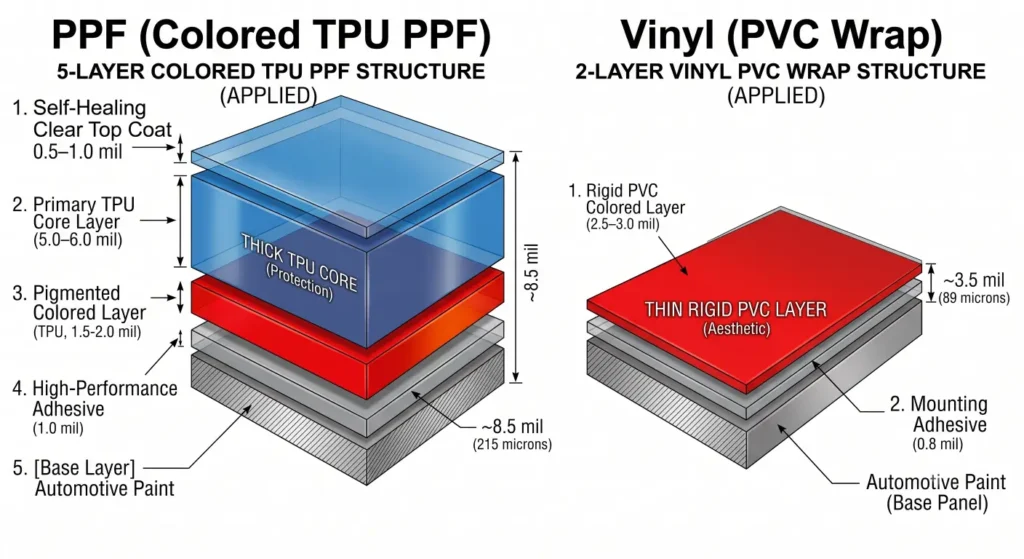
Vinyl wraps use PVC as the base material, typically 3–4 mil thick, with a 1–3 year outdoor lifespan. The color and texture range is enormous — carbon fiber, matte, satin, brushed metal, chrome, and hundreds of solid colors. The primary job is transformation: turning a white fleet van into a branded delivery vehicle, or giving a sports car a matte finish without a paint booth. But the secondary job — shielding factory paint from UV, minor scratches, and road grime — is real. For commercial fleet operators, a wrap does two things at once: branding and paint preservation. Both show up on the balance sheet.
Colored PPF sits at the intersection of protection and style. Built on a TPU base — the same material as clear PPF — it delivers 6–8 mil of thickness, self-healing capability, and 3–5 year durability, all in a pigmented or textured finish. Think of it as PPF that happens to be colored, not a vinyl wrap pretending to be PPF. That distinction matters for catalog positioning: colored PPF commands a higher price point and appeals to customers who want premium protection and a unique look.
For distributors, this category deserves close attention. Wraps typically carry better margins than clear PPF — installation is labor-intensive and repeatable (customers change colors every few years), creating a recurring revenue stream. A well-structured catalog places clear PPF as the protection anchor and wraps/colored PPF as the style-and-protection upsell. Both belong in the “paint protection” conversation.
What Makes a Quality PPF: Material, Construction, and Performance
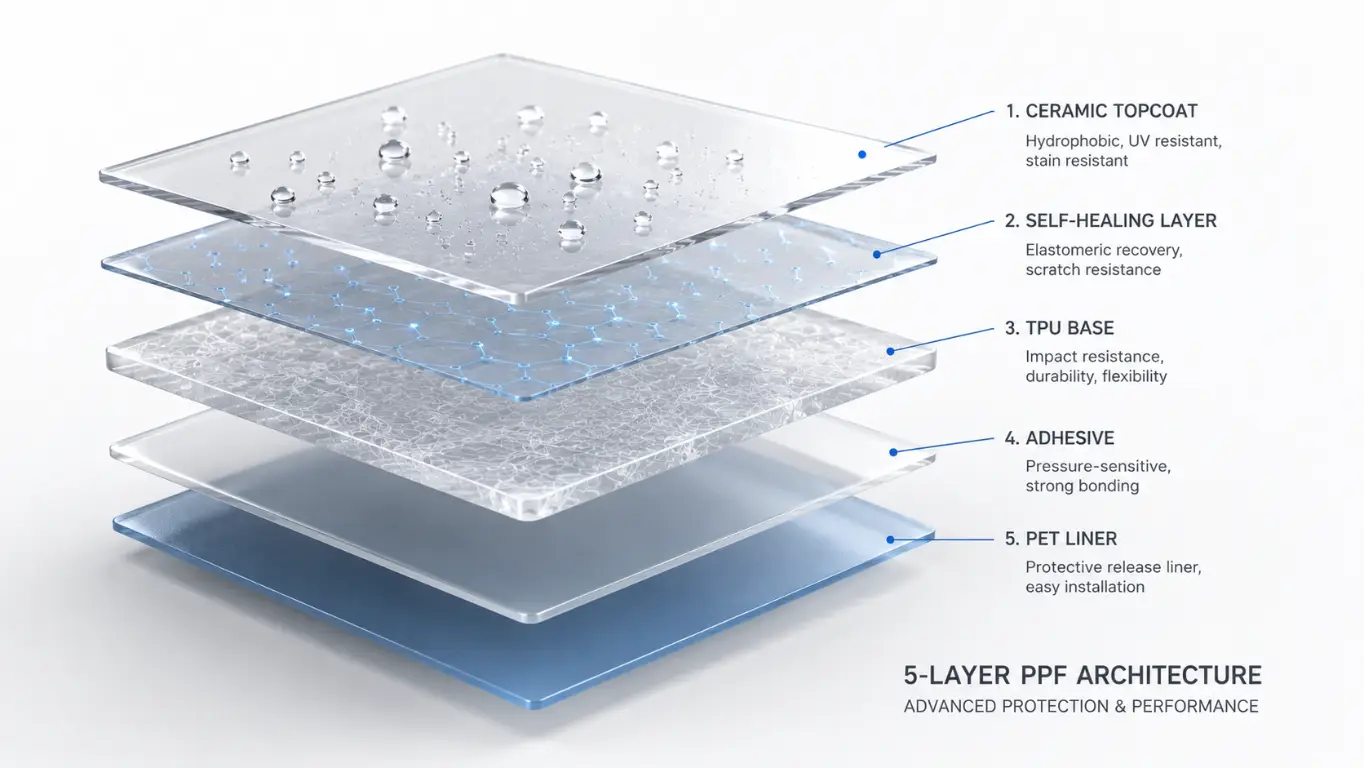
A PPF’s performance comes down to three layers working together: the TPU substrate that forms the film’s body, the adhesive that bonds it to paint, and the topcoat that handles everything the outside world throws at it. Each layer can be built well or built cheap — and you’ll see the difference in months, not years.
TPU Substrate: Aliphatic vs. Aromatic and Why It Matters
The single most important variable in PPF quality — the one that determines whether a film stays clear or yellows — is the chemistry of its base layer.
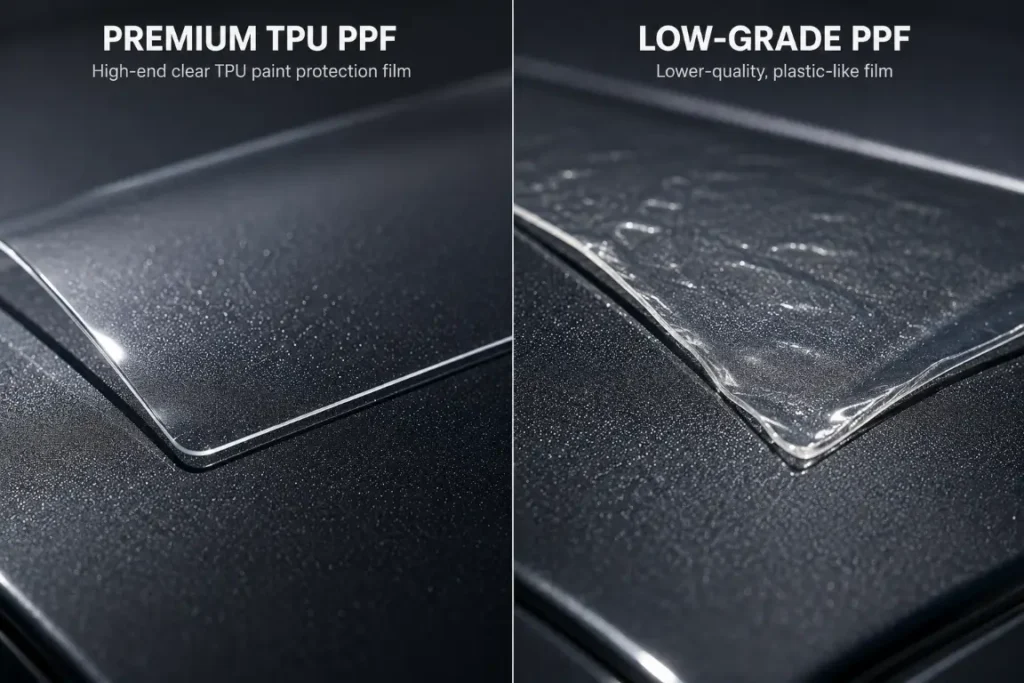
Aliphatic TPU, made from HDI or H₁₂MDI diisocyanates, contains no benzene rings in its molecular backbone. Aromatic TPU, made from MDI (diphenylmethane diisocyanate), does. Those benzene rings are exactly the structural feature that photo-oxidizes under UV exposure, producing quinone-like chromophores — compounds that look yellow-brown to the naked eye. Even with UV stabilizers added, aromatic TPU yellows within 1–3 years outdoors. Aliphatic TPU has no such degradation pathway. It maintains color stability through 5,000+ hours of QUV accelerated weathering (ASTM G154), correlating to a 10+ year real-world lifespan.
10+ year clarity. No benzene rings — UV-stable at the molecular level. Maintains color through 5,000+ hours of QUV testing (ASTM G154). The gold standard for premium PPF.
1–3 year yellowing. Benzene rings photo-oxidize under UV into yellow-brown chromophores. Even with stabilizers, outdoor yellowing is inevitable. Cost-engineered, not protection-engineered.
Between the extremes sit TPH (thermoplastic hybrid) films at 3–5 year durability and PVC films at 1–3 years — the latter better suited to short-term color-change wraps than long-term clear protection.
For procurement, the practical test is straightforward: does the supplier identify their TPU resin source? The three global benchmarks are Lubrizol (USA), BASF (Germany), and Arkema (France). A manufacturer that transparently names its resin supplier — and backs it with third-party ASTM G154 test data — plays in a different league than one handing you an internal spec sheet and a smile.
Adhesive Systems: The Invisible Decision Maker
Adhesive failure is the most common warranty claim in PPF — edge lifting, bubbling, and residue left on factory paint all trace back to the adhesive layer. A properly formulated pressure-sensitive adhesive (PSA) must satisfy three competing demands: allow repositioning during install, develop strong adhesion after curing (0.3–0.6 N/mm per ASTM D3330), and release cleanly years later.
Climate matters too. Installers in the Middle East need low initial-tack adhesives that don’t become unworkable at 45°C. Shops in Northern Europe need formulations that cure in cold, damp conditions. Ashland (USA) is the dominant global supplier — its name on a spec sheet is a meaningful quality signal.
Self-Healing Topcoats and Surface Properties
Self-healing is PPF’s most hyped feature — and its most misunderstood. The mechanism is elastomeric recovery: the topcoat’s polyurethane chains, heated past ~40–50°C, snap back to their original configuration, erasing shallow scratches. The key word is shallow. A scratch that cuts through the topcoat will not heal. Period.
Beyond self-healing, the topcoat defines surface behavior: hydrophobic (≥100° contact angle — beads water) or hydrophilic (sheets water to prevent spots). The topcoat must also resist bird droppings, bug splatter, tree sap, and commercial car wash detergents. A topcoat backed by 5,000-hour QUV validation separates a film that looks new at year five from one that looks tired by year two.
Ceramic Coatings and Liquid Protectants: Beyond the Hype
No category of car paint protection products gets marketed harder — or more dishonestly — than ceramic coatings. Three claims in particular need a hard look.
“9H hardness — harder than your clear coat.” The 9H refers to the pencil hardness test (ASTM D3363). A 9H pencil leaves no visible scratch on a cured coating. This has zero connection to the Mohs hardness scale, where 9 means corundum (ruby/sapphire). A ceramic coating won’t stop a key, a rock, or a firm fingernail. What it resists are micro-swirls from bad washing — and that alone is worth paying for.
“Permanent protection.” No ceramic coating is permanent. Professional-grade formulas (SiO₂ at or above 80%) deliver 2–5 years. Consumer sprays (SiO₂ 5–20%) last months. SiO₂ concentration is the single most reliable predictor of longevity.
“Scratch-proof.” Ceramic coatings reduce swirl marks from washing. They do not prevent mechanical damage. The gap between “swirl-resistant” and “scratch-proof” is the gap between honest marketing and hype.
- 9H = pencil hardness, not Mohs hardness. A key will still scratch it.
- No coating is permanent — professional grades last 2–5 years with proper care.
- Swirl-resistant ≠ scratch-proof. Mechanical impact still damages the surface.
For buyers evaluating ceramic coating lines, two factors drive the decision: SiO₂ concentration and application complexity. The newer SiCarbon+ technology — swapping carbon for oxygen in the SiO₂ molecular matrix — produces denser coatings with larger water contact angles. It’s becoming a meaningful differentiator among premium brands.
Comparing Paint Protection Options: A Use-Case Framework
The wrong question: “Which car paint protection product is best?” The right question: “Which product fits a given customer’s driving conditions, budget, and expectations?”
| Product Type | Protection | Lifespan | Rock Chip | Hydrophobic | Cost (Installed) | DIY | Best For |
|---|---|---|---|---|---|---|---|
| PPF (Aliphatic, front) | ★★★★★ | 7–10 yrs | ✅ | ≥100° | $1,500–$4,000 | ❌ | Highway drivers, luxury |
| PPF (Full car) | ★★★★★ | 7–10 yrs | ✅ | ≥100° | $4,000–$9,000 | ❌ | Collector cars |
| Colored PPF (TPU) | ★★★★☆ | 3–5 yrs | ✅ | ≥100° | $2,500–$6,000 | ❌ | Style + protection |
| Ceramic (Pro-grade) | ★★★☆☆ | 2–5 yrs | ❌ | ≥100° | $1,000–$3,000 | ⚠️ | Daily drivers |
| Vinyl Wrap (PVC) | ★★☆☆☆ | 1–3 yrs | ⚠️ | Low | $1,500–$4,000 | ❌ | Fleets, color-change |
| Ceramic Spray | ★★☆☆☆ | 3–12 mo | ❌ | 80–95° | $20–$100 | ✅ | Budget DIY |
| Carnauba Wax | ★☆☆☆☆ | 4–8 wks | ❌ | Moderate | $10–$50 | ✅ | Short-term shine |
| Synthetic Sealant | ★★☆☆☆ | 3–6 mo | ❌ | Moderate | $15–$80 | ✅ | Budget maintenance |
Scenario 1: The highway commuter. Eighty kilometers a day on interstates, gravel trucks everywhere. No amount of ceramic coating stops a stone at highway speed. PPF — even just a front-end package — is the only product that matches the actual risk. For a dealership or detailer, this is the highest-margin upsell because the value proposition doesn’t need explaining.
Scenario 2: The urban daily driver. Parks outdoors, washes every few weeks, wants it to look good with minimal effort. Ceramic coating hits the sweet spot: hydrophobicity cuts wash time, gloss is visible, 2–5 year lifespan lines up with ownership cycles. PPF would be overkill; wax would be underkill.
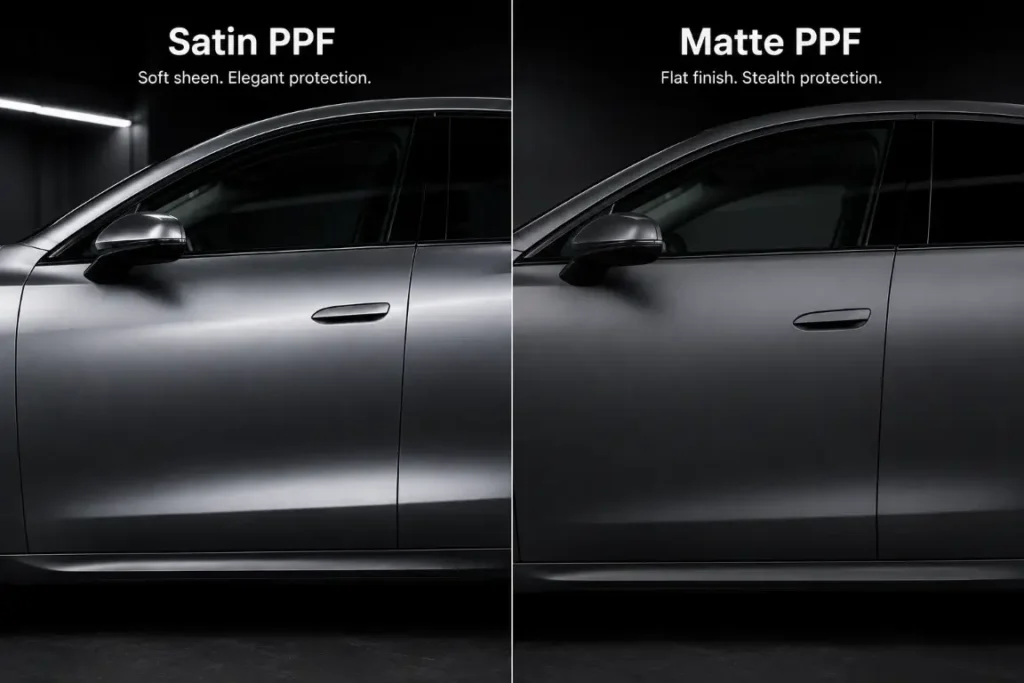
Scenario 3: The style-conscious owner. Wants the car to stand out — matte finish, unique color, or branded graphics — and expects the film to protect the paint underneath. Colored PPF or a quality vinyl wrap delivers on both counts. For commercial fleets, a wrap earns its keep twice: branding ROI on the outside, factory paint preserved for resale on the inside.
Scenario 4: The budget-conscious owner. Leasing for 2–3 years, or unwilling to spend four figures on paint protection. A quality synthetic sealant reapplied every 3–4 months — or a consumer SiO₂ spray every 6–12 months — gives meaningful UV and contamination protection at a price that sells itself.
What to Look for When Sourcing Paint Protection Products
Knowing what makes a good product is the first half. Knowing how to verify that a supplier actually delivers it is the second — and for B2B buyers, this is where margin gets made or lost.
Material Quality Verification: Beyond the Spec Sheet
Every supplier can fill a PDF with impressive numbers. Independent verification is what separates manufacturers from middlemen. Before committing to a bulk order, ask for third-party lab reports covering: UV accelerated weathering (ASTM G154, UVA-340 at 0.89 W/m²·nm), tensile strength and elongation (ASTM D882 — premium TPU should clear 30 MPa with >200% elongation), peel adhesion (ASTM D3330 — target 0.3–0.6 N/mm), and optical transmission with haze (ASTM D1003 — ≥90% for a film invisible once installed).
These requirements apply to colored PPF and wraps as well. PVC films should at minimum provide UV stability data and dimensional stability under heat — PVC shrinks, and a wrap pulling back from panel edges in month six is a warranty nightmare.
Supplier transparency on raw materials is a strong leading indicator. A manufacturer that names its TPU resin source (Lubrizol, BASF, Arkema) and adhesive supplier (Ashland) is telling you its claims can be checked.
The physical sample test cannot be skipped. Order 1–2 test rolls, install on actual vehicles, and watch for at least 30 days — 90 is better. A spec sheet can lie; an installed film on a parked car cannot.
Supplier Evaluation: Red Flags and Green Lights
Price is the easiest metric to compare. It should not be the deciding one.
The best risk mitigation tool in the industry is simple: request samples from 2–3 shortlisted suppliers → install and observe for 30–90 days → negotiate pricing based on what you saw → place a trial order of 10–20 rolls before container volumes. Skip steps, and you’re gambling.
Customization and OEM: Building Your Own Product Line
For private-label buyers and distributors who want to stand out rather than compete on price, customization depth is a direct measure of a manufacturer’s R&D capability. Customization runs on a spectrum — from packaging and branding at entry level, through specification customization (thickness, hydrophobicity, finish, color matching), to formulation-level R&D collaboration at the advanced tier.
For wraps and colored PPF, exclusive color and texture development is the most valuable customization — an exclusive palette is a genuine competitive moat. The procurement questions that matter: what’s the minimum order quantity at each tier? How fast is design-to-sample turnaround? Who owns the IP on co-developed formulations? A 48-hour design proof is the speed benchmark; most manufacturers run on 5–10 business days.
from 2–3 suppliers
30–90 Days
on Results
10–20 Rolls
Building Your Paint Protection Strategy: From Product Knowledge to Purchase Decision
You now have the technical lens to evaluate any car paint protection product on its merits and the sourcing framework to tell reliable suppliers from marketing operations. What’s left depends on your business model.
If you’re a distributor or dealer: Request samples from 2–3 manufacturers that meet the quality benchmarks above. Build a tiered catalog — premium clear PPF for high-margin protection customers, a colored PPF and vinyl wrap line for the style-and-protection segment, a value ceramic coating for volume, and a sealant or spray for entry-level buyers.
If you’re a detailer or installer: Pick 2–3 core SKUs that cover the customer spectrum — highway commuter, urban daily driver, style-conscious owner, budget-conscious owner — and master the install on each before adding more. One product installed flawlessly builds more trust than ten products installed inconsistently.
If you’re a car owner reading this: Match your driving conditions — not your neighbor’s recommendation — to the right product category. Then find an installer who can show you actual work on vehicles you can inspect in person.
Whichever path you’re on, one principle holds: seeing a physical sample on a real vehicle tells you more than any catalog, spec sheet, or website ever will.
References
- Infinita Lab. “ASTM G154 UV Exposure Procedure Guide.” 2025. https://infinitalab.com/blog/astm-g154-uv-exposure-procedure-guide/
- KPAL Automotive. “Aliphatic TPU and Aromatic TPU PPF Car Wrap.” https://www.kpalautomotive.com/blog/…
- KPAL Automotive. “Analysis of TPU Selection for PPF.” https://www.kpalautomotive.com/blog/…
- KPAL Automotive. “Why Do Paint Protection Films Yellow?” https://www.kpalautomotive.com/blog/…
- Alibaba.com. “PPF Supplier Guide for B2B Procurement.” https://www.alibaba.com/price-comparison/ppf-supplier
- Dupotop Films. “Clear PPF vs Color PPF: Inventory Guide for Distributors.” https://dupotopfilms.com/clear-vs-color-ppf-inventory-guide/
- FlexiPPF. OEM & Customization. https://www.flexippf.com/oem/
- FlexiPPF. Contact. https://www.flexippf.com/contact/
- FlexiPPF. Homepage. https://www.flexippf.com/
 English
  Spanish
  Dutch
Dutch  Japanese
  Russian
  Arabic