
What Is Thin Film Coating?
If you have ever installed a screen protector on your phone, you have already handled thin film coating technology. The same principle — an ultra-thin engineered layer bonded to a surface — powers the films on your car’s paint, your office windows, and the anti-reflective coating on your sunglasses.
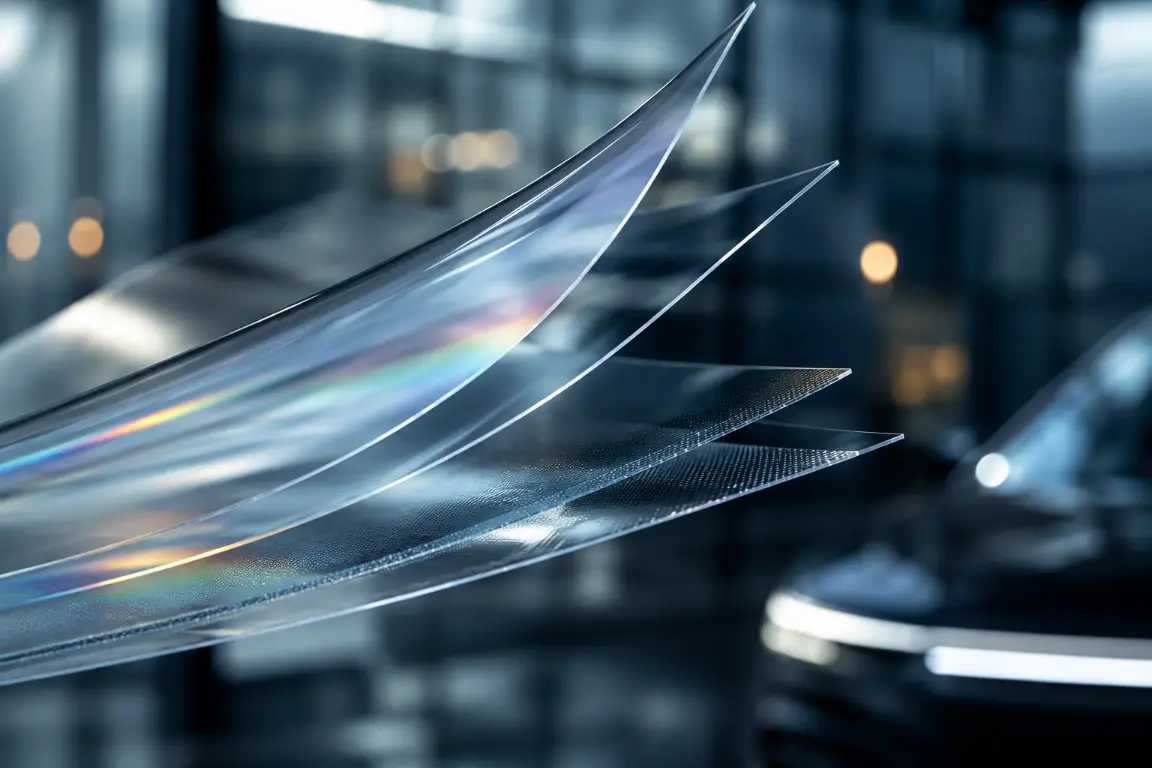
A thin film coating is a functional layer, measured in microns or nanometers, deposited onto a substrate to add or enhance specific properties. In the automotive and architectural world, these are pre-manufactured multi-layer film products — typically 6.5 to 10.5 mil (165 to 267 microns) thick — engineered for specific optical clarity, thermal control, and mechanical durability. They are not spray-on coatings that cure chemically on a surface. They are precision-manufactured films, usually built from a functional top coat, a substrate layer (often TPU or polyester), an adhesive layer, and a protective release liner.
This article focuses on ready-to-apply thin film products for automotive and architectural applications. If you are a car dealer, distributor, professional installer, or building manager evaluating film options for protection, energy savings, or aesthetics, this guide is written for you.
Types of Thin Film Coatings by Application
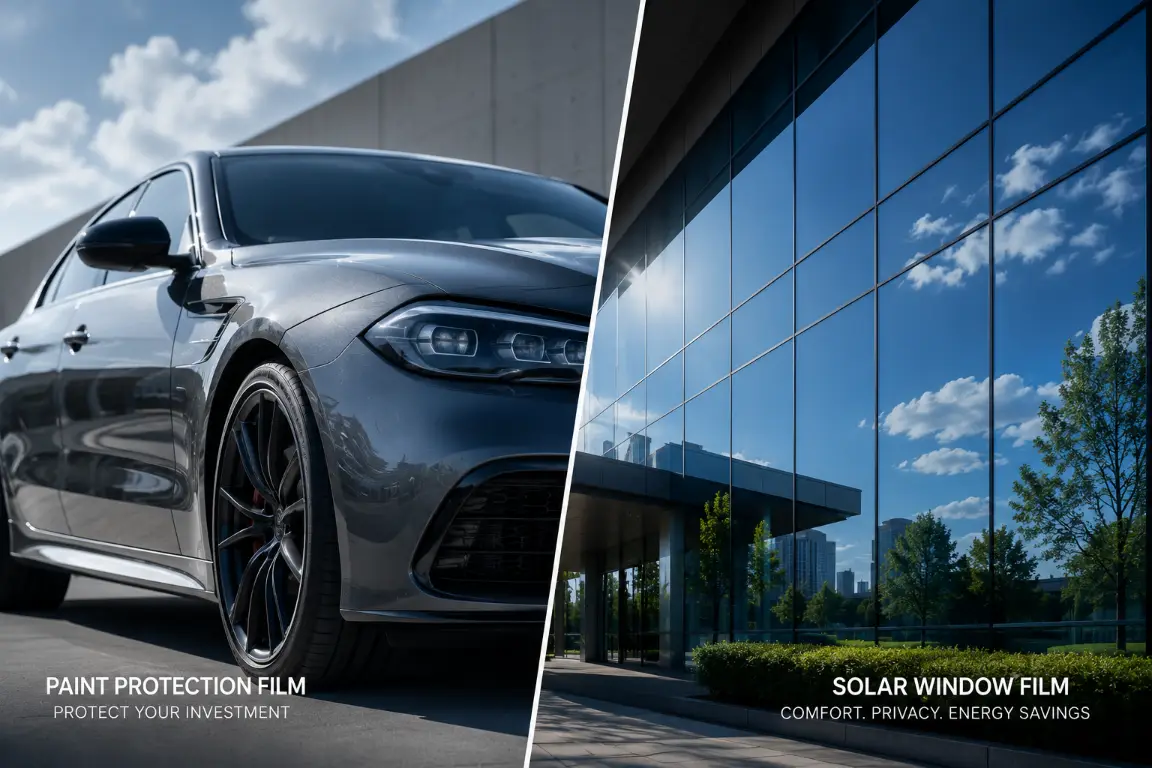
Thin film coatings fall into two broad categories based on where they are used: mobile surfaces (automotive) and stationary surfaces (architectural). The performance demands, installation methods, and selection criteria differ significantly between the two. Understanding each category separately is the first step toward making the right choice.
Automotive Thin Film Coatings
Most car owners encounter thin film coatings within the first month of vehicle ownership — even if they do not realize it. The automotive film category covers four main product types, each serving a distinct purpose.
Paint Protection Film (PPF) is the heavyweight of the category. Made from thermoplastic polyurethane (TPU), PPF forms a transparent, impact-absorbing shield over painted surfaces. It protects against stone chips, road debris, light scratches, and insect etching. Premium PPF products feature a self-healing top coat: shallow scratches disappear when exposed to heat — around 80°C from hot water or direct summer sunlight. Typical PPF thickness ranges from 6.5 to 10.5 mil, with thicker films offering greater impact resistance.
Window Tints reduce cabin heat, block ultraviolet radiation, and add privacy. Available in dyed, metallized, and ceramic formulations, they are differentiated by their Visible Light Transmission (VLT) rating — the percentage of visible light that passes through. VLT options typically range from 5% (limo-dark) to 95% (near-clear). A critical distinction: metallized films can interfere with GPS, 5G, and toll pass signals by attenuating radio frequencies by 20–30 dB. Ceramic films, by contrast, are RF-transparent and fully compatible with modern vehicles equipped with advanced driver-assistance sensors.
Headlight and Windshield Tints offer targeted protection for specific glass surfaces — shielding headlight lenses from UV-induced yellowing and reducing windshield glare. Some jurisdictions impose minimum VLT requirements for front windshields, so always verify local regulations before specifying a product.
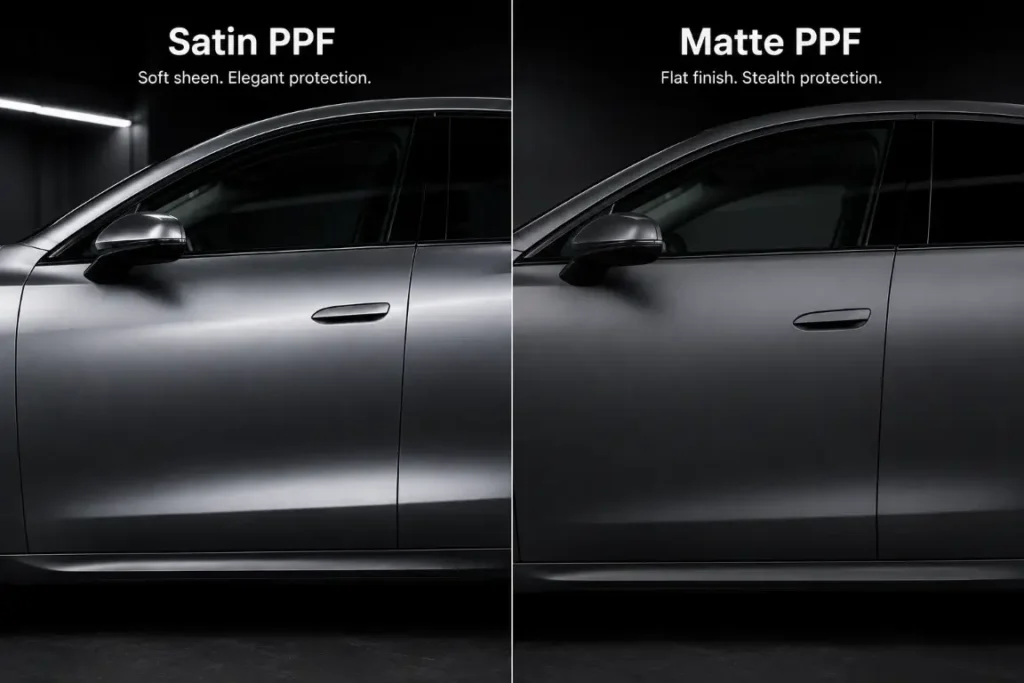
Car Wraps and Color-Change Vinyl occupy the aesthetic end of the spectrum. Available in matte, gloss, satin, carbon-fiber, and brushed-metal textures, these films allow full or partial vehicle color changes without repainting — and can be removed to restore the original finish.
Architectural Thin Film Coatings
Architectural films are the most underappreciated tool in building energy management. Applied to existing windows, they can reduce cooling loads by up to 30% — without the cost and disruption of window replacement. For facility managers and building owners, this means a typical return on investment within 2 to 5 years through electricity savings alone.
Solar Control Films are the workhorse of the category. By reflecting or absorbing infrared and ultraviolet radiation, they reduce solar heat gain and cut glare. Performance is measured by Total Solar Energy Rejected (TSER), which accounts for energy across all three solar spectrum bands: ultraviolet (3%), visible light (44%), and infrared (53%). Premium solar control films achieve TSER values of 60% to 80%.
Safety and Security Films transform standard annealed glass into a barrier against forced entry, smash-and-grab theft, and injury from shattered glass during storms or seismic events. These films — typically 4 to 15 mil thick — hold glass shards together upon impact. At 7 mil thickness, properly installed safety film with an attachment system can meet ANSI Z97.1 and CPSC 16 CFR 1201 impact safety standards.
Decorative Films serve aesthetic and functional purposes: creating privacy through frosted or patterned finishes, displaying branding and wayfinding graphics, or applying Pantone-matched colors for interior design statements. Unlike etched or printed glass, decorative films are reversible — a significant advantage for leased commercial spaces.
Key Performance Metrics That Matter
Marketing claims in the film industry are abundant, but only a handful of measurable physical parameters actually determine a product’s real-world performance. Understanding these four dimensions — and knowing the industry benchmarks for each — lets you evaluate products objectively rather than relying on brochure language.
UV Protection and Optical Clarity
Ultraviolet blocking above 98% is now the industry baseline — almost every reputable film product achieves this. The real differentiators in optical quality are more subtle.
Visible Light Transmission (VLT) is a specification, not a virtue. Lower VLT means darker tint, which some buyers want for privacy — but it is not inherently “better.” For automotive front windshields, most jurisdictions require VLT of 70% or higher. For architectural applications, VLT choice depends on the balance between daylight harvesting and heat rejection.
Haze — measured per ASTM D1003 — is the clarity metric that separates premium films from budget alternatives. Below 1% haze means optical-grade clarity. Above 2%, the film produces a visible milky or cloudy appearance that becomes distracting in direct light. Always ask for haze specifications, not just “clarity” claims.
Gloss matters specifically for PPF. Measured at a 60° angle in Gloss Units (GU), premium films achieve ratings of 95 GU and above — matching or exceeding factory clear coat finishes.
Durability, Self-Healing, and Warranty
Durability is the invisible dimension that separates a one-year film from a ten-year investment. B2B buyers — distributors, fleet managers, dealerships — care about durability more than any other metric because warranty claims and reinstallation costs hit their bottom line directly.
Anti-yellowing is validated through accelerated weathering tests, typically SAE J2527 xenon-arc exposure. Premium TPU-based films demonstrate stability beyond 5,000 hours of continuous exposure — roughly equivalent to 5 to 7 years of real-world sun exposure in a high-UV climate.
Self-healing is not marketing fiction — it is polymer physics. The elastomeric top coat on a quality PPF responds to heat by allowing its molecular chains to re-flow and fill shallow scratches. The trigger temperature is around 80°C, easily reached by pouring hot water over the surface or parking in direct summer sun. Deep cuts that penetrate through the top coat into the TPU layer will not self-heal — which is why thickness matters for impact protection.
Adhesion quality determines whether a film stays put for a decade or peels in year three. The industry standard test is ASTM D3330 peel adhesion. A properly bonded film should require consistent, measurable force to remove and should leave no adhesive residue on the substrate — a critical consideration for leased vehicles and commercial properties.
Warranty is only as good as its fine print. A “10-year warranty” that excludes fading, edge lift, and installer error is functionally a 2-year warranty. Read the exclusions before comparing warranty durations.
Heat Reduction and Energy Efficiency
Heat rejection is the most frequently manipulated specification in the film industry. The gap between marketing numbers and real-world performance can be substantial.
Total Solar Energy Rejected (TSER) is the only honest metric for comparing heat rejection across products. It measures the percentage of total solar energy — ultraviolet (3%), visible (44%), and infrared (53%) combined — that the film prevents from passing through the glass. A film advertising “95% IR rejection” may only achieve 50% TSER because it absorbs visible-spectrum heat rather than reflecting it. TSER tells the full story; single-band IR numbers do not.
The distinction between reflective and absorptive films has real consequences. Reflective films — including Low-E coatings with emissivity values at or below 0.10 — bounce solar energy back outward, keeping both the glass and the interior cool. Absorptive films trap heat in the glass itself, which then radiates inward. For architectural applications, applying a high-absorption film to insulated (double-pane) glass can create a dangerous thermal stress differential. Temperature differences exceeding 30°C across the pane can cause glass to crack — one of the most common and costly mistakes in architectural film specification.
For building projects, look for films carrying NFRC (National Fenestration Rating Council) certification. An NFRC label provides independently verified U-factor, Solar Heat Gain Coefficient (SHGC), and Visible Transmittance data — the same metrics used in energy codes and LEED certification calculations.
How to Choose the Right Thin Film Coating for Your Needs
The best film is not the one with the highest numbers — it is the one that matches your actual use case. Before diving into product categories, evaluate your situation against three universal decision dimensions: climate conditions (high-temperature and high-UV environments demand fundamentally different films than temperate regions), usage intensity (a daily commuter car faces different stress than a commercial fleet vehicle operating 12 hours a day), and budget horizon (a low-cost film replaced every 2 years often costs more over a decade than a premium film with a 10-year warranty).
Choosing Films for Automotive Applications
Automotive buyers face product-category overload: PPF, ceramic coating, window tint, color-change wrap — what goes on first, and what actually matters for your use case?
Start by identifying your primary need rather than browsing product catalogs. A new car owner wanting to preserve factory paint should prioritize PPF — the original paint’s protection window closes the moment the car leaves the showroom. An owner of an older vehicle seeking a cosmetic refresh will get far more value from a color-change wrap. Someone who parks outdoors in a high-UV climate should address window tint before considering PPF — because interior dashboard and leather degradation from UV exposure is cumulative and irreversible.
If your vehicle has GPS navigation, 5G connectivity, toll passes, or advanced driver-assistance sensors, avoid metallized window films. These films can attenuate RF signals severely enough to cause navigation dropouts and toll pass failures. Ceramic and nano-ceramic films provide equivalent heat rejection without signal interference.
Finally, read the warranty exclusions before comparing brands. A PPF warranty that excludes “edge lift” and “impact damage beyond 2 mm” leaves the most common real-world failure modes uncovered. Look for warranties that explicitly cover yellowing, cracking, bubbling, and adhesive failure — not just “manufacturing defects.”
Choosing Films for Architectural Projects
Architectural film selection requires a different decision sequence than automotive — starting with the glass, not the film.
The first and most critical step is a glass audit. Is the existing glazing single-pane or insulated (double-pane)? Does it already have a Low-E coating, and if so, on which surface? What is the window orientation and daily sun exposure duration? These factors determine which film types are physically safe to apply. The most expensive mistake in architectural film specification — thermally induced glass breakage — occurs when a high-absorption film is applied to insulated glass without accounting for thermal stress. If the temperature difference across the glass pane exceeds approximately 30°C, the risk of cracking becomes significant.
Once glass compatibility is confirmed, quantify the energy savings. A well-specified solar control film on a south-facing commercial façade can reduce annual cooling costs by 25 to 35%. For a 10-story office building with 500 square meters of glazed south-facing surface, this translates to measurable electricity savings — figures that provide the ROI justification facility managers need for budget approval.
Compliance matters. Some historic districts restrict visible light reflectance on exterior windows (commonly capped at 20%). NFRC-certified films provide independently verified performance data that can be submitted for building permit applications and LEED certification credits — a practical advantage that non-certified alternatives cannot match.
Finding a Reliable Thin Film Coating Supplier
Once you know what product you need, the final step is finding a manufacturer who can deliver consistent quality — not just a convincing sample. Global procurement of thin film products carries specific risks: a sample roll can be flawless while bulk production varies batch to batch; a warranty is meaningless if the supplier becomes unreachable six months after delivery.
The table below provides a structured framework for evaluating potential suppliers across the dimensions that matter most in real-world procurement:
| Evaluation Dimension | Basic | Good | Excellent |
|---|---|---|---|
| Factory Scale & Equipment | Single production line | ≥10,000 m² facility, imported coating machines | ≥50,000 m², multiple extrusion lines, Class 10,000 cleanrooms |
| Raw Material Sourcing | Domestic generic resins | Partial imported materials | Branded premium inputs (Lubrizol/BASF TPU, Ashland adhesive) with traceable supply chain |
| Warranty Terms | Verbal promise only | Written warranty, ≥5 years | 10-year written warranty with clear claims process and defined coverage scope |
| Customization Capability | Standard catalog specs only | Color/size adjustments | Full OEM: custom formulation, Pantone color matching, private-label packaging, logo, and pattern design |
| Lead Time & Service | ≥30 days | 15–30 days | ≤15 days, 48-hour design proofs, same-day in-stock shipping, 24/7 support |
| Certifications & Quality Control | No external verification | Internal QC lab with basic equipment | Third-party certification, full-spectrum lab (spectrophotometer, haze meter, adhesion tester, weathering chamber) |
Before negotiating price, verify three minimum requirements: the factory has a dust-controlled production environment (cleanroom), the primary raw materials have a traceable supply chain back to named suppliers, and the warranty is a written document — not a verbal assurance. If a supplier cannot satisfy all three, the price is irrelevant.
Some manufacturers have built their business around filling the gap between commodity suppliers and premium global brands. For example, FlexiPPF — operating from a 60,000 m² Shenzhen facility with four extrusion lines and eight Korean-imported coating machines — offers full OEM customization down to a single roll, with 48-hour design turnaround and Pantone-matched color options for architectural projects. This category of supplier appeals to distributors and private-label brands who need manufacturing capability without the volume commitments that larger factories typically demand.
The global window film market was valued at over $13 billion and is growing at 6–8% annually. Asia-Pacific accounts for roughly 42% of global demand. New suppliers enter the market regularly. A structured evaluation framework protects against the temptation to choose based on the lowest quote — and helps ensure that the film you receive in month 12 matches the sample you approved in month one.
The information in this article draws on technical standards published by the International Window Film Association (IWFA), ASTM International, and the National Fenestration Rating Council (NFRC). For specific product performance data, always request current specification sheets directly from manufacturers.
References
- International Window Film Association (IWFA). “Window Film Education and Technical Resources.” https://iwfa.com
- ASTM International. “ASTM D1003 — Standard Test Method for Haze and Luminous Transmittance of Transparent Plastics.” https://www.astm.org/d1003-21.html
- ASTM International. “ASTM D3330 — Standard Test Method for Peel Adhesion of Pressure-Sensitive Tape.” https://www.astm.org/d3330-d3330m-04r18.html
- National Fenestration Rating Council (NFRC). “Certified Products Directory.” https://nfrc.org
- Fortune Business Insights. “Window Film Market Size, Share & Industry Analysis, 2025–2034.” https://www.fortunebusinessinsights.com/window-film-market-102081
- FlexiPPF. “OEM & Customization Services.” https://www.flexippf.com/oem/
- FlexiPPF. “Automotive & Architectural Film Products.” https://www.flexippf.com/
 English
  Spanish
  Dutch
Dutch  Japanese
  Russian
  Arabic