
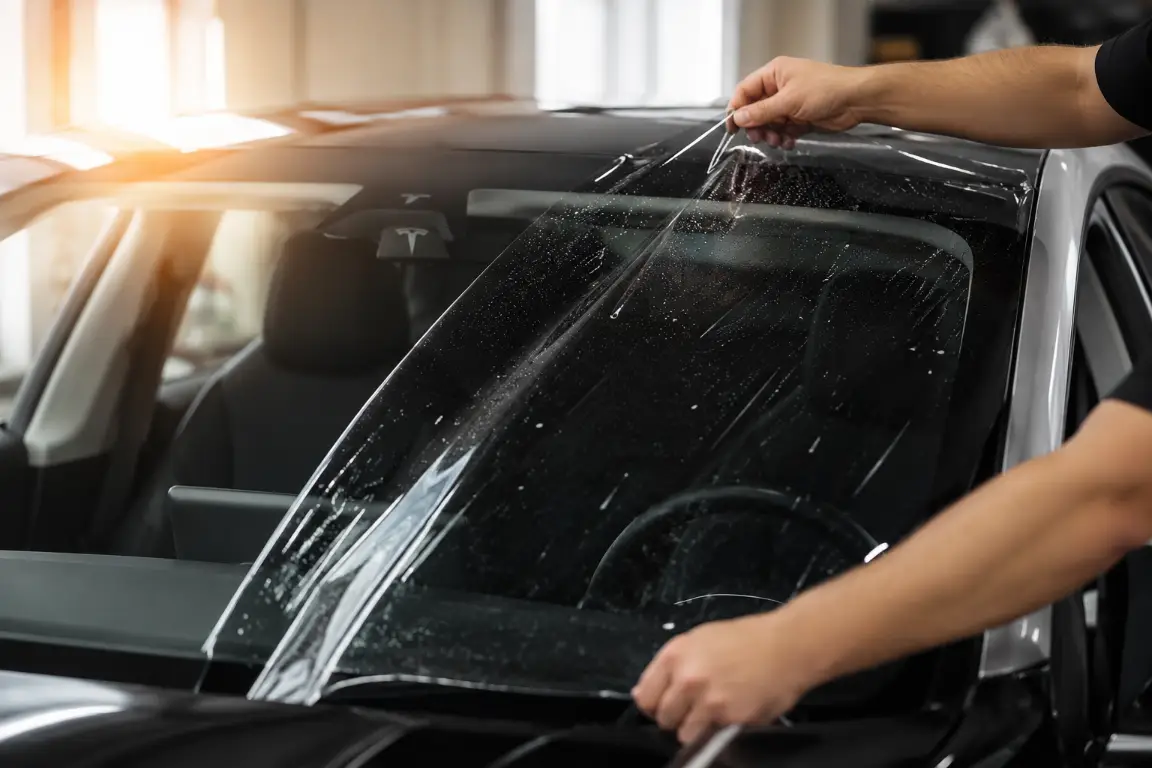
A cracked Tesla windshield is not a $300 problem. Between the glass itself, the ADAS camera recalibration, and the labor, a single replacement runs anywhere from $1,000 to $1,700 — and Tesla’s factory warranty rarely covers it. For Tesla owners, this is a known anxiety. For the dealerships, detailers, and aftermarket shops that serve them, it is an overlooked revenue opportunity hiding in plain sight.
This guide is written for the B2B buyer: the distributor sourcing inventory, the 4S dealership evaluating add-on services, the detail shop owner deciding which windshield protection film to stock. By the end, you will know how to evaluate film quality at the parameter level, how to vet suppliers, and how to turn windshield protection into a profitable line of business.
Why Tesla Windshields Are a Growing Concern for Owners and Dealers
Tesla windshields are not ordinary auto glass. Behind the glass sits a forward-facing camera cluster that powers Autopilot, Full Self-Driving, and automatic emergency braking. When the windshield is replaced, that camera must be recalibrated. That procedure adds $300 to $500 to the bill on top of the glass and labor. Third-party shops can do the work, but many owners fear (rightly or not) that only a Tesla Service Center can get the calibration right.
The result is a repair bill that routinely lands between $1,000 and $1,700 for a Model 3 or Model Y — the two highest-volume Tesla models on the road. Tesla itself acknowledged the cost burden by launching a windshield protection subscription plan in 2025: $12 per month for Model 3/Y owners, scaling to $35 per month for Cybertruck. It covers one free replacement per year, unlimited chip repairs, and the mandatory ADAS recalibration. The math is straightforward: five years of the Model Y plan costs $720, while a single replacement without coverage costs $1,200 or more. One incident pays for the plan.
But the subscription reveals a deeper problem. Tesla windshields crack often enough that a recurring insurance product makes commercial sense. Owners on Tesla forums report “stress cracks” — spontaneous fractures originating from the bottom edge of the glass with no impact event, particularly on 2023–2026 Model Y and Model 3 vehicles. Tesla Service has, in multiple documented cases, classified these as wear and tear and denied warranty coverage, leaving owners with the full replacement bill.
The insight for the B2B buyer is not that Tesla’s subscription plan exists. It is that every Tesla owner who hears about a $1,700 windshield replacement is a prospective customer for physical windshield protection: a film that absorbs stone impacts before they reach the glass. Insurance reimburses after the damage. A protection film prevents the damage from happening at all.
(glass + ADAS calibration + labor)
(5–10 year lifespan, one-time cost)
Windshield Protection Options: What Actually Works
Not all “protection” is created equal. The table below compares the four paths a Tesla owner can take — and the one that creates the strongest business case for a B2B seller.
| Protection Approach | Mechanism | Typical Cost per Vehicle | Effective Lifespan | Best For |
|---|---|---|---|---|
| Tesla Protection Plan (subscription) | Insurance-style reimbursement | $144–$420/year | Ongoing | Individual owners who prefer monthly payments |
| Windshield Protection Film (TPU) | Physical impact-absorbing barrier | $200–$500 (installed) | 5–10 years | Comprehensive pre-damage protection |
| Ceramic Glass Coating | Chemical surface treatment | $50–$150 | 1–3 years | Light protection; water/dirt repellency |
| No Protection | None | $0 | Until the first crack | High risk; one incident = $1,000+ |
The critical distinction is between a film and a coating. A TPU windshield protection film — typically 6.5 to 7.5 mil thick — absorbs and disperses the kinetic energy of a stone impact across its polymer matrix. A ceramic coating changes the surface energy of the glass (making water bead and dirt slide off), but it offers essentially zero impact resistance. It is the difference between a helmet and a raincoat.
For the B2B buyer, the film represents the highest-margin, highest-value product in this category. It is a physical good with professional installation, creating a service revenue stream that a subscription or a spray-on coating cannot match.
Inside a Quality Windshield Protection Film: The Parameters That Separate Premium from Commodity
A windshield protection film is only as good as three layers: the substrate that absorbs the impact, the adhesive that keeps it bonded, and the top coat that defends against the elements. Understanding each layer is what separates a buyer who shops on price from one who shops on quality.
The Material Foundation: TPU, Adhesive, and Top Coat
The film’s backbone is thermoplastic polyurethane (TPU). Not all TPU is equal. The raw material supply chain determines much of what the finished film can do. Lubrizol’s ESTANE® TPU, produced in the United States, is the industry reference standard: it delivers anti-yellowing performance exceeding 5,000 hours of accelerated UV exposure with a color shift (Delta E) below 0.10. BASF TPU from Germany is a respected alternative in the mid-to-premium tier. Generic domestic TPU particles, by contrast, show measurable yellowing at half the exposure duration. The difference becomes visible on a windshield within two to three years of daily sun.
The adhesive layer matters for two reasons that B2B buyers feel more acutely than consumers. First, installability: a repositionable adhesive (like Ashland’s formulation, the dominant choice in premium films) lets the installer slide the film into precise position before squeegeeing it down, cutting installation time and reducing waste. Second, removability: a quality adhesive peels clean after five or more years without leaving residue that requires solvents to remove. Cheap adhesives fail on both counts.
The top coat is the film’s first line of defense. A ceramic-infused top coat enables self-healing: minor swirl marks and surface scratches disappear within seconds when exposed to heat (hot water or ambient temperatures above 80°C). Without a ceramic top coat, the film’s surface degrades visibly within the first year.
When evaluating a supplier, ask these three questions: Which company manufactures your TPU? Which adhesive system do you use? Does your top coat contain ceramic particles? A supplier who cannot answer all three with named sources is telling you something.
Performance Metrics That Separate Premium from Commodity Films
Laboratory testing reveals what a showroom sample cannot. Six standardized metrics provide an objective quality baseline. Any supplier worth negotiating with should be able to produce third-party test reports for each.
| Metric | Test Standard | Premium Threshold | Why It Matters |
|---|---|---|---|
| Visible Light Transmission (VLT) | ASTM D1003 | ≥ 90% | Windshield films must preserve optical clarity; below 90%, nighttime visibility suffers |
| Haze | ASTM D1003 | < 0.9% | Haze above 1% creates a visible milkiness on the glass |
| Tensile Strength | ASTM D882 | ≥ 20 MPa | Determines whether film tears under stone impact or absorbs energy |
| Elongation at Break | ASTM D882 | ≥ 200% (premium: >400%) | Higher elongation = greater capacity to stretch rather than rupture |
| UV Aging (Delta E) | ASTM G154 | < 0.10 after 2,000 hrs | The anti-yellowing score; visible yellowing in 2–3 years = warranty liability |
| Tear Strength | ASTM D1004 | ≥ 100 N/mm | Resistance to crack propagation; low score = small nick turns into a tear |
A practical test: the next time a supplier sends you a sample, do not run your fingernail across it and call it a day. Ask for the ASTM D1003, D882, and G154 reports. A supplier who produces them without hesitation passed the first real filter. One who looks confused did not.
Manufacturing Quality: Why the Factory Floor Determines What Rolls Into Your Shop
Two films made from the same Lubrizol TPU, using the same adhesive system, with the same top coat chemistry can still perform differently. The variable is manufacturing precision.
The cleanliness of the production environment is the single largest determinant of optical clarity. A Class 100,000 cleanroom — common in general manufacturing — allows enough airborne particles to create microscopic surface defects known as “orange peel”: a subtle waviness invisible to the naked eye in isolation but noticeable as reduced sharpness when looking through the film on a windshield. Class 10,000 (ISO 7) is the practical minimum for automotive optical films. Class 1,000 (ISO 6) is the premium standard.
Coating precision compounds the effect. The thickness tolerance of each layer — ±2 microns for a premium line versus ±5 microns for a standard line — determines whether the film’s optical properties are consistent across the entire roll. Imported coating machines from South Korea and Germany hold the tighter tolerance; domestic equipment varies.
Finally, a factory’s quality control laboratory reveals how seriously it takes consistency. The benchmark setup includes, at minimum: a spectrophotometer (color accuracy), a haze meter (optical clarity), an adhesion tester (bond strength), a contact angle goniometer (hydrophobicity), an extreme-temperature chamber (weathering simulation), and a formaldehyde tester (VOC safety). A factory with three of these six is average. A factory with all six, calibrated and producing batch-level reports, is the one you want in your supply chain.
IATF 16949 certification — the automotive industry’s quality management standard, significantly more demanding than ISO 9001 — encompasses five core tools: Advanced Product Quality Planning (APQP), Production Part Approval Process (PPAP), Failure Mode and Effects Analysis (FMEA), Statistical Process Control (SPC), and Measurement Systems Analysis (MSA). A factory that holds IATF 16949 has been audited against the same process discipline expected of Tier 1 automotive suppliers. It is the strongest single signal of manufacturing maturity available short of an on-site visit.
- Which company manufactures your TPU?
- What class is your cleanroom?
- What equipment is in your QC lab?
How to Evaluate Windshield Film Suppliers Like a Pro
The previous section taught you how to judge the film. This section teaches you how to judge the company behind it. Three dimensions form a complete supplier evaluation: production capability, customization flexibility, and post-sale accountability.
Factory Scale, Certifications, and Production Capability
Production capability is the first hard filter. A supplier’s factory footprint — square meters, number of production lines, monthly output — tells you whether they can grow with you or will cap your volume within the first year. Context matters more than absolute numbers: a 60,000-square-meter factory with four extrusion lines and eight imported coating machines signals a different tier of operation than a 10,000-square-meter facility with a single line. Neither is inherently “bad.” They serve different buyer profiles.
Certifications provide the verification layer. IATF 16949 is the automotive industry gold standard: it signals that the factory operates under the same process discipline expected of companies supplying directly to automakers. ISO 9001 is the baseline, acceptable but not differentiating. A supplier with neither should not make your shortlist.
Raw material traceability completes the capability picture. A supplier should be able to show procurement documentation linking their TPU to Lubrizol, BASF, or another named manufacturer — not just claim it. The same applies to adhesive systems and top coat chemistry. Traceability is not a marketing detail. It is how you verify that the film you ordered in batch three is made from the same inputs as the sample that passed your tests.
Customization Flexibility: MOQ, Branding, and Technical Adaptability
A supplier’s minimum order quantity (MOQ) is the most honest signal of their willingness to work with growing businesses. The industry spans a wide range: some manufacturers will ship a single roll for testing, while others require 50 or more rolls to open an account. A 1-roll MOQ signals that the supplier is structured to support buyers who are still validating market demand — not just those who have already proven it.
Beyond MOQ, the depth of OEM and ODM capability reveals how much of the product the supplier is willing to adapt to your business rather than the other way around. Full OEM support spans four layers: custom formulation adjustments (thickness, self-healing performance, UV protection tuning), custom colors and finishes, custom packaging with your brand identity, and logo printing directly on the film liner. A 48-hour design turnaround — the industry benchmark for responsive custom work — indicates that the supplier has standardized its customization workflow rather than treating each request as a one-off project.
Product iteration cadence is a forward-looking signal. A supplier that launches two to three new designs or formulations per quarter is actively investing in R&D and responding to market feedback. A supplier whose catalog has not changed in two years may struggle to keep your offering competitive as downstream preferences shift. Companies like Flexippf, for example, structure their OEM program around a one-piece MOQ, 48-hour design proofs, and a quarterly product update cycle — a combination that makes them accessible to buyers who are still testing the windshield protection category in their local market.
Warranty, Support, and What Happens When Things Go Wrong
A 10-year warranty is a marketing claim. A 10-year warranty with a documented claims process is a business safeguard. The distinction is everything.
When evaluating a supplier’s warranty, look past the headline number and examine three specifics. First, what is covered? A complete warranty addresses yellowing, bubbling, peeling, and cracking — all four failure modes. A warranty that covers only “manufacturing defects” without defining them is a warranty that will be difficult to claim against. Second, what is the claims process? The strongest suppliers provide a clear sequence: submit photographic evidence → technical review within a defined window (typically 48–72 hours) → approved replacement shipped or refund issued. Ambiguity in this sequence is a red flag. Third, what technical support comes with the film? Installation video tutorials, downloadable PDF manuals, and real-time messaging support (WhatsApp or equivalent) are table stakes for a supplier serving international buyers. Factory training programs and on-site installation support separate the committed partners from the transactional vendors.
A practical test: before placing your first order, submit a technical question through the supplier’s support channel. Measure the response time and the specificity of the answer. A supplier who replies within 24 hours with a detailed, technically accurate response has demonstrated more about their reliability than any warranty document ever will.
Turning Windshield Protection Into a Revenue Stream for Your Business
Tesla’s global fleet surpassed five million vehicles in 2024 and is adding roughly 1.8 million new units annually. Even a conservative adoption estimate — say, 5% of new Tesla buyers opting for windshield protection film — translates to 90,000 vehicles per year entering the addressable market. That is an annual increment, not a one-time pool.
For a dealership or detail shop, the unit economics are compelling. A roll of TPU windshield protection film (1.52 meters wide by 15 meters long) yields enough material for five to seven vehicles. At a wholesale cost of roughly $50 to $150 per vehicle in film, against a retail installation price of $200 to $500, the per-unit margin lands between $150 and $400. Installation time runs one to two hours — dramatically faster than full-body paint protection film, which typically consumes two to three days. A single trained technician can complete three to four windshield installations in a standard workday.
The service also functions as a gateway product. A customer who comes in for windshield protection has already self-identified as someone who cares about protecting their vehicle. They are a prime candidate for related services: door edge guards, headlight protection film, ceramic coating, and full or partial PPF. The windshield film pays for itself on the first job. The upsell potential is pure margin.
Starting is straightforward: identify a reliable OEM supplier using the evaluation framework laid out in this guide, order one or two test rolls, train a technician using the supplier’s installation videos, and offer the service to your next 10 Tesla customers at an introductory price. Track uptake, gather feedback, and scale from there. The market signal is already public: Tesla owners are actively discussing windshield cracks and replacement costs in forums and social media every day. The demand exists. The question is who will be there to meet it.
To compare supplier specifications, OEM customization options, and request sample rolls for your market, visit the Flexippf product catalog or reach out through the contact page for a tailored quote.
References
- Tesla. “Windshield Protection Plan.” 2025. tesla.com/support/windshield-protection
- Notebookcheck. “Tesla rolls out monthly Windshield Protection plan.” 2025. notebookcheck.net
- Lubrizol. “ESTANE® TPU Solutions for Paint Protection Film.” lubrizol.com
- ASTM International. “ASTM D1003.” astm.org/d1003-21.html
- ASTM International. “ASTM D882.” astm.org/d0882-18.html
- ASTM International. “ASTM G154.” astm.org/g0154-23.html
- Flexippf. “OEM & Customization.” flexippf.com/oem/
- Flexippf. “Official Website.” flexippf.com
- Flexippf. “Contact.” flexippf.com/contact/
 English
  Spanish
  Dutch
Dutch  Japanese
  Russian
  Arabic