
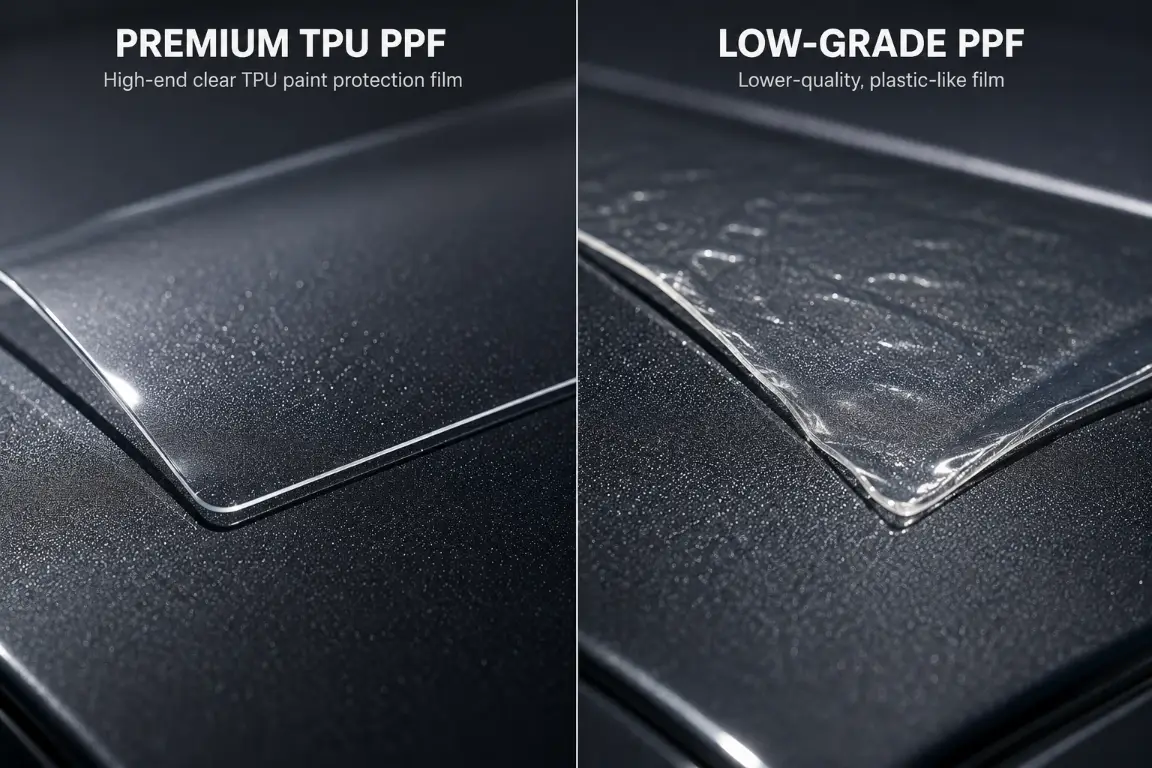
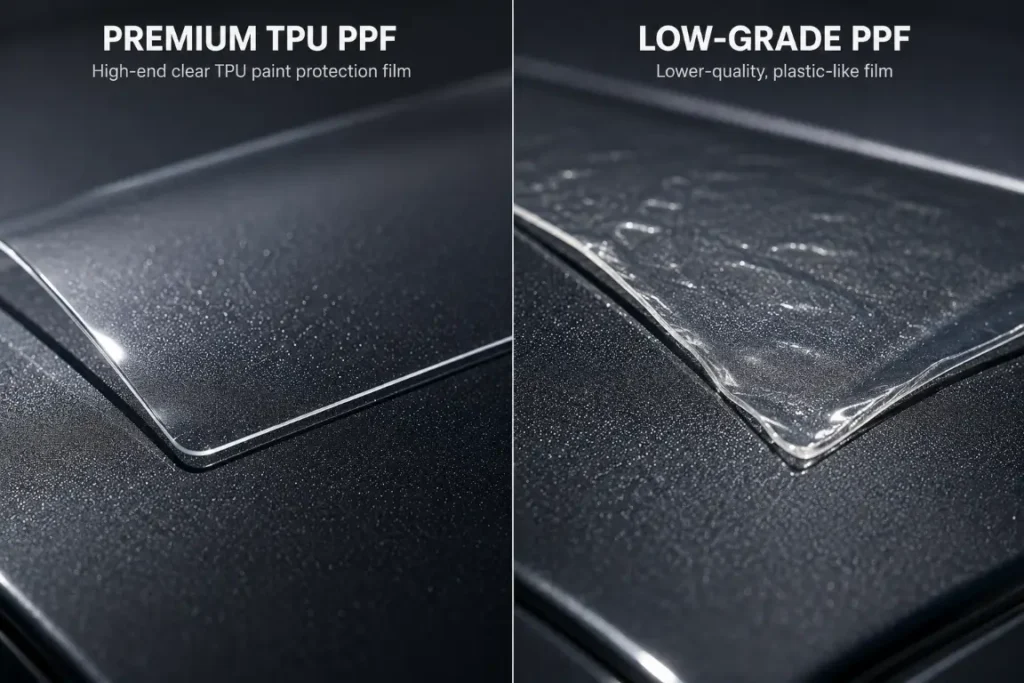
You walk into a PPF shop. The installer slides two sample books across the counter. One film costs $1,800 for full-body coverage. The other? $900. Both are described as “paint protection film,” and both promise to shield your paint from rock chips and scratches. Both have vaguely similar-sounding names — TPU and TPH. The temptation to save $900 is real.
But here’s what most comparison articles won’t tell you: that $900 savings is a loan, not a discount. When it comes due around year three, the repayment includes yellowed film, adhesive residue baked onto your clear coat, and a removal bill that eats whatever you thought you saved.
This guide walks through the real differences between TPU and TPH PPF, dimension by dimension. By the end, you’ll be able to make a decision based on chemistry and economics rather than marketing labels.
What Are TPU and TPH? (They’re Chemically Unrelated)
The first thing to understand is that TPU and TPH are not “two grades of the same thing.” They belong to completely different chemical families. The similar-sounding names are more accident than ancestry.
TPU (Thermoplastic Polyurethane) is a high-performance elastomer — a material that combines the elasticity of rubber with the processability of plastic. It was originally developed for medical devices, military coatings, and aerospace applications before making its way into automotive paint protection. The key to TPU’s performance is its molecular structure: alternating hard and soft segments create a network of hydrogen bonds that can break and re-form. This is the chemistry behind TPU’s signature self-healing ability.
TPH (Thermoplastic Polyolefin Hybrid) is, chemically speaking, an upgraded version of PVC. Its base is polyvinyl chloride — the same plastic used in plumbing pipes — modified with plasticizers (typically DOP or DINP compounds) to make it flexible enough to wrap around a car panel. The “H” stands for “Hybrid,” but this is a marketing term, not a chemical classification. TPH contains no polyurethane. Think of it this way: TPU is fruit juice pressed from actual fruit. TPH is a fruit-flavored drink. It looks similar in the bottle, but the recipe is entirely different.
This chemical difference is the root of every performance gap that follows.
TPU vs. TPH: Six Performance Dimensions Compared
Once you look past the marketing language, PPF performance comes down to a handful of measurable physical properties. The table below compares TPU and TPH across the six dimensions that actually matter for real-world protection.
| Dimension | TPU | TPH | Why It Matters |
|---|---|---|---|
| Self-Healing | Heat-activated (40–60°C); scratches disappear in seconds via hydrogen-bond re-formation | None — no “memory molecule” network exists; scratches are permanent | Determines whether your film still looks new after a year of car washes |
| Elongation (Stretch) | 350–400% for PPF-grade TPU (ASTM D412); conforms to compound curves without stress marks | ~200%; stress-whitens and tears on complex contours like bumpers and mirror caps | Affects installation quality on modern cars with aggressive body lines |
| Yellowing Resistance | Aliphatic TPU: ΔE ≤ 1.5 after 2,000+ hrs QUV (ASTM G154); stays optically clear for 5–10 years | Begins yellowing within 18–24 months; PVC-based chemistry lacks UV-stable molecular backbone | The single most visible failure mode — a yellowed car looks worse than no PPF at all |
| Transparency & Gloss | 90–96 GU gloss rating; enhances paint depth without altering color perception | ~90 GU when new; develops haze as plasticizers migrate to the surface over time | You paid for that paint color — the film should showcase it, not mute it |
| Adhesive Safety | Repositionable adhesive with controlled initial tack (2–4 N/25mm); peels cleanly years later | High initial tack (6–8 N/25mm); plasticizer migration causes adhesive cross-linking, which can make removal require heat and chemical agents | The “hidden cost” dimension: what happens when the film comes off |
| Service Life | 5–10 years (aliphatic grades); one installation covers typical ownership period | 2–4 years; requires replacement 1–2 times within the same ownership window | This single number drives the total cost equation below |
The adhesive gap deserves special attention. TPH’s plasticizers don’t stay put. Over time, they migrate out of the film and into the adhesive layer, where they accelerate chemical cross-linking. What started as a moderately sticky adhesive becomes aggressively bonded to your clear coat. Removal three years later isn’t peeling film off paint. It’s a multi-hour job involving a heat gun, adhesive remover, and — in worst cases — paint correction to fix the damage.
Adhesive failure is the most expensive PPF problem because it surfaces years after installation — when the shop that sold you the film may no longer exist. Always verify adhesive chemistry before buying.
The Aging Timeline: How Each Material Looks After 3, 5, and 7 Years
Static comparison tables tell you what’s different. A timeline tells you what that difference actually means for your car.
Year 0–1: Both films look good. A fresh TPH installation can be hard to distinguish from TPU with the naked eye. This is when most buyers who chose TPH feel smart about their decision.
Year 2–3: The divergence begins. TPH starts showing the first signs of degradation — a faint warm tint, especially visible on white and silver cars. The root cause is plasticizer migration, which creates microscopic voids in the film that scatter light differently. Edges may begin lifting on complex curves where the film was stretched beyond its elastic limit during installation. TPU, assuming it’s the aliphatic grade, shows no visible change.
Year 5: By now, most TPH installations have been removed and replaced — at least once, sometimes twice. The film has either yellowed noticeably (ΔE shifts of 15–40+ are documented for PVC-based films under sustained UV exposure) or begun developing a hazy, “milky” surface texture that won’t buff out. A quality TPU installation, meanwhile, is roughly at the midpoint of its service life. Gloss retention typically remains above 90%.
Year 7+: This is where the economic case for TPU closes completely. A TPU film installed today may just now be reaching the end of its warranty window — and many aliphatic TPU films are still going strong. The TPH owner, by contrast, has paid for two or three full replacements. Even if each TPH install was half the price of TPU, the math has already flipped.
There’s a moment most TPH buyers experience around year three. They stand next to their car, notice the film doesn’t look quite right anymore, and realize that the “bargain” protection now needs to be professionally removed. That removal, as the next section explains, isn’t free.
Installation and Removal: Where TPH’s Real Price Tag Hides
If PPF were a product you stick on and never think about again, TPH might have a stronger case. But PPF has two critical lifecycle events — installation and eventual removal — and TPH behaves worse at both.
Installation Behavior: Why TPU Is Faster and Cleaner to Apply
From an installer’s perspective, the difference between TPU and TPH is night and day. And installation labor is a line item on your invoice.
TPU’s high elongation capacity (350–400%) means it can stretch over compound curves — modern bumpers, sculpted hoods, aerodynamic mirror housings — in a single piece. The film distributes tension evenly, so there’s no spring-back at the edges two weeks later. TPU also uses a repositionable adhesive. The initial tack is intentionally low (2–4 N/25mm), giving the installer time to lift, adjust, and re-lay the film until positioning is perfect. Once squeegeed down, the adhesive builds to full bond strength over 24–48 hours.
TPH is a different experience. Its lower elongation (~200%) means the installer hits the material’s physical limit much sooner. Stretch too far and the film stress-whitens, then tears. Complex panels often require piecing — using multiple separate sections — which leaves visible seams. The adhesive starts aggressive (6–8 N/25mm initial tack), so there’s almost no repositioning window. If the film touches the panel in the wrong spot, you’re peeling it back under tension. With TPH, that’s when tears happen.
The practical consequence: a TPU full-body install might take a skilled installer 6–8 hours. The same car in TPH can take 9–12 hours, and the result still won’t look as clean.
Removal Consequences: When Cheap Film Takes the Clear Coat With It
This is the chapter most TPH marketing skips entirely.
When TPU reaches the end of its service life, removal is straightforward. Warm the film to 40–50°C with a heat gun or parked-in-the-sun heat, lift a corner, and peel. The adhesive stays on the film, not the paint. A full car comes off in 30–60 minutes with zero paint damage.
TPH removal is a different story. Those plasticizers that migrated into the adhesive layer have, over 2–3 years, catalyzed chemical cross-linking. The adhesive has essentially cured into a semi-permanent bond with the clear coat. Removal now requires sustained heating at 80–100°C — hot enough to risk damaging the clear coat if the installer isn’t extremely careful — followed by chemical adhesive remover and mechanical buffing to eliminate residual haze. The process takes 4–8 hours for a full car. The labor bill, typically $300–600, often exceeds what was “saved” by choosing TPH in the first place.
Professional detailers have a saying: “TPH removal is a service, not a step.”
TPU removes in under 60 minutes with zero paint damage. The cheaper film’s final bill arrives on removal day.
If you’re buying a used car that already has PPF installed and you can’t verify whether it’s TPU or TPH, budget for a professional removal. The previous owner’s bargain shouldn’t become your paint correction bill.
How to Verify You’re Getting Genuine TPU (Not a Hybrid)
Here’s an uncomfortable truth about the PPF industry: there are shops selling “TPU PPF” that isn’t TPU. Sometimes it’s pure TPH with a misleading label. Increasingly, it’s a “TPU+TPH hybrid” — a film that contains just enough TPU to blur the test results but is structurally a TPH product with all the same long-term failure modes.
The good news: you don’t need a chemistry degree to tell the difference. Three simple tests will expose what’s actually on the roll.
The Stretch Test — 30 Seconds to Spot the Difference
Ask the installer for a small off-cut sample. Any shop doing PPF work has scrap pieces. Hold it between both hands and pull slowly and steadily.
Genuine TPU will stretch to at least three times its original length without tearing. More importantly, when you release tension, it retracts smoothly and evenly. The surface remains optically clear with no visible texture change. This is the elastomer’s “shape memory” at work.
TPH tells a different story. Around 1.5–2× stretch, you’ll notice a white, cloudy zone forming at the point of maximum tension. This is stress whitening — a classic PVC behavior caused by microscopic voids forming as the plasticizer-polymer matrix separates under load. Keep stretching and the film will tear abruptly, often with a snap. Release before tearing, and the surface won’t fully recover. You’ll see a rippled “orange peel” texture where the film was stretched.
The test takes 30 seconds and is nearly impossible to fake. No amount of marketing copy can make TPH stretch like polyurethane.
The Heat Recovery Test — Proof of Self-Healing
TPU’s signature feature is self-healing, and it’s the easiest thing to verify. Take that same sample, drag your fingernail across the surface to create a visible scratch, then pour a cup of hot water (50–60°C, about the temperature of hot tea) over the scratched area.
On genuine TPU, the scratch disappears within 10–30 seconds. The hot water pushes the material above its glass transition temperature. At that point, the hydrogen bonds in the hard segments temporarily release, the compressed elastic network relaxes back to its original configuration, and the bonds re-form as the material cools. The surface returns to optical flatness.
On TPH, the scratch stays. Maybe it looks slightly shallower — the heat can soften the plasticizers and allow a tiny amount of flow — but the scratch doesn’t heal. TPH has no hydrogen-bond network, no shape-memory polymer structure, and no mechanism for scratch recovery. If the film claims “self-healing” but fails this test, it’s not TPU.
The self-healing mechanism has limits: scratches deeper than approximately 25μm (equivalent to 2000-grit sandpaper marks) exceed what the polymer network can recover. But for the swirl marks, wash-induced micro-scratches, and light abrasions that make up 95% of real-world paint damage, TPU’s self-healing is a genuine material property — not a coating that wears off.
The Paper Trail — What Documentation Should Come With Real TPU
If you can’t or don’t want to do physical tests, the paperwork tells you a lot.
A legitimate TPU product should name its substrate supplier. The global TPU raw material market for PPF is dominated by three names: Lubrizol Estane®, BASF Elastollan®, and Covestro Desmopan®. These are the aliphatic TPU grades engineered specifically for outdoor durability. If a brand cannot or will not tell you whose TPU they use, treat that as a red flag.
Second, ask for the Technical Data Sheet (TDS). It doesn’t need to be a 50-page document. A single page listing elongation at break (should be ≥300% per ASTM D412), tensile strength, QUV aging results (ΔE after ≥1,000 hours), and adhesive peel strength is standard. If the TDS doesn’t exist or the numbers are conspicuously absent, the product hasn’t been independently characterized.
Third, look at the warranty language. A real TPU warranty runs 5–10 years and specifies measurable failure criteria: yellowing ΔE ≤ 3, edge lift ≤ 2mm, adhesion loss ≤ 20%. A warranty that says “covers manufacturer defects” without defining what a defect is — that’s not a warranty. It’s a sentence designed to sound like one while promising nothing.
Making the Right Choice for Your Car and Budget
After everything covered above, the decision framework is actually straightforward.
If you plan to keep your car longer than three years, or it’s a vehicle you care about: Choose TPU — specifically, aliphatic TPU from a manufacturer that names its substrate supplier. The math is settled. At the 5-year mark, TPH’s replacement and removal costs have already exceeded TPU’s single-install price. You’re not spending more for TPU. You’re spending once instead of two or three times.
If you’re leasing for 24 months with zero intention of buying out the lease, and budget is the absolute priority: TPH can work — but with a critical caveat. Have the film removed at the 18-month mark, before plasticizer migration reaches the point where adhesive cross-linking turns removal into a multi-hour ordeal. Waiting until lease return at month 36 is how you end up with a surprise $500 removal bill that wipes out whatever you saved on the film.
If you want TPU-level protection but the full-car price is out of reach: Partial coverage of the high-impact zones — front bumper, hood leading edge (first 18–24 inches), fenders, mirror caps, door edges, and door cups — typically costs about the same as full-car TPH. It protects the areas that take 80%+ of road debris damage. This is almost always a better allocation of budget than full-body coverage in an inferior material.
When comparing options, look for manufacturers who are transparent about their raw material sources and back their product with a specific, measurable warranty. For example, Shenzhen-based FlexiPPF has been producing automotive films since 2005 and uses Lubrizol Estane® and BASF Elastollan® TPU across its six PPF product series, with a 5-layer construction that includes a ceramic top coat, an Ashland adhesive layer, and an 8-to-10-year warranty. The distinction worth paying attention to isn’t “which brand is famous.” It’s “which manufacturer controls its own production and names its raw materials.” Those two questions filter out most of the market. The gap between companies that formulate their own films and those that white-label commodity rolls shows up in your paint’s condition five years from now.
Get TPU Samples & Specifications
Compare real material performance before you decide. FlexiPPF ships sample swatches with full technical data sheets — no obligation.
Request Samples & PricingReferences
- Lubrizol Engineered Polymers. “ESTANE AG 8451-E Technical Data Sheet.” lubrizol.com
- ASTM International. “ASTM D412-16(2021) — Standard Test Methods for Vulcanized Rubber and Thermoplastic Elastomers — Tension.” astm.org
- ASTM International. “ASTM G154-23 — Standard Practice for Operating Fluorescent Ultraviolet (UV) Lamp Apparatus for Exposure of Materials.” astm.org
 English
  Spanish
  Dutch
Dutch  Japanese
  Russian
  Arabic