
If you’ve ever typed “best car paint protection” into Google, you know the problem: every result tells you something different. One swears by ceramic coating. Another says PPF is the only real answer. A third insists a $30 bottle of wax is all you need.
What nearly all of them miss is a fourth option — one that does double duty: protecting your paint while completely transforming how your car looks.
Here’s the thing most guides won’t tell you: these four options aren’t rivals. They do different jobs, at different price points, for different priorities. Once you understand what each one actually protects against — and what it doesn’t — the decision becomes straightforward.
The Four Options at a Glance
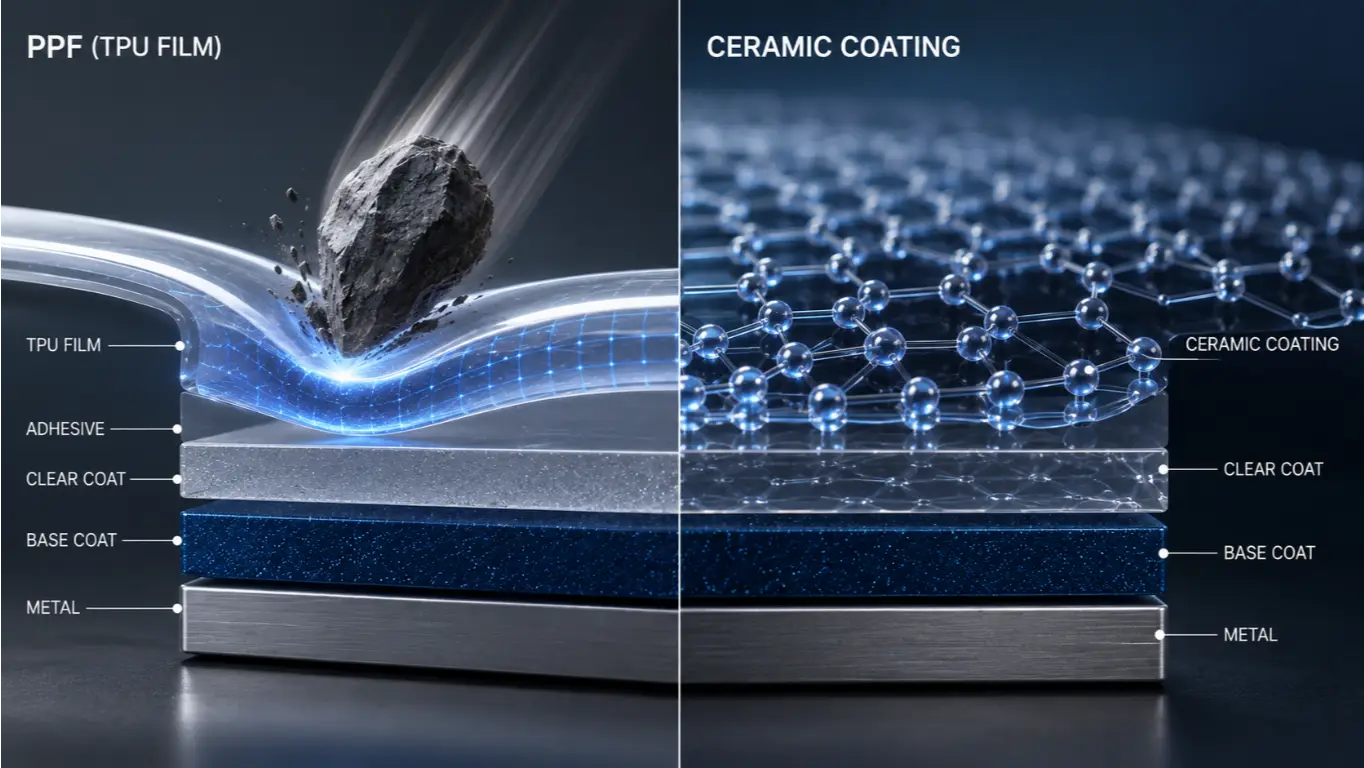
Car paint protection falls into four distinct categories. Think of them not as “pick one,” but as different tools — and sometimes the right answer is a combination.
| Protection Type | Thickness | Durability | Primary Job | Also Does | Starting Cost |
|---|---|---|---|---|---|
| PPF | 200–250μm (8–10 mil) | 5–10 years | Stops rock chips and physical impacts | Self-heals light scratches with heat | $1,200 (partial front) |
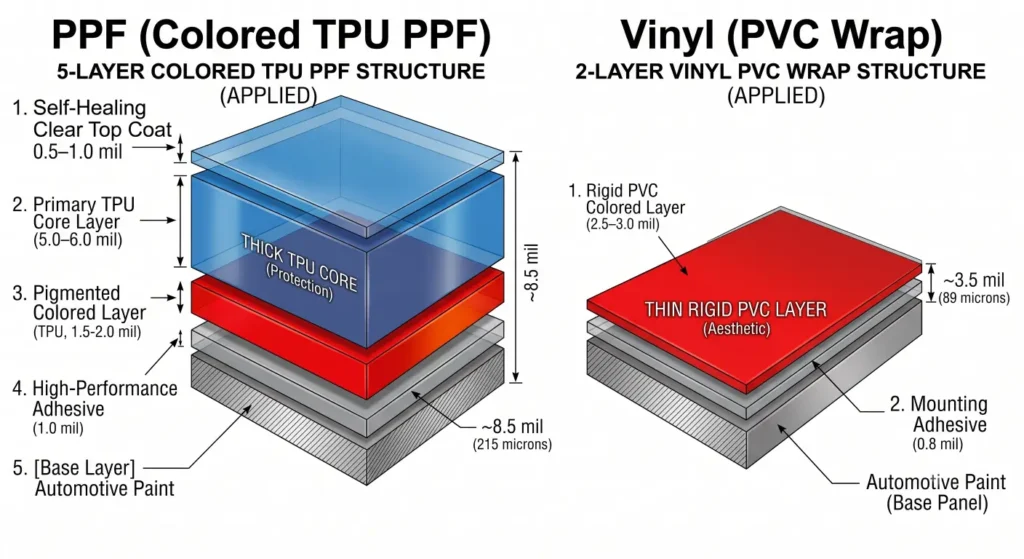
| Vinyl Wrap | 76–102μm (3–4 mil) | 3–7 years | Full color change | Blocks UV, bird droppings, tree sap, and light abrasion from reaching paint | $2,500 (full car) |
| Ceramic Coating | 1–3μm | 2–5 years (pro) | Chemical resistance + gloss + easy cleaning | Makes washing dramatically faster | $500 (DIY) / $1,000+ (pro) |
| Wax / Sealant | <1μm | 4–8 weeks (wax) | Temporary shine on a budget | Zero install risk — DIY in an hour | $15–$50 |
A useful analogy: if your car’s paint is a smartphone screen, PPF is the tempered glass protector, a vinyl wrap is a high-quality skin, ceramic coating is the oleophobic coating, and wax is the microfiber cloth.
Vinyl Wraps — The Paint Protection Nobody Talks About
Most people think of vinyl wraps as purely cosmetic — you wrap a car because you want matte orange instead of gloss white. That’s true, but it’s only half the story. A quality cast vinyl wrap creates a continuous 3–4 mil physical membrane over every painted panel. That membrane blocks UV radiation, sheds bird droppings and tree sap before they can etch into the clear coat, and absorbs light abrasion from road grit and everyday contact.
The Evidence — What Happens to Paint Under a Wrap
The proof isn’t theoretical. On GrassrootsMotorsports, an owner ran a 3M vinyl wrap for seven years of track use and long-distance highway driving. When a professional removed it, the paint underneath was “in perfect shape.” Jalopnik summarized the consensus: wraps “act as a UV shield, blocking sun damage like sunscreen… taking the beating from chips, road grime, and dings before the paint does.”
“Healthy skin + slow removal = no harm. Sunburn + ripping = disaster. Your clear coat is the skin.” — Jalopnik, 2025
The trade-off is thickness. At 3–4 mil, a vinyl wrap is roughly half as thick as PPF. It will not stop a rock at highway speed the way 8-mil PPF will. But for UV, chemical, and light-abrasion protection, it is a legitimate solution — and it gives you a color-change capability no transparent film can match.
The Rules — When a Wrap Protects, When It Destroys
Wrap-as-protection is not unconditional. It works when three things are true: the factory paint is in excellent condition, you use premium cast vinyl (3M, Avery Dennison — not cheap calendered film), and you have it professionally removed within five years. Cast vinyl contains UV-stabilized pigments and plasticizers that keep it flexible for 5–7 years; calendered vinyl degrades visibly in 2–3.
It backfires when owners wrap over paint that already has chips, rust, or failing clear coat — the adhesive bonds to the damage, and removal pulls the clear coat off with the film.
The practical rule: if your paint is compromised, fix it first. If it’s factory-fresh, a cast vinyl wrap is a legitimate protective layer that also changes your car’s color.
What Makes a Quality Film — Materials & Specs
Most guides hand you a list of brand names and tell you which one to buy. But the quality of a PPF or wrap isn’t decided by the logo on the box. It’s decided by what raw materials went into it, how it was manufactured, and what test standards it passed.
TPU, TPH, PVC — and Cast vs Calendered
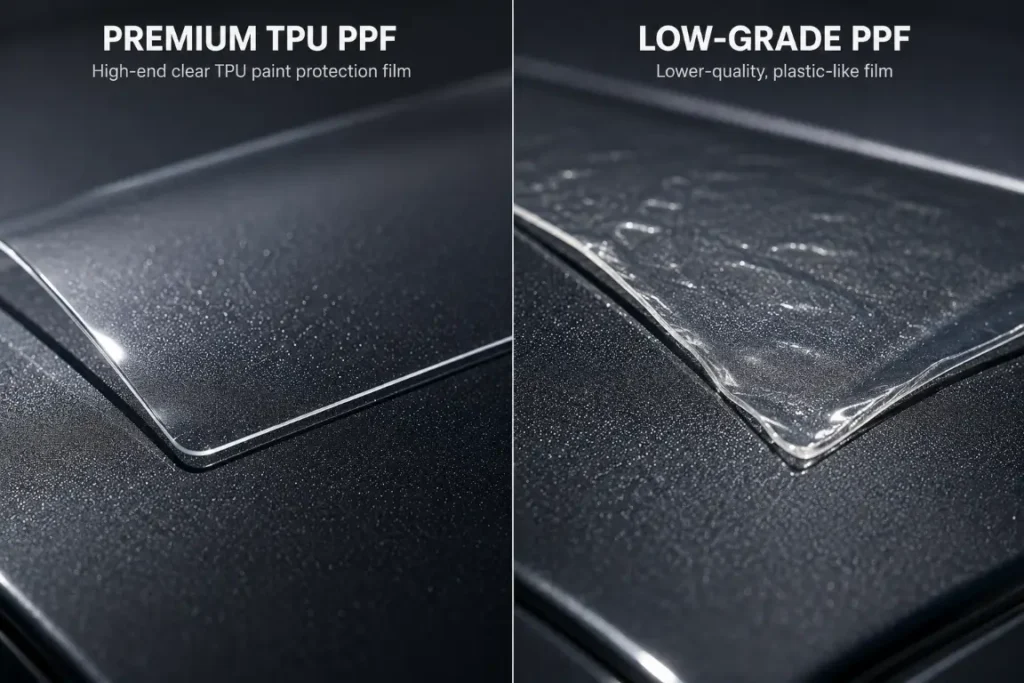
PPF and wraps each have their own material hierarchy. For PPF: TPU is the only material worth paying for. But even within TPU: aliphatic vs. aromatic. Aromatic TPU is cheaper but yellows under UV — sometimes in under a year. Aliphatic TPU survives 2,000+ hours of QUV-A accelerated weathering without visible degradation.
For wraps, the parallel: cast vinyl (3M, Avery Dennison) vs. calendered vinyl. Cast vinyl is made by pouring liquid PVC onto a casting sheet and curing it slowly — molecules stay relaxed, no shrinking. Calendered vinyl is squeezed through rollers under pressure — molecules are stressed, so cheap wraps shrink and crack within 2–3 years.
If you’re buying PPF and don’t know aliphatic vs aromatic — or buying a wrap and don’t know cast vs calendered — you are buying blind. Brand names don’t answer this question. Specifications do.
How Premium Films Are Made
A finished PPF roll is a five-layer sandwich: ceramic top coat (8–12μm) for gloss and hydrophobic beading; self-healing PU layer that recovers at 40–60°C; TPU base (150–200μm) — the structural core; adhesive layer (25–40μm, typically Ashland) that bonds without damaging clear coat; PET liner — peeled off at installation.
Two steps determine quality. Extrusion: sub-2μm thickness uniformity needed across the roll. Korean and German lines hit this; low-end equipment drifts to ±5μm. Coating: ceramic top coat is applied in a Class 10,000 cleanroom — nanoparticle dispersion at this stage decides whether water beads uniformly or pools.
Many PPF and wrap brands don’t manufacture their own film. They source TPU from the same chemical companies (Covestro, Lubrizol, BASF), contract-manufacture in the same factory clusters, and differentiate through top coat formulations and warranty programs. The factory matters more than the brand.
Six Specs to Demand From Any Film
You don’t need to be a materials scientist. Just ask for these numbers.
All six numbers should appear on the film’s Technical Data Sheet. If a supplier won’t share the TDS — treat it like a used car seller who won’t pop the hood.
What You’ll Actually Pay
PPF pricing has two variables: how much you cover, and what you drive.
| Coverage Level | What’s Protected | PPF Cost | Wrap Cost | Best For |
|---|---|---|---|---|
| Partial Front | Bumper, partial hood, mirrors | $1,200–$1,800 | — | Budget-conscious; lease vehicles |
| Full Front | Hood, bumper, fenders, mirrors, headlights | $2,200–$3,200 | — | Most new car buyers — the sweet spot |
| Full Front + Extras | Full front + door edges, rockers | $3,000–$4,200 | — | SUV/truck owners; highway commuters |
| Full Body | Every painted panel | $5,500–$8,000 | $2,500–$5,000 | PPF for luxury/collectors; wrap for color + protection |
| Exotic Full Body | Porsche, McLaren, etc. | $8,000–$12,000+ | — | Exotic owners |
The practical takeaway: full-body PPF is overkill for most people. High-impact zones — front bumper, hood, fenders, mirrors — take 90% of road debris. Cover those at a third of full-body cost. If you want color change too, cast vinyl wrap + front PPF is smarter money than full-body PPF alone.
Installation Quality: The 90% Factor
“PPF is 10% material, 90% installation.” A skilled installer with a mid-range film beats a careless one with the best film on the market. Same rule applies to wraps.
Red Flags — Signs of a Bad Install
- Lifting edges — Dust and moisture get underneath. Within months, the section peels.
- Trapped bubbles — Anything larger than a soybean is permanent.
- Visible seam lines — Gaps over 1–2mm between sections.
- Orange peel texture — Low-grade film or overstretched during application.
- Razor marks on paint — Installer cut directly on the car. Scores the clear coat. Permanent.
Razor marks mean the installer cut the film directly on your car’s paint. This scores the clear coat — damage no polishing can fix. If you see blade marks, walk away. The paint is permanently compromised.
How to Find a Quality Installer
- Check their portfolio — Close-ups of bumper corners, mirror housings, sensor cutouts. If they make a 911 bumper seamless, they can handle your car.
- Verify certifications — XPEL, STEK, 3M, SunTek certified programs require 50–100 full-car installs.
- Ask about warranty registration — Pros register it proactively. If they brush it off, the warranty is worthless.
- Visit the shop — Clean, enclosed, well-lit bay. Not an open garage. Dust is the enemy.
- Read reviews with photos — Customer photos from weeks or months after install. That’s where problems show.
Making the Right Choice
You now know more about paint protection than most people who sell it. The final step: match that knowledge to your situation. “Best” is personal.
Recommendations by Vehicle & Driving Habit
| Scenario | Recommendation | Why |
|---|---|---|
| New luxury / performance | Full front PPF + full-body ceramic | Impact defense on high-risk zones, gloss everywhere |
| New Tesla / EV | Full front PPF (strongly recommended) | Tesla paint: 80–120μm vs industry 120–150μm. Softer, thinner. |
| Color change + protection | Cast vinyl wrap + optional front PPF overlay | Wrap protects factory paint + gives you the look. Add PPF on front for impacts. |
| Daily highway commuter | Partial or full front PPF | Gravel at 70+ mph = hammer force. Highest-ROI PPF. |
| Off-road / track | Full front PPF + rockers + rear arches | Side debris hits areas front kits miss. |
| Lease / short-term | Ceramic spray sealant ($20–30 DIY) | 80% of gloss benefits at 1% of PPF cost. |
| Classic / collector | Full-body PPF or cast vinyl wrap | One unlucky trip can ruin decades-old original paint. |
Four Things to Remember
- PPF stops rock chips. Nothing else does. Not ceramic, not wax, not vinyl wrap.
- Vinyl wraps protect paint — they just don’t advertise it. Cast vinyl blocks UV, droppings, sap, salt for 5–7 years. Paint must be factory-fresh; removal must be professional within 5 years.
- Material > brand. Aliphatic TPU for PPF. Cast vinyl for wraps. Check the TDS.
- The installer is the product. Choose accordingly.
If you want to go deeper — comparing full specification sheets across product lines, understanding top coat formulations, or evaluating samples from manufacturers who publish complete technical data — a manufacturer’s specification page is the right next step. Look for full TDS disclosure, clear material provenance, and registered warranty terms. Manufacturers like FlexiPPF publish layered construction details, substrate sourcing (Lubrizol/BASF TPU, Ashland adhesive), and performance specs across PPF, vinyl wrap, and ceramic coating series — the transparency you need to apply everything from this guide to a real comparison.
 English
  Spanish
  Dutch
Dutch  Japanese
  Russian
  Arabic