
What Car Wax Actually Does for Your Paint
Here’s a mental model that will save you from a lot of wasted weekends: car wax is sunscreen, not armor.
When you apply wax, you’re laying down a microscopic sacrificial layer — typically about 0.1 to 0.5 microns thick — that sits on top of your clear coat. It does not chemically bond with the paint. It just sits there, taking the beating from UV rays, bird droppings, road grime, and car wash brushes so your actual paint doesn’t have to.
This is why wax works, and also why it fails.
Wax does three things well: it adds depth and gloss by filling microscopic imperfections in the clear coat, it repels water so contaminants don’t linger on the surface, and it provides a modest UV buffer that slows oxidation. That’s the good news.
What wax cannot do is stop a rock chip at highway speed. It can’t prevent a shopping cart from leaving a scratch. It won’t survive more than a handful of washes before needing reapplication. And compared to modern alternatives — synthetic sealants lasting 4 to 6 months, ceramic coatings lasting 2 to 5 years, or paint protection film (PPF) lasting 8 to 10 years at 150 to 200 microns thick — traditional wax’s 2-to-8-week endurance window feels almost quaint.
None of this means wax is obsolete. It means you should choose it with your eyes open. Wax is for the person who enjoys the ritual, who wants the warmest possible gloss on a garage-kept weekend car, or who needs an affordable, low-commitment layer of protection right now. Understanding its boundaries is the first step to picking the right product — or realizing you need something stronger entirely.
Types of Car Wax Explained
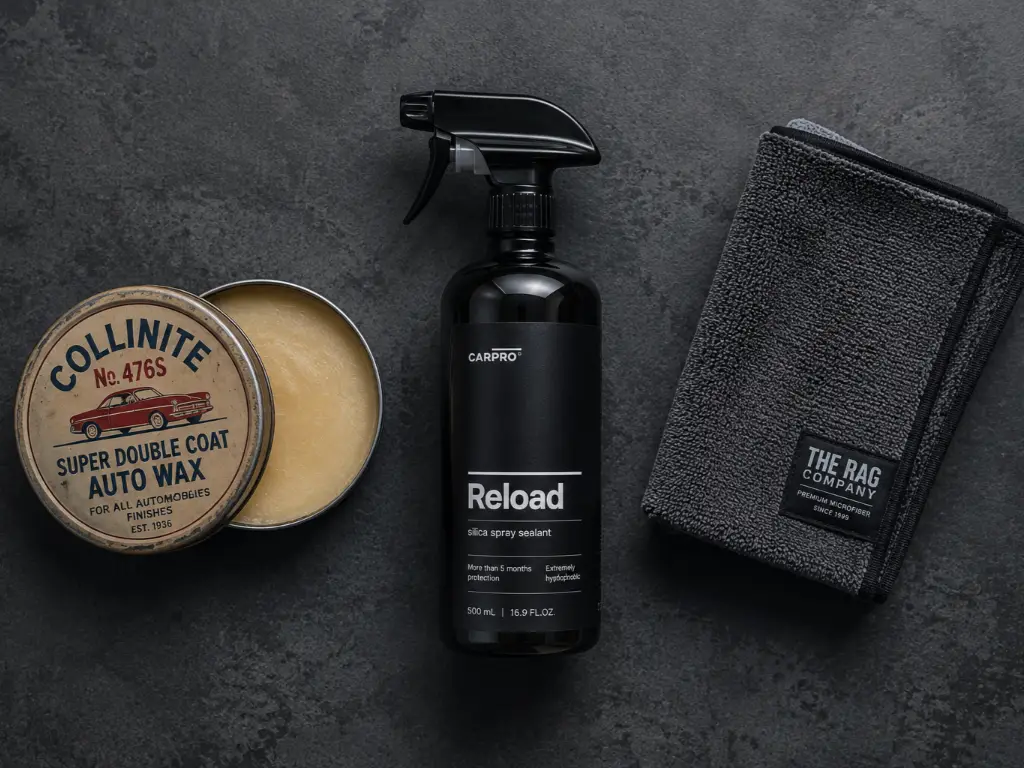
Walk down the car care aisle and you’ll face four distinct categories. They’re not random — each represents a different trade-off between durability, ease of use, and the character of the shine.
Carnauba Paste Wax — The Classic Choice for Depth and Warmth
Carnauba wax comes from the leaves of the Brazilian palm tree Copernicia prunifera, and it’s graded by purity: Grade 1 White is the top tier, down to Grade 3 Grey at the budget end. The wax you buy in a tin is never 100% carnauba — pure carnauba is a rock-hard brick that would be impossible to spread. Typical carnauba content in a quality paste wax runs between 30% and 47%, blended with oils and solvents to make it workable. Any product claiming “100% carnauba” is stretching the truth.
The reason enthusiasts still swear by paste wax after decades of chemical innovation is simple: nothing else produces quite the same optical warmth. Carnauba’s refractive index — roughly 1.47 to 1.52 — sits closer to your clear coat’s natural refractive index than any synthetic polymer. Light penetrates slightly deeper before reflecting back, producing what detailers call a “wet look”: depth rather than just surface brightness.
The trade-off is real. Carnauba wax lasts 2 to 8 weeks on a daily driver, melts and degrades in direct summer heat, and demands genuine effort to apply and buff off evenly. It’s the right choice for a show car that lives in a garage, or for someone who considers a Sunday morning waxing session genuinely therapeutic.
Liquid and Spray Waxes — Convenience Without Compromise
Liquid waxes are essentially paste wax in a more spreadable form — they go on faster and wipe off with less effort, though the gloss depth takes a small hit. Spray waxes represent the extreme end of convenience: mist on, wipe off, done in 15 minutes. The catch is concentration. Spray waxes carry roughly one-third to one-half the active ingredients of a paste, which translates to a lifespan of 2 to 4 weeks at best.
Where sprays truly shine is as a maintenance layer. Apply a durable synthetic sealant or ceramic coating as your base protection, then top it up with a spray wax after every few washes. You get the longevity of the base layer and the just-detailed slickness of fresh wax, with almost no time investment.
Synthetic Sealants — The Durability Engineers
If carnauba wax is hand-poured coffee, synthetic sealants are precision-engineered espresso machines. Instead of sitting on the paint, polymer and fluoropolymer sealants form a semi-permanent chemical bond with the clear coat. This bond resists heat, car wash detergents, and road salt far better than any natural wax can.
The numbers tell the story: a quality synthetic sealant leaves a film 0.5 to 2 microns thick (2 to 5 times thicker than wax), achieves water contact angles of 110° to 115° — rivaling entry-level ceramic coatings — and lasts a genuine 4 to 6 months on a daily driver. Products like Collinite 845 Insulator Wax, with a solid content around 35% to 40% (compared to 15% to 20% for typical liquid waxes), have earned near-legendary status in detailing forums for their refusal to quit.
The downside? The gloss leans “cold” — high reflectivity that some describe as glassy or plastic-like, missing the organic depth that carnauba delivers. And some sealants leave white residue on black plastic trim, a frustration that’s easy to avoid with careful application but maddening when you forget.
Ceramic-Infused Hybrids — The Best of Both Worlds
The fastest-growing segment in car care isn’t pure wax or pure ceramic — it’s the hybrid middle ground. These products suspend microscopic silicon dioxide (SiO₂) particles in a polymer or wax base, borrowing the hydrophobic properties of a true ceramic coating while keeping the wipe-on, wipe-off simplicity of a traditional wax.
SiO₂ concentration is the number to watch. Spray-type hybrids typically carry 2% to 5% SiO₂. Liquid hybrids push that to 5% to 15%. A full professional ceramic coating, by comparison, is 70% to 90% SiO₂ and chemically cross-links with the clear coat during a multi-hour curing process. The hybrid won’t give you five years of protection — but it will give you 3 to 6 months of noticeably better water beading and UV resistance than any conventional wax, for about the same effort.
Water contact angle makes a useful shorthand here: traditional wax achieves roughly 90° to 100°, ceramic hybrids hit 100° to 110°, and true ceramic coatings reach 110° to 120°. Every extra degree means water rolls off more easily, taking dirt and contaminants with it.
How to Choose the Right Wax: Key Criteria That Matter
Before scrolling through product recommendations, build your own decision framework first. Here are the five dimensions that actually separate one wax from another — and a quick way to map them to what you care about.
| Dimension | What “Good” Looks Like | Who Cares Most |
|---|---|---|
| Durability | How many washes before water stops beading | Daily drivers parked outside |
| Ease of Application | Time from opening the bottle to finishing the buff | Weekend DIYers, beginners |
| Gloss Character | Warm depth (carnauba) vs. cold reflectivity (synthetic) | Enthusiasts, show car owners |
| Hydrophobicity | How quickly and completely water rolls off | Rainy climates, dusty regions |
| Cost Per Use | Material cost divided by number of applications per container | Budget-conscious owners |
The one-sentence decision guide: if durability and water beading are your top priorities, go synthetic sealant or ceramic hybrid. If gloss depth and the application ritual matter more, pick a high-grade carnauba paste. If you want both but refuse to spend your weekends waxing, a ceramic hybrid spray is probably your sweet spot.
Durability isn’t measured by guesswork. The industry benchmarks for automotive exterior weathering include ASTM D4587 (fluorescent UV condensation exposure) and SAE J2527 (xenon-arc accelerated weathering for automotive exteriors). These standards simulate years of sun, heat, and moisture in a controlled laboratory environment — the same tests used to validate products far more demanding than car wax. Professional-grade paint protection films, for example, are routinely subjected to 5,000 hours or more of accelerated UV testing to ensure they won’t yellow, crack, or delaminate over a decade of real-world exposure. That gap in testing rigor — weeks versus thousands of hours — reflects the fundamental difference between a sacrificial wax layer and a long-term protective film.
Best Car Waxes for Different Needs
No single wax wins across every category because no single car owner has the same priorities. Here are the products that dominate their respective niches, based on hands-on testing data and community consensus across detailing forums.
Best for Set-and-Forget Durability
If you want to wax your car and then forget about it for half a year, two products consistently rise to the top.
Collinite 845 Insulator Wax ($20–$25) is the closest thing the detailing world has to a folk hero. Originally formulated as an electrical insulator wax, its unusually high solid content — roughly 35% to 40%, nearly double a typical liquid wax — translates into 4 to 6 months of real-world durability. The application has one non-negotiable rule: apply it whisper-thin. Over-application turns removal into an upper-body workout. Warm the bottle in hot water for five minutes before use, and a single bottle will last you years.
Soft99 Fusso Coat ($30–$35) takes a different technical approach. This Japanese fluoropolymer paste sealant claims up to 12 months of protection; daily-driver reality lands closer to 4 to 5 months, which is still exceptional. It’s particularly popular on white and light-colored cars, where its bright, reflective finish complements the paint rather than fighting it. The critical technique point: do not let Fusso Coat sit on the panel too long before buffing, or you’ll wish you had.
Best for Show-Car Shine
When the goal isn’t protection but pure visual impact, carnauba content and application experience matter most.
Autoglym Ultra High Definition Wax (approximately £51) was named Parkers’ 2026 Test Winner after a four-month winter durability trial, praised for its almost effortless application and buffing — a rarity among high-carnauba pastes. The gloss is deep without being greasy, and the included applicator and microfiber cloth are genuinely good, not afterthoughts.
Meguiar’s Gold Class Carnauba Plus ($22) has been a staple for decades for a reason. Its carnauba-polymer blend produces the kind of warm, liquid glow that makes dark paint look a foot deep. The trade-off is longevity: expect about 3 weeks on a daily driver before you notice the beading fade. This is a wax for people who enjoy the process of waxing — not people trying to avoid it.
A note on gloss character. Carnauba wax creates “warm” depth because its refractive index (roughly 1.47–1.52) is closer to automotive clear coat than synthetic polymers (roughly 1.42–1.45). Imagine the difference between a wet river stone and a pane of glass — both reflect light, but one feels deep and organic while the other feels bright and precise. Neither is better; they suit different tastes and different paint colors.
Best Budget-Friendly Protection
Spending less doesn’t mean wasting your time. These two prove that smart formulation matters more than price.
Turtle Wax Super Hard Shell (£7 for 397 grams) is the undisputed value champion. It delivers 3 to 4 months of protection at a cost-per-application measured in pennies. The pre-softened formula spreads easily, and the generous tin means you won’t run out mid-season. It won’t win any gloss competitions, but for someone who just wants decent protection on a commuter car, the math is hard to argue with.
Meguiar’s Ultimate Liquid Wax ($25) is the synthetic alternative at the affordable end. Its polymer-based formula goes on and off with almost zero effort, won’t stain black plastic trim (a common frustration with cheaper waxes), and lasts a solid 3 to 6 months. If you’re new to waxing and want a result you can be proud of on the first try, start here.
Best Foolproof Application
First-time waxers have one overriding fear: messing it up. These two products make mistakes genuinely hard to achieve.
Turtle Wax Hybrid Solutions Ceramic Spray Coating ($16) converted a generation of wax skeptics. Spray onto a clean panel, spread with a microfiber, buff off — total time under 2 minutes per panel. The SiO₂-infused formula delivers 4 to 6 months of durability with water beading that embarrasses waxes at twice the price. The application window is forgiving: 2 to 5 minutes before buffing, compared to the careful haze-timing that traditional waxes demand.
Griot’s Garage 3-in-1 Ceramic Spray ($20) is frequently cited as the longest-lasting spray sealant in its class, with an application process nearly identical to the Turtle Wax. If you want one product, one step, and a result that lasts through a season of car washes, either of these will serve you well.
Beyond Wax: When Paint Protection Film Makes More Sense
There’s a moment in every car owner’s journey when the math of wax stops adding up. Maybe you’ve just spent your third Saturday in two months reapplying paste wax to a car that lives in the driveway. Maybe you noticed a constellation of tiny chips on your hood after a highway road trip. Maybe you caught yourself reading the UV protection specs on a wax bottle — not the shine claims — and realized your priorities have shifted.
That moment signals something important: you may have outgrown what wax can do.
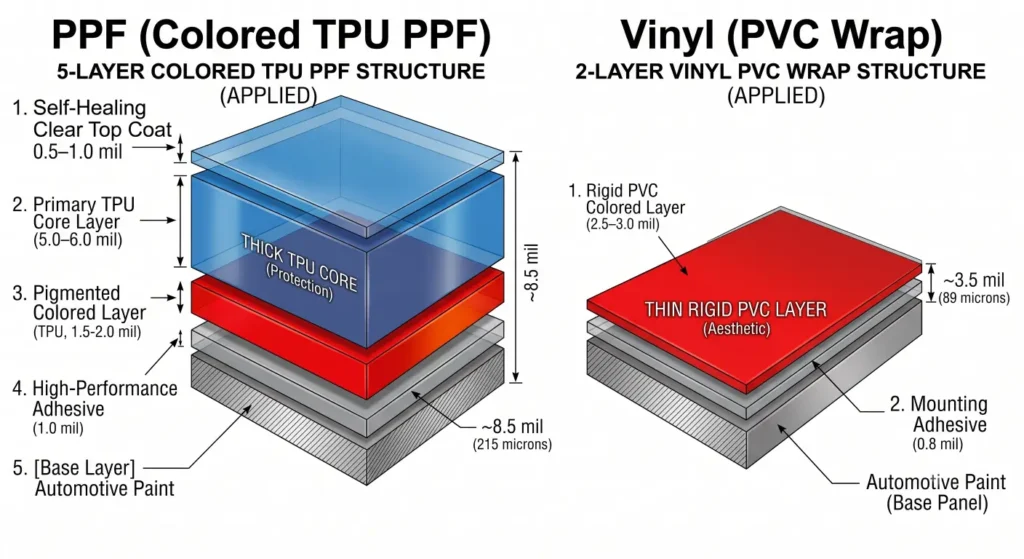
Paint protection film (PPF) represents a fundamentally different category of protection. Where wax is a sacrificial chemical layer measuring fractions of a micron, PPF is a physical barrier — a thermoplastic polyurethane (TPU) film typically 6 to 10 mils thick (150 to 250 microns), roughly 500 times thicker than a wax layer. It absorbs rock impacts that would chip bare paint. Its top coat self-heals minor scratches when exposed to heat. And where a premium wax might survive 8 weeks of weather, a properly manufactured PPF is engineered to last 8 to 10 years, backed by the same accelerated weathering standards — 5,000 hours or more of QUV testing — that validate industrial coatings and architectural glass.
The cost conversation changes when you look at it across time. A high-quality wax regimen might run $100 to $200 per year in product, applied six to eight times annually. A full ceramic coating costs $500 to $2,500 and lasts 2 to 5 years. PPF on high-impact areas — front bumper, hood, mirror caps, rocker panels — typically runs $1,500 to $4,000 and lasts up to a decade. Divide that out, and the annual cost gap between premium wax and partial PPF narrows considerably once you factor in your own labor.
You don’t have to choose one over the other. Many owners apply PPF on impact zones and use wax or a ceramic spray on doors, roof, and rear panels — getting physical protection where it matters and affordable gloss everywhere else.
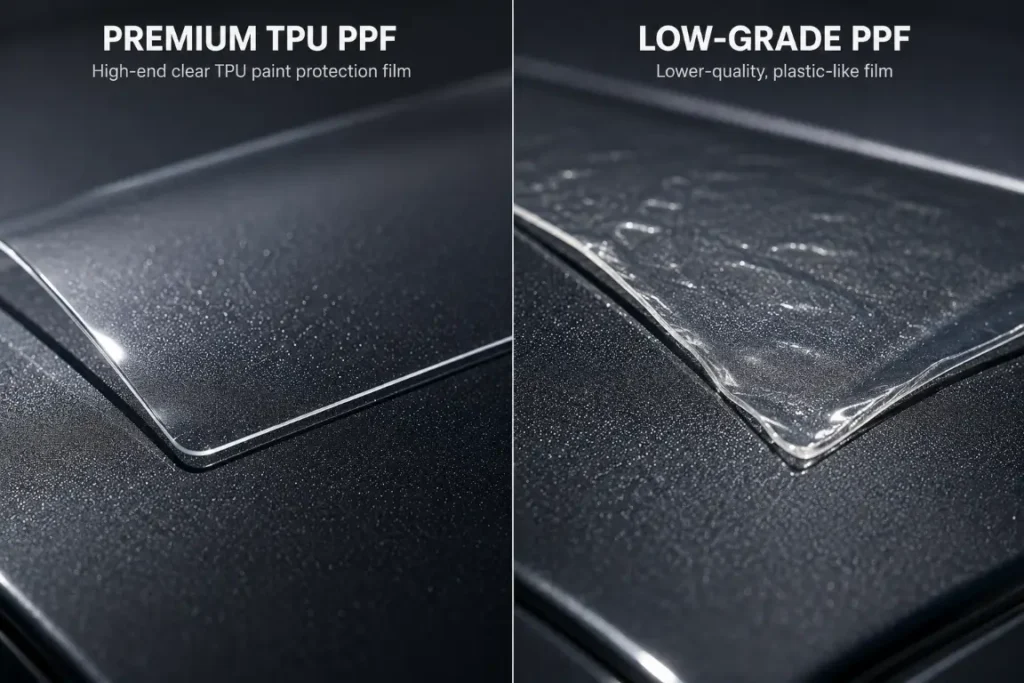
If you’re evaluating PPF for the first time, look for a few objective markers of quality: TPU substrate (not PVC or TPH, which yellow and crack), a ceramic-infused top coat for hydrophobic performance, at least 8 mils of total thickness, and a manufacturer warranty of 8 to 10 years backed by documented accelerated aging test data. Suppliers like FlexiPPF build their PPF on a 5-layer construction with a ceramic top coat over self-healing TPU, carry a 10-year warranty, and validate anti-yellowing performance through 5,000-hour QUV testing — the kind of engineering benchmark worth asking about regardless of which brand you ultimately choose.
How to Apply Wax for Maximum Protection
Prep work matters more than product choice. A $200 jar of carnauba applied over contaminated paint will underperform a $15 spray wax applied over a properly prepared surface. Every time.
Step 1: Deep Clean — Not Just a Wash
A routine shampoo removes surface dirt. It does not remove iron particles embedded in your clear coat (visible as tiny orange specks on light-colored cars), tar spots, or the layer of bonded contaminants that make your paint feel rough to the touch. You need three things before wax touches your car: an iron remover (spray on, watch it turn purple as it dissolves metallic particles), a tar remover for stubborn black spots, and a clay bar or clay mitt to pull out everything else. Run your hand over the paint inside a plastic bag — if it feels like sandpaper, you’re not done cleaning.
Step 2: Paint Correction — Optional but Transformative
If your paint has visible swirl marks, fine scratches, or a hazy appearance under direct light, this is the moment to polish. Applying wax over uncorrected paint is like putting on a clean shirt without showering — you’re sealing the problems in, not fixing them. A single-stage polish with a dual-action machine will remove light swirls and dramatically improve the final result. If your paint is in good shape, skip this step and proceed directly to waxing.
Step 3: Application Conditions
Wax in the shade on a cool surface. The ideal panel temperature is between 10°C and 30°C (50°F to 86°F) — below that range, wax becomes stiff and difficult to spread evenly; above it, solvents flash off too quickly and you’ll struggle to buff the residue clean. Test the panel with the back of your hand: if it’s uncomfortably warm to touch, wait. Apply wax as thin as you possibly can. A thick layer doesn’t add more protection — it just adds more work and wastes product. Most people use three to five times more wax than necessary on their first attempt.
Step 4: Curing and Maintenance
Wax needs time to fully harden. Keep the car dry for at least 12 to 24 hours after application. Rain or an enthusiastic sprinkler system during the curing window will compromise the bond and shorten the wax’s lifespan before it even begins. For ongoing maintenance, wash with a pH-neutral car shampoo (pH 6.5 to 7.5) — anything heavily alkaline, like an all-purpose degreaser, will strip wax far faster than normal wear.
Quick Application Checklist
Follow this checklist once and the process becomes second nature. The real shift happens when you stop thinking of wax as a chore and start treating it as the cheapest insurance policy your car’s paint will ever have. Whether you stick with a trusty paste wax, graduate to a ceramic hybrid, or decide it’s time to explore what PPF can do for your daily driver, the right protection — applied correctly — pays for itself in resale value and pride of ownership.
References
- Parkers.co.uk. “The Best Car Wax 2026 — Tested and Rated.” 2026. parkers.co.uk/car-advice/car-care/best-car-wax/
- SAE International. “J2527: Performance Based Standard for Accelerated Exposure of Automotive Exterior Materials Using a Controlled Irradiance Xenon-Arc Apparatus.” sae.org/standards/content/j2527/
- ASTM International. “D4587: Standard Practice for Fluorescent UV-Condensation Exposures of Paint and Related Coatings.” astm.org/d4587-11.html
- Collinite. “Comparing Paste Wax and Liquid Wax.” collinite.com
- FlexiPPF. “Automotive Paint Protection Films.” flexippf.com/automotive-films/paint-protection-films/
- FlexiPPF. “Quality, Support & Warranty.” flexippf.com/quality-support-warranty/
- FlexiPPF. Official Website. flexippf.com
 English
  Spanish
  Dutch
Dutch  Japanese
  Russian
  Arabic