
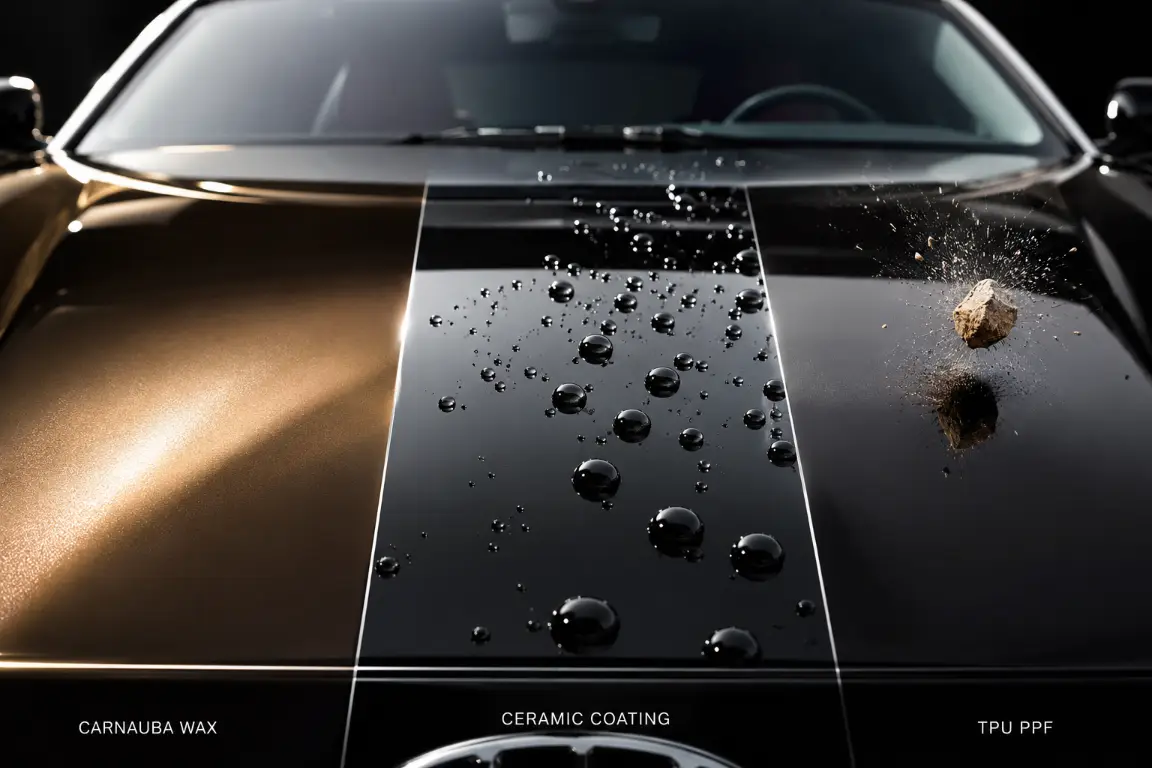
If you have ever stared at a paint protection quote and wondered whether any of it is worth the money, you are not alone. The market throws three terms at you — wax, ceramic coating, and paint protection film — and expects you to know the difference. Most people do not. Here is the 60-second version.
| Protection Type | Material | Durability | Physical Impact Protection | Gloss Level | Typical Cost (Full Car) |
|---|---|---|---|---|---|
| Wax (Carnauba) | Natural palm wax | Weeks to months | None | Deep, warm | $50–$200 |
| Ceramic Coating | SiO₂ (silicon dioxide) liquid polymer | 2–5 years | None | High, mirror-like | $1,000–$3,000 |
| Paint Protection Film (PPF) | TPU (thermoplastic polyurethane) film | 5–10 years | Excellent | Moderate to high | $5,000–$8,000+ |
Think of it this way: wax is sunscreen — thin, temporary, needs reapplication. Ceramic coating is a screen protector — hard, glossy, but offers zero impact resistance. PPF is body armor — thick, elastic, and actually takes the hit so your paint does not have to. That is the hierarchy. The rest of this article explains why it matters and how to navigate the choices without getting taken for a ride.
Paint Protection Film — The Technology That Actually Shields Your Paint
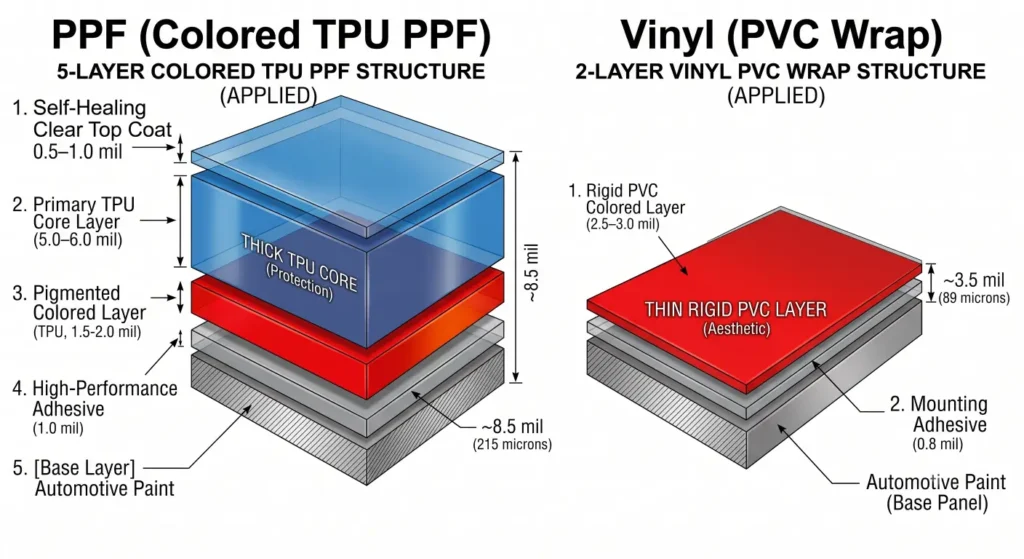
PPF is not a single layer of plastic stretched over your hood. It is a five-layer engineered system, and every layer serves a distinct function. From top to bottom: a ceramic-infused clear coat handles the environment, a self-healing polyurethane layer absorbs damage, the TPU base film provides structural integrity, a pressure-sensitive adhesive bonds it to the paint, and a PET release liner protects everything until installation. When people say “PPF is just expensive plastic wrap,” they are missing four of those five layers. Here is what each layer actually does for you.
Self-Healing: What It Actually Does (and Does Not Do)
Self-healing is the most marketed feature of PPF — and the most misunderstood. The science is real: thermoplastic polyurethane has a molecular structure that, when heated above approximately 40–50°C, allows polymer chains to return to their original configuration. Minor swirl marks and light surface scratches genuinely disappear under sunlight or warm water.
But here is what the brochure leaves out: self-healing does not fix everything. A rock chip at highway speed punches through the film entirely. No amount of heat will close that hole. A deep scratch from a key will not vanish. The mechanism works on car-wash micro-abrasions, not impact trauma. Forum owners who call it “overhyped” are not wrong — they were sold expectations the technology was never designed to meet. Think of it like a memory-foam pillow: it recovers from the impression of your head overnight, but a knife cut stays forever.
UV Resistance and Anti-Yellowing: The 5,000-Hour Problem
Every PPF owner eventually asks: will it turn yellow? The answer depends almost entirely on one variable — whether the TPU is aliphatic or aromatic. Aromatic TPU costs $2–4 per kilogram and yellows under sustained UV exposure, sometimes within one to two years in tropical climates. Aliphatic TPU costs $8–15 per kilogram and resists yellowing at the molecular level because its polymer backbone lacks the conjugated double bonds that oxidize into yellow chromophores.
Quality manufacturers validate this with accelerated weathering tests — QUV-A chambers running ASTM G154 protocols, subjecting film samples to the equivalent of years of sunlight in weeks. Top-tier films claim 5,000-hour anti-yellowing certification. If a supplier cannot tell you whether their TPU is aliphatic or aromatic, you have your answer. The film will yellow, and no amount of marketing copy will stop it.
Hydrophobicity and Chemical Resistance: Keeping Contaminants Out
A water droplet beading on your hood is not just satisfying to watch — it is a structural signal. The ceramic nano-particles embedded in the top coat — typically SiO₂ or SiC at 10–50 nanometer particle size — create a surface with a water contact angle exceeding 110 degrees. Anything above 90 degrees qualifies as hydrophobic; above 110 degrees means water, dirt, and liquid contaminants struggle to find purchase.
This is not self-cleaning. It is easy-cleaning. Bird droppings, tree sap, and road salt still land on your car. But on a properly hydrophobic surface, they bead up and rinse off instead of etching into the film over days. The same ceramic top coat that makes water bead also provides chemical resistance across a pH range of roughly 2 to 12 — acidic enough to handle bird droppings, alkaline enough to survive road de-icers. Without this layer, PPF is just vulnerable polyurethane, and polyurethane degrades when chemistry attacks it.
Impact Protection: The Physical Shield
Here is the number that matters most when comparing PPF to any liquid coating: thickness. Ceramic coating measures 0.5 to 2 microns thick. PPF measures 150 to 267 microns — roughly 100 times thicker. A micron-level coating cannot absorb the kinetic energy of a pebble flying off a truck tire at 70 miles per hour. A quarter-millimeter of elastic polyurethane can. That is not marketing. That is physics.
This is PPF’s irreducible value proposition. Everything else — the gloss, the hydrophobicity, the self-healing — is secondary. The primary job is impact protection. If you park in a garage and drive on clean suburban roads, this might not matter to you. If you commute on highways or live anywhere with gravel, it is the only thing that matters.
Gloss, Clarity, and Aesthetics: The Visible Side of Protection
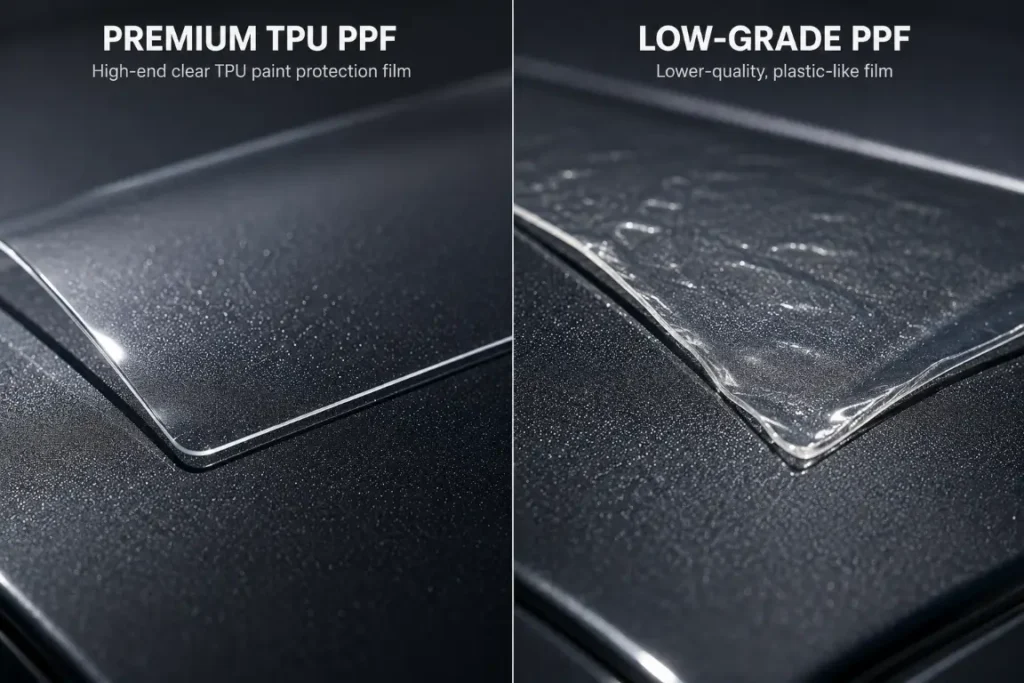
The final concern most buyers voice is whether PPF will ruin the look of their paint. Quality film is nearly invisible when properly installed — haze below 1%, light transmission above 90%, and gloss measured at 95–96 GU on a 60-degree gloss meter. That is functionally indistinguishable from a factory clear coat. Poor-quality film, by contrast, introduces orange-peel texture, visible haze, and edges that collect grime. The best compliment a PPF installation can receive is that nobody notices it is there.
What Separates Quality PPF from a Cheap Film
Most comparison articles stop at “PPF versus ceramic coating.” They never ask the harder question: what separates good PPF from bad PPF? The answer lives in four places — the substrate, the top coat, the adhesive, and the factory floor. None of them are visible on a finished car. All of them determine whether your film lasts three years or ten.
TPU Substrate: The Foundation That Determines Everything
The TPU base layer accounts for more than half of a PPF roll’s material cost, and the choice of supplier sets the ceiling on every performance characteristic that follows. Lubrizol (USA), BASF (Germany), and Covestro (Germany) are the three names that dominate the premium tier. Their aliphatic polycaprolactone-based TPU delivers tensile strength above 30 MPa per ASTM D882 and elongation at break exceeding 400% — numbers that translate directly into a film that stretches over complex body contours without thinning and resists tearing under impact.
Ask any potential supplier two questions: who makes your TPU, and is it aliphatic or aromatic? If they cannot answer both, the film budget was likely allocated to marketing rather than materials. The price difference between the two chemistries — roughly three to five times — explains why cheap PPF exists and why it fails early.
Top-Coat Technology: The First Line of Defense
Above the TPU base sits the top coat — the layer that meets sunlight, rain, and road chemicals first. Two technologies compete here: traditional polyurethane clear coats and nano-ceramic reinforced coatings. The performance gap is not subtle. A nano-ceramic top coat loaded with SiO₂ or SiC particles achieves a water contact angle above 110 degrees and provides meaningful UV absorption at the surface. A plain PU top coat manages perhaps 90–95 degrees and relies entirely on additives mixed into the TPU below for UV protection — a weaker, second-line strategy.
The top coat also determines stain resistance. Ever seen a PPF with faint yellow bird-drop marks that would not wash off? That is a top-coat failure. The chemistry was not dense enough to prevent organic acids from penetrating.
Adhesive Layer: Why Installation Success Starts in the Factory
Adhesives are the invisible variable that separates a smooth installation from a disaster — and every professional installer knows it. The engineering challenge is paradoxical: the adhesive must have low initial tack so the installer can reposition the film during squeegeeing, then build to high ultimate adhesion within days so the film never lifts at the edges. Industry-grade acrylic adhesives from suppliers like Ashland (USA) achieve this with a controlled cure profile — loop tack around 2–5 N/25mm at application, building to 15–25 N/25mm after curing.
Cheap adhesives skip the controlled-cure engineering. They grab immediately and make repositioning impossible, or they never fully bond and let edges lift within months. Worse, low-quality adhesive residues can transfer to the paint upon removal, turning a protective film into a paint-damage liability. This is not a corner worth cutting.
Manufacturing Certifications and Quality Control
A factory is not just a building with machines. It is a controlled environment, and the certifications it holds tell you whether quality is engineered in or inspected in after the fact. IATF 16949 — the automotive industry’s own quality management standard, significantly more demanding than generic ISO 9001 — signals that a manufacturer operates at the level the auto industry itself requires. REACH and RoHS compliance indicate the film chemistry meets European Union standards for chemical safety.
On the production floor, a Class 10,000 cleanroom means the air contains fewer than 10,000 particles of 0.5 microns or larger per cubic foot — a level of dust control that prevents microscopic contaminants from embedding between film layers. Inline thickness monitoring with ±1 micron precision catches gauge variation before it becomes an installation problem downstream. These are not marketing bullet points. They are the difference between a film that performs identically roll after roll and one that surprises you.
Installation — Why the Installer Matters More Than the Brand
There is a saying among professional detailers that belongs in every PPF buyer’s guide: the best film, poorly installed, is worse than a mid-grade film installed perfectly. The product is only half the outcome. The installer is the other half, and the industry has not done a good job of explaining why.
Professional Installation vs DIY: A Honest Assessment
Every car forum has at least one thread where a well-intentioned owner tried to DIY their PPF and regretted it. The failure modes are consistent: bubbles that never dissipate despite the installer’s promise that they would, wrinkles from stretching the film unevenly over compound curves, edges that lift within weeks because surface preparation was inadequate, and — in the worst cases — adhesive residue that damages paint when the botched film is removed.
Professional installation is expensive for a reason. Shops use DAP (Dealer Application Pattern) software with pre-cut templates for over 30,000 vehicle models, eliminating the need to cut film on the car’s paint. They work in clean environments — at minimum Class 100,000 — and control installation temperature within a 15–30°C window where the film’s handling characteristics are optimal. The installer’s hands have done this thousands of times. That tactile experience cannot be replicated by watching YouTube tutorials.
The decision framework is simple: small, flat surfaces like door sills or mirror caps are DIY-feasible. Full hoods, front bumpers with sensor cutouts, and any panel with compound curvature belong in a professional bay. The cost of fixing a DIY mistake often exceeds the cost of paying a pro the first time.
Climate, Environment, and PPF Performance
The same PPF behaves differently in Phoenix than it does in Montreal. High-UV, high-heat environments accelerate oxidation — if the film uses aromatic TPU, yellowing appears within one to two years rather than the typical three to five. Coastal salt spray adds chemical aggression that a weaker top coat cannot resist. Cold climates present a different challenge: TPU stiffens below approximately 10°C, making installation more difficult and increasing the risk of edge lifting if the film was applied outside the recommended temperature window.
The practical takeaway: if you live in a tropical or desert climate, aliphatic TPU is not a nice-to-have. It is a requirement. And if your installer does not adjust their process for ambient temperature, find a different installer.
Maintenance and Longevity: Getting Your Money’s Worth
PPF is not maintenance-free, but it is low-maintenance. Three rules cover most of what you need to know. First, avoid automatic car washes with rotating brushes — the mechanical action can catch film edges and initiate peeling. Second, use a pH-neutral car shampoo (pH 6–8); aggressive alkaline cleaners can degrade the top coat over time. Third, have a professional inspect the film edges and overall condition every 6 to 12 months. Early intervention on a lifted edge costs nothing compared to replacing an entire panel because contamination worked its way underneath.
Need PPF that matches your climate and installation requirements?
Explore Custom OptionsWhat You Are Really Paying For — The Cost Reality of Paint Protection
The prices that scare people away from PPF deserve an honest breakdown, not a marketing deflection. Here is what the numbers actually look like in 2025–2026:
| Coverage | Typical Cost (USD) | What You Get | Best For |
|---|---|---|---|
| Partial Front | $500–$1,500 | Bumper, partial hood | Lease vehicles, budget-conscious owners |
| Full Front | $1,500–$2,500 | Hood, fenders, bumper, mirrors | Highway commuters, new car buyers |
| Full Vehicle | $5,000–$8,000+ | Every painted surface | Luxury/sports cars, long-term keepers |
The cost breaks down into three roughly equal parts: material (30–40%), labor (50–60%), and shop overhead plus warranty reserve (10–20%). This is why a “$3,000 full-car PPF” should set off alarm bells — at that price point, the material cost per square meter has been driven below what any reputable TPU supplier charges. The math does not work unless someone is cutting corners on chemistry.
On the wholesale side — relevant if you are a shop or distributor sourcing directly — premium PPF from established Chinese manufacturers runs $15–35 per square meter FOB, depending on TPU grade and top-coat technology. Retail installed prices of $40–70 per square meter reflect the labor and warranty burden layered on top. The margin is not as outrageous as some forum posters assume.
Making the Right Choice for Your Vehicle
No article can tell you whether PPF is “worth it” for you personally. The answer depends on variables only you control. But a short self-assessment gets you there in four questions.
How long do you plan to keep this car? Less than three years — skip PPF entirely. A ceramic coating will keep it shiny through the lease return and cost a fraction as much. Five years or more — the math starts to favor PPF, especially if you factor in the avoided cost of paint correction at resale.
Where do you drive? Highway miles equal rock chips, period. If your daily commute involves a freeway, full-front PPF is not an indulgence. It is insurance against a certainty. City-only drivers can probably get by with ceramic coating alone.
How much do paint imperfections bother you? Be honest. Some people shrug at a stone chip. Others lose sleep over it. PPF is for the second group. There is no judgment either way.
What is your actual budget? If you have $500 to spend, get a high-quality ceramic coating and call it done. If you have $2,000, full-front PPF is the highest-value protection you can buy. If the budget is open and the car is a keeper, full-vehicle PPF topped with ceramic coating is the gold standard — physical protection where impacts happen, hydrophobic gloss everywhere else.
The best protection is not the most expensive one. It is the one that matches how you actually use your car.
If you are ready to explore PPF options tailored to your specific needs — whether a standard clear film or a custom thickness and finish — FlexiPPF, a Shenzhen-based manufacturer, offers single-roll minimum orders with 48-hour design proofs and full private-label packaging. Their custom PPF solutions page details the customization range, while the paint protection film product line covers everything from standard clear PPF to colored and matte variants — all built on Lubrizol and BASF TPU substrates with 10-year warranty coverage.
 English
  Spanish
  Dutch
Dutch  Japanese
  Russian
  Arabic