
The question “How long does a car wrap last?” in the sphere of car wrapping and asset preservation is seldom responded to with adequate granularity. To the consumer, it is a utility question; to the investor or business owner, it is an amortization question. The time of a vehicle wrap is not a time constant. Instead, it is a variable process that is reliant on three different inputs: the chemical composition of the substrate, the environmental conditions of the geographic location, and the demands of the maintenance schedule.
Although the market average of a typical vinyl installation is between three and five years, this is a statistical mean that hides the complexity of material science. In order to make a rational choice concerning the protection of vehicles, one should know how the degradation works and why the superiority of thermoplastic polyurethane (TPU) over traditional polyvinyl chloride (PVC) is emerging as a better choice.
This discussion will provide valuable insights into the life cycle of automotive films, the cost implications of not maintaining the car, and the industrial rationale of selecting high-performance options such as those produced by FlexiPPF.
Core Data: The Real Lifespan Matrix of Vinyl Wraps
To evaluate durability, we must first categorize the types of vinyl. The disparity in longevity between entry-level films and premium vinyl wraps is not merely a matter of branding, but of molecular engineering. The following data represents the functional lifespan—defined as the period before the material begins to exhibit structural failure (cracking) or significant aesthetic degradation (fading).
Calendared vs. Cast Vinyl: The Molecular Divide
The manufacturing of vinyl is the main factor that determines wrap longevity.
1. Calendared Vinyl (Economy Grade): 1-2 Years Calendared vinyl is made by pouring a molten PVC paste into heavy rollers to flatten it, similar to rolling out dough. Although this material is cost-effective, it has a memory of its original form. With time it has a certain tension, trying to contract to its original bulk.
- The Consequence: This will cause rapid shrinkage in a vehicle application, especially at the edges and recesses, often leading to premature peeling. The stress, coupled with sun exposure, normally reduces the viable life to less than 24 months before lifting and cracking takes place.
2. Cast Vinyl (Premium Grade): 5-7 Years The standard of industry in long-term automotive application is cast vinyl. During this process, the PVC is cast in the form of a liquid on a casting sheet and then cured in an oven. Since this flexible material is not subjected to mechanical stress during formation, it has dimensional stability.
- The Consequence: Brands that use cast vinyl typically refer to a 5 to 7 year vertical life. Nevertheless, it is important to mention that this is applicable to vertical surfaces (doors, fenders). This lifespan can be shortened by 30-40% by horizontal surfaces that absorb direct sunlight.
The Cost of Aesthetics: Chrome, Satin, and Matte Finishes

There exists an inverse correlation between the visual complexity of a film and its durability. Various finishes react differently to the elements:
- Gloss Wraps: Standard gloss wraps are generally the most robust and mimic the look of clear coat paint.
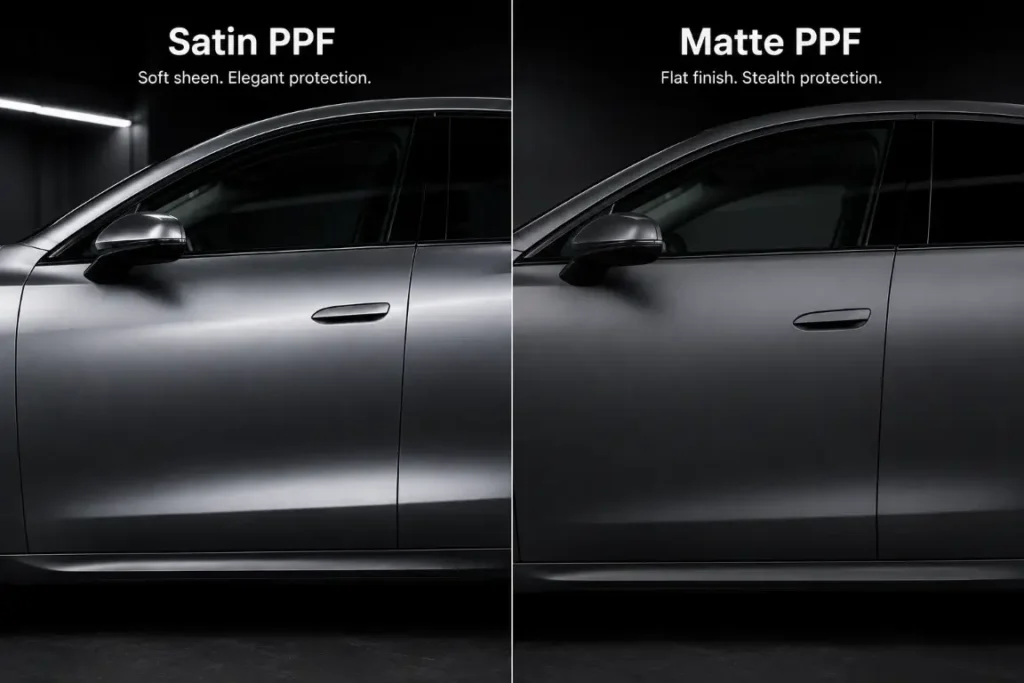
- Matte Wraps & Satin Wraps: While matte wraps and satin wraps are a popular choice for a stealthy aesthetic, their textured surface can trap contaminants more easily, requiring strict regular cleaning.
- Chrome Wraps: These materials often utilize a multi-layer construction involving a metallized layer. This layer is highly susceptible to oxidation and delamination. Consequently, chrome wraps often have a significantly shorter lifespan, frequently 1 to 3 years.
- Fluorescent and Neon Films: The pigments required to achieve high-visibility fluorescence are chemically unstable under UV radiation. Rapid fading is inevitable, often within 12 to 18 months.
The rational consumer must weigh the marginal utility of a striking appearance against the accelerated depreciation of the material.
Your Coordinates Determine Longevity: Environmental Impact Analysis
A warranty document is a promise that is fixed, whereas the environment is a dynamical aggressor. The lifetime of your car wrap is closely connected with the geographical position of the car operation. The global distribution data of FlexiPPF suggests that climate is a multiplier—or divisor—of durability.
1. Hot and Sunny Areas (e.g., Texas, Australia, Middle East)
The most important catalyst in the degradation of polymers is ultraviolet radiation. The chemical bond of PVC and the plasticizers that make it flexible is broken by high-energy photons.
- The Effect: In areas where there is extreme heat and constant sun exposure, the normal 5-year projection of vinyl ought to be calculated as 3 years. The UV damage hastens the cross-linking of adhesives, which increases the removal process by a great deal of labor.
- Factory Insight: This requires the use of high-grade UV inhibitors in the topcoat, which is a standard practice in high-end production but not in low-end films.
2. Saline and High Latitude (e.g., Canada, Scandinavia)
In lower temperatures, it is not radiation but brittle fracture and corrosion that concern us. Extreme temperatures cause vinyl to stiffen, making it prone to fractures caused by road debris. Moreover, road salts cause a corrosive slurry that strikes the wrap adhesive edge.
- The Effect: The color can be held constant, but the edges tend to fail prematurely as a result of chemical ingress.
3. Saturated Humidity and Industrial Acid Rain
Moisture in wet, industrial areas forms a weak acid that deposits on the film with atmospheric pollutants. This scratches the surface over a long time, giving it a chalky look that is impossible to remove.
The Strategic Lesson: It is wrong to use a one-size-fits-all approach to film selection. Professional installation presupposes a consultation on the formulations based on the climate, which FlexiPPF offers in the form of pre-sale climate adaptation recommendations.
The Hidden Deadline: The Economics of Deferred Removal

The basic misconception about the life of the wrap is that you should wait until it fails completely. Most owners believe that they ought to change the wrap when it appears ugly or shows signs of wear. This is economically a disastrous mistake.
A wrap has two deadlines:
1. The Aesthetic Deadline: When the wrap is getting pale.
2. Mechanical Deadline: The adhesive hardens and the vinyl brittle.
The Removal Cost Curve
When a wrap is taken off during the suggested life (e.g. Year 5), the vinyl is soft, and the glue comes off easily. The labor fee is nominal, maybe $300-500.
But when the owner does not remove it until Year 7 or 8, after the Mechanical Deadline, the situation is very different:
- Embrittlement: The vinyl breaks into millimeter-sized pieces instead of tearing in sheets.
- Adhesive Bonding: The bond strength of glue is stronger than tensile strength of vinyl.
- Paint Damage Risk: The violent mechanical scraping needed to take the film off is a high risk of damaging the clear coat beneath.
Removal costs in this deferred scenario may reach up to 2,000 or even higher, much of which is explained by the fact that the number of labor hours will increase exponentially. Thus, the lifespan of a wrap should not be considered as the duration of time that it can remain on, but rather the duration that it ought to remain on to ensure the liquidity of assets.
The Ultimate Lifespan Comparison: Vinyl Wrap vs. Colored PPF
The market is in the process of structural change. Colored Paint Protection Film (PPF) is replacing the conventional PVC Vinyl Wrap with a better material technology.
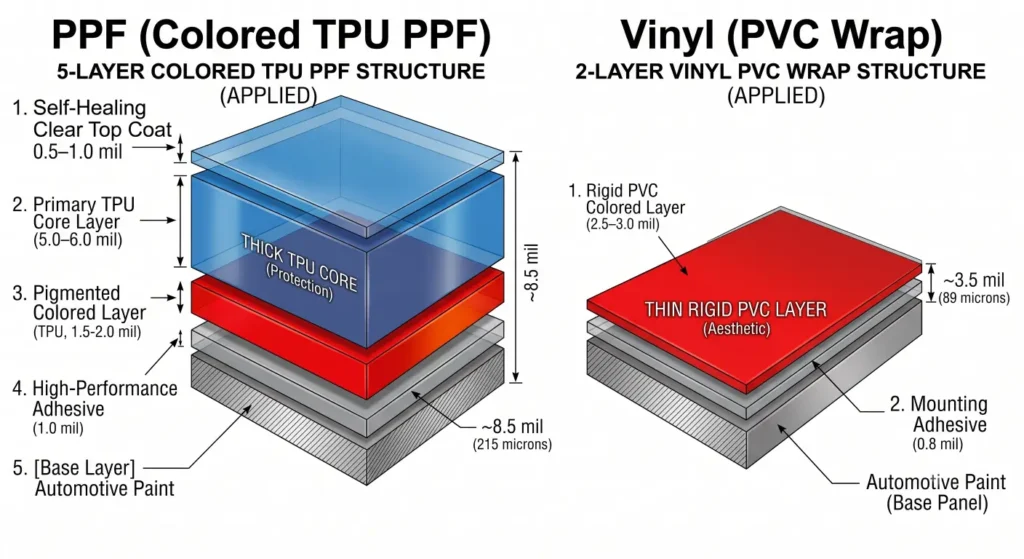
In terms of material science, it is a replacement of Polyvinyl Chloride (PVC) with Thermoplastic Polyurethane (TPU). The disparity in life expectancy and utility is immense.
1. Molecular Structure and Elasticity.
- Vinyl (PVC): This is a rigid plastic that is softened through the use of plasticizers. These plasticizers outgas over time and the material goes back to its brittle state. It is a depreciating asset from the time it is installed.
- Colored PPF (TPU): A polymer that is an elastomeric material. It is inherently pliable and it is not dependent on unstable plasticizers. It has a much longer structural integrity.
2. The Self-Healing Mechanism
Among the main critics of vinyl life is the presence of micro-scratches (swirl marks) as a result of washing. Such scratches scatter light and the wrap becomes dull after 2-3 years.
- TPU Benefit: Colored PPF has a hyper-elastic topcoat. The polymer chains rearrange to their original position when subjected to heat (sunlight or warm water) effectively healing scratches. This makes aesthetic life equal to mechanical life.
3. Impact Resistance
Vinyl is strictly cosmetic; it provides no protection against road debris. Vinyl will be punctured by a stone chip and the paint will be damaged. Colored PPF, in its turn, is 6-8 mils (as compared to 3-4 mils of vinyl) and is designed to absorb the impact energy.
- The Verdict: Vinyl is a short-term aesthetic change (3-5 years), whereas Colored PPF is a long-term capital improvement (7-10 years), which does not affect the underlying asset.
| Feature / Metric | Standard Vinyl Wrap (PVC) | FlexiPPF Colored PPF (TPU) |
| Primary Material | Polyvinyl Chloride (Rigid Plastic) | Thermoplastic Polyurethane (Elastic Rubber) |
| Average Lifespan | 3 – 5 Years | 7 – 10 Years |
| Material Thickness | 3 – 4 mil (Thin) | 7 – 8 mil (Thick/Protective) |
| Impact Protection | None (Cosmetic Only) | High (Resists Rock Chips) |
| Self-Healing | No (Scratches Accumulate) | Yes (Heat-Activated Healing) |
| Surface Texture | High “Orange Peel” | Flat, Mirror-Like Finish |
| Warranty Standard | 2 – 5 Years (Limited) | 10 Years (Comprehensive) |
Why Choose FlexiPPF High-Performance Films: Durability Defined at the Source
Durability claims in a saturated market are marketing hyperbole. Durability is a measurable parameter at FlexiPPF based on our supply chain, manufacturing equipment, and strict testing procedures. Elite wrappers and those managing complex metro restyling projects prefer our films because we are a vertically integrated manufacturer that controls the lifespan determinants.
The Material Foundation: BASF and Ashland
The quality of raw ingredients limits the duration of a film. We do not compromise on the substrate.
- German BASF TPUBase: We use polyester and TPU base material of BASF (Germany). This gives it outstanding tensile strength and optical clarity. Most importantly, it is chemically designed in such a way that it is not yellow or brittle like cheaper alternatives.
- American Ashland Adhesive: The bonding between the car and the film is important. We use Ashland adhesive technology (USA) that has low VOC emissions and high heat resistance. This guarantees that the film bonds well but removes easily even after years of exposure, which reduces the risks of deferred removal as described earlier.
Accurate Production and Testing
We have a production plant of 60,000 square meters that uses 13 German Brunkner production lines and 8 slot-die coating machines that are imported in Korea. This degree of accuracy gives us the ability to regulate the thickness of the coating to the micron so that we have uniform protection on all rolls.
Our assertions are confirmed by statistics, rather than guesses:
- UV Resistance: Our films have 5,000 hours of accelerated UV exposure testing, which guarantees color stability that is way beyond what industry standards are.
- Thermal Stability: Our products are approved to operate at temperatures as high as 80℃, which means they can be used in the harshest desert conditions.
- The 10-Year Warranty: Since we have control over the inputs and the process, FlexiPPF will provide a 10-year warranty on all paint protection films. This doubles the industry average of vinyl wraps, and the cost of ownership is reduced by half to the consumer annually.
Customization and Supply Chain Flexibility
For our B2B partners, longevity extends to the relevance of the product in the market.
- Rapid Adaptation: Our expert R&D team and professional designers can create custom designs within 48 hours.
- Flexible MOQ: Whether you require a single roll for a prototype or 100 rolls for a fleet, our logistics allow for immediate dispatch of in-stock items (1-2 days).
- Comprehensive Range: With over 100 varieties of automotive and architectural films (including safety films that block 99% of UV and reduce heat by 65%), we provide a complete ecosystem of protective solutions.
Extending the Lifecycle: The Gold Standard of Maintenance
Even the strongest TPU film needs proper maintenance to achieve the highest possible life. Degradation will accelerate without proper care. To ensure the best results, follow these maintenance practices:
1. Automated Car Wash Rejection: Nylon bristles of automated car wash are abrasives. In the long run, they will erode the topcoat of any film. The only acceptable methods are hand washing or touchless washes.
2. Ceramic Maintenance: We suggest that a ceramic coating or special sealant be used on film. This serves as a protective shield, taking in UV radiation and environmental spillage before it reaches the TPU or Vinyl layer.
3. Indoor Storage: Although our films eliminate 99% of UV rays, when parked in a garage, the thermal cycling (expansion and contraction) that the material has to withstand is greatly reduced, which will add years to its life.
FlexiPPF Support: We understand that the installation and maintenance are complicated variables. This is the reason why we have Installation Care Instructions and 7×24 technical support to help us with any quality or operational issues.
Frequently Asked Questions (FAQ)
Q: Why do horizontal surfaces (hoods and roofs) fail faster than doors?
A: Horizontal surfaces receive solar radiation at a perpendicular angle, maximizing energy absorption. This results in higher surface temperatures and increased UV exposure. We typically advise that the lifespan of horizontal applications is roughly 70-80% of vertical applications.
Q: Can FlexiPPF films be polished?
A: Our TPU-based PPF products feature self-healing topcoats that generally render polishing unnecessary. However, if deep marring occurs, they can be professionally polished. Traditional vinyl wraps should never be polished with abrasive compounds.
Q: Is the 10-year warranty transferable?
A: Our 10-year warranty reflects our confidence in the BASF TPU and Ashland adhesive matrix. It covers defects such as yellowing, bubbling, and cracking, ensuring the film performs as specified for a decade. Specific transferability terms depend on the distributor, but the factory backing remains constant.
Conclusion: Short-Term Variance vs. Long-Term Asset Protection
The issue of how long a car wrap lasts in the ultimate analysis is a decision between two different value propositions.
If the goal is a low-cost, temporary aesthetic upgrade, a generic vinyl wrap has a 3-5-year usefulness. Nevertheless, it is necessary to be cautious about the timeline of removal to prevent punitive restoration expenses.
When the goal is long-term asset preservation, impact resistance, and a set-it-and-forget-it lifecycle, the data points unambiguously to Colored PPF. Using the combination of German engineering, American adhesive technology, and high-end TPU chemistry in FlexiPPF, vehicle owners can not only change their color, but also have their investment fortified over 10 years.
The lowest wrap in the economics of vehicle ownership is not the one that has the lowest price, but the one that has the longest life and covers the most.
Would you like to explore our catalog of over 100 automotive film options or request a sample of our high-performance TPU material?
Read more:
 English
  Spanish
  Dutch
Dutch  Japanese
  Russian
  Arabic