
What Sun Damage Actually Does to Your Car Paint
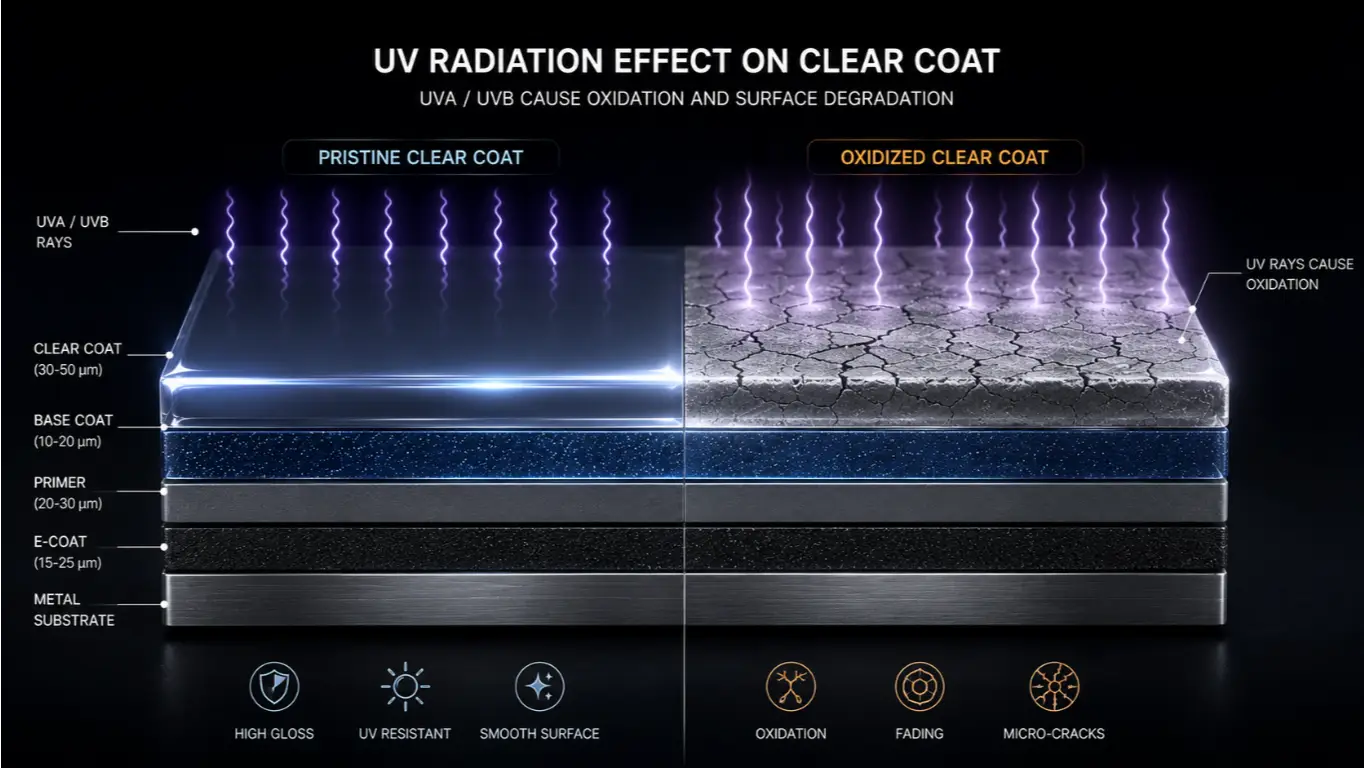
Sun damage doesn’t happen overnight. It’s a slow, cumulative process. By the time you notice the chalky, faded patches on your hood or roof, the damage has already penetrated deep into your car’s clear coat.
Here’s what’s happening at the chemical level. Sunlight carries two types of ultraviolet radiation that attack your car’s paint in different ways. UVA rays have longer wavelengths and penetrate deeper, breaking down the polymer chains in your clear coat from within. UVB rays are shorter but more energetic: they attack the surface, causing the outer layer of clear coat to oxidize and turn cloudy. Together, they form a one-two punch. UVA weakens the structure. UVB eats away at the surface.
Modern clear coats — typically 30 to 50 microns thick — do contain UV filters from the factory. This is why a new car can sit in the sun for a couple of years without visible damage. But those factory UV inhibitors degrade over time. Under consistent outdoor exposure in a sunny climate, unprotected clear coat can show noticeable oxidation within three to five years. The degradation accelerates when contaminants enter the picture: bird droppings (with a pH around 3.5 to 4.5), tree sap, and dead insects all become more corrosive when baked onto hot paint by direct sunlight.
Think of your car’s clear coat like your skin’s natural melanin. It provides baseline protection, but it’s not enough for prolonged exposure. Wax is your sunscreen — needs regular reapplication. Ceramic coating is a long-wear protective serum, chemically bonded and longer-lasting. Paint protection film is your UV-blocking jacket: a physical barrier, maximum defense. Each has its place. Understanding where you fall on that spectrum is what the rest of this guide is about.
Wax and Synthetic Sealants: Affordable, Proven Sun Protection
Your Protection, Your Budget: A Framework for Choosing
Before diving into product types and application techniques, understand the three variables that determine how well wax or sealant protects your paint: the chemical formulation, the thickness of application, and how often you reapply. Pick the wrong product for your situation — or stretch the reapplication interval too far — and you’re driving with significantly less protection than you think.
Types of Car Wax and Sealants for UV Protection
Walk into any auto parts store and the wax aisle is overwhelming. But nearly every product falls into one of three categories, and they’re not created equal when it comes to sun protection.
Natural carnauba wax is the classic choice. It produces a deep, warm gloss that enthusiasts love, and it’s easy to apply. The trade-off: durability. Carnauba wax typically lasts six to eight weeks before breaking down, and its UV-blocking capability is modest. Most natural waxes contain only a small percentage of UV-absorbing compounds — often 1% to 5% of the total formulation. They’re best for garage-kept cars where appearance matters more than extreme protection.
Synthetic polymer sealants are the practical upgrade. Unlike wax, which sits on top of the clear coat, synthetic sealants chemically bond with the paint surface. This bond holds for four to six months, and the UV inhibitors in quality sealants are more concentrated and stable than those in natural wax. If your car lives outside and you want solid protection without spending ceramic-coating money, this is your best option. Look for products that list specific UV absorbers — benzophenone-class compounds or benzotriazole derivatives — rather than just printing “UV protection” on the label.
Hybrid wax-sealant formulas occupy the middle ground: better durability than pure wax (typically three to four months) and better gloss than pure sealant. They’re a convenient all-rounder if you only want to buy one product and don’t mind reapplying quarterly.
How to Apply Wax and Sealant for Maximum UV Protection
Even the best product underperforms if it’s applied incorrectly. Here’s a five-step routine that maximizes the protective layer you’re putting down.
Step 1: Wash and decontaminate. Old wax residue, iron fallout, and road film create a barrier between the sealant and your clear coat. Use a pH-neutral car shampoo and, ideally, a clay bar or chemical decontamination spray before applying protection. If the surface isn’t clean, the sealant bonds to dirt — not to your paint.
Step 2: Work in the shade. Apply wax or sealant only when the paint surface is cool to the touch. The ideal ambient temperature range is 15°C to 25°C (59°F to 77°F). Above 30°C (86°F), the product’s flash time — how quickly solvents evaporate — can drop by more than half. The product dries before it bonds properly, leaving streaks and uneven coverage.
Step 3: Work in small sections. Tackle the car one 60 × 60 cm (roughly 2 × 2 foot) panel at a time. Apply a thin, even layer. More product does not mean more protection. Too thick an application makes removal harder and wastes material without improving UV defense.
Step 4: Wait for the haze, then remove. Carnauba waxes typically haze in three to five minutes; synthetic sealants can take ten to twenty minutes. Follow the product’s specific instructions. Wipe off with a clean microfiber towel, turning to a fresh side frequently.
Step 5: Reapply on schedule. For consistent UV protection, reapply carnauba wax every six to eight weeks and synthetic sealant every four to six months. A simple test: spray water on your hood. If it beads into tight, round droplets, your protection layer is still working. If the water spreads into a flat sheet, it’s time to reapply.
Ceramic Coating: The Glossy Middle Ground — Honest Pros and Cons
Ceramic coating has become the most heavily marketed paint protection product of the last decade. The promises sound magical: permanent shine, scratch-proof surface, never wax again. The reality is more nuanced. It’s worth understanding before you spend anywhere from $800 to $2,500 on a professional application.
The table below cuts through the marketing to show what ceramic coating actually delivers.
| Dimension | What It Actually Does | Common Marketing Exaggeration | What This Means for You |
|---|---|---|---|
| UV Protection | Adds a chemically resistant secondary layer above the clear coat; slows oxidation rather than blocking UV entirely | “Blocks 100% of UV rays” — misleading; modern clear coats already contain UV filters; the coating adds incremental protection | Useful but not a standalone UV solution; works best as part of a layered strategy |
| Scratch Resistance | 9H pencil hardness rating (not Mohs hardness); resists light swirl marks from washing but does NOT prevent scratches from keys, branches, or road debris | “9H hardness — diamond-like protection” — deliberately conflates pencil hardness scale with Mohs hardness scale | Your car will still scratch. Ceramic coating makes it harder to scratch during washing, not during accidents |
| Hydrophobicity | Extremely water-repellent; dirt and grime slide off more easily; washing takes half the time | Often accurate — this is ceramic coating’s strongest real-world benefit | The biggest quality-of-life upgrade: your car stays cleaner longer and washes faster |
| Gloss Enhancement | Deepens color and adds a “wet look” shine that lasts years without waxing | Generally accurate for quality coatings | If appearance is your priority, this is ceramic coating’s strongest selling point |
| Durability | Professional-grade coatings (70–90% SiO₂ content) last 2–5 years; consumer-grade sprays (<10% SiO₂) last 6–18 months | “Permanent protection” — no coating is permanent; all degrade with UV exposure and washing | Budget for reapplication. A “5-year coating” in Arizona sun may last closer to 3 years |
| Impact Protection | None. Ceramic coating is microns thin and provides zero defense against rock chips, door dings, or gravel strikes | Rarely claimed directly, but “full protection” language implies it | If you drive highways or gravel roads, you still need PPF on impact zones |
One strategy worth highlighting: ceramic coating and PPF are not competitors. They’re complementary. Applying ceramic coating on top of PPF combines the physical impact protection of film with the gloss and easy-cleaning properties of coating. This layered approach costs more upfront but delivers the best of both technologies. The only rule: PPF goes on first. Ceramic coating prevents PPF adhesive from bonding properly, so the order matters.
Paint Protection Film: The Science Behind Maximum UV Defense
What Separates Good Protection from Great Protection
Paint protection film is the only solution on the market that provides a physical barrier between your paint and the outside world. But not all PPF is created equal. Before exploring how it works, understand this: your protection is only as good as the film’s quality and the installer’s skill. These next three sections give you the knowledge to evaluate both.
How PPF Blocks UV and Protects Paint at the Material Level
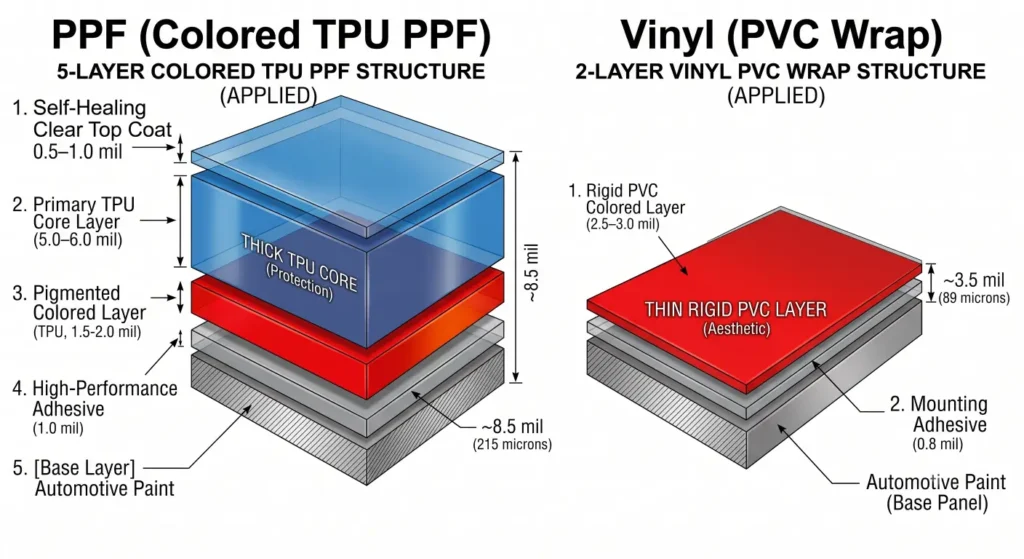
PPF is often described as “a clear sticker for your car,” but that sells it short. Quality PPF is a precision-engineered, three-layer system where each layer has a specific job.
The top layer is a UV-inhibitor coating. This is where the sun protection lives. Chemical UV absorbers — typically benzotriazole-class compounds and hindered amine light stabilizers (HALS) — are embedded in this transparent top coat. When UV radiation hits the film, these absorbers convert the ultraviolet energy into harmless heat before it can reach the clear coat underneath. The concentration and quality of these inhibitors is what separates premium PPF from budget film, and it directly determines how long the film resists yellowing.
The middle layer is the workhorse: thermoplastic polyurethane (TPU). TPU is elastic, impact-absorbing, and self-healing. When minor scratches or swirl marks appear on the film’s surface, heat from sunlight or warm water (above roughly 40°C / 104°F) triggers the TPU’s molecular chains to reorganize, closing the scratch. This isn’t marketing fiction; it’s a well-documented property of high-quality TPU. Budget films that use PVC or TPH instead of TPU lack this capability entirely and are far more prone to yellowing and cracking.
The bottom layer is a pressure-sensitive acrylic adhesive. It needs to hold the film firmly in place for up to a decade, then release cleanly without pulling paint when the film is eventually removed.
PPF vs Ceramic Coating: The Honest Head-to-Head for Sun Protection
These two products are constantly compared, but they solve fundamentally different problems. Here’s a straightforward breakdown.
| What You’re Protecting Against | PPF (Paint Protection Film) | Ceramic Coating | Which One Wins |
|---|---|---|---|
| UV radiation and oxidation | Top-coat UV inhibitors block UV before it reaches clear coat | Adds a chemical-resistant layer that slows oxidation | PPF (physical barrier > chemical barrier) |
| Rock chips and gravel strikes | Absorbs impact; prevents chips from reaching paint | Zero impact protection | PPF — ceramic coating cannot stop physical impacts |
| Light scratches and swirl marks | Self-healing TPU layer repairs minor scratches with heat | Some resistance to wash-induced swirls, but will still scratch | PPF |
| Water spots and chemical etching | Moderate — newer films include hydrophobic top coats | Excellent — water beads and slides off; bird droppings and sap wipe away easily | Ceramic coating (significant margin) |
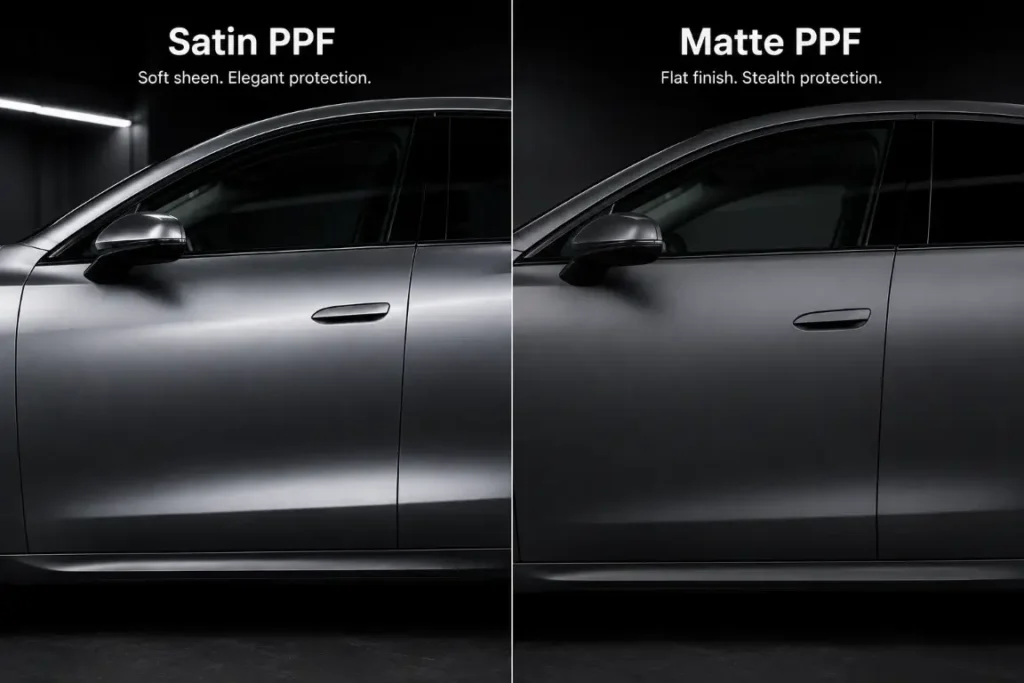
| Gloss and appearance | Saturates or slightly mutes paint depth; matte options available | Deepens color and adds “wet look” gloss | Ceramic coating |
| Longevity | 5–10 years with warranty | 2–5 years (professional grade) | PPF |
| Cost (full car, pro installation) | $4,500–$8,500 | $1,000–$2,500 | Ceramic coating (dramatically less expensive) |
| Removability | Professional removal required ($500–$1,500) | Wears off naturally or can be polished away | Ceramic coating |
The bottom line: these aren’t competing products. PPF protects your paint from physical damage. Ceramic coating makes your car easier to clean and look better while doing it. The ideal setup uses both: PPF on high-impact zones (front bumper, hood, fenders, mirrors) and ceramic coating over the entire vehicle, including on top of the PPF.
Five Things to Look for in Quality PPF — A Manufacturer’s Perspective
Most PPF buying guides tell you to compare brands. But brands change. What doesn’t change are the technical standards that separate quality film from marketing hype. Here are five things to check, directly from the production side of the industry.
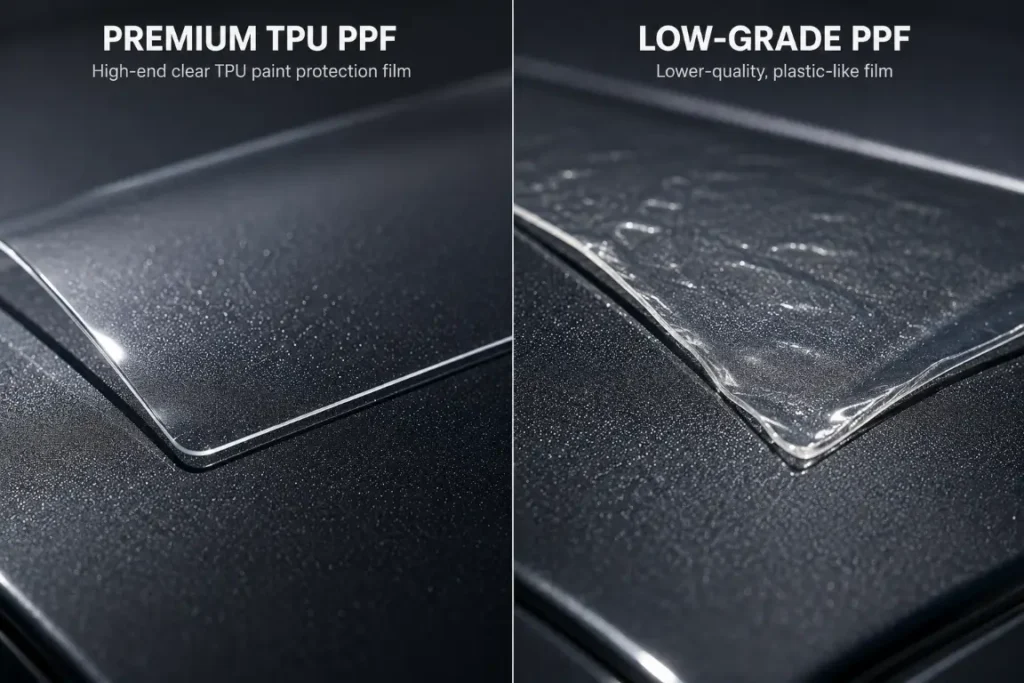
1. The base material: TPU, not PVC or TPH. Thermoplastic polyurethane is the only base material that delivers self-healing, elasticity, and long-term UV stability. PVC-based films are cheaper but yellow within one to three years and can become brittle. TPH is a middle-ground material that mimics some TPU properties but lacks its molecular self-healing capability. Ask directly: “Is this film 100% TPU?” If the answer is evasive, walk away.
2. Top-coat UV inhibitor quality. The top coat is where UV protection actually happens. Premium films use concentrated benzotriazole or HALS-based UV absorbers in a ceramic-infused clear coat. The practical test: ask for accelerated aging data. Quality PPF should have undergone at least 5,000 hours of QUV accelerated weathering testing and show a color difference (ΔE value) below 2 — the threshold at which the human eye can barely perceive yellowing. Top-tier films target ΔE below 1.
3. Thickness consistency across the roll. A quality film maintains thickness within a tolerance of ±5% across the entire roll width. Inconsistent thickness leads to uneven protection and visible texture differences on the car. Thickness alone isn’t a quality indicator — 6 to 8 mil (150 to 200 microns) is the standard range for premium PPF — but consistency is.
4. Adhesive performance. The adhesive needs to do two contradictory things: hold the film down securely for up to 10 years, then release cleanly. Low-quality adhesives either fail early (lifting edges, bubbling) or bond so aggressively that they pull paint during removal. The industry benchmark for a clean adhesive is Ashland or equivalent pressure-sensitive acrylic formulations, tested for clean removal after accelerated aging equivalent to the film’s warranty period.
5. Warranty terms, not just warranty length. A “10-year warranty” means nothing without reading the fine print. Does it cover yellowing? (Many don’t.) Does it cover labor for removal and replacement, or just the cost of the replacement film? Does it require annual “inspections” at the installing shop to remain valid? A genuine warranty covers film yellowing, cracking, bubbling, and delamination — and includes labor — for the full stated term.
If you’re evaluating PPF products and suppliers, these five criteria give you an objective scorecard that works regardless of brand name or marketing budget. When a manufacturer can show you their TPU certification, QUV test data with ΔE values, thickness tolerance specifications, adhesive partner name, and warranty terms with labor coverage, you’re looking at a product built on engineering rather than advertising.
How to Match Protection to Your Driving Life
One Rule for Choosing: Your Parking Situation Matters More Than Your Car’s Price Tag
The most common mistake in paint protection is overspending on the wrong solution. A $5,000 full-car PPF wrap on a garaged weekend car is overkill. A $20 bottle of spray wax on a daily commuter parked under the Arizona sun is inadequate. Here’s how to match protection to how you actually use your car.
For the Daily Commuter: Practical Protection on a Realistic Budget
You drive a standard sedan or crossover. It parks in an office lot or on the street. You want to protect your investment without spending thousands.
Recommended combination: Synthetic polymer sealant applied every four months ($20–$50 per application if you do it yourself), plus a reflective car cover if outdoor parking is unavoidable ($50–$150), plus a windshield sunshade ($10–$30). Total annual protection cost: roughly $150 to $300.
Why this works: The horizontal surfaces of your car — hood, roof, trunk — receive the most direct sunlight. A quality synthetic sealant provides a sacrificial UV-absorbing layer exactly where you need it most. The car cover eliminates direct exposure during the long hours your car sits parked. For a daily commuter, this combination covers 90% of the sun-exposure risk at a fraction of the cost of ceramic coating or PPF.
Compare the math: $250 per year on sealant and covers for five years comes to $1,250. A professional paint correction and respray after five years of zero protection typically costs $1,500 to $3,000 — and the car’s resale value takes an additional hit from the visible paint degradation.
For the Enthusiast or Weekend Car: Premium Looks, Proven Protection
You bought something special. It might be a new sports car, a meticulously maintained classic, or simply a vehicle you plan to keep for ten years. It lives in a garage most nights but sees weekend road trips, cars-and-coffee meets, and occasional highway miles.
Recommended combination: Professional ceramic coating on the entire vehicle ($1,000–$2,000, including paint correction), plus PPF on high-impact zones — front bumper, full hood, front fenders, and side mirrors ($1,500–$2,500). Total investment: $2,500 to $4,500.
Why this works: The ceramic coating keeps the car looking showroom-fresh with minimal effort. You’ll wash less often and the car will look better between washes. The partial PPF on forward-facing panels protects against the one thing ceramic coating can’t stop: rock chips at highway speed. The PPF takes the impact; the ceramic coating makes everything easier to clean. This two-tier setup typically delivers five-plus years of protection with routine maintenance.
For the Commercial Fleet or Work Truck: Maximum Durability, Minimum Downtime
You manage multiple vehicles — a sales fleet, delivery vans, or construction trucks. They work outdoors year-round, and vehicle appearance directly reflects on your brand. Downtime for paint work costs you revenue.
Recommended combination: Bulk PPF on forward-facing panels for customer-facing vehicles, with negotiated fleet pricing (typically 15–25% below retail), plus annual professional sealant application for workhorse vehicles where PPF isn’t justified.
Why this works — the ROI perspective: A fleet of ten vehicles, each with $500 per year in basic protection, costs $5,000 annually. Without protection, those same ten vehicles may need partial repainting within five years at $3,000 to $5,000 per vehicle — a potential $30,000 to $50,000 expense, plus the lost-use cost of vehicles sitting in a body shop. Even conservatively, a basic fleet protection program pays for itself several times over through extended paint life and higher resale values.
Simple Habits That Multiply Any Protection’s Lifespan
Whatever protection you choose, your daily routine determines how long it lasts. These six habits require minimal effort but dramatically extend the life of wax, sealant, ceramic coating, or PPF.
Wash every two weeks. Dust and road grime don’t just look bad. They act like microscopic lenses, focusing sunlight and accelerating UV damage on the paint beneath. A biweekly wash removes this amplifying layer before it does harm.
Remove bird droppings and tree sap immediately. In direct sunlight at 30°C (86°F) or above, bird droppings — with their pH of 3.5 to 4.5 — can etch into clear coat within two to four hours. Keep a bottle of quick detailer and a microfiber cloth in your trunk. The sooner you wipe it off, the less damage it does.
Use pH-neutral car shampoo. Household dish soap has a pH of 9 to 12 — strongly alkaline — and strips wax and sealant protection in a single wash. Automotive-specific shampoos are formulated at pH 6 to 8, cleaning effectively without attacking your protection layer.
Wash in the shade. Direct sunlight causes water and cleaning solution to dry before you can rinse, leaving mineral deposits and soap residue baked onto the surface. If shade isn’t available, wash early morning or late afternoon.
Dry with microfiber towels, one panel per side. Flip to a fresh towel surface for each panel. Reusing a dirty towel drags grit across your paint and instills swirl marks. This is the single cheapest way to keep your paint looking newer longer.
Test your protection quarterly. Spray water on your hood. If it beads into tight round droplets, your protection is intact. If the water flattens into a sheet, it’s time for a fresh application. This ten-second test tells you more than any product’s claimed durability window.
The science behind paint protection runs deeper than most articles let on. When you know what to look for — TPU vs. PVC in PPF, SiO₂ concentration in ceramic coatings, UV absorber chemistry in sealants — you stop shopping by brand name and start evaluating products on their technical merits. If you’re curious about what goes into manufacturing PPF that meets the standards covered in this guide, FlexiPPF produces five-layer films with ceramic top coats, validated through 5,000-hour QUV anti-yellowing testing, and backs them with a 10-year warranty covering film and labor. That’s the kind of spec sheet that makes the five-point quality checklist actionable.
References
- FlexiPPF. “Paint Protection Films — Product Specifications.” https://www.flexippf.com/automotive-films/paint-protection-films/
- FlexiPPF. Official Website. https://www.flexippf.com/
 English
  Spanish
  Dutch
Dutch  Japanese
  Russian
  Arabic