
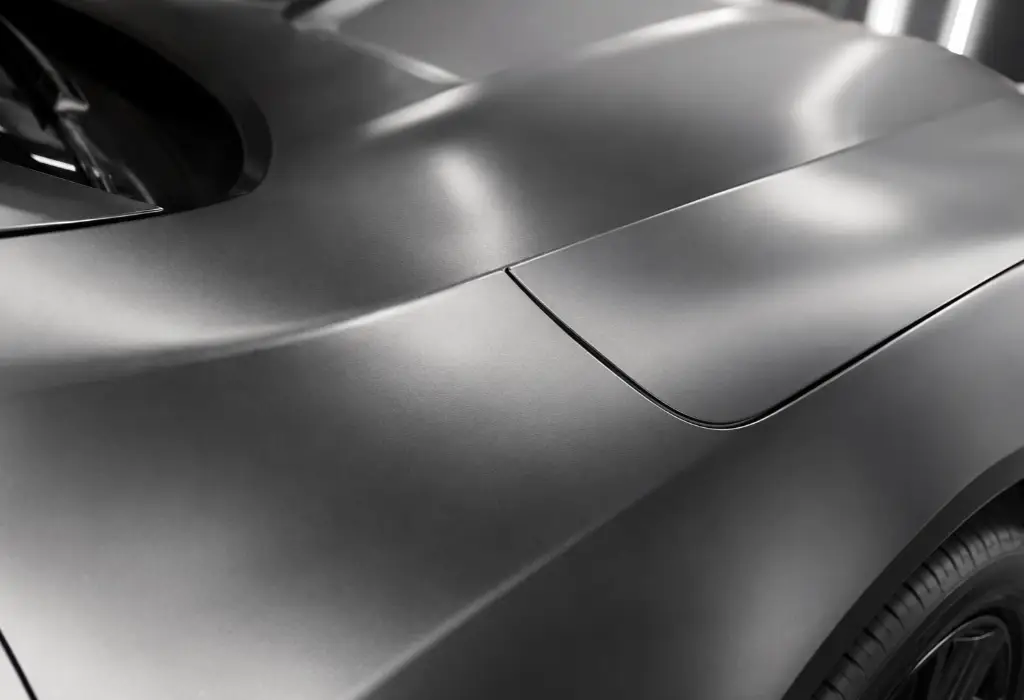
Your car’s paint is not decoration. It is the last line of defense between your vehicle’s metal body and everything the world throws at it: rain, salt, UV radiation, bird droppings, and gravel kicked up at highway speeds. When the paint fails, rust follows. When rust follows, the repair bill multiplies.
The good news: protecting your car’s paint has never been more achievable. The challenge: the options on the market — wax, sealants, ceramic coatings, paint protection film — are often sold as interchangeable upgrades when they are fundamentally different tools built for different jobs.
This guide walks through every major protection method, explains what each one actually does and what it does not, and gives you a clear framework for matching protection to how you actually use your car.
What Actually Damages Your Car Paint (And What Doesn’t)
Before choosing a defense, know what you are defending against. Here is a fact that surprises most car owners: the biggest cause of paint wear is not the environment. It is the way you wash your car.
Automatic car washes with stiff brushes are the number one enemy. Those swirling microscratches you see under gas station lights? That is the cumulative effect of dirty brushes grinding road grit across your clear coat at high speed. Even at home, a dirty wash mitt or a drying blade dragged across the surface can inflict more micro-damage in ten minutes than a month of highway driving.
Next come the biological threats. Bird droppings are surprisingly acidic — with a pH that can dip below 3.5, they can etch into clear coat within 48 hours if left to bake in the sun. Tree sap and bug remains carry similar risks. Road salt, common in winter climates, accelerates corrosion once it finds a scratch or chip to work into.
The irony: the biggest threat to your paint is not the environment — it is how you wash your car. Dirty wash mitts and automatic brushes grind road grit across your clear coat, inflicting more micro-damage in ten minutes than a month of highway driving.
What about UV rays and sun damage? This is where marketing has outpaced reality. Modern automotive clear coats already contain UV filters that block over 95% of ultraviolet radiation. Paint fade is far less of a problem on cars built in the last decade than it was on their predecessors. Sun exposure still matters, but it is not the paint-killer it is often made out to be.
And then there is the one threat no habit can avoid: flying debris. A rock kicked up on the highway at 70 miles per hour carries enough kinetic energy to chip through clear coat and paint in an instant. No washing technique, no parking strategy, and no wax will stop it. There is only one solution for physical impact — and we will get to it.
The Paint Protection Spectrum: Wax, Sealant, Ceramic, and PPF Compared
If you are comparing protection methods for the first time, the landscape can feel like a wall of marketing claims. The table below is your map. Use it as a reference point as you read through each method in detail.
| Method | What It Is | Protection Type | How Long It Lasts | DIY Cost | Pro Cost |
|---|---|---|---|---|---|
| Wax / Sealant | A sacrificial layer that sits on top of the paint | Chemical | 1–12 months | $8–$60 | $100–$500 |
| Ceramic Coating | A semi-permanent nano-polymer bonded to the clear coat | Chemical + Hydrophobic | 2–5 years | $50–$150 | $500–$3,000 |
| PPF | A thermoplastic polyurethane film applied over the paint | Physical + Chemical | 5–10 years | Not recommended | $500–$8,000 |
With the overview in place, here is what each method actually delivers.
Wax and Paint Sealants — The Entry-Level Sacrificial Layer
Wax and paint sealants work on the same principle: apply a thin sacrificial layer on top of the clear coat, and let the environment attack that layer instead of the paint itself. When the layer wears away, you apply a fresh one.
Natural carnauba wax produces a warm, deep gloss that enthusiasts have loved for decades. It lasts one to three months under normal conditions — less if you wash frequently or park outdoors. Synthetic paint sealants, made from cross-linked polymers, trade some of that warmth for durability. Six to twelve months is typical, and the finish is more mirror-like than waxy.
Neither stops a rock chip. Neither prevents scratches. Both are chemical shields only: they buy you time against bird droppings, water spots, and light UV exposure, and they make the car easier to wash. The key variable with sealants is cross-link density, not thickness. A well-formulated sealant forms a tighter polymer network, which is why a $60 bottle can outperform a $20 one even though both look the same going on.
Think of wax and sealants as sunscreen. Wax is SPF 15 — reapply it regularly. Sealant is SPF 50 — it lasts longer and protects better, but it is still a temporary layer that washes away eventually.
Ceramic Coating — The Semi-Permanent Chemical Bond
Ceramic coating is simultaneously the most talked-about paint protection method and the most misunderstood.
Here is what it actually is: a liquid polymer containing silicon dioxide (SiO₂) nanoparticles that chemically bond with your car’s clear coat. Once cured, it forms a layer typically 1 to 3 microns thick — roughly one-fiftieth the diameter of a human hair. It is thin. It is not armor.
What ceramic coating does exceptionally well: it makes your car dramatically easier to clean. A quality coating produces a contact angle above 100 degrees, meaning water beads and rolls off, carrying dirt with it. Chemical resistance is excellent; bird droppings, bug acids, and road salt have a much harder time reaching the clear coat. And the gloss enhancement is real — the coating fills microscopic pores in the clear coat, producing a deeper, wetter-looking reflection.
What ceramic coating does not do: stop rock chips. This is the single most important distinction to internalize. Ceramic coating is a chemical barrier, not a physical one. A stone traveling at highway speed will punch through it as if it were not there. The scratch-resistance claims you see in marketing — “9H hardness,” “diamond-infused” — describe the coating’s resistance to light swirl marks and wash-induced marring, not its ability to withstand impact. The real mechanism behind the scratch resistance is slickness, not hardness: a slicker surface means less friction when you wash, which means fewer opportunities to create swirl marks in the first place.
One more thing worth knowing: the prep work matters more than the product. Paint correction — removing existing swirls, oxidation, and defects — takes roughly 70% of a professional ceramic coating job’s labor hours. If a shop quotes you a ceramic coating for a fraction of what others charge, they are almost certainly skipping the correction step. That means they will permanently seal every existing imperfection under the coating.
Paint Protection Film (PPF) — The Physical Barrier
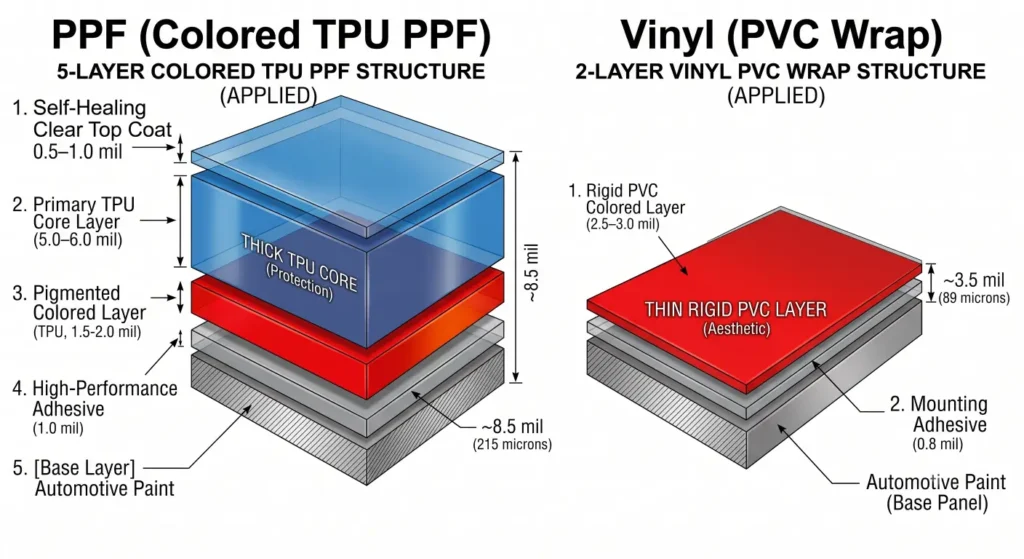
Paint protection film is the heavy artillery. Originally developed for military helicopter rotor blades, PPF is a clear, multi-layer thermoplastic polyurethane film that is applied directly to the vehicle’s painted surfaces. It is typically 6.5 to 10.5 mil thick. One mil equals 0.001 inches, or 25.4 microns.
Unlike every other method discussed so far, PPF absorbs physical impact. A rock that would chip through clear coat and paint bounces off a PPF-covered panel. The film can be scratched, but here is the trick: quality PPF is self-healing. The polyurethane layer’s polymer chains rearrange when heated — by sunlight or a bucket of warm water — literally pushing minor scratches and swirl marks back to a flat surface. Deep cuts that penetrate the top coating will not self-heal, but surface-level marring disappears.
PPF is built in five functional layers:
The TPU substrate determines the film’s performance ceiling. The two most widely recognized suppliers of PPF-grade TPU are Lubrizol (USA, under the Estane brand) and BASF (Germany). The adhesive layer determines what happens when the film is eventually removed. Quality adhesives like Ashland’s formulations are engineered to peel cleanly after a decade of service. Bargain adhesives can bond permanently to the clear coat.
Thickness matters for protection strategy. A 6.5-mil film is adequate for daily commuting. Highway warriors and off-road vehicles benefit from 8.5 mil or thicker. At 10.5 mil — about 43% thicker than the industry average — the film is capable of absorbing impacts that would damage thinner alternatives.
Cost is the obvious barrier. A full-vehicle PPF installation runs $2,000 to $8,000. Partial coverage on high-impact zones — front bumper, hood, fenders, mirrors — typically costs $500 to $2,000. DIY installation is not recommended: PPF requires stretching, precision trimming, and a dust-free environment that most garages cannot provide.
Inside a Quality PPF: What Separates a 10-Year Shield from a 3-Year Regret
Not all PPF is created equal, and the differences are not visible on a spec sheet that only lists thickness and warranty length. Every film is a composite system: raw materials contribute roughly 50% of final quality, manufacturing precision contributes 30%, and installation skill accounts for the remaining 20%. A failure in any one of these three collapses the entire product.
The Five Layers That Make or Break a PPF
Ceramic Top Coat
Determines hydrophobicity, stain resistance, and gloss. A contact angle above 110 degrees is the benchmark for super-hydrophobic performance, and a gloss unit reading above 95 produces a mirror-like finish.
Self-Healing Polyurethane
Recovers from scratches through polymer chain rearrangement. Heat provides the energy for polymer chains to return to their lowest-energy, flat configuration, erasing surface-level damage in the process.
TPU Substrate
The structural backbone that determines optical clarity and UV stability. Premium TPUs like Lubrizol’s Estane and BASF’s formulations maintain a color difference below ΔE 3 after 5,000 hours of accelerated weathering — below the threshold of visible yellowing.
Adhesive Layer
Quality acrylic adhesives, such as Ashland’s formulations, are engineered for controlled initial tack during installation and clean removability even after a decade of service. Adhesive aging is validated through high-temperature accelerated aging in a laboratory environment.
PET Release Liner
Its surface flatness directly affects adhesive uniformity. An uneven liner creates microscopic thickness variations in the adhesive layer, determining whether the film’s edges stay down over time.
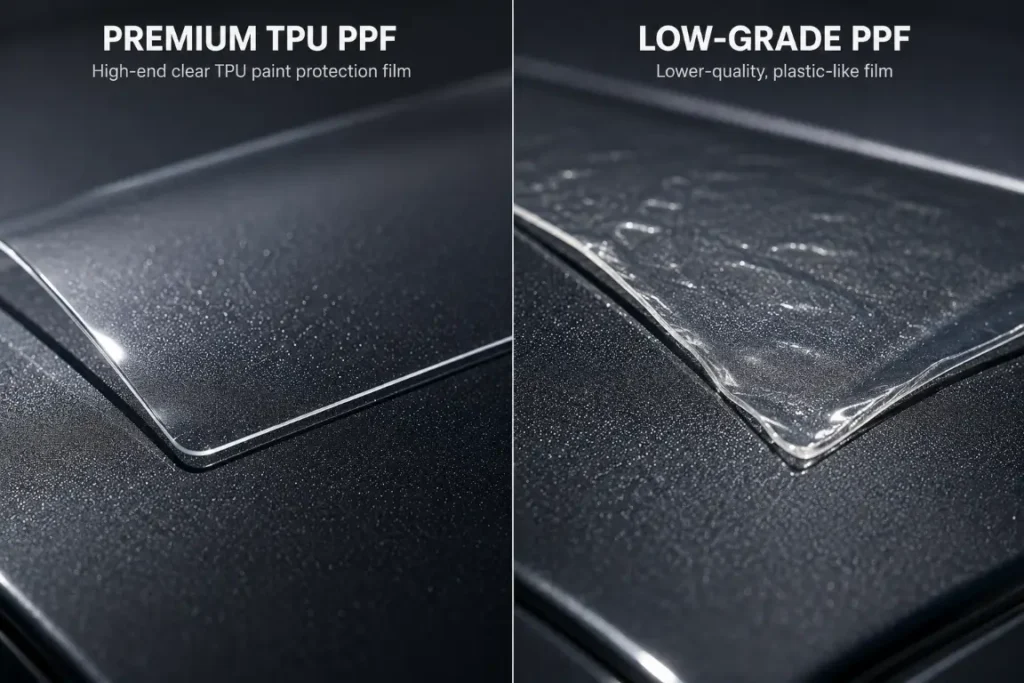
Across all five layers, the manufacturing environment dictates consistency. PPF coating and lamination must happen in at least a Class 10,000 cleanroom (ISO 7), where airborne particle counts are controlled below 352,000 particles per cubic meter. In an uncontrolled environment, dust particles trapped between layers create visible “fish eyes” — the most common quality defect in budget PPF. Thickness tolerance is another tell: premium production lines hold variation to within ±0.5 mil of the nominal specification, while budget lines can swing ±1.5 mil, meaning an “8.5-mil film” may measure only 7 mils in spots.
Why the Installer Matters as Much as the Film
The best PPF in the world, applied poorly, is worse than no PPF at all. A film with visible seams, trapped debris, lifting edges, and stretch marks cannot be fixed — it can only be removed and replaced.
How do you evaluate an installer before handing over your car? Ask these five questions:
- “What TPU does your film use, and who supplies it?” A professional installer should be able to name the TPU supplier without hesitation. If the answer is “I’m not sure” or a generic brand name, move on.
- “What is the film’s thickness tolerance?” If they do not know what this means, they have not been trained to think about film quality beyond the marketing brochure.
- “Do you work in a dust-controlled environment?” PPF installation requires at least an ISO 8 (Class 100,000) clean environment. A standard detailing bay with open bay doors does not qualify.
- “What does your warranty cover — yellowing, lifting, or removal?” A warranty that covers only “manufacturing defects” without specifying yellowing thresholds or edge-lifting coverage is not a warranty — it is a disclaimer dressed up as one.
- “Do you use pre-cut kits or hand-cut bulk film?” Pre-cut patterns reduce blade contact with the paint but may leave visible seams at panel edges. Bulk-cut installations allow wrapped edges for a seamless look but demand vastly more skill. Neither is wrong, but the installer should be able to explain their choice.
Ask: “What TPU does your film use?” A professional installer names the supplier immediately without hesitation.
Ask: “What is the film’s thickness tolerance?” If they do not know what this means, they have not been trained to look beyond the marketing brochure.
Ask: “Do you work in a dust-controlled environment?” Proper PPF installation requires at least an ISO 8 (Class 100,000) clean environment.
Ask: “What does your warranty cover?” Look for specific coverage of yellowing thresholds, edge lifting, and removal costs — not just generic “manufacturing defects.”
Ask: “Do you use pre-cut kits or hand-cut bulk film?” They should be able to explain their choice and the trade-offs of each approach.
Red flags: quotes significantly below the local market average, a shop that stocks only one film thickness and claims it works for every vehicle, and any installer who says PPF “needs no maintenance.”
After installation, it is normal to see slight white haze along edges for the first 48 hours. This is residual moisture evaporating, not a defect. But edges that are still white, lifted, or bubbling after a week are installation failures that will only get worse.
Matching Protection to Your Driving Life
There is no universally “best” protection method. There is only the best method for how you actually use your car.
| Your Driving Life | Recommended Approach | Why |
|---|---|---|
| Daily commuter, covered parking at work | Paint sealant + periodic wax | Damage risk is manageable; sealant provides solid chemical protection at minimal cost |
| Frequent highway driving, worried about rock chips | PPF on front bumper, hood, fenders, and mirrors | Roughly 90% of highway debris impacts these zones |
| New car, planning to keep it 5+ years | Full front PPF + ceramic coating on entire vehicle | PPF handles physical threats; ceramic coating delivers easy cleaning and long-term gloss |
| Off-road or unpaved road use | Full-coverage PPF, minimum 8.5 mil | Branch scratches and gravel spray require wider coverage and thicker film |
| Leasing or selling within 3 years | DIY sealant only | Heavy investment in protection will not be recovered at resale |
| Garage-kept weekend car, minimal mileage | Ceramic coating | Physical impact risk is near zero; the value is in dust repellency and gloss preservation |
If you remember one rule from this entire table: PPF is the only protection method that stops a rock chip. If you only spend one significant amount: invest in a quality ceramic coating — it delivers the largest day-to-day experience improvement for the broadest range of drivers. Protection is proportional. A $3,000 PPF wrap on a $12,000 commuter car is harder to justify than a $600 ceramic coating on a car you plan to own for a decade. Match the investment to the vehicle’s value and your ownership horizon.
The right protection starts with the right film.
Compare PPF specifications side by side — thickness, TPU source, warranty terms — before you decide.
The Long Game — Maintenance, Longevity, and What Happens When PPF Comes Off
Every protection method has a lifespan, and those lifespans are conditional, not guaranteed.
Wax lasts one to three months. Less if you park outdoors; less if you wash weekly. Sealant lasts six to twelve months under the same conditions. Ceramic coating is rated for two to five years, but that assumes pH-neutral washing and annual maintenance — skip the maintenance and an 18-month coating can lose its hydrophobic performance in half that time. PPF is warrantied for five to ten years, and quality films installed correctly routinely last a decade. Budget films with unverified TPU sources can yellow and lift within three.
These are best-case numbers under proper care. The single most effective maintenance habit, across all methods, is washing with a pH-neutral car shampoo and a clean microfiber wash mitt. Automatic brush washes are the enemy of every protection product on this list.
And then there is the question nobody asks until year seven: what happens when the PPF comes off?
Quality PPF, built on Ashland-grade adhesives, removes cleanly. The film peels away as a single sheet, leaving the factory clear coat intact and unmarked. Budget PPF tells a different story. Three things can go wrong: the adhesive permanently cures to the clear coat and must be mechanically polished off; the TPU layer embrittles over time and shatters during removal instead of peeling; or the film lifts repainted panels — aftermarket paint adhesion is rarely equal to factory paint, and a PPF’s adhesive does not know the difference.
This is the real cost of choosing a PPF based on price alone. The quality decisions you make at installation — about TPU sourcing, adhesive chemistry, and installer competence — settle up seven to ten years later, in a removal bay, with a technician’s heat gun and plastic razor blade.
Regardless of which protection path you choose, the materials behind the product matter more than the logo printed on the packaging. For PPF specifically, transparency about raw material sourcing is the most reliable signal of quality: Lubrizol or BASF TPU substrates, Ashland adhesive systems, and ceramic top coats with measurable, published hydrophobic specifications. FlexiPPF, a Shenzhen-based manufacturer, publishes full specifications across six PPF product series — spanning 6.5 to 10.5 mil thickness with a 10-year warranty — which makes its catalog a useful reference point for what a complete technical specification should include, regardless of which brand you ultimately choose.
Request PPF Specifications & Samples
Get full technical data sheets, thickness options, and TPU sourcing documentation for your business.
Contact FlexiPPFReferences
- FlexiPPF. “Paint Protection Films.” https://www.flexippf.com/automotive-films/paint-protection-films/
- FlexiPPF. “Quality Support & Warranty.” https://www.flexippf.com/quality-support-warranty/
- FlexiPPF. Homepage. https://www.flexippf.com/
- ASTM International. “ASTM D882 — Standard Test Method for Tensile Properties of Thin Plastic Sheeting.” https://www.astm.org/d0882-18.html
- ISO. “ISO 14644-1:2015 — Cleanrooms and associated controlled environments.” https://www.iso.org/standard/53394.html
 English
  Spanish
  Dutch
Dutch  Japanese
  Russian
  Arabic