
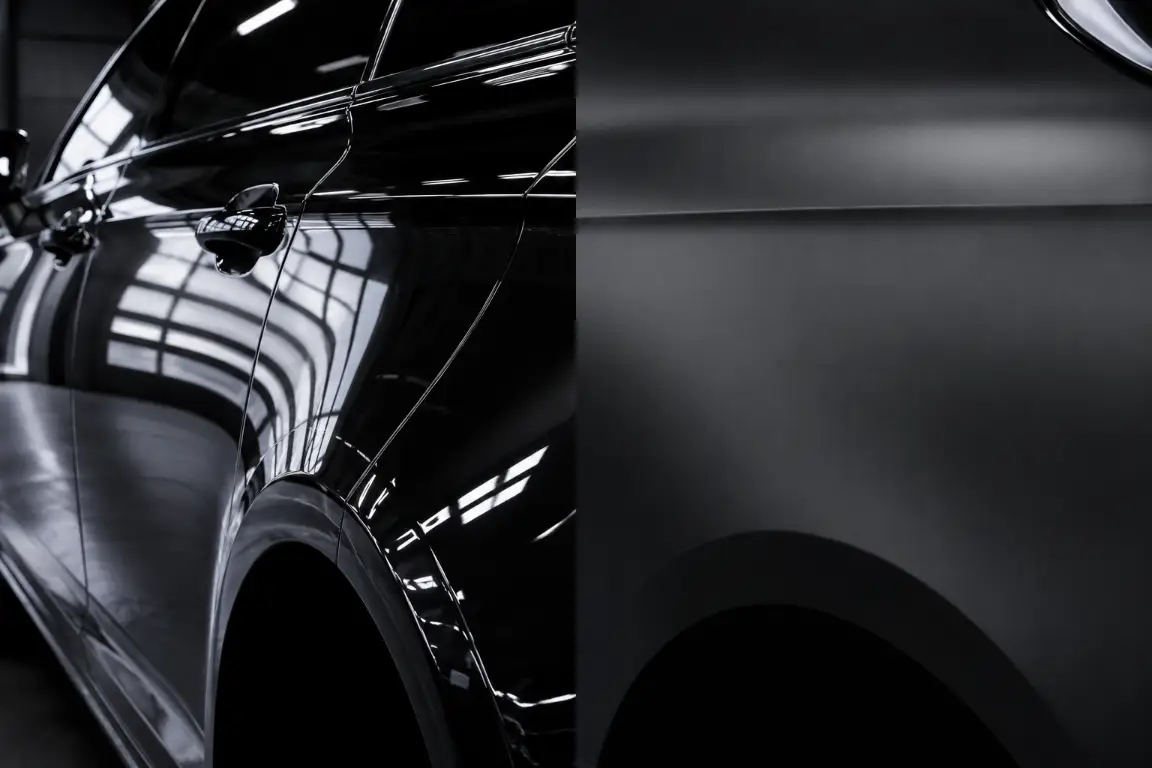
What Are Gloss PPF and Matte PPF?
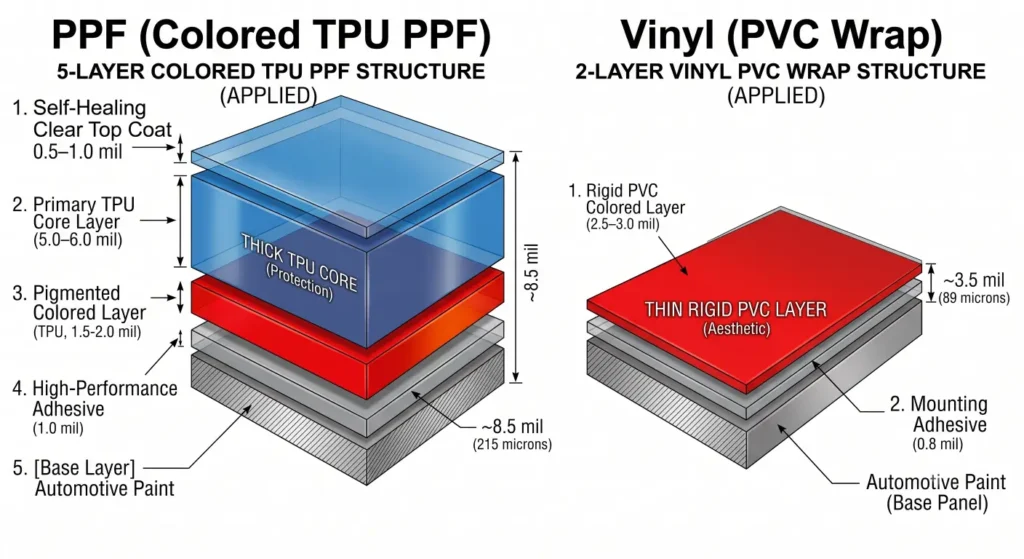
Both gloss and matte paint protection film (PPF) share the same fundamental construction: a multi-layer urethane film — a self-healing clear coat on top, a thermoplastic polyurethane (TPU) base in the middle, and an acrylic adhesive layer on the bottom. The difference between the two finishes comes down to the top layer’s surface texture.
Gloss PPF has an optically smooth top coat that is nearly invisible once applied. Its surface roughness sits below 0.05 μm — close to optical-grade flatness — which is why it amplifies your factory paint rather than altering it. Matte PPF uses a micro-textured top coat (surface roughness in the 0.5–2.0 μm range) that scatters incoming light, wiping out reflections and creating a flat, non-glossy appearance.
Here is how the two finishes compare:
| Dimension | Gloss PPF | Matte PPF |
|---|---|---|
| Finish effect | High-shine, “wet-look,” amplifies reflections | Flat, non-reflective, “stealth” aesthetic |
| Visual transparency | Nearly invisible — preserves factory paint look | Transforms the vehicle’s visual identity entirely |
| Best suited for | Luxury cars, metallic/pearl finishes, resale-focused owners | Dark-colored vehicles, custom builds, owners seeking a distinctive look |
| One-line summary | Invisible protection | Visual transformation |
Gloss PPF is invisible armor. Matte PPF is a style decision that also protects. Which one belongs on your car depends on what you value more — preserving the factory intent or rewriting it.
How Each Finish Transforms Your Car’s Appearance
The difference between gloss and matte PPF is not about “better or worse.” It is about what you want your car to say. Gloss amplifies the factory intent; matte rewrites it. Knowing what each finish actually looks like in real-world conditions is the first step toward a decision you will not regret.
The Gloss PPF Look — Amplified Factory Finish
Gloss PPF is for the owner who loves their car’s factory paint and wants to keep it looking exactly that way — only better. The film’s optical clarity adds what detailers call a “wet-look” depth: reflections become sharper, metallic flakes appear more three-dimensional, and dark colors like black, navy, and deep burgundy take on a liquid-glass richness that factory clear coat alone cannot deliver.
This finish is the default choice for luxury sedans, sports cars with metallic or pearl paint, and any vehicle where preserving resale value matters. A Mercedes S-Class in obsidian black with gloss PPF looks like a freshly detailed showroom car — every day.
One caveat worth knowing: gloss PPF will not hide existing paint imperfections. If your car has orange peel texture, swirl marks, or water spots before installation, the film’s clarity will faithfully reproduce every one of them. A professional paint correction before PPF application is not optional — it is the difference between invisible protection and permanently sealed-in mediocrity.
The Matte PPF Look — A Complete Visual Transformation
Matte PPF is the single most dramatic change you can make to a car’s appearance without touching a spray gun. By scattering light across its micro-textured surface, the film eliminates reflections almost entirely. Body lines soften. The car’s silhouette reads as a single, uninterrupted shape rather than a collection of reflective panels. The effect is part stealth fighter, part concept-car reveal.
Color pairing matters enormously. Dark colors — black, charcoal gray, deep blue — deliver the most dramatic transformation. A gloss-black vehicle wrapped in matte PPF goes from executive sedan to military-spec overnight. White and silver cars take on a ceramic, sculptural quality — less aggressive, more architectural. If you have seen a matte-wrapped Range Rover or Porsche 911 in person, you already know the effect is hard to describe and impossible to ignore.
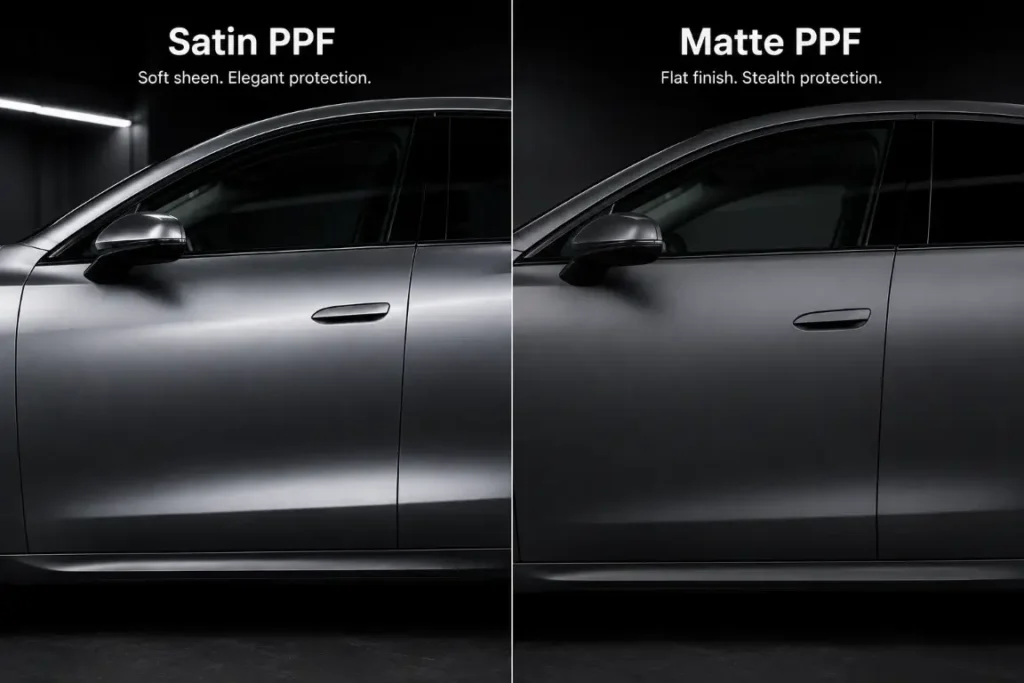
There is also a middle ground worth naming: satin PPF. With a surface roughness between gloss and matte (roughly 0.2–0.5 μm), satin delivers about 30% of matte’s visual drama with roughly 70% of gloss’s ease of maintenance. If you are drawn to matte’s look but uneasy about the upkeep, satin deserves a serious look.
The Real Maintenance Commitment
If visual preference is the fun part of the decision, maintenance is the commitment you are signing up for. The gap between gloss and matte here is wider than most installers will tell you upfront.
Gloss PPF Maintenance — What to Expect
Gloss PPF is easy to live with. A standard pH-neutral car shampoo, a microfiber wash mitt, and a quality drying towel are all you need. Washing every two to four weeks is enough for most daily-driven vehicles. Touchless automatic car washes work in a pinch, though hand-washing is always the better option.
The self-healing top coat handles light swirl marks on its own — park the car in direct sunlight for 20 to 30 minutes (the clear coat activates around 40–50°C), and minor marring disappears. You can apply traditional ceramic coatings, spray sealants, and detail sprays without restriction. The only real watch-outs: avoid pressure-washing within a few inches of film edges, which can lift them over time, and remove bird droppings, tree sap, and bug splatter quickly — acidic contaminants will etch any polymer surface, PPF included.
In practice, gloss PPF maintenance feels like normal car care plus about 10% more attention.
Matte PPF Maintenance — The Unfiltered Truth
Matte PPF maintenance is a different conversation. Owners on automotive forums consistently report that matte needs two to three times the washing frequency of gloss — once every one to two weeks, not once a month. Dust, road film, and water spots stand out sharply against a non-reflective surface, and there is no glossy shine to distract the eye from them.
The product restrictions are absolute. You cannot use wax, polish, gloss-enhancing sealants, or any product containing fillers or silicones. Doing so fills the micro-texture that creates the matte effect and leaves behind shiny patches that are effectively permanent — you cannot un-polish a matte surface. Your cleaning arsenal is limited to pH-neutral shampoos and matte-specific products. Brands like Gyeon Matte, Dr. Beasley’s Matte, and CarPro CQuartz Skin are among the few formulations built for matte PPF.
A matte-specific ceramic coating is not a luxury — it is close to a necessity. Applying one adds $1,000 to $2,000 to your total cost but substantially improves the film’s cleanability and resistance to water spotting. Without it, every rain shower leaves a constellation of mineral deposits that demand immediate attention.
The daily reality: handprints show. Water streaks show. You will learn to blot-dry rather than wipe-dry. Bird droppings and bug splatter must come off immediately — the micro-textured surface gives acidic contaminants more surface area to bond with, and the damage window is shorter than with gloss. Many matte PPF warranties require an annual professional inspection and maintenance visit, which runs $300 to $1,000 depending on your installer and region.
If reading this section made you tired, gloss or satin is probably the better call. If it made you think “I can handle that for the look I want,” matte is still on the table.
Hand-wash only — matte shows dust and water spots far more than gloss.
No wax, polish, or silicone-based products. Permanent shiny spots if you get it wrong.
Annual pro maintenance strongly advised. Matte-specific ceramic coating adds $1K–$2K upfront.
What You’ll Actually Pay — and How Long It Lasts
PPF pricing is notoriously opaque. Shops quote wildly different numbers for the same car, and the installation fee is only the beginning. What follows is a realistic cost picture — the kind few industry sources give you straight.
The True Cost Breakdown
A full-vehicle PPF installation typically ranges from $4,000 to $8,000, depending on vehicle size, installation complexity, and regional labor rates. Partial coverage — front bumper, hood, fenders, and mirror caps — drops the bill to $1,500 to $3,000 and protects the highest-impact zones for daily highway driving.
Matte PPF generally commands a 10 to 20 percent premium over gloss for the same coverage area. The reason is simple: every imperfection — a faint bubble, a slightly uneven edge, a blade mark — is more visible on a non-reflective surface. Installers compensate with extra time and precision, and that labor cost lands on your invoice.
Beyond the film itself, factor in these additional costs:
| Cost Layer | Gloss PPF | Matte PPF |
|---|---|---|
| Full-vehicle film installation | $4,000–$7,000 | $4,500–$8,000 |
| Ceramic coating (recommended) | $500–$1,500 (optional) | $1,000–$2,000 (strongly advised) |
| Annual professional maintenance | Usually included in warranty | $300–$1,000 |
| Estimated 5-year total | $4,500–$8,500 | $6,000–$12,500 |
One point worth internalizing: PPF does not increase your car’s trade-in value. Multiple owners across Tesla, Rivian, and 4Runner forums have confirmed that dealers do not pay a penny more for a PPF-equipped vehicle. PPF is an investment in your own ownership experience — protection, appearance, and peace of mind — not a financial asset.
Durability and Installation — Two Factors That Matter More Than Finish
Both gloss and matte PPF share the same core protective capabilities. A 6 to 8 mil TPU film — regardless of its top-coat finish — absorbs rock chips, resists scratches, and blocks UV radiation with equal effectiveness. Most manufacturers warranty their films for 8 to 10 years, and the self-healing mechanism works identically across finishes.
The differences emerge over time. Gloss PPF shows swirl marks and fine scratches more readily, though the self-healing layer addresses most of them. Matte PPF hides light marring but reveals uneven wear more dramatically — a patch of film that has seen more sun, more road debris, or more aggressive cleaning loses its uniform flatness, creating visible tone variations across panels. Forum reports of matte PPF showing noticeable degradation within two to three years of outdoor parking are not rare.
Installation quality matters more than finish choice. A poorly installed film — edges lifting, contamination trapped under the surface, blade marks on the clear coat — ruins the result regardless of whether you picked gloss or matte. Matte raises the stakes: marginal work that might pass visual inspection on a glossy surface becomes a glaring defect on a flat one.
When evaluating installers, ask three questions: How many matte PPF installations have you completed in the past year? Can I see a vehicle you finished at least six months ago — not a fresh delivery? Do you have customer references I can contact? An installer who hesitates on any of these is not the one.
If you are comparing PPF products across manufacturers, one signal of quality consistency is whether the manufacturer produces both gloss and matte films from the same TPU base and adhesive system. When the two finishes share a common substrate, you are comparing surface texture, not entirely different products — and the performance baseline holds steady regardless of which finish you choose.
Making the Right Choice for Your Vehicle
By now, you have enough information to make a decision grounded in reality rather than marketing. Here is a scenario-based framework to pull it all together:
| Your Situation | Recommended Finish | Why |
|---|---|---|
| You love your factory paint and want invisible protection | Gloss PPF | Preserves original appearance; lowest maintenance; safest choice for resale |
| You drive a dark-colored vehicle and want a dramatic, custom look | Matte PPF | Dark colors deliver matte’s most striking transformation; gloss black → matte black is a completely different car |
| You want some visual distinction but worry about matte maintenance | Satin PPF | About 30% of matte’s visual impact with roughly 70% of gloss’s ease of care; the pragmatic middle ground |
| You use automatic car washes and wash infrequently | Gloss PPF | Matte requires hand-washing at higher frequency; gloss tolerates normal care routines |
| You are willing to hand-wash every 1–2 weeks and use dedicated products | Matte PPF | The maintenance burden is real but manageable if you treat it as part of the ownership experience |
| Budget is a primary concern | Gloss PPF (partial coverage) | Front-end-only gloss PPF provides high-impact protection at $1,500–$3,000; matte partial coverage looks inconsistent |
If you are still torn, ask your installer for sample swatches of both finishes placed on your actual paint color. A 15-centimeter square of film on your hood tells you more than any article or video ever could. Look at it in direct sunlight, under overcast skies, and under garage lighting before deciding.
One final principle: choose the film and the installer before you choose the finish. A $5,000 PPF job from a meticulous, experienced installer will outperform an $8,000 job from a shop rushing through its tenth car that week. Your PPF will be on your car for the next five to ten years. Take the time to get both the product and the people right.
If you are comparing PPF options across brands, FlexiPPF manufactures both gloss and matte paint protection films from a shared TPU substrate and adhesive system — so the finish is the choice, not the quality baseline. You can explore their PPF product line here.
Request gloss and matte PPF samples from a manufacturer that produces both finishes from the same TPU substrate.
Request SamplesReferences
- ONE PPF Team. “Gloss vs Matte PPF: Which Finish Is Right for Your Build?” ONE PPF Blog, April 2026. onepaintprotection.com
- UPPF USA. “Gloss vs. Satin vs. Matte Paint Protection Film: Which Finish Should You Choose.” UPPF USA Blog. uppf-usa.com
- Apeax. “Gloss PPF vs Matte PPF: Which One is Right for Your Vehicle?” Apeax Blog. apeax.com
- Rivian Forums. “Folks that did matte/stealth/satin PPF, any regrets, lessons?” rivianforums.com
- Tesla Motors Club. “Anyone regret having full PPF done?” teslamotorsclub.com
- FlexiPPF. “Paint Protection Films — Product Line.” flexippf.com
- FlexiPPF. Homepage. flexippf.com
 English
  Spanish
  Dutch
Dutch  Japanese
  Russian
  Arabic