
01 What Is Color PPF? The Best of Both Worlds
If you have spent any time in the automotive aftermarket, you already know what clear PPF does — an invisible TPU (thermoplastic polyurethane) shield that protects factory paint from rock chips, scratches, and UV degradation. Color PPF takes that same aliphatic TPU base and adds a pigmented color layer between the substrate and the topcoat, giving you protection and a color change in a single product.
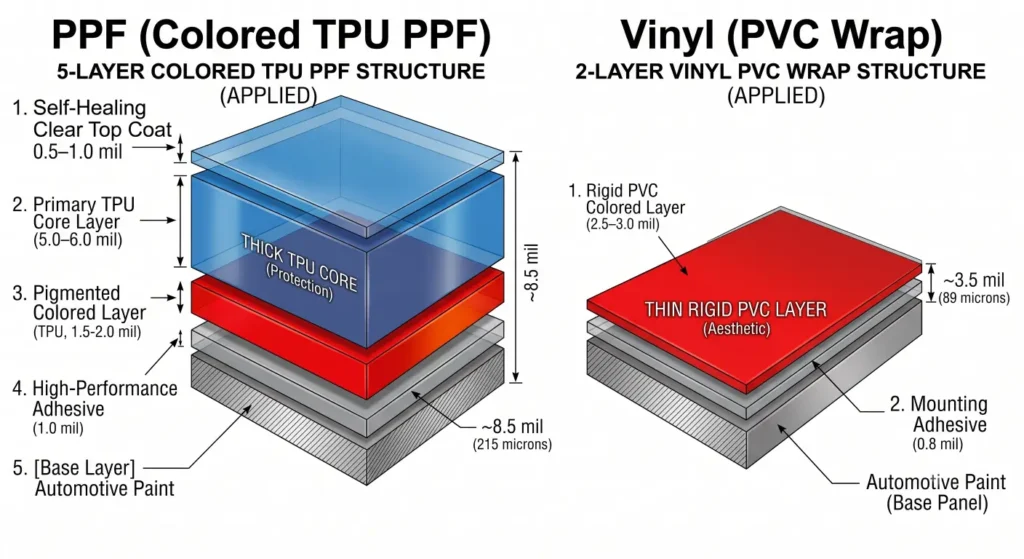
It is not a vinyl wrap. Vinyl wraps are thin — typically 3 to 4 mil — with no self-healing capability and a 2-to-5-year lifespan. Color PPF sits at 6.5 to 10 mil thick, self-heals minor scratches with heat, and carries warranties of 5 to 10 years. The difference is structural: vinyl sits on the surface as decoration; color PPF bonds as armor.
In the sections ahead, we will walk through every finish type, break down what separates quality color PPF from commodity film, and give you a practical framework for evaluating suppliers — whether you are a distributor expanding your catalog, an installer adding a premium service line, or a shop owner deciding which brand to carry.
02 Color PPF vs. Vinyl Wrap vs. Clear PPF: What Is the Real Difference?
A question that comes up in nearly every buying conversation: why not just use vinyl? The numbers tell the story.
| Dimension | Color PPF | Clear PPF | Vinyl Wrap |
|---|---|---|---|
| Thickness | 6.5–10 mil | 6.5–10 mil | 3–4 mil |
| Self-healing | Yes (heat-activated) | Yes (heat-activated) | No |
| UV / yellowing resistance | High (aliphatic TPU) | High (aliphatic TPU) | Low to moderate |
| Lifespan | 5–10 years | 5–10 years | 2–5 years |
| Color options | 50–500+ depending on brand | None (transparent only) | Thousands |
| Installed cost | $$$$ | $$$ | $$ |
| Paint protection | Full impact + scratch | Full impact + scratch | Minimal |
| Best for | Protection + color change in one step | Preserving OEM paint invisibly | Budget color change, short-term use |
If protection is your only priority, clear PPF wins on cost. If you want a color change on a budget and are fine replacing it in three years, vinyl works. But if you — or your customer — want both protection and a custom look without layering two products, color PPF is the only single-SKU answer.
03 The Five Finish Types That Define PPF Colors
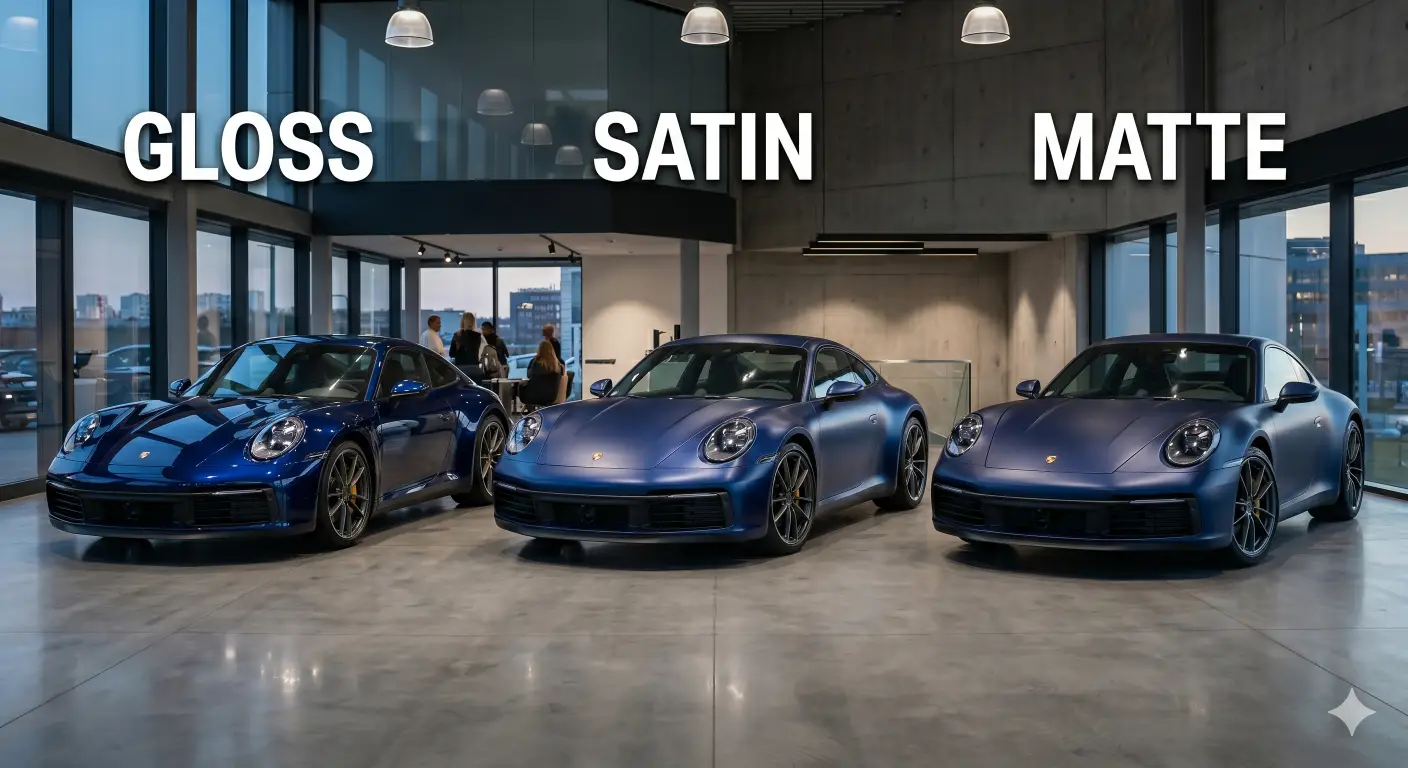
Before you compare specific color names, you need to understand the finish categories. The finish determines how light interacts with the film — and that interaction changes how every color reads on the car. Think about three things before choosing: (1) do you want the car to look understated or aggressive? (2) is it a daily driver, a show car, or a commercial fleet vehicle? (3) how much maintenance effort is realistic?
Gloss PPF: The High-Shine Classic
Gloss is the workhorse of the color PPF world. A quality gloss PPF delivers 95 to 96 GU (gloss units) at a 60-degree measurement angle — essentially mirror-grade reflectivity. Piano black, racing red, and bright white dominate this category.
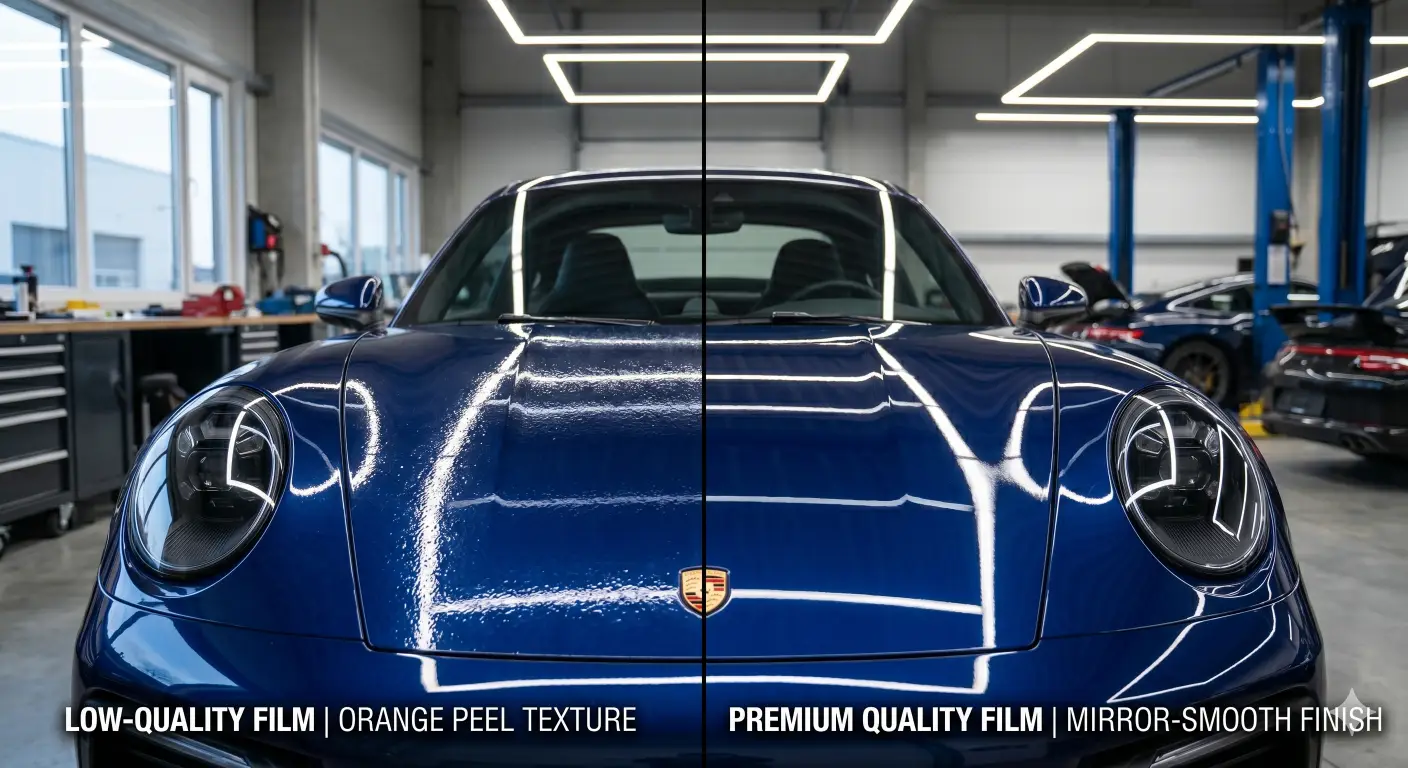
One thing that separates good gloss PPF from average: the orange peel effect. During coating, if the topcoat does not flow out evenly, the surface develops a subtle dimpled texture — the same micro-texture you see on an orange peel. On dark gloss colors, this is immediately visible under showroom lighting. Top-tier manufacturers invest in cleanroom coating lines specifically to minimize this. If you are evaluating samples, hold a dark gloss swatch under angled light. If the reflection looks rippled rather than mirror-smooth, move on.
Matte PPF: The Stealth Look That Dominates
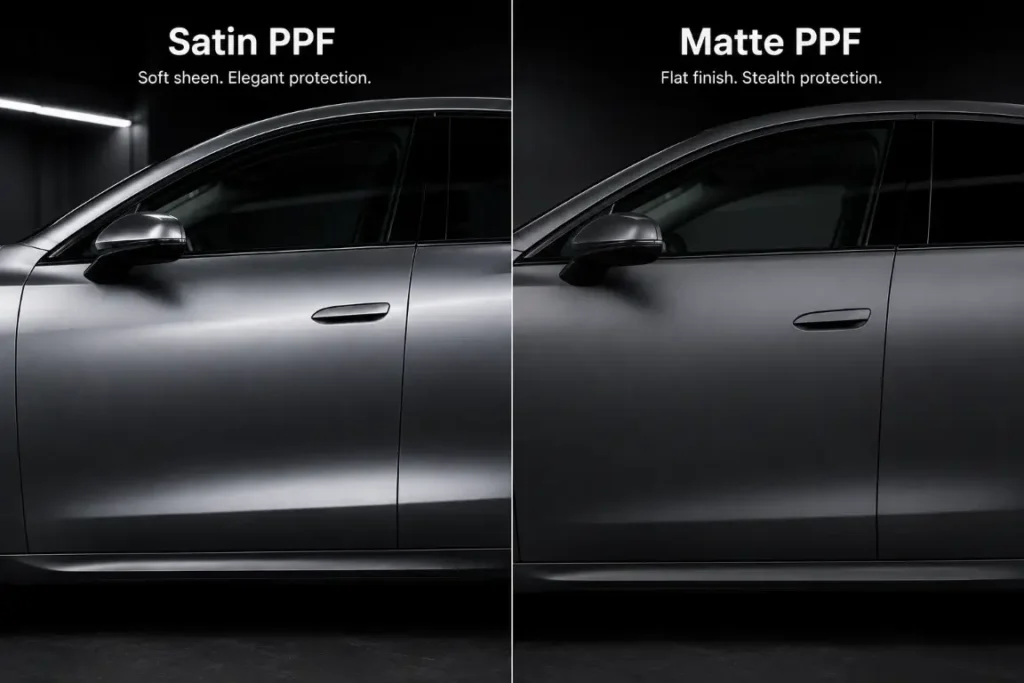
Matte PPF produces a flat, non-reflective surface by introducing controlled micro-roughness — surface roughness Ra typically 0.5 to 2.0 μm — that scatters light instead of reflecting it. The result reads as purposeful and aggressive, which is why matte black alone accounts for a dominant share of color PPF sales globally.
The trade-off is maintenance. You cannot wax or polish matte PPF without destroying the finish. It requires pH-neutral matte-specific cleaners. But for the right vehicle — an SUV, a performance truck, or a blacked-out sports sedan — the visual payoff is unmatched. The Cybertruck era has only accelerated demand: “unfinished” has become a deliberate aesthetic choice.
Satin PPF: 2026’s Breakout Finish
If gloss is a mirror and matte is a chalkboard, satin is silk — a soft semi-gloss sheen (20 to 40 GU at 60 degrees) that diffuses light just enough to hide fingerprints and light dust, while still showing body lines clearly. Installers across North America are reporting satin orders growing at roughly twice the rate of other finishes in 2026.
Satin deep blue, satin white, and satin grey are the top sellers. The finish works especially well on luxury sedans and executive SUVs — vehicles where the owner wants presence, not volume.
Metallic and Chrome PPF: Depth Through Particles
Metallic PPF embeds aluminum flake or mica powder directly into the color layer. Aluminum flake produces sharp, directional reflectivity; mica powder creates a softer, pearlescent glow. Particle sizes range from 5 to 50 μm, and the orientation of these particles during film stretching determines whether the final install looks uniform or patchy.
This is the hardest category to install well. When a metallic PPF is stretched around a compound curve, the metal particles can reorient inconsistently, producing visible color variation between panels. The installation temperature window is tight — 18 to 28 degrees Celsius. Outside that range, the film’s elongation behavior changes and the metallic distribution suffers. For installers, metallic PPF commands a premium labor rate for a reason.
Color-Shift and Chameleon PPF: The Optical Illusion
Color-shift PPF is built on thin-film interference — the same physics that gives a butterfly wing its iridescence. Multiple coating layers, each with a different refractive index and each controlled to a thickness tolerance of roughly ±5 nanometers, cause light of different wavelengths to constructively or destructively interfere depending on viewing angle.
The result: a film that reads purple from the front, blue from the side, and green at an oblique angle. Single-roll pricing can run two to three times that of standard color PPF. The market for these films is narrow but sticky — a shop that installs one color-shift job typically gets three referral inquiries within a month, because the car itself becomes a rolling advertisement.
04 What Goes Into Quality Colored PPF: A Manufacturer’s Inside Look
Two rolls of color PPF that look identical on a swatch card can diverge dramatically after three years of real-world exposure. What separates them is not marketing — it is the material stack, the color integration process, and the testing regimen behind the final product.
Think of it as three concentric layers of quality: what goes in, how it goes together, and how you prove it worked.
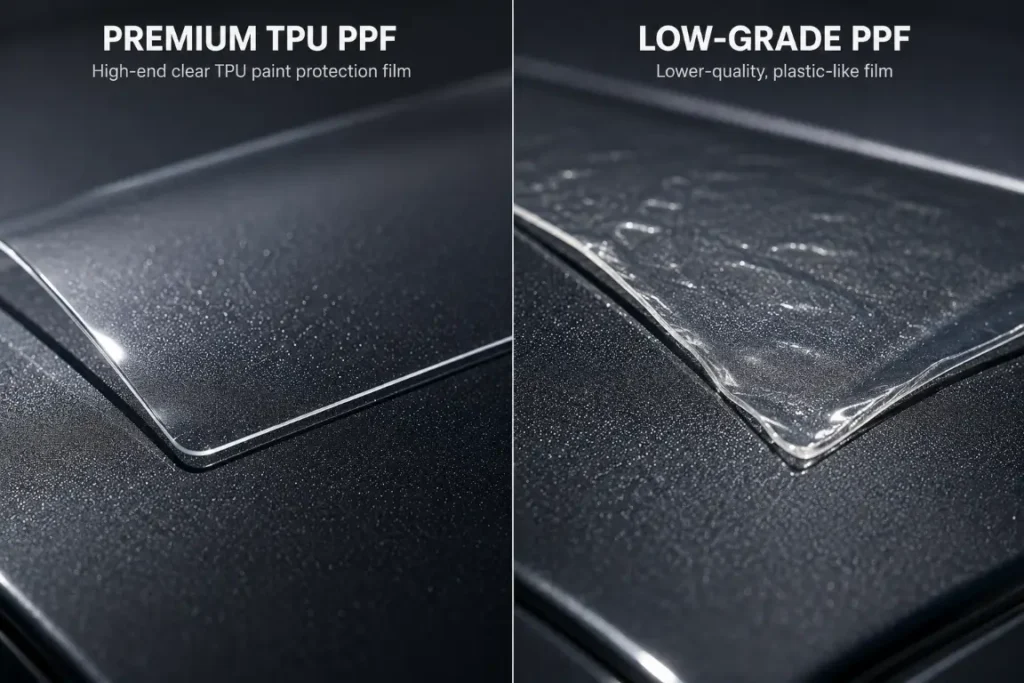
For example, a manufacturer that builds color PPF on Lubrizol or BASF aliphatic TPU, uses Ashland acrylic pressure-sensitive adhesive, and runs production on German magnetron sputtering lines with ISO-governed quality checks — such as the Shenzhen-based supplier FlexiPPF — is operating at a fundamentally different quality tier than a factory cutting cost on aromatic TPU and unbranded adhesive. The difference shows up not in month one, but in year three, when the cheaper film has yellowed and the premium film still looks factory-fresh.
Raw Materials: Why TPU Grade and Adhesive Choice Define Everything
Two families of TPU exist for PPF: aliphatic and aromatic. Aliphatic TPU resists UV-induced yellowing and holds its clarity through years of sun exposure — it also costs 30 to 50 percent more than aromatic TPU, which yellows predictably under UV. If a supplier describes their TPU as “imported” without naming the source, assume aromatic until proven otherwise. Lubrizol (USA) and BASF (Germany) are the two names that set the industry standard for aliphatic TPU in PPF applications; Lubrizol’s ESTANE ALR series is engineered specifically for paint protection and has documented weathering performance equivalent to nine years of outdoor exposure with no significant degradation.
The adhesive layer matters just as much. Ashland (USA) acrylic pressure-sensitive adhesive is the reference standard in PPF manufacturing. Its defining characteristic is a dual-mode performance curve: low initial tack during installation, which lets the installer reposition the film, followed by high long-term adhesion — peel strength of 20 N/cm or higher — that keeps edges from lifting over years of thermal cycling and car washes.
The topcoat, typically a nano-ceramic formulation, determines hydrophobicity. A contact angle of 105 degrees or higher is the threshold for genuine water-repellent behavior; at 110 degrees and above, water beads roll off the surface, carrying dirt with them.
Color Integration: How PPF Gets (and Keeps) Its Color
PPF is not surface-painted. The color lives as a dedicated layer within a five-layer sandwich: hydrophobic topcoat → color layer → TPU substrate → adhesive → release liner. The color layer is created through co-extrusion — color masterbatch pellets and TPU pellets are melted and extruded together at 190 to 220 degrees Celsius, fusing pigment into the polymer matrix rather than merely coating its surface.
This distinction is what gives color PPF its longevity. A surface coating would abrade away over years of washing and road debris; a co-extruded color layer is the full thickness of the film, and it wears at the same rate as the TPU itself.
Then there is the batch problem. Color PPF is produced in production runs — typically around 600 meters per batch — and even with identical formulations, batch-to-batch color variation is a physical reality. Quality manufacturers control this with spectrophotometer measurement against a master standard, targeting a Delta-E (ΔE) of less than 1.0 — the threshold below which the human eye cannot distinguish a difference. If a supplier cannot tell you their internal ΔE tolerance for color matching, they either do not measure it or do not want you to know the number. Either is a red flag.
Quality Testing: What Happens Before PPF Leaves the Factory
A 10-year warranty is a piece of paper unless it is backed by a testing file. The four tests that matter:
- UV aging (QUV): Per ASTM G154, PPF samples go through alternating cycles of UVA-340 lamp exposure at 60 degrees Celsius and condensation at 50 degrees Celsius. A minimum of 3,000 hours is the industry benchmark — this simulates roughly 5 to 10 years of outdoor UV exposure depending on geography.
- Color fastness: Post-QUV, the film’s ΔE shift is measured via spectrophotometer. A shift below 2.0 after accelerated aging is good; below 1.0 is excellent.
- Mechanical properties: Tensile testing per ASTM D882 — elongation at break should exceed 230 percent. Peel adhesion should hold above 20 N/cm after thermal cycling.
- Chemical resistance: Acid, alkali, and salt spray exposure — simulating everything from acid rain to road salt to industrial fallout.
Suppliers operating under ISO 9001 or IATF 16949 certification have process-level traceability for every batch. If quality issues surface, they can trace back to the specific raw material lot, production shift, and coating machine. Ask for the COA (Certificate of Analysis) for any batch you are considering — reputable factories provide them as a matter of course.
05 The Colors Shops Are Actually Ordering: 2026 Market Trends
Here is what the market is pulling, based on B2B order data and installer-side demand signals through mid-2026.
| Color Category | Top-Selling Shades | 2026 Demand | Strongest Markets | Best-Suited Vehicles |
|---|---|---|---|---|
| Matte Black | Jet black, stealth charcoal | Highest volume | Global (all markets) | SUVs, trucks, performance sedans |
| Satin White | Frost white, pearl satin | Fastest growing | North America, Middle East | Luxury SUVs, executive sedans |
| Metallic Grey | Nardo grey, gunmetal, titanium | Consistently strong | Europe, North America | Sports cars, premium sedans |
| Gloss Piano Black | Mirror black, obsidian | Steady high demand | Asia, Middle East | Luxury sedans, Tesla models |
| Satin Navy Blue | Deep indigo satin, midnight blue | Rising | Europe, North America | Executive sedans, coupes |
| Forest Green | British racing green matte, pine satin | Emerging premium | Europe, Australia | SUVs, vintage restorations |
| Desert Sand / Clay | Warm beige satin, terracotta matte | Emerging premium | Middle East, North America | Luxury SUVs, off-road builds |
| Color-Shift Purple-Blue | Violet-to-blue chameleon | Niche, high margin | All premium markets | Show cars, flagship installs |
The broader pattern: 2023 was about “what color can I change to?” — flashy neons and bold chromes. 2026 is about “what color looks like it could have been a factory special order?” Earth tones are replacing neons, satin is replacing chrome, and understated depth is winning over attention-grabbing brightness. The PPF market is maturing from modification culture to refinement culture.
06 How to Evaluate Colored PPF Suppliers: A Distributor’s Practical Checklist
Choosing a color PPF supplier is not about who has the longest color list. It is about whose quality you can predict, whose deliveries you can count on, and whose warranty actually means something. Here is a four-part evaluation framework, ranked by importance.
Verify the Material Stack: TPU, Adhesive, and Topcoat
Start with the material stack — if the base is wrong, nothing else matters. Three questions to ask any supplier:
- TPU source: Is the TPU from a named, verifiable supplier (Lubrizol, BASF, Covestro), or is it described vaguely as “imported TPU”? Ask for the supplier name and grade. If the salesperson hesitates, that is your answer.
- Adhesive: Is it Ashland or an equivalent brand with published peel-strength data? Request the TDS (Technical Data Sheet) — not the brochure, the engineering document with test values.
- Topcoat: Is it a nano-ceramic coating with a published contact angle (≥105 degrees), or a standard UV-cured clearcoat? The former repels water and resists chemical etching; the latter performs adequately for two to three years and then begins to degrade.
If a supplier cannot answer all three questions with specific names and numbers, treat that as a disqualifier. It does not mean the product is bad — it means you cannot verify whether it is good.
Assess Color Range and Custom Capability
A catalog of 500 colors sounds impressive until you realize 450 of them never ship. The metrics that matter:
- Stocked vs. list colors: How many colors are actually in inventory versus “available to produce”? Stock depth tells you which colors the supplier believes in enough to hold.
- Custom color MOQ: Can range from 1 roll (for stock colors) to 100 to 500 rolls (for new color development requiring a dedicated masterbatch run). Match this to your business size — a distributor moving 50 rolls a month has different needs than a shop ordering 3.
- Sample turnaround: From color request to physical swatch in hand — the industry benchmark is 24 to 48 hours for a design proof and 7 to 10 days for a physical sample.
- Color matching: Can the supplier match a Pantone or RAL code? Do they use a spectrophotometer for verification? If your customer says “I want this specific Porsche green,” can the factory deliver?
Check MOQ, Lead Time, and Production Flexibility
MOQ and lead time signal factory maturity. A supplier offering 1-roll MOQ on stock colors and shipping same-day on in-stock inventory has invested in warehousing and logistics. A supplier quoting 30-day lead times on every order, including stock colors, is likely producing to order — which means your “stock” order is competing for production capacity with every other order in the queue.
New color introduction cadence is another useful signal. Two to three new colors per quarter indicates a factory with an active R&D function. Zero new colors in 12 months suggests a factory running a fixed formula book — adequate for commodity supply, but not a partner who will help you stay ahead of trends.
Demand Warranty and After-Sales Support Details
A 10-year warranty is an industry-standard claim. What you need to know is what it actually covers and what triggers it. Ask for these specifics in writing:
- Coverage scope: Does it cover yellowing, cracking, delamination, and color fading? Or only “manufacturing defects” — a phrase narrow enough to exclude nearly everything?
- Trigger conditions: Is there a registration requirement? Must the installation be performed by a certified installer? Who bears the labor cost of removal and replacement if the film fails?
- Response time: From claim submission to resolution proposal — a 24-hour first-response commitment is a reasonable benchmark for a supplier with a dedicated technical support team.
- Installation support: Does the supplier provide installation manuals, training videos, or live technical support? For shops adding color PPF as a new service line, supplier-provided training is as valuable as the film itself.
The dividing line between a supply partner and a transactional vendor is simple: a partner puts the warranty terms in the contract, and a vendor puts them in the brochure. Insist on the former.
Ready to upgrade your color PPF supply?
From gloss and matte finishes to precise custom color matching, explore FlexiPPF’s complete catalog and discover a manufacturer you can rely on.
 English
  Spanish
  Dutch
Dutch  Japanese
  Russian
  Arabic