
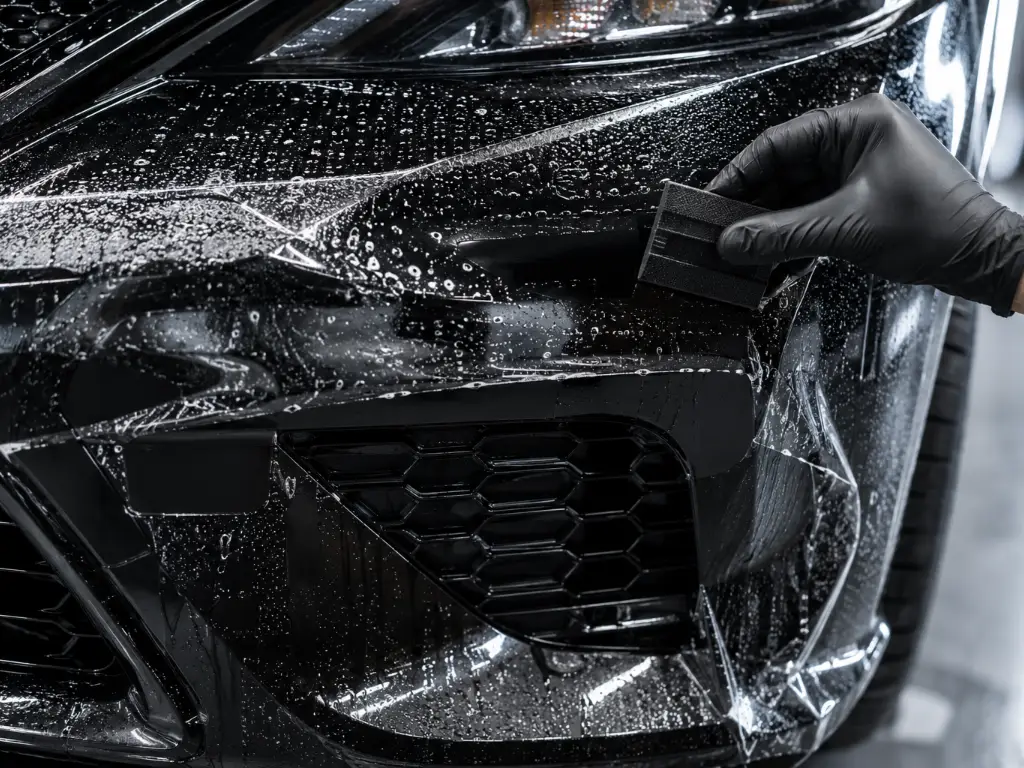
You’re standing in a shop, looking at a quote for $600 to wrap your front bumper in paint protection film. Your neighbor paid $400 at a different shop. A forum post swears they got it done for $300. And the dealership quoted $900.
Who’s telling the truth? Probably all of them.
PPF pricing is genuinely wide-ranging. Not because shops are arbitrary, but because the cost of wrapping a front bumper depends on several variables that most quotes bundle into a single number. This guide unpacks exactly what drives that number, what you should expect to pay at each coverage level, and where your money actually goes.
What Determines the Cost of PPF on a Front Bumper
Two identical-looking quotes can be $400 apart because five factors move the needle on front bumper PPF pricing:
| Cost Factor | How It Affects Price | Typical Price Swing |
|---|---|---|
| Vehicle size & bumper complexity | Larger SUVs/trucks need more material; complex bumpers with sensors, intakes, and multi-plane curves take more labor | $200–400 difference between a compact sedan and a full-size SUV |
| Film quality & type | TPU with self-healing top coat costs 2–3× more than basic PVC film; ceramic-infused top coats add another premium layer | $150–400 swing on material alone for the same bumper |
| Coverage extent | Bumper-only vs. bumper + partial hood + fenders — each added panel increases material and labor | $500–1,500 difference between bare minimum and full-front packages |
| Installer skill level | A STEK Black Label or Xpel Certified installer charges $100–150/hr; a general wrap shop might charge $60–80/hr | 50–100% labor rate difference |
| Geographic location | Major metros (LA, NYC, SF, Miami) run 20–30% higher than smaller markets like Colorado Springs or Austin suburbs | $100–250 on a front bumper job |
Think of it like buying a suit: off-the-rack versus custom-tailored. A pre-cut kit (plotter-cut to your car’s make and model) is faster, taking 4 to 6 hours of labor. A custom bulk install where the installer hand-trims every edge takes 6 to 10 hours, but the result wraps fully around panel edges with no visible seam. Same bumper, two very different processes — and two very different bills.
Front Bumper PPF Cost: Real Price Ranges by Coverage Level
Coverage is the single biggest lever on your final bill. By industry convention, the front bumper alone accounts for roughly 15–25% of a full-vehicle wrap cost. Below, the three most common coverage levels — from budget-conscious to full-send — with real-world pricing.
Bumper-Only Coverage ($300–$900)
This is the entry point: the front bumper gets full PPF coverage, including sensor cutouts and edge wrapping, and nothing else.
For a standard sedan or compact car, expect $300–$500. SUVs, trucks, and anything with a tall, sculpted front fascia push into the $500–$900 range. Add $50–100 if your bumper has parking sensors, cameras, or radar units that need precise trimming around.
The appeal is obvious — it’s the cheapest way to protect the panel that takes the most abuse. The trade-off is equally obvious: your hood and front fenders remain bare. Forum threads across Miata.net, GR86.org, and Ranger6g are full of the same refrain: “Did bumper-only, and six months later I had rock chips on the hood.” If you go this route, do it with open eyes.
Partial Front Package: Bumper + High-Impact Zones ($800–$1,500)
This is the industry’s consensus “sweet spot” for daily-driven vehicles. It covers the front bumper, the leading 18–24 inches of the hood, the front portions of both fenders, and the side mirror caps.
Pricing lands at $800–$1,100 for most sedans and $1,000–$1,500 for larger vehicles. For that, you get protection on roughly 80% of the surfaces that catch highway debris, at about half the cost of a full front package.
The honest caveat: a partial hood means a visible seam line across the hood where the film edge stops. In most lighting conditions, it’s subtle. On a dark car in direct sunlight, you’ll see it. Some installers minimize this by following body lines; others recommend going full-hood if the seam would bother you. Ask to see examples of both on your car’s color before deciding.
Full Front & Beyond: Maximum Protection ($1,500–$3,500+)
Full front coverage extends PPF across the entire hood, both full fenders, the front bumper, side mirrors, and headlights. This is the default choice for new luxury cars and sports cars, where a single respray of a factory-painted bumper can cost $800–$1,500. The PPF math is straightforward: one avoided respray pays for the film.
Expect $1,500–$2,500 for a full front on most vehicles. The installation takes 8–15 hours depending on the car’s panel complexity — a Porsche 718 with its deep intakes and curved nose demands more skill (and time) than a Tesla Model 3 with its relatively flat surfaces. Real-world quotes from owner forums bear this out: a Porsche 718 owner reported $1,900–$2,200 for Llumar Valor full-front coverage; a GR86 owner in Houston got Xpel Ultimate Plus full-front for $1,200.
For track-day regulars and high-mileage highway drivers, the Track Package adds rocker panels, A-pillars, and rear impact zones for $2,500–$3,500+. At this tier, you’re protecting against everything short of a collision.
Material vs. Labor: Where Your PPF Dollar Actually Goes
Most shoppers see a single number on a quote. But every installer knows that number hides two very different worlds: the cost of the film and the cost of the hands applying it. Understanding the split changes how you evaluate any quote.
The Real Cost of PPF Film Material
The film material for a front bumper wrap, at wholesale prices, costs roughly $15–$75.
A standard sedan bumper uses about 3–5 square feet of film (including trim waste). Wholesale PPF rolls sell in the range of $5–$15 per square foot depending on quality tier:
| Film Tier | Wholesale Price (per sq ft) | What You Get |
|---|---|---|
| Economy TPU | $4–7 | Basic impact resistance; limited or no self-healing; 3–5 year functional life |
| Mid-grade TPU with self-healing | $7–12 | Heat-activated scratch recovery; 5–7 year warranty; decent clarity |
| Premium TPU with ceramic top coat | $10–18 | Hydrophobic surface (110°+ contact angle); 8–10 year warranty; 95–96 GU gloss rating; stain and yellowing resistance |
The raw material number alone is misleading. Judging a PPF quote by the wholesale cost of the film is like judging a steak dinner by the price of uncooked beef. The real story is what happens to that film next.
The TPU particle source matters too. Lubrizol (US) and BASF (Germany) supply the base resin for premium films; the adhesive layer — typically Ashland (US) or Henkel (Germany) — determines whether the film removes cleanly years later or leaves a $300–500 adhesive-removal nightmare. These upstream choices cascade into the film’s retail price long before it reaches an installer’s shelf.
Labor: The Skill You’re Really Paying For
Labor typically accounts for 70–85% of your installed PPF cost. On a front bumper job quoted at $600, roughly $420–$510 is paying for the installer’s time.
A front bumper wrap takes 4–10 hours depending on the method. At installer labor rates of $75–$150/hour (the spread between a general wrap shop and a factory-certified specialist), that’s $300–$1,200 in labor alone. The rate difference isn’t arbitrary: reaching proficiency in PPF installation takes 30–40 cars, according to installer-trainer Gabe Fletcher, who warns newcomers to “be prepared to set $30,000 in material on fire and do every job twice your first year.”
Programs like STEK Black Label certify only 11 shops nationwide. Each is evaluated on craftsmanship, customer service, and business infrastructure. An installer carrying that credential has passed a filter that most shops never attempt. That premium in their hourly rate buys you a dramatically lower probability of peeling edges, trapped debris, or adhesive failure two years in.
Cheap labor isn’t cheaper if it costs you a $500 adhesive-removal job and a respray.
PPF vs. Alternatives: Cost Comparison for Front-End Protection
Once you know what PPF costs, the natural next question is: “Is there a cheaper way to achieve the same thing?” The three main front-end protection options shake out like this:
| Dimension | PPF (Front Bumper) | Ceramic Coating | Repaint (Single Bumper) |
|---|---|---|---|
| Cost | $300–900 | $200–500 (full front-end coating) | $500–1,500 |
| Type of protection | Physical impact (rocks, gravel, scratches) | Chemical (UV, water spots, bird droppings) | Cosmetic restoration — zero new protection |
| Self-healing | ✅ Heat-activated scratch recovery | ❌ | ❌ |
| Thickness | 6.5–10.5 mil (165–267 microns) | 1–2 microns | Paint + clear coat: 4–8 mil |
| Lifespan | 7–10 years | 2–5 years | 3–7 years depending on conditions |
| Resale impact | Preserves factory paint → higher resale | Indirect (maintains gloss) | ❌ Repainted panels raise accident-history suspicion |
PPF and ceramic coating aren’t competitors. They’re complementary. PPF handles physical impact; ceramic coating handles chemical and environmental degradation. Many owners layer ceramic coating on top of PPF for the best of both worlds. The one thing neither can do is restore already-damaged paint. That’s repaint territory, and it’s always more expensive than protecting the original finish from day one.
How to Choose the Right PPF Coverage for Your Budget
At this point, the question shifts from “what does PPF cost?” to “what should I spend, given my situation?” The answer depends on three things: what you drive, how you drive it, and how long you plan to keep it.
Matching Coverage to Your Vehicle and Driving Habits
Real owner scenarios point to three clear paths:
Daily commuter sedan/SUV (10k–15k miles/year): A Partial Front package ($800–$1,300) covers the high-impact zones that catch 80% of highway debris. The front bumper, hood leading edge, mirror caps, and fender fronts are exactly where the damage accumulates. Unless you’re parking under trees or tailgating gravel trucks daily, this is the cost-to-protection ratio sweet spot.
New car, planning to keep it 5+ years: Full Front coverage ($1,500–$2,500) maximizes factory-paint preservation over a long ownership horizon. Spread the cost over five years and it’s $300–$500/year — roughly the cost of one professional detail. The resale math tilts further in your favor on luxury brands where factory paint condition directly impacts trade-in offers.
Luxury, sports, or high-performance car: Full Front or Track Package ($2,000–$3,500+). When a single bumper respray on a Porsche or BMW runs $800–$1,500, the PPF math is straightforward: one avoided respray pays for the film. Track Package adds coverage on rocker panels and rear impact zones — the areas that suffer on canyon runs and track days.
Before signing any quote, get at least three and ask each shop to specify: film brand and series, thickness in mil, whether it’s pre-cut or custom bulk install, edge treatment (wrapped vs. butt-cut), and warranty length. A quote that won’t disclose the film brand is a red flag. A price more than 30% below your market’s average is another.
The B2B Lens: What Shops and Distributors Pay for PPF
If you’re a detailer, shop owner, or distributor reading this, you already know the retail pricing above is the consumer-facing side of the equation. What you care about is the supply side — and the economics are shifting.
An installer buying PPF by the roll pays roughly $500–$1,500 per roll (25–50 ft × 60 inches wide), which breaks down to $35–$100 in material cost per front bumper job. The shop’s margin structure on that $600 bumper wrap: 15–25% material, 40–55% labor, 15–20% overhead, leaving 10–20% net. The profit isn’t in the film — it’s in the installation efficiency.
The larger trend reshaping this supply chain is the shift toward factory-direct sourcing. A growing number of US installers and distributors are bypassing domestic brand markups — which typically add 2–4× to the ex-factory price — and purchasing directly from manufacturers with verifiable raw-material credentials. The logic is straightforward: if the TPU comes from Lubrizol or BASF, the adhesive from Ashland, and the production happens in an ISO-standard facility with Class 10,000 cleanrooms, the end product is functionally equivalent to a premium domestic brand — without the brand tax.
This doesn’t mean every factory-direct option is equal. The three variables to verify are the same ones that separate premium films from budget failures: TPU base resin source, adhesive chemistry, and top-coat application method (immersion coating versus spray-on). Get those three right, and the supply-chain savings are real. Get them wrong, and the warranty claims erase the margin.
For installers evaluating direct-sourcing options, manufacturers like Flexippf — a Shenzhen-based PPF producer running Lubrizol and BASF TPU on Ashland adhesive, with 6.5–10.5 mil product lines and an 8–10 year warranty — represent the factory-direct model in practice. Their OEM program operates at a 1-piece MOQ, meaning shops can test samples without committing to container-level volumes. Product specifications are available on their PPF product page, with OEM and wholesale details at flexippf.com/oem.
References
- Nick Car Film. “What Is the Installation Cost of PPF Car Wrapping for Different Parts of the Car?” 2025. nickcarfilm.com
- ALUKOVINYL. “Paint Protection Film Cost Breakdown: What Influences Pricing and Is It Worth It?” 2025. alukovinyl.com
- UPPF USA. “PPF Cost Guide: Full Vehicle Coverage Cost and Packages Explained.” 2025. uppf-usa.com
- CarLab Detailers. “Paint Protection Film (PPF) Cost Breakdown: What You’re Really Paying For.” 2025. carlabdetailers.com
- Apex Auto Pros. “How Much Does PPF Cost? A Pro’s Guide to 2025 Pricing.” 2025. apexautopros.com
- Fletcher, Gabe. Talkin’ Paint Podcast. Industry commentary on PPF installer training economics. talkinpaint.com
- FlexiPPF. “Paint Protection Films — Product Specifications.” flexippf.com
- FlexiPPF. “OEM and Wholesale PPF.” flexippf.com
- FlexiPPF. “Manufacturing & Factory.” flexippf.com
- FlexiPPF. Homepage. flexippf.com
 English
  Spanish
  Dutch
Dutch  Japanese
  Russian
  Arabic