
Paint protection film does not last forever. Whether your PPF has turned yellow, started peeling at the edges, or cracked into a spiderweb pattern across the hood — at some point, removal stops being optional. The only question is what it costs.
The short answer: professional PPF removal on a typical mid-size sedan runs between $500 and $1,500. But that range hides a lot. Two cars of the same model year can land at opposite ends of it. The biggest variable is one most car owners never think about until the bill arrives.
01 Why PPF Eventually Needs to Come Off
PPF is a sacrificial layer, and like any sacrificial layer, it has a finite service life. Most films are designed to last 5 to 10 years. Real-world conditions — UV exposure, road salt, automatic car washes, temperature swings — accelerate the clock.
The most common trigger is visible aging. Yellowing comes first: a warm tint that shows up most on white and silver paint. The industry threshold for “visible to the naked eye” is a Delta-E color difference above 3. After that, edge lifting begins — moisture and car-wash chemicals seep under the film’s perimeter and break the adhesive bond. Eventually the film cracks, hazes, or bubbles. At that point, removal is no longer cosmetic maintenance. It is damage control.
Then there is the collision scenario. If a panel gets repaired and repainted, the PPF on that panel has to come off before the body shop can work. And there is the used-car scenario: you buy a vehicle with PPF already installed by the previous owner. You do not know the brand, the install date, or the shop that did the work. All you know is that the film on the hood does not look great, and you want to know what it will cost to be rid of it.
Think of PPF like a phone screen protector — except the surface area is 200 times larger and getting removal wrong means a trip to the paint booth, not a $15 piece of replacement glass.
- It’s been 3–7 years
- It’s yellowing or peeling
- You bought the car used
02 The 4 Factors That Determine PPF Removal Cost
Before you can read any quote, you need to know where the money goes. PPF removal cost stacks up in three layers: labor (60–80% of the total), adhesive residue treatment (0 to 30%), and paint correction (optional, 5–20%). Those proportions alone tell you most of what you need to know — the technician’s time is the bill, and everything else is a modifier on top of that.
Labor: The Biggest Piece of the Bill
Professional PPF removal is skilled manual work. There is no machine for this. A technician stands at your car with a steamer or heat gun, working panel by panel, for anywhere from 4 to 14 hours.
Hourly shop rates range from $60 in lower-cost regions to $150 in coastal metropolitan markets. A compact sedan with PPF in good condition can be finished in 4–6 hours. A full-size pickup with aged, brittle film can push past 12 hours. That gives a labor-only range of roughly $240 to $2,100.
Why the huge spread in time? Panel geometry. A flat hood panel releases cleanly. A front bumper with sensor cutouts, grille openings, fog-light recesses, and compound curves forces the technician to work the film off inch by inch at different angles. Curved panels take 30–50% longer than flat ones. If every panel on your vehicle is contoured, your labor bill reflects it.
The method matters too. Steam is slower than dry heat but leaves far less adhesive residue on the paint — which means less downstream cleanup cost. A technician who rushes through with a heat gun may finish faster but saddle you with a residue-removal bill that wipes out the labor savings.
Adhesive Residue: The Cost Wild Card
Adhesive residue is why two identical vehicles can get quotes hundreds of dollars apart from the same shop. The technician cannot see the residue until the film comes off. Every quote is an estimate.
Residue severity falls into three tiers. Light residue — a thin, gummy film that wipes off with standard solvent — adds little to no extra cost. It is often absorbed into the base labor rate. Moderate residue, the most common scenario for films 4–7 years old, requires dedicated adhesive remover and an extra 1–3 hours of work, adding $100–$300. Heavy residue — thick, crystallized adhesive that has chemically bonded with the clear coat — demands multiple rounds of solvent dwell time, steam, and careful physical removal. That pushes the adder to $300–$600 or more.
What determines which tier you land in? Three things: how old the film is, how much UV exposure it has endured, and — critically — what brand of PPF was originally installed. That third point matters enough to deserve its own section.
Vehicle Size and Panel Count: Bigger Costs More, but Complex Costs the Most
It is obvious that a full-size SUV costs more to strip than a compact sedan. Surface area alone puts the compact car at roughly 180–220 square feet of film versus 300–380 square feet on a large SUV. More area means more hours.
What is less obvious: panel count matters almost as much as area. Every panel seam is an edge the technician has to work — a place where the film can tear, where adhesive tends to concentrate, and where surrounding trim and badges demand extra care. A sports coupe with long, uninterrupted hood and door panels may be faster to strip than a compact crossover with short panels, roof rails, and cladding everywhere.
One detail most car owners discover too late: plastic bumper covers are the highest-risk panels. Factory paint adhesion on flexible plastic is 40–60% weaker than on stamped metal. When a technician peels film off a plastic bumper, the margin between clean removal and clear coat lift is measured in degrees of pull angle and seconds of heat dwell. Shops know this, and they price for it.
Factory paint on plastic adheres 40–60% weaker than on metal — one wrong pull angle and you’re looking at a repaint, not a polish.
Film Age and Condition: The Older, the Pricier
PPF ages on a curve, not a straight line. In its first 2–3 years, the film is still pliable — the TPU layer retains elasticity, the adhesive still releases cleanly, and a technician can remove a panel in 15–30 minutes. Between years 3 and 7, the film’s UV stabilizers begin to deplete. The surface may still look fine, but the TPU is losing flexibility and the adhesive is hardening. Per-panel removal time climbs to 30–60 minutes, and the film increasingly tears into fragments rather than peeling in sheets.
Beyond year 7, the film enters what detailers call the “shatter zone.” UV degradation has broken down the polymer chains in the TPU. The film no longer peels — it crumbles into fingernail-sized pieces. Removal time per panel can reach 1–2 hours. Some technicians resort to eraser wheels — rotating rubber discs that friction-strip the remaining film — but these require constant motion to avoid burning through the clear coat. Surface temperature at the contact point can hit 180–200°F within 2–3 seconds of dwell, which is enough to mar factory paint.
The practical takeaway: if your PPF is under 3 years old and you know the brand, removal should be straightforward and affordable. If it is over 7 years old and you do not know what brand it is, budget for the worst case.
03 How PPF Brand and Quality Change the Removal Equation
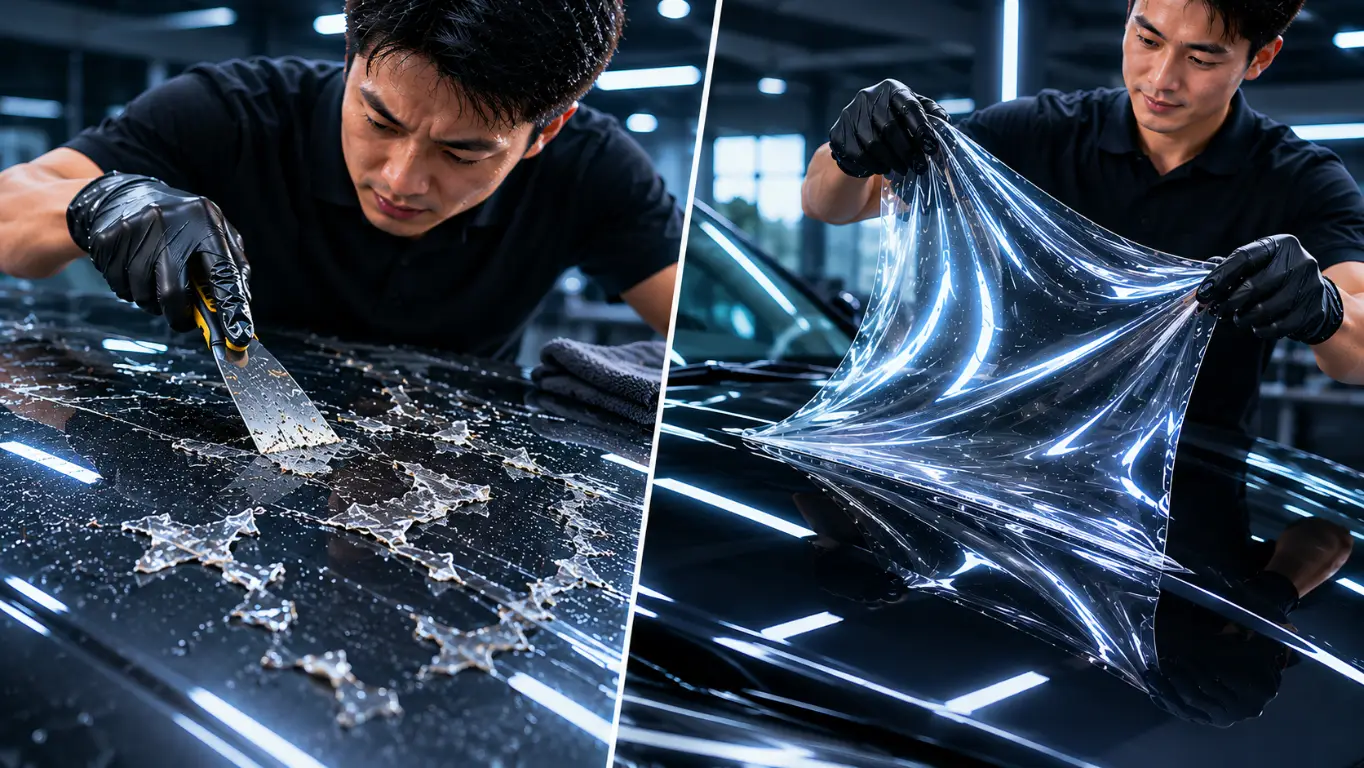
Every PPF removal cost article on the first page of Google skips one thing: the single biggest predictor of your removal bill is the brand of film sitting on your paint right now. Not the shop. Not the climate. The film itself. This is not brand loyalty — it is chemistry.
What Makes a PPF Removable: The Engineering Behind Clean Release
A paint protection film that removes cleanly after 5 or 7 years was not lucky. It was designed to do exactly that, starting at the molecular level.
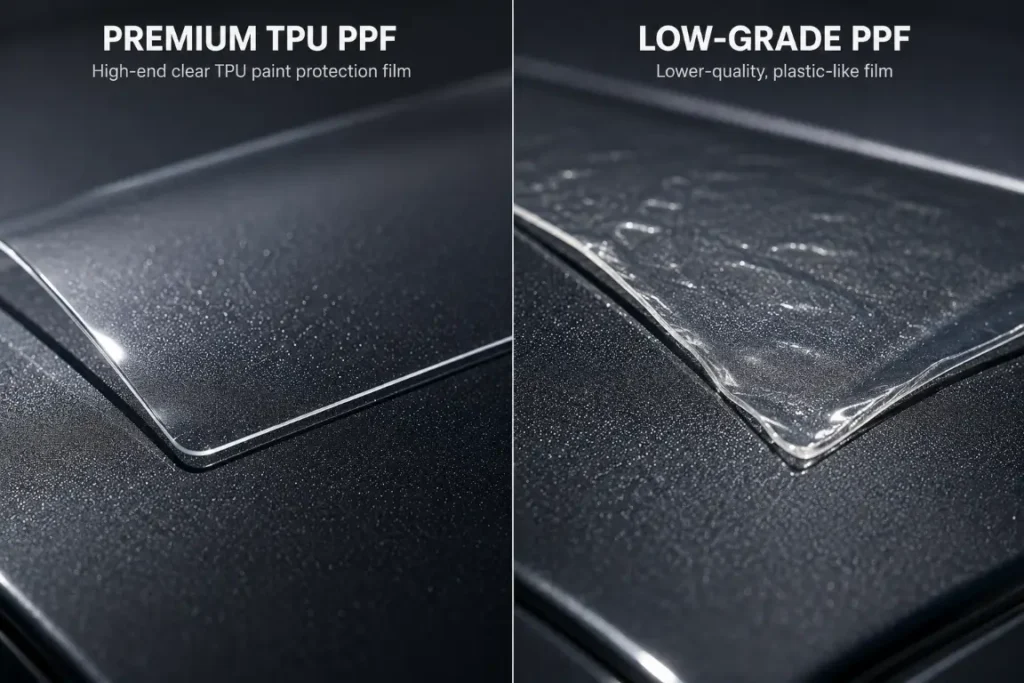
The foundation is the TPU substrate — the film’s structural layer. Automotive-grade TPU from suppliers like Lubrizol or BASF uses a polyester-based formulation that resists UV chain-scission, the chemical process that makes plastic brittle. Industrial-grade TPU and TPH (a cheaper polyolefin blend sometimes passed off as “PPF”) lack these UV-stable polymer chains. After 12–24 months of sun exposure, they begin to embrittle. The film that was flexible at installation turns into a rigid shell that shatters on removal.
Above the TPU sits the adhesive layer, and this is where the biggest divergence happens. Automotive-grade adhesives — Ashland is the dominant supplier — are formulated with a specific release characteristic: they bond strongly enough to stay put at highway speeds and through pressure-washer passes, but release cleanly when heated and pulled at the correct angle, even years later. Typical initial peel strength for automotive-grade PPF adhesive is 8–15 N/25mm. After years of UV aging, it may rise to 15–20 N/25mm but stays within the removable range. Industrial-grade pressure-sensitive adhesives start at 20–30 N/25mm and can climb past 40 N/25mm after aging — well into the range where the adhesive bond exceeds the clear coat’s cohesion.
The top coat completes the system. A ceramic-infused clear coat is not just about hydrophobics and self-healing. Its primary long-term job is UV shielding. It absorbs and scatters UV radiation before it can penetrate to the TPU and adhesive layers below. Without an effective top coat, the entire film stack ages faster — and the removal bill years later reflects that accelerated degradation.
When Cheap PPF Becomes a Removal Nightmare
Inexpensive PPF creates four distinct failure modes at removal time, and none of them are rare:
Fragmentation. The film has lost elasticity and cannot be peeled in sheets. The technician has to work it off in chips — like removing old window tint — tripling or quadrupling the labor hours.
Adhesive bonding. The industrial-grade adhesive has undergone UV-catalyzed cross-linking with the clear coat. Standard adhesive removers cannot break these bonds. The technician escalates to stronger solvents, then to physical methods like eraser wheels or wet-sanding. Each escalation adds cost and risk.
Clear coat lift. The adhesive bond to the clear coat exceeds the clear coat’s bond to the base color layer. When the film peels, the clear coat comes with it. The fix is not polish — it is a repaint. Cost: $800 to $2,500 per affected panel.
Uneven UV ghosting. The film’s UV inhibitors were unevenly distributed or depleted at different rates across the panel. After removal, the paint underneath shows a zebra-stripe pattern of lighter and darker zones. A full multi-stage paint correction is the only fix.
These are not edge cases. Films using industrial-grade TPU or TPH have a greater than 50% probability of showing at least one of these failure modes within 3 years of installation, especially in high-UV climates like the American Southwest, Australia, or the Middle East.
The Real Math: Why Premium PPF Costs Less Over Time
Strip away the chemistry and look at the numbers. Here is the five-year total cost of ownership for cheap versus premium PPF on a mid-size sedan:
| Cost Component | Budget PPF (Industrial TPU/TPH) | Premium PPF (Automotive-Grade TPU) |
|---|---|---|
| Initial installation (full front) | $600–$1,200 | $1,800–$2,400 |
| Removal (at ~3 years, due to early degradation) | $500–$1,500 | — |
| Removal (at ~7 years, end of service life) | — | $300–$800 |
| Paint correction / repair after removal | $500–$3,000 | $0–$350 (minor polish, if needed) |
| Total 5-year cost | $1,600–$5,700 | $2,100–$3,200 |
The budget option’s best case barely beats the premium option’s total cost. The budget option’s worst case is nearly double. And the premium option includes a film that has not yellowed, cracked, or self-destructed during those five years — it protected the paint the entire time.
What to ask before your next PPF installation: “What grade of TPU does this film use, and who supplies the adhesive?” If the installer cannot answer both questions with brand names, you are likely looking at a film whose removal cost will land in the right-hand column of the budget table.
04 DIY vs Professional Removal: The True Cost Comparison
Search “PPF removal” on any car forum and you will find the same debate: do it yourself or pay a pro? The cost difference looks compelling on paper — until you factor in what “cost” actually means.
Cost Breakdown: Tools, Time, and Total DIY Spend
A DIY PPF removal kit costs between $100 and $200: a steamer rental ($30–$80), heat gun ($25–$50), a bottle of Rapid Remover or equivalent ($20–$40), a set of plastic razor blades ($10–$20), and microfiber towels ($15). That is the easy part.
The hard part is time. A first-time DIY removal on a compact sedan takes 8–12 hours, including the learning curve — your first two panels will take twice as long as your last two. On a mid-size SUV, budget 12–20 hours. That is a full weekend of standing in your garage with a steamer in one hand and a plastic scraper in the other, working film off inch by inch.
And DIY almost always carries a hidden second cost: paint correction. Plastic razor blades, no matter how careful you are, leave micro-marring on the clear coat. You will need at least a single-stage machine polish afterward. Do it yourself: $50–$100 in supplies. Pay a pro: $150–$350. Either way, it is not optional — the paint will look dull and hazy without it.
Real minimum DIY cost: $150 in tools + one weekend + a polish. Real professional cost: $500–$1,000 for the same vehicle, with zero of your time and full liability on the shop.
The Risk You Are Actually Taking: Paint Damage
One number tells the story: a single repainted panel costs $800 to $2,500. A plastic bumper cover repaint runs $500 to $1,500. On a Dodge Hellcat forum, a user summed up DIY PPF removal in one line: “If you do it, you’re on the hook for any paint damage. Getting either of those parts repainted would cost >$1,000 each.”
Three mistakes cause most DIY paint damage, and all three are avoidable — if you know what you are doing before you start. Pulling the film at too steep an angle (above 45 degrees) concentrates force on the clear coat instead of the adhesive bond line. Holding a heat gun stationary for more than 2–3 seconds can push surface temperature past the point where clear coat blisters. Using an eraser wheel without keeping it perfectly flat against the panel lets the edge dig in and cut through to the color coat.
Professional shops carry liability insurance. You do not. That insurance premium is built into their labor rate, and it is the cheapest paint insurance you will ever buy.
When to DIY and When to Call a Pro
05 PPF Removal Cost by Scenario: Real Numbers for Real Situations
| Scenario | Vehicle | Film Age | Labor | Adhesive Treatment | Paint Correction | Total Range |
|---|---|---|---|---|---|---|
| Simple | Compact sedan, premium film | 2 years | $300–$500 | $0–$100 | $0 (not needed) | $300–$600 |
| Typical | Mid-size SUV, brand unknown | 5 years | $500–$900 | $100–$300 | $150–$350 | $750–$1,550 |
| Complex | Full-size truck, budget film | 8+ years | $900–$1,800 | $300–$600 | $350–$900 | $1,550–$3,300 |
Most real-world jobs fall into the typical scenario. If you drive a mid-size sedan or crossover with PPF that has been on the vehicle for 4–6 years, budget $900 to $1,500 for a complete professional removal with moderate residue cleanup and a light polish. That number covers the majority of vehicles on the road right now with aging PPF.
06 Beyond Removal: Paint Correction, Replacement, and Full Lifecycle Thinking
Once the film is off, you face a fork in the road: leave the paint bare or install new PPF. The right answer depends on how long you plan to keep the vehicle.
If the old film was on for more than 3 years, budget at minimum a light polish — $150 to $350 — to even out any UV aging differences between the covered and exposed paint. This is not about making the car look detailed. It is about making the paint look uniform. Skip this step and you may see exactly where the old film edges used to be, etched into the clear coat as a faint permanent line.
If you plan to sell the vehicle within a year or two, removal plus polish is the financially sensible endpoint. The next owner can decide about fresh PPF on their own terms. If you are keeping the car long-term, the removal-plus-replacement full cycle on a mid-size sedan runs roughly $2,500 to $4,000 — the removal cost from the table above plus $1,800 to $2,400 for fresh full-front installation using automotive-grade film.
This is where the article’s earlier lesson becomes immediately useful. You just spent ten minutes learning that the brand of film determines the cost of removal. If you are reinstalling PPF, the single most important question is not about price — it is about what is inside the film. Automotive-grade TPU. Automotive-grade adhesive. A UV-stabilized top coat. These three specs, confirmed by the installer with supplier names, are what separate a film that peels cleanly in 2026 from one that crumbles into a weekend-ruining nightmare in 2031.
Manufacturers who build PPF this way — specifying Lubrizol or BASF TPU and Ashland adhesive, with a five-layer construction that includes a dedicated ceramic top coat — are engineering for the full lifecycle of the product. If you are comparing replacement film options, asking for those three details by name will tell you more about your future removal bill than any warranty brochure.
References
- One and Done Prep. “Paint Protection Film Removal Cost: Price Guide 2026.” 2026. https://oneanddoneprep.com/paint-protection-film-removal-cost-price/
- Adnan Painting and Remodeling. “Paint Protection Film Removal Cost 2026.” 2026. https://adnanpaintingandremodeling.com/paint-protection-film-removal-cost/
- 218 Customs. “Can PPF Be Removed Safely? Removal Costs & Process.” https://218customs.com/can-ppf-be-removed-safely-removal-costs-process/
- WellBuilt Florida. “Paint Protection Film Removal Cost Guide 2026.” 2026. https://wellbuiltflorida.com/paint-protection-film-removal-cost/
- FlexiPPF. “Paint Protection Films — Product Line.” https://www.flexippf.com/automotive-films/paint-protection-films/
- FlexiPPF. Homepage. https://www.flexippf.com/
 English
  Spanish
  Dutch
Dutch  Japanese
  Russian
  Arabic