
You just took delivery of your new Tesla. Before you can even enjoy the instant torque, the internet forums hit you with a wave of anxiety: "If you don't wrap your Tesla immediately, the paint will be ruined in a week." Then, you call a local detailing shop and they quote you $6,000 for a Full Body Paint Protection Film (PPF).
Is spending 15% of your vehicle's value on a clear plastic sticker a necessity, or is it a brilliantly orchestrated upcharge? In this comprehensive breakdown, we strip away the marketing hype. We will analyze the 2026 pricing tiers, calculate the brutal financial ROI between wrapping and repainting, and expose the hidden shop fees nobody warns you about.
The Reality of Tesla Paint Quality and Why PPF is Highly Debated
The complaints surrounding Tesla's paint aren't just internet rumors—they are rooted in environmental chemistry. Whether your vehicle rolls out of the Fremont or Shanghai gigafactory, it is coated using a water-based, eco-friendly paint system to comply with strict environmental regulations.
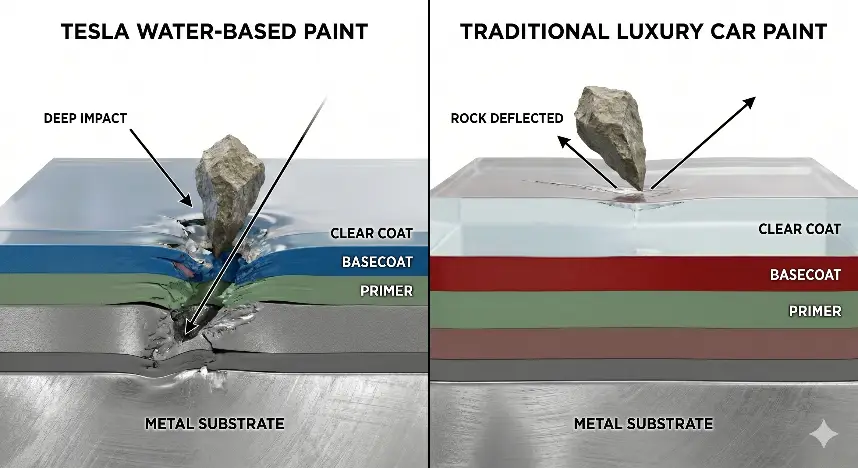
While this is great for the environment, it compromises physical durability. A standard Tesla clear coat measures roughly 4-5 mils (thousandths of an inch) in total thickness, significantly thinner than the 6-7 mils found on traditional German luxury vehicles. More importantly, this eco-friendly paint is physically "brittle."
Comprehensive Breakdown of Tesla PPF Pricing
If you are looking for the bottom line, here is the unvarnished truth about 2026 market rates. Pricing fluctuates based on geography and shop reputation, but these baseline figures represent the national average for high-quality TPU (Thermoplastic Polyurethane) films.
Partial Front Versus Full Front Coverage Costs
The front of your Tesla is ground zero for rock chips. Shops typically offer two distinct packages here.
| Coverage Type | Panels Included | 2026 Estimated Cost | The Verdict |
|---|---|---|---|
| Partial Front | Front bumper, front 1/3 of the hood & fenders, side mirrors. | $600 - $1,500 | Not Recommended. It leaves a visible "seam line" across your hood. Over time, wax, dirt, and dust collect on this edge, making it highly visible on white and black Teslas. |
| Full Front | Entire hood, full front fenders, front bumper, side mirrors. | $1,400 - $2,800 | The Sweet Spot. This covers the high-impact zones completely, eliminating visible seams and offering the highest ROI for daily commuters. |
Full Body Coverage and Matte Finish Surcharges
Stepping up from the front end to the entire vehicle causes the price to jump exponentially. A standard clear Full Body PPF ranges from $4,000 to $8,000+. The drastic increase isn't just about surface area; it involves highly complex labor, such as removing taillights, door handles, and executing intricate edge wraps on the rear quarter panels.
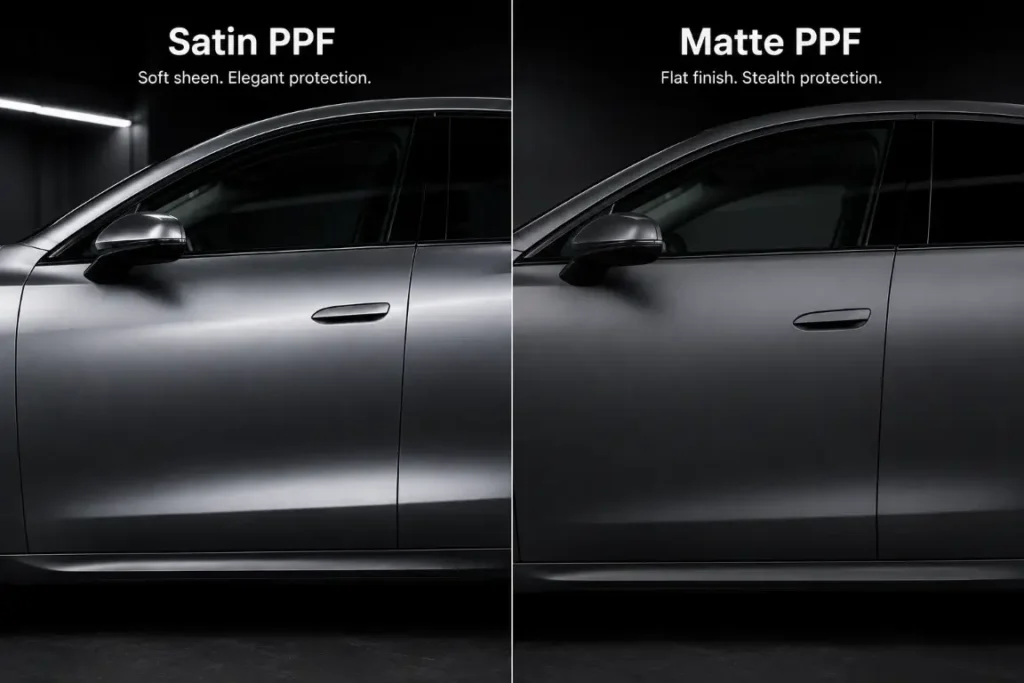
Furthermore, if you intend to change the aesthetic of your glossy Tesla to a satin or matte finish using products like stealth PPF, expect an additional 15% to 20% surcharge. Matte films require absolute perfection during installation—if a clear film is stretched slightly too much, it’s invisible; if a matte film is over-stretched, it creates a shiny, ruined "stretch mark." Additionally, newly redesigned body shapes (such as the Model 3 Highland or the Model Y Juniper) often carry an "early adopter tax" because shops face higher material waste while learning the new panel geometries.
The Hidden Costs Shop Owners Rarely Disclose Upfront
The price quoted on a shop's website is rarely the price you pay when you pick up your keys. In the detailing industry, low advertised base prices are often used as lead magnets, followed by necessary upsells once your car is in the bay.
- Paint Correction ($300 - $500): Even if you drive your Tesla straight from the delivery center to the shop, the paint is rarely flawless. Factory sanding marks, rail dust, and dealership wash scratches (holograms) are common. If you apply PPF over these defects, they are permanently sealed in. A single-stage machine polish is almost always mandatory before film application.
- Old Film Removal ($100 - $150/hr): If you bought a used Tesla with yellowing or damaged PPF, removing it safely without peeling the clear coat requires steam, chemicals, and intense labor. This is never included in a standard installation quote.
The Financial ROI Comparison Between PPF and Factory Repaint
Let’s step away from the marketing brochures and look at this through a cold, financial lens. The core question is: Does spending thousands on film save you money in the long run?
According to certified Tesla collision centers, entirely repainting a damaged front bumper costs roughly $1,000 to $1,500. Repainting a hood might cost another $1,500.
If you own a standard Model 3 or Model Y valued at $40,000, spending $6,000+ (15% of the car's total value) on a Full Body PPF to protect against a potential $1,500 repaint is a negative ROI. Even if the car gets scratched, you could replace and repaint the damaged panels multiple times for the cost of one full-car wrap.
When does Full Body PPF make financial sense?
1. If you own a $100,000+ Model S/X Plaid, where maintaining factory original paint significantly impacts high-end resale value.
2. If you opted for a highly expensive factory paint color or a custom wrap that is impossible to color-match later.
3. If your primary goal is peace of mind and you simply hate looking at swirl marks, rendering the "investment" an emotional lifestyle choice rather than a financial one.
Pro Installation Versus DIY Kits for Tesla Owners
Staring at a $2,000 quote for front-end PPF, many Tesla owners naturally wonder: "Can I just buy the film for $500 and do it myself in the garage?"
The True Cost and Value of Professional Labor
When you pay a premium shop, you are only paying about 30% for the physical TPU material. The remaining 70% buys you environmental control and technical mastery. Professionals operate in climate-controlled cleanrooms equipped with specialized lighting to eliminate dust contamination. They utilize "bulk installation" techniques (custom cutting the film on the car) to achieve wrapped edges, folding the film behind the panels so no lines are visible. You are paying for their ability to perfectly align cutouts for ultrasonic sensors and cameras without putting a razor blade through your clear coat.
The Hidden Risks and Modern Solutions of DIY Application
The internet is littered with stories of DIY disasters. Traditional raw PPF materials feature highly aggressive adhesives with immense initial tack. If you misalign a fender piece and try to pull it up, you risk creating irreversible "stretch marks" or trapping massive air pockets. Furthermore, hand-cutting edges without experience almost guarantees jagged lines or lifting corners within a month. Your $500 attempt quickly becomes garbage, and you end up paying a pro anyway.
However, the industry has evolved. If you are dead-set on saving labor costs and possess genuine mechanical patience, modern supply chains have solved the traditional DIY nightmares. The key is sourcing enterprise-grade materials tailored for ease of use.
For instance, specialized suppliers like FlexiPPF provide precisely engineered solutions that eliminate the guesswork. Instead of wrestling with bulk film, utilizing their Precise Pre-Cutting technology (derived from accurate 3D scans of specific Tesla models) ensures the film fits the panel perfectly without requiring a knife. More importantly, FlexiPPF utilizes Ashland adhesives from the USA, engineered for low initial tack. This specific chemical formulation allows you to lift, reposition, and squeegee the film multiple times without damaging the material. When paired with their comprehensive installation manuals and 10-year warranty, the barrier to a successful, cost-effective DIY application is drastically lowered.
The Golden Protection Combo for Budget Conscious Owners
If Full Body PPF is overkill and DIY isn't your preference, what is the optimal path for a daily-driven Tesla?
Visualize a "Damage Heatmap" of a Tesla traveling at 80 mph. The deep red, high-impact zones are almost entirely localized: the flat nose of the bumper, the leading edge of the hood, and the side mirrors account for 85% of all rock strikes. The doors and rear hatch? Mostly green zones, suffering only from light wash swirls or UV fading.
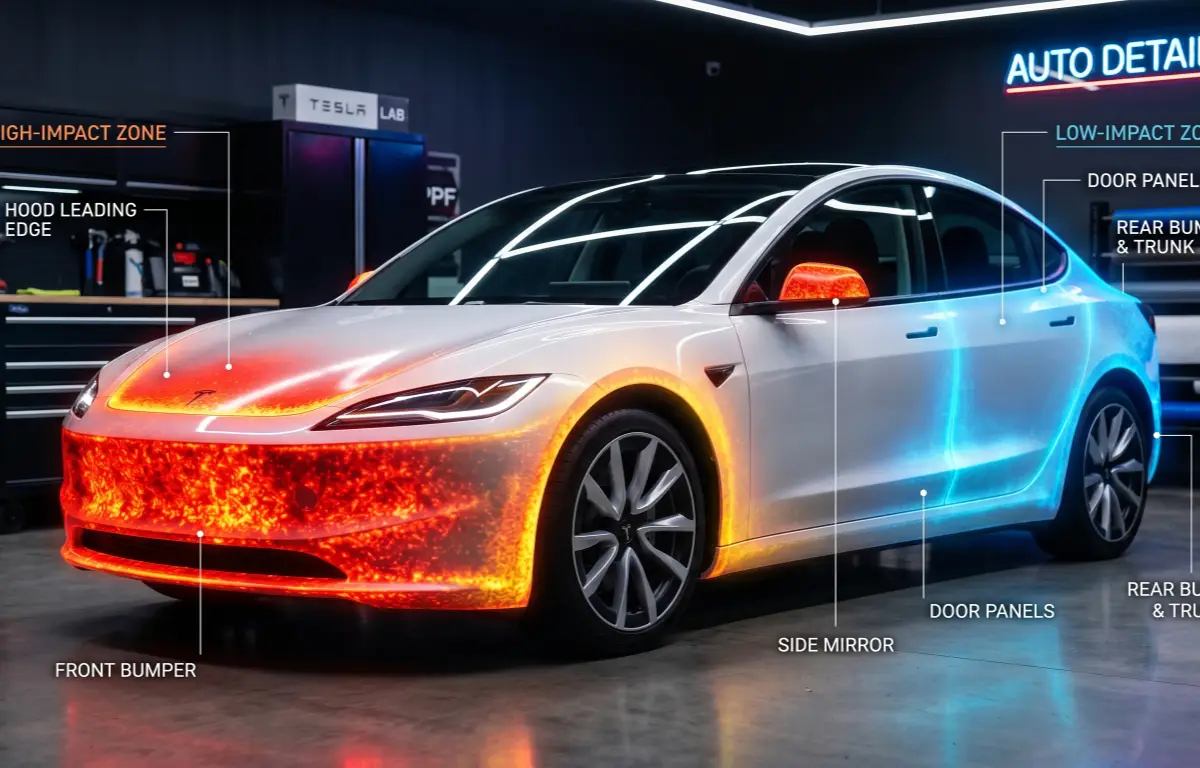
The Smart Money Strategy:
1. Full Front PPF ($1,500 - $2,000): Deploy your heavy armor exactly where the physical impacts occur.
2. Ceramic Coating on the Rest of the Car ($500 - $800): Apply a chemical liquid quartz coating to the doors, roof, and rear. This won't stop a rock, but it provides incredible UV resistance, prevents chemical etching from bird droppings, and makes washing the car effortless.
This hybrid approach keeps your total investment under $2,500 while solving 90% of your real-world paint problems.
How to Inspect a PPF Job Like an Industry Insider
Whether you paid top dollar to a shop or executed a high-end pre-cut installation yourself, you need to know how to evaluate the final result. Don't just look at the shine; inspect the structural integrity.
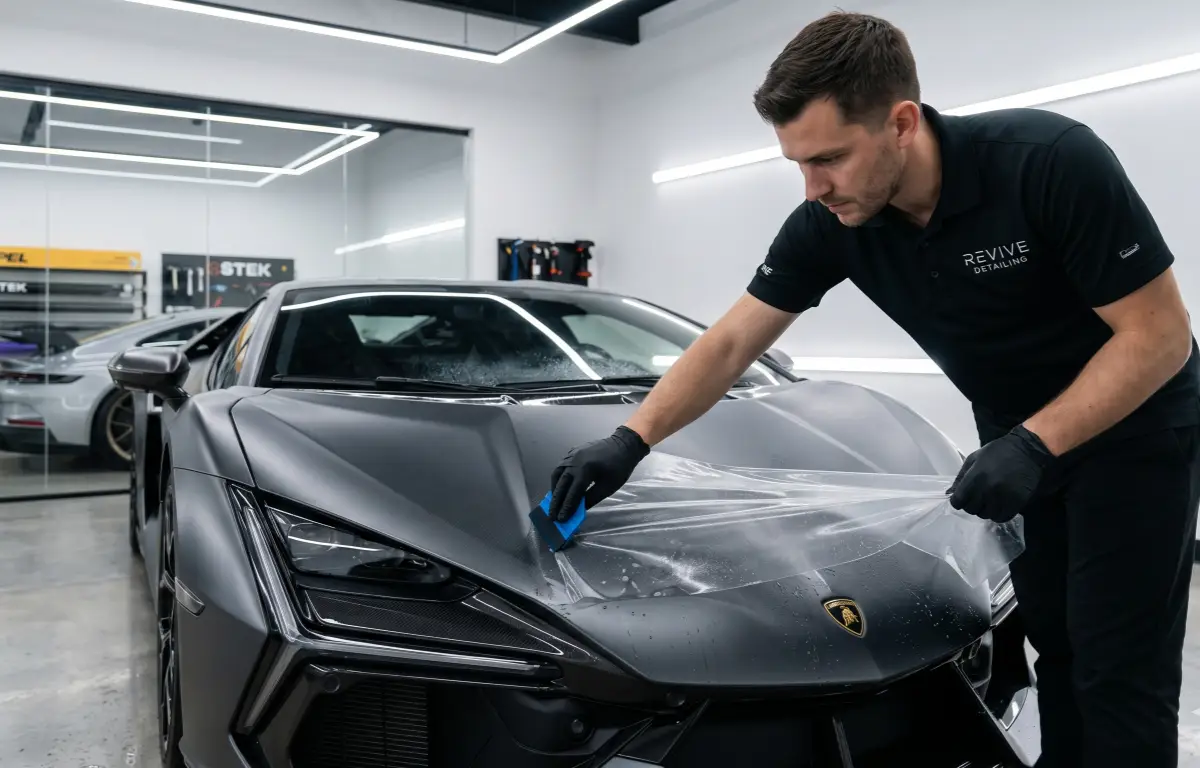
- Wrapped vs. Unwrapped Edges: Run your finger along the edge of the hood. A premium installation will have the film tucked underneath the panel. If you feel a sharp edge stopping just short of the panel's end, dirt will eventually pack into that seam.
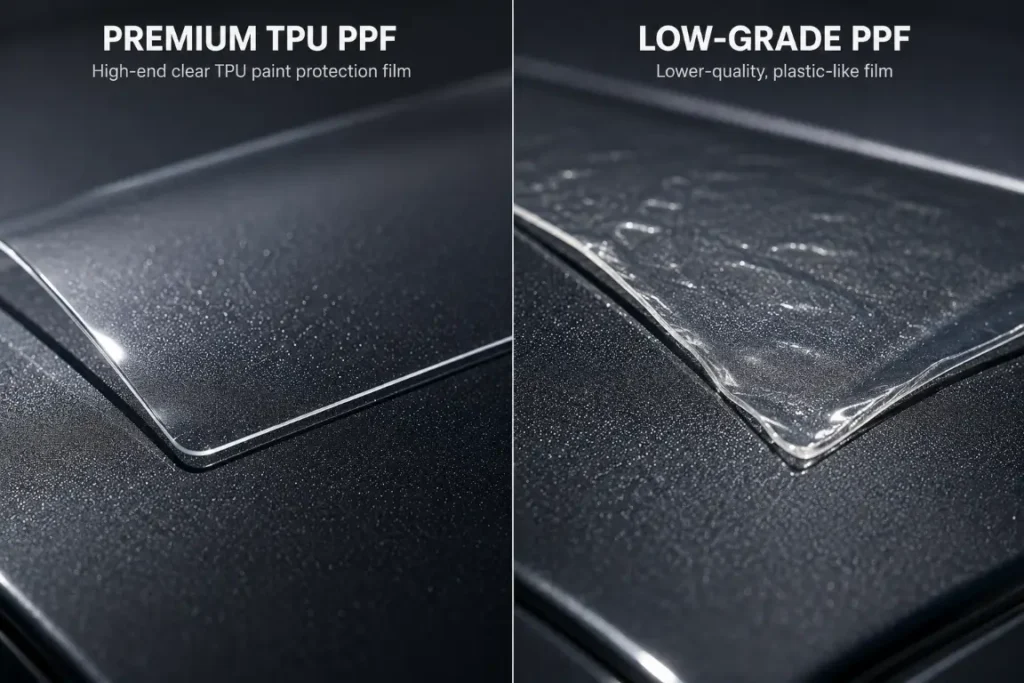
- Water Blisters vs. Dirt Nibs: Small, hazy moisture bubbles are normal and will evaporate through the porous TPU within two weeks of sun exposure. However, if you see tiny, hard white specks trapped under the film, that is permanent dust contamination (dirt nibs) caused by poor prep work.
- Supply Chain Transparency (The Ultimate Test): A shop's workmanship means nothing if they use cheap film that yellows in a year. When negotiating, demand proof of the material's origin. The gold standard in the B2B supply chain relies on premium substrates and advanced manufacturing. For example, industry leaders like FlexiPPF utilize world-class German BASF polyester substrates combined with advanced Nano Ceramic Coatings, processed through German Brückner production lines and magnetron sputtering equipment. This level of manufacturing density guarantees extreme UV resistance and structural stability. If a shop cannot verify their film uses comparable top-tier TPU and adhesive technology capable of backing a true 10-year warranty, take your Tesla elsewhere.
Final Verdict on When You Should Invest in PPF
Stop letting forum anxiety dictate your wallet. Use this definitive decision tree to determine your next move:
- Condition A: You are leasing the Tesla for 2-3 years, or you treat cars purely as A-to-B appliances.
Action: Spend $0 on PPF. Wash it regularly and enjoy the drive. - Condition B: You drive 50+ miles daily on highways, hate seeing rock chips, and plan to keep the car for 5+ years.
Action: Invest in a Full Front PPF + Ceramic Combo. - Condition C: You ordered Solid Black paint (which shows every micro-scratch), you want a matte aesthetic, or you are an obsessive perfectionist with an unlimited budget.
Action: Invest in Full Body PPF.
 English
  Spanish
  Dutch
Dutch  Japanese
  Russian
  Arabic