
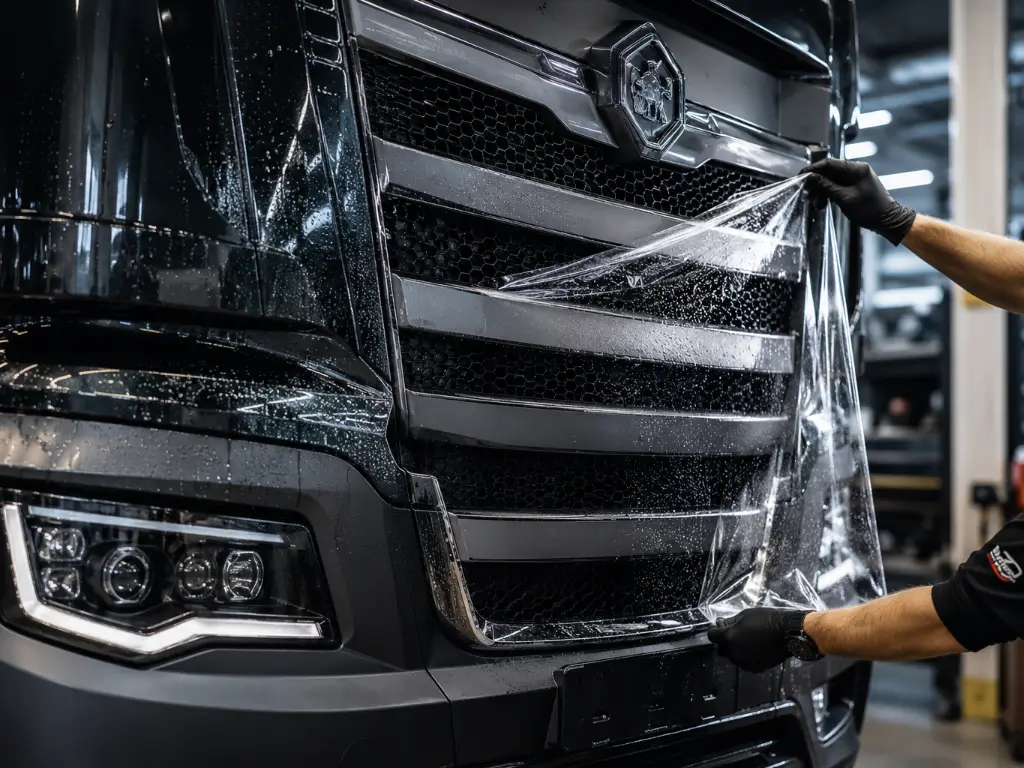
Why Truck Paint Protection Is a Business Investment
Picture two identical 2022 Freightliners parked side by side at a used-truck lot. One has a front end peppered with stone chips, hood oxidation that catches the afternoon light at all the wrong angles, and door panels scarred from years of loading-dock brushes. The other still holds a factory-fresh shine. The price difference between them? Typically 10 to 20 percent — and that gap widens with every passing year the first truck stays on the road unprotected.
Commercial trucks face a level of paint abuse that passenger vehicles simply never encounter. A long-haul semi covers 45,000 to 100,000 miles annually, compared to the 12,000 to 15,000 miles typical of a family car. Every one of those miles exposes the truck’s leading surfaces to gravel spray, road salt, and insect impact at highway speeds. UV radiation oxidizes the clear coat layer by layer, and for trucks operating on construction sites, gravel roads, or in regions with winter de-icing programs, the damage compounds even faster.
The business case goes beyond cosmetics. Damaged paint does not just look bad — it costs money in three measurable ways. First, paint correction and panel resprays run $800 to $1,500 per panel, and fleet trucks with chronic front-end damage can need this work every two to three years. Second, every day a truck sits in a body shop is a day it is not earning — at $800 to $1,500 in lost revenue per day per truck, the downtime alone can exceed the repair bill. Third, when it is time to trade in or sell, severe paint degradation directly reduces the vehicle’s residual value by 10 to 20 percent — a five-figure hit on a heavy-duty truck.
Paint protection is not a detailing expense. It is a line item in your fleet’s total cost of ownership — and one that pays for itself several times over across a typical five-to-eight-year holding period.
Types of Truck Paint Protection: A Quick Overview
Before diving into comparisons, it helps to understand the full landscape. Five main approaches exist for protecting truck paint, each with a different protection mechanism and ideal use case.
| Protection Type | How It Works | Best For | Typical Service Life |
|---|---|---|---|
| PPF (Paint Protection Film) | Clear thermoplastic polyurethane film applied over painted surfaces; absorbs impact energy | High-impact zones — front bumper, hood, fenders, rocker panels | 5–10 years |
| Ceramic Coating | Liquid-applied chemical layer that bonds to clear coat; provides chemical resistance and hydrophobicity | Full-body gloss, UV protection, easier cleaning | 2–5 years |
| Spray-On Bed Liner / Body Armour | Polyurea-based thick coating sprayed onto surfaces; extreme abrasion resistance | Truck beds, wheel wells, rocker panels, off-road underbody | 10+ years |
| Premium Fleet-Grade Repaint | High-durability paint system (epoxy primer + urethane topcoat) designed for 8–10 year service | Full-vehicle refurbishment before resale or branding refresh | 8–10 years |
| Undercoating / Corrosion Protection | Wax-based or rubberized coating applied to chassis and underbody | Winter/salt-belt corrosion prevention | 1–3 years per application |
For most commercial fleets, the conversation quickly narrows to two options: PPF and ceramic coating. Bed liners serve a different purpose (cargo-area protection), and undercoating is more about chassis rust than paint preservation. The decision between PPF and ceramic — or whether to combine both — is where fleet buyers need to focus.
PPF vs. Ceramic Coating: Choosing the Right Protection for Your Fleet
The question is not which technology is “better.” It is which threat your fleet faces most often — and what each solution is actually designed to stop. Use this simple framework before reading further: if your trucks primarily suffer from physical impacts (stone chips, road debris, branch scratches), you need PPF. If your main challenge is chemical exposure, frequent washing, and UV degradation, ceramic coating is the stronger candidate. Many fleets benefit from both — PPF on high-impact zones with ceramic coating applied over the entire vehicle for easy cleaning and UV defense.
When Paint Protection Film Is the Right Choice for Your Fleet
PPF works by placing a physical, energy-absorbing barrier between the road and your paint. When a stone strikes the film at 70 miles per hour, the TPU layer stretches and dissipates the impact energy — the paint underneath stays untouched. This is not a claim that ceramic coating can make; it offers zero physical impact protection.
The material science behind this matters. Quality PPF uses thermoplastic polyurethane with an elongation-at-break rating of 300 to 400 percent, meaning it can stretch to three or four times its original length before failing. Impact testing under ASTM D256 standards confirms that properly specified TPU films absorb enough energy to prevent paint damage from typical road debris. The self-healing mechanism — activated when the film reaches 40 to 60°C, whether from sunlight, engine heat, or a warm water rinse — allows minor scratches and swirl marks to disappear as the polymer chains reflow.
For fleet applications, the strongest candidates are long-haul highway trucks, construction and mining vehicles operating on gravel-heavy sites, and any truck accumulating over 50,000 miles per year on interstates. These vehicles face sustained, high-velocity debris impact that no chemical coating can withstand. A logistics fleet running 20 trucks on I-80 through Wyoming, where winter gravel and summer construction debris are constants, will see measurable paint damage reduction within the first year of PPF application on leading surfaces.
When Ceramic Coating Makes More Sense
Ceramic coating solves a different problem. It forms a chemical bond with the clear coat at the molecular level, creating a surface that repels water, resists chemical etching from bird droppings and bug acids, and blocks UV radiation that causes clear-coat oxidation. A quality ceramic coating achieves a water contact angle above 100 degrees — rain and wash water bead up and roll off, carrying dirt with them instead of leaving mineral deposits.
The practical benefit for a fleet is straightforward: trucks stay cleaner longer, and when they are washed, the process takes less time and uses fewer chemicals. For urban delivery fleets, refrigerated trucks, and vehicles that need to maintain a polished brand image with frequent washing, ceramic coating delivers a measurable operational efficiency gain. The coating itself is only 2 to 5 microns thick (compared to PPF’s 150 to 300 microns), so it provides no physical impact protection — but that is not its job.
The best outcome for most commercial fleets combines both technologies: PPF on the front bumper, hood leading edge, mirrors, and rocker panels where debris impact is concentrated, with a ceramic coating applied over the entire vehicle — including over the PPF itself where the two products are compatible. This layered approach addresses both physical impact and chemical exposure, maximizing protection without over-investing in full-body PPF.
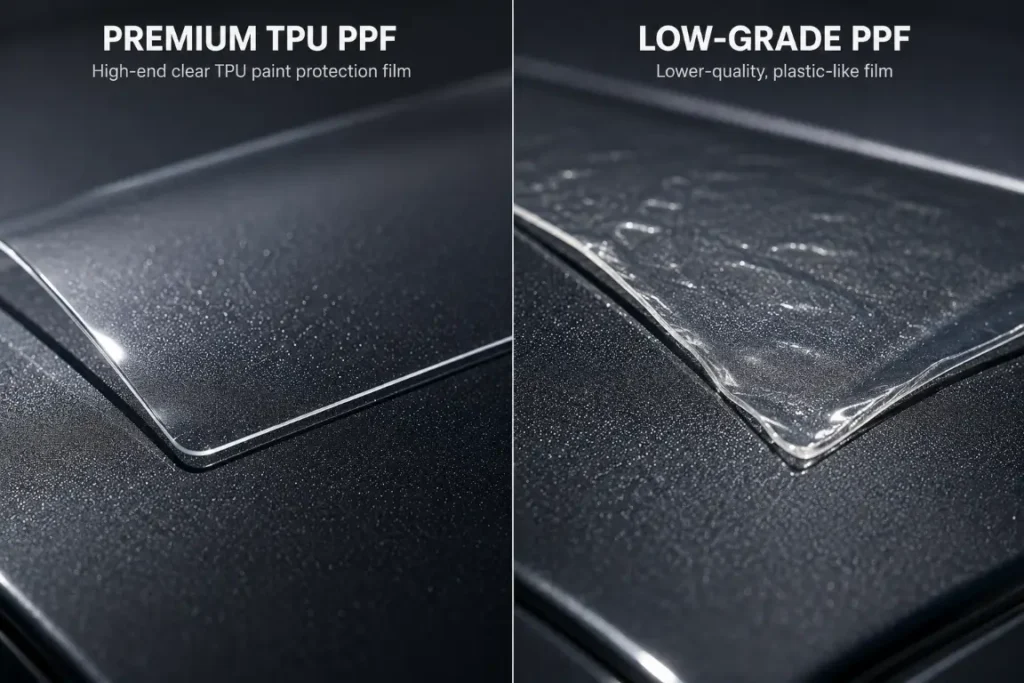
What Separates Professional-Grade PPF from Consumer Films
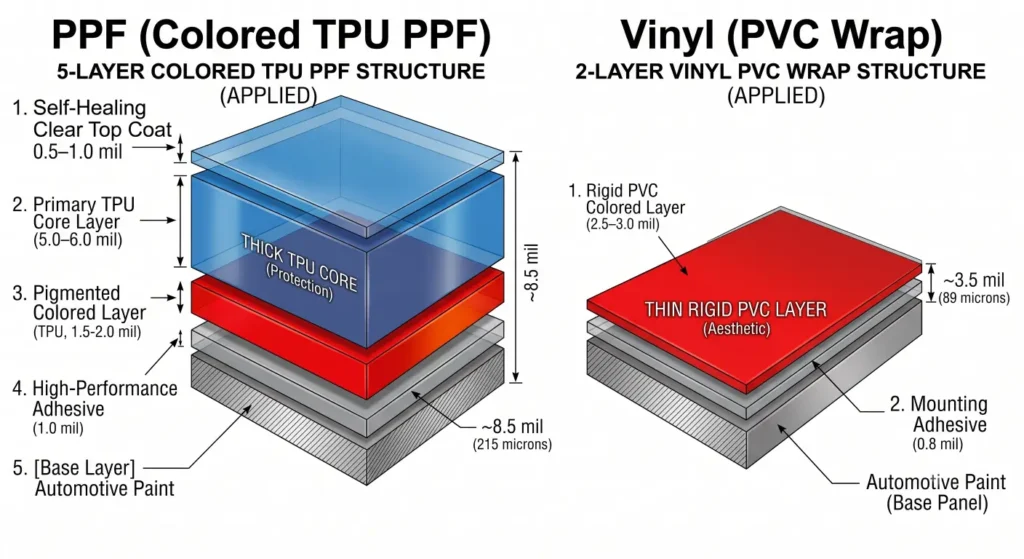
Most PPF buying guides stop at brand names: XPEL versus 3M versus SunTek. But for a fleet buyer making a purchase decision that will cover dozens or hundreds of vehicles over multiple years, the question needs to go deeper. Every PPF is a four-layer sandwich: a self-healing top coat, a TPU substrate, an adhesive layer, and a release liner. The quality of the film is the sum of the quality of each layer — and the manufacturing process that binds them together.
The TPU Foundation: Why the Base Material Decides Everything
Think of TPU the way you would think of a processor in a laptop. The brand on the outside matters less than the chip on the inside. In PPF, roughly 70 percent of the film’s performance — its tensile strength, elongation, UV resistance, and anti-yellowing longevity — is determined by who made the TPU and how it was processed.
Three global suppliers dominate the premium TPU market for paint protection films: BASF of Germany, Lubrizol of the United States, and Covestro of Germany. Together, these three account for the vast majority of high-end PPF substrates. TPU from these sources consistently delivers tensile strength above 40 MPa (ASTM D412), elongation at break exceeding 300 percent, and color stability through 5,000 hours of accelerated UV aging (QUV ASTM G154) with a delta-E color shift below 3 — meaning the film stays clear, not yellow.
A supplier who can name their TPU source is demonstrating transparency. A supplier who cannot — or who describes it only as “high-quality imported TPU” — is asking you to trust a black box. For a fleet investment that needs to perform across five to ten years of hard service, that is not a bet worth taking.
Topcoat Technology: Self-Healing, Hydrophobicity, and UV Resistance
The topcoat is what the driver and the wash crew actually experience. Three performance dimensions define its quality: how fast scratches heal, how well water beads, and how effectively UV is blocked.
Self-healing is not magic — it is polymer physics. When the TPU layer warms to its glass transition temperature (typically 40 to 60°C), the molecular chains regain mobility and reflow into the scratch, filling the depression. This is a genuine material property of quality TPU, not a coating that fills scratches with sacrificial material. The practical test is simple: pour warm water (approximately 60°C) over a surface scratch on quality PPF, and watch it vanish within seconds. Films that require “heat gun treatment” for healing are using a different, less capable chemistry.
Hydrophobicity is measured by water contact angle under ASTM D7334. A contact angle of 105 degrees or higher classifies the surface as genuinely hydrophobic — water beads into near-spheres and rolls off, taking surface dirt with it. This directly reduces washing frequency and chemical consumption. UV protection should block at least 98 percent of UV radiation; the topcoat achieves this through a combination of UV absorbers and hindered amine light stabilizers (HALS) that prevent both the film itself and the underlying paint from photodegradation.
The Adhesive Layer: Bond Strength, Low Initial Tack, and Long-Term Stability
Adhesive quality is the invisible variable that determines whether PPF stays stuck for a decade or starts peeling in year three. Two global names set the benchmark: Ashland of the United States and Henkel of Germany produce pressure-sensitive acrylic adhesives engineered specifically for automotive film applications.
The key specification is the tack profile. During installation, the adhesive must have low initial tack — typically 2 to 5 Newtons per 25 millimeters — so the installer can reposition the film on a large truck panel without it grabbing prematurely. After curing, the final bond strength should reach 15 to 25 N/25mm. This keeps the film in place through temperature swings from -40°C to 120°C and through repeated high-pressure washing. Adhesives that lack this engineered dual profile will either fight the installer during application or fail to hold long-term. On a commercial truck, “long-term” means surviving everything from Canadian winters to desert summers without bubbling, lifting, or leaving residue upon removal.
Film Thickness: What Gauge Does Your Fleet Actually Need?
Thickness is not a “more is better” variable — it is a matching exercise between film gauge and operating environment. Standard PPF runs 6 to 8 mil (150 to 200 microns). Heavy-duty films at 10 to 12 mil (250 to 300 microns) exist for extreme applications.
Here is a practical guide by fleet type:
- Long-haul highway trucks: 8 to 10 mil on the front bumper, hood, and mirror caps. These vehicles face sustained high-speed debris; the extra 2 mil over standard absorbs significantly more impact energy before the paint layer is threatened.
- Construction and mining vehicles: 10 to 12 mil, extending coverage to rocker panels, lower doors, and fender flares. Gravel and rock spray hits from all angles — not just the front.
- Urban delivery fleets: 7 to 8 mil is usually sufficient. Lower speeds and paved roads reduce the impact threat; the priority is chemical protection and ease of cleaning.
- Trucks with oversized panels: Pay attention to roll width. Standard PPF rolls are 60 inches (1.52 meters) wide. For a semi-truck hood or a box-truck side panel that exceeds this dimension, the installer will need to create a seam — and seams are the first place dirt accumulates and edges begin to lift. Wide-format PPF at 72 inches (1.83 meters) eliminates this problem by covering large panels in a single, seamless sheet.
The Real Cost of Truck Paint Protection: A Fleet Buyer’s Calculation
The sticker price of PPF installation — typically $1,500 to $3,000 for partial front coverage and $3,000 to $5,000 for a full front on a Class 8 truck — triggers sticker shock in most first-time fleet buyers. But the correct comparison is not against doing nothing. It is against the cumulative cost of not having the film.
| Cost Category | Without PPF (5-Year Cumulative) | With PPF (Including One-Time Install) | 5-Year Savings |
|---|---|---|---|
| Paint repair & panel resprays | $3,500–$6,000 | $500–$1,000 | $2,500–$5,000 |
| Vehicle downtime during repairs | $2,000–$4,000 | $0–$500 | $1,500–$3,500 |
| Residual value loss from paint condition | $3,000–$5,000 | $0–$1,000 | $2,000–$4,000 |
| PPF installation | $0 | -$2,500–$4,000 | — |
The arithmetic is straightforward: across a five-year holding period, a single truck with PPF on high-impact surfaces saves between $6,000 and $12,500 in avoided costs, net of the initial installation. For a fleet of 50 trucks, that is $300,000 to $625,000 in recovered value — enough to fund the PPF installation several times over. And this calculation does not account for the intangible benefit of a fleet that consistently looks well-maintained on the road, which matters when your trucks are also your rolling billboards.
Scale matters, too. Bulk PPF procurement for a fleet of 20 or more vehicles typically unlocks volume pricing that brings per-truck costs down by 15 to 30 percent compared to single-vehicle retail quotes. When evaluating suppliers, ask about fleet pricing tiers — the difference can be significant.
How to Choose a Paint Protection Film Supplier: A Business Buyer’s Checklist
By now, you know what PPF is, how it compares to alternatives, what separates quality film from commodity product, and what the numbers look like. The remaining question is: who do you buy it from? For a business buyer — whether you are a fleet manager purchasing for your own trucks, a detail shop stocking for customers, or a distributor building a private-label brand — the supplier selection process determines not just the product quality but also pricing predictability, delivery reliability, and what happens when something goes wrong.
Use this six-dimension framework to evaluate any PPF supplier: manufacturing strength, raw material transparency, quality certifications, customization flexibility, delivery reliability, and warranty and support.
Manufacturing Strength: Why Factory Capability Matters to Your Bottom Line
The single most important question to ask any PPF supplier is: do you own your factory?
A supplier that operates its own extrusion lines and coating machines controls its production schedule, quality consistency, and costs directly. A supplier that is a trading company — buying film from one factory, having it coated at another, and slitting it at a third — adds markup at every handoff while losing visibility into quality control at each step.
Concrete indicators of manufacturing strength include: total factory floor area (60,000 square meters signals serious scale; under 5,000 may indicate a small workshop), number of production lines, coating equipment origin (German and Korean coating machines are the industry benchmark for precision), and monthly production capacity. For a fleet buyer, the practical difference is lead time. A factory-direct supplier can ship in-stock products the same day and begin custom production within one to two days.
Customization and Flexibility: Can Your Supplier Adapt to Your Market?
Standard PPF off the shelf works for standard applications. But fleets, distributors, and private-label brands often need something different: a specific film thickness for a region with harsh roads, a proprietary packaging design that builds your brand, a color-matched film for a fleet with a distinctive livery.
The question is whether your supplier treats customization as a core capability or a reluctant exception. The strongest signal is minimum order quantity. A supplier that requires 50 or 100 rolls to begin a custom run is optimized for large brands placing annual contracts — not for a distributor testing a new market or a fleet manager who needs 15 rolls in a specific gauge. Suppliers that accept single-roll minimums for custom orders, deliver design proofs within 48 hours, and launch two to three new designs per quarter are built for the pace at which real businesses operate.
Warranty and Support: What Happens After the Sale
Every PPF supplier offers a warranty. The difference between a warranty that protects your investment and one that is marketing language comes down to four specifics.
First, warranty duration and scope. Five years is the industry floor; ten years signals confidence in material stability. But duration means nothing without scope — a warranty should explicitly cover yellowing, cracking, peeling, and delamination. If the warranty document only mentions “manufacturing defects” without listing these failure modes, you are buying an escape clause, not protection.
Second, technical support availability. A supplier that offers 24/7 technical response — with a dedicated team, not a shared customer-service inbox — can resolve installation questions before they become warranty claims.
Third, pre-cutting capability. Advanced suppliers use 3D vehicle scanning data to pre-cut film to exact panel dimensions before shipping. This reduces installation time — often by 30 to 40 percent compared to hand-cutting on the vehicle — and eliminates the risk of an installer’s blade touching your truck’s paint.
Fourth, claims handling. Ask directly: if a film yellows on a truck in Arizona after four years, what is the process? Who pays for removal and reinstallation — not just the replacement film? A supplier that covers labor as well as materials has confidence in their product. A supplier that hesitates on this question is telling you something about their own expectations.
References
- ASTM International. “ASTM D256 — Standard Test Methods for Determining the Izod Pendulum Impact Resistance of Plastics.” astm.org
- ASTM International. “ASTM D412 — Standard Test Methods for Vulcanized Rubber and Thermoplastic Elastomers — Tension.” astm.org
- ASTM International. “ASTM D7334 — Standard Practice for Surface Wettability of Coatings.” astm.org
- ASTM International. “ASTM G154 — Standard Practice for Operating Fluorescent Ultraviolet (UV) Lamp Apparatus.” astm.org
- Ferguson Truck Center. “Paint Protection Film Worth It for Semi Trucks.” fergusontruckcenter.com
- Sunco Protective Films. “The Role of PPF in Fleet Vehicle Maintenance.” suncoprotectivefilms.com
- FlexiPPF. “OEM & Customization Services.” flexippf.com
- FlexiPPF. “Automotive Paint Protection Films.” flexippf.com
- FlexiPPF. “Contact FlexiPPF.” flexippf.com
 English
  Spanish
  Dutch
Dutch  Japanese
  Russian
  Arabic