
01 What “Types of PPF” Actually Means — and Why the Material Matters
Not all paint protection film is created equal. A PPF that still looks flawless after seven years is built from different materials than one that yellows and peels in eighteen months. Most buyers never ask which one they’re getting.
“Types of PPF” splits along two axes. The first is material — what the film itself is built from. That determines durability, flexibility, and whether it can heal its own scratches. The second is finish — how the surface looks and behaves, from high-gloss invisible to matte stealth. These two dimensions interact. A gloss-finish film made from cheap PVC will look worse after 12 months than a matte TPU film after five years.
Think of it like phone screen protectors. A PET film and a tempered glass protector both look transparent in the box. But touch, impact resistance, scratch recovery, and longevity are worlds apart. PPF types differ by at least three times that margin — and the stakes are higher when you’re protecting a vehicle worth tens of thousands of dollars.
By the end, you’ll know which material types exist, which chemistry actually prevents yellowing, which finishes fit your maintenance habits, and how to choose without overpaying.
02 PPF Types by Material — TPU, TPH, and PVC Explained
Before diving into each material, here’s the framework that matters: every PPF lives or dies on three properties — elasticity (can it stretch around curves without lifting?), yellowing resistance (will it still be clear in three years?), and self-healing ability (do minor scratches disappear, or are they permanent?). Keep these three in mind. They’re the ruler. The materials below are the measurements.
TPU (Thermoplastic Polyurethane) — The Gold Standard
TPU dominates the global PPF market, accounting for over 80% of all paint protection film sold (Grand View Research, 2024). That dominance isn’t marketing. It’s structural.
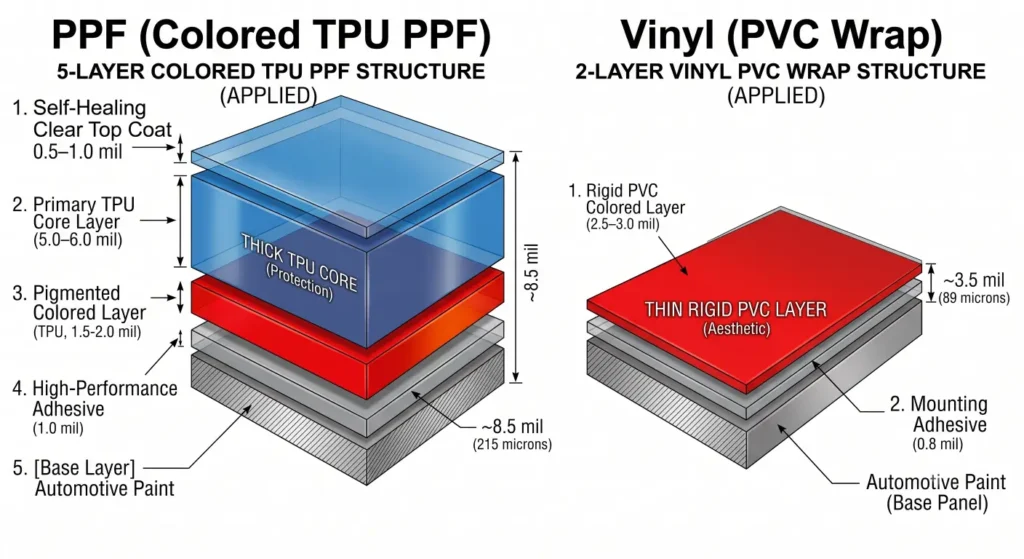
A quality TPU film is built in three layers. The top coat is a clear, elastomeric layer that repairs micro-scratches when exposed to heat. The middle layer is the TPU substrate: a polymer with a microphase-separated structure of hard segments (urethane groups, providing strength) and soft segments (polyols, providing elasticity). The bottom adhesive layer uses high-molecular pressure-sensitive adhesive for residue-free removal.
The numbers tell the story. TPU stretches 500–800% before breaking, with tensile strength between 20–50 MPa. It stays flexible from −40°C to 100°C. Its soft-segment polymer chains undergo entropy-driven elastic recovery when thermally activated — the scientific way of saying minor scratches vanish in sunlight. A well-made TPU film lasts 5–10 years.
But here’s the catch: not all TPU is the same. Inside the “TPU” label sit two completely different chemical families. More on that in the next section.
TPH (Thermoplastic Polyolefin Hybrid) — The Budget Compromise
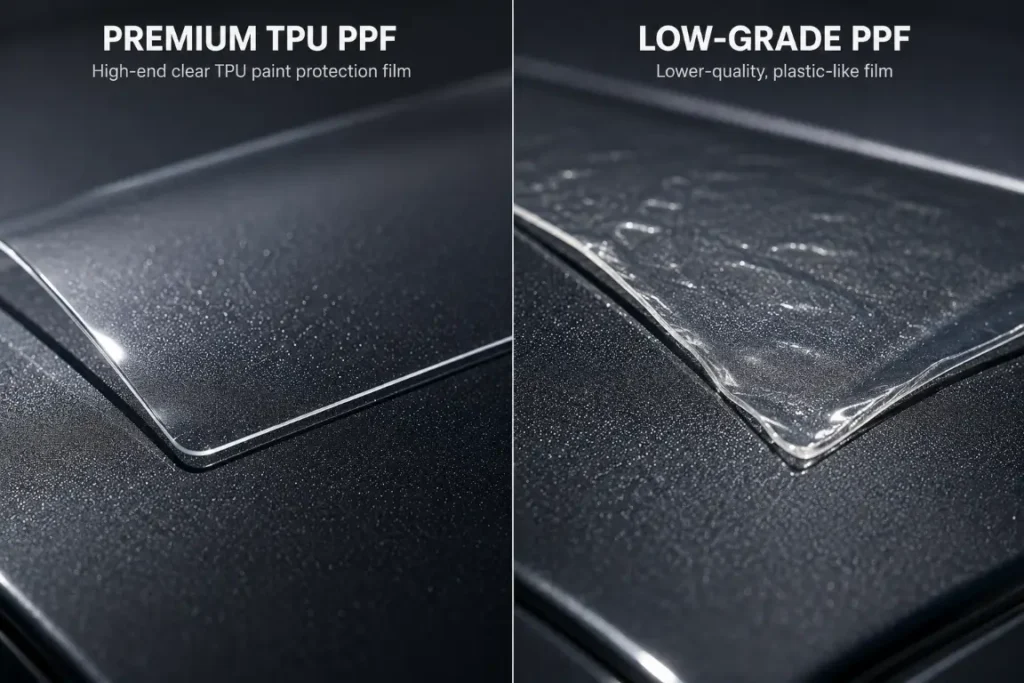
TPH is what happens when manufacturers blend PVC with polyolefins (PE/PP) to create something that looks like TPU for a while. It’s the “cotton-blend” of PPF: cheaper than pure cotton, looks similar on the rack, but pills and deforms after a year of washing.
The performance gap matters. TPH stretches only 200–400% at break, with tensile strength between 15–25 MPa. It has little to no self-healing capability because it lacks the soft-segment molecular architecture that gives TPU its recovery properties. Lifespan tops out at 2–4 years. After that, the PVC component’s thermal instability accelerates yellowing, and the adhesive layer — usually a lower-grade formulation — starts risking delamination or residue.
TPH has its place: short-term leased vehicles, budget fleet protection, or any scenario where the car leaves your hands within two years. For anything you plan to keep, the upfront savings evaporate once you factor in removal and replacement. One more thing: TPH contains chlorine from its PVC component, making it non-compliant with EU REACH halogen restrictions. European importers, take note.
PVC (Polyvinyl Chloride) — The First Generation (and Why It’s Fading)
PVC is where PPF began. Originally developed as “helicopter tape” to protect rotor blades during the Vietnam War, it served its purpose. But automotive paint protection has moved on.
The fundamental problem is molecular. PVC is a linear polymer with an elastic modulus of 2–4 GPa — an order of magnitude stiffer than TPU. It doesn’t stretch; it fights the installer. Elongation at break is a mere 100–200%, with no soft-segment/hard-segment architecture to enable self-healing. The yellowing has a chemical root: PVC’s chlorine atoms are photolytically labile. UV exposure strips them off, leaving conjugated double bonds that absorb visible light as a yellow-brown tint.
Lifespan: 1–2 years, optimistically. It’s the Nokia 3310 screen of PPF. It technically protected things in its era, but next to modern Gorilla Glass, it’s a different category entirely. If someone quotes you an “unbelievably cheap full-car PPF,” you’re looking at PVC. Walk away.
03 Inside TPU — The Aliphatic vs. Aromatic Difference That Changes Everything
“Buy TPU” is the advice everyone gives. It’s incomplete. Inside the TPU family, two chemical pathways diverge. The choice between them determines whether your film stays clear for a decade or starts yellowing in year three.
Aliphatic TPU — The UV-Stable Choice
Aliphatic TPU is built on HDI (hexamethylene diisocyanate) monomers. HDI’s molecular structure is a straight-chain alkane — no carbon-carbon double bonds, no aromatic rings. That means it doesn’t absorb UV radiation in the 280–400nm range that causes polymer degradation. It’s structurally indifferent to sunlight.
The evidence is in accelerated weathering data. Under ASTM G154 QUV testing — the industry’s standard for simulating years of sun exposure in weeks — aliphatic TPU films show a color shift (ΔE) below 2 after 2,000 hours (ASTM International, 2023). That’s below the threshold of human perception. Aromatic TPU, exposed to the same conditions, typically registers ΔE values of 8–15: clearly visible yellowing.
This is why aliphatic TPU commands 85% of the global PPF market and supports 10-year warranties. It costs more per square foot, but the cost-per-year math favors it decisively. Think of it like outdoor furniture: indoor plastic chairs last forever with any material. Outdoor loungers need UV-stabilized formulations, or they’re chalky white by August. Aliphatic TPU is the outdoor-grade formulation.
Aromatic TPU — Cheaper, But at What Cost?
Aromatic TPU uses MDI (methylene diphenyl diisocyanate) monomers, which contain benzene rings. Those rings absorb UV light at exactly the wavelengths that trigger photo-Fries rearrangement — a chemical reaction that converts the aromatic rings into quinone-like structures. Quinones are yellow-brown chromophores. The reaction is irreversible. No amount of cleaning, polishing, or “UV protectant spray” will reverse it because the color isn’t on the surface. It’s in the polymer backbone.
The yellowing rate is 3–5 times faster than aliphatic TPU. In hot, high-UV markets — think UAE, Saudi Arabia, Australia, Arizona — aromatic TPU can show visible discoloration within two years. That said, it’s not universally wrong. Deep black cars mask yellowing better than white or silver. Budget-sensitive fleet operators who cycle vehicles every 3–4 years may find the tradeoff acceptable. The key is knowing what you’re buying, not discovering the difference through disappointment.
When you’re evaluating suppliers, the material sourcing tells you everything before you even see the film. Reputable manufacturers build their PPF on established raw material chains: Lubrizol or BASF aliphatic TPU substrate, Ashland adhesive, ceramic-infused top coat, 5-layer construction with a 10-year warranty behind it. These aren’t marketing bullet points. They’re the supply-chain signals that separate factories from resellers.
04 PPF Types by Finish — Gloss, Matte, and Advanced Surfaces
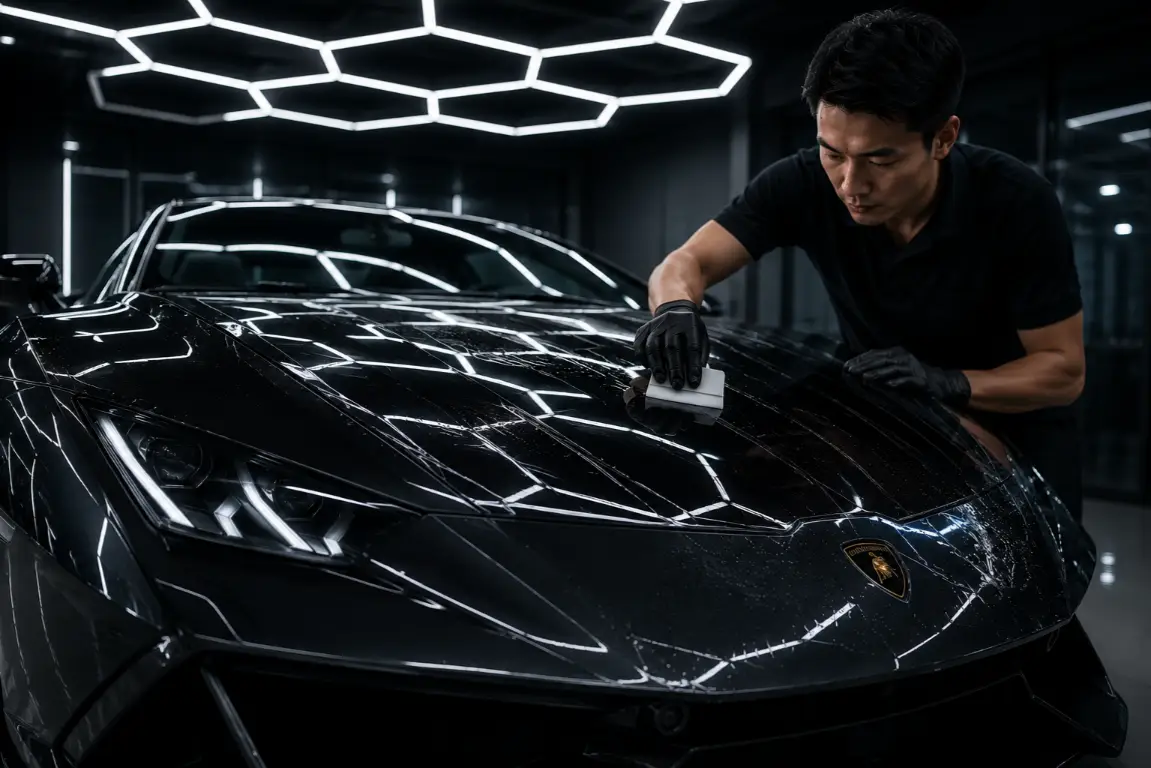
Choosing a finish isn’t about which one looks best in the showroom. It’s about which maintenance reality you’re signing up for. The aesthetic preference is personal. The cleaning routine is mandatory.
Gloss PPF — The Invisible Shield
Gloss is the default for a reason. A well-made gloss PPF registers 95+ GU (gloss units) at a 60° measurement angle under ASTM D523 — matching or exceeding factory clearcoat, which typically lands between 85–92 GU. Installed correctly, it’s optically invisible. The car looks like it just left the showroom, every day.
The tradeoff: gloss shows everything. Swirl marks from automated car washes. Water spots from parking near sprinklers. Dust accumulation between washes. If you wash your car every two weeks and know what a microfiber mitt is, gloss PPF rewards you. If you go months between washes, you’ll be disappointed — not because the film failed, but because it’s faithfully preserving a dirty finish.
Gloss PPF accounts for roughly 70% of all installations. It’s the safe choice, and for most vehicles, the right one.
Matte PPF — The Stealth Look (and the Hidden Tradeoffs)
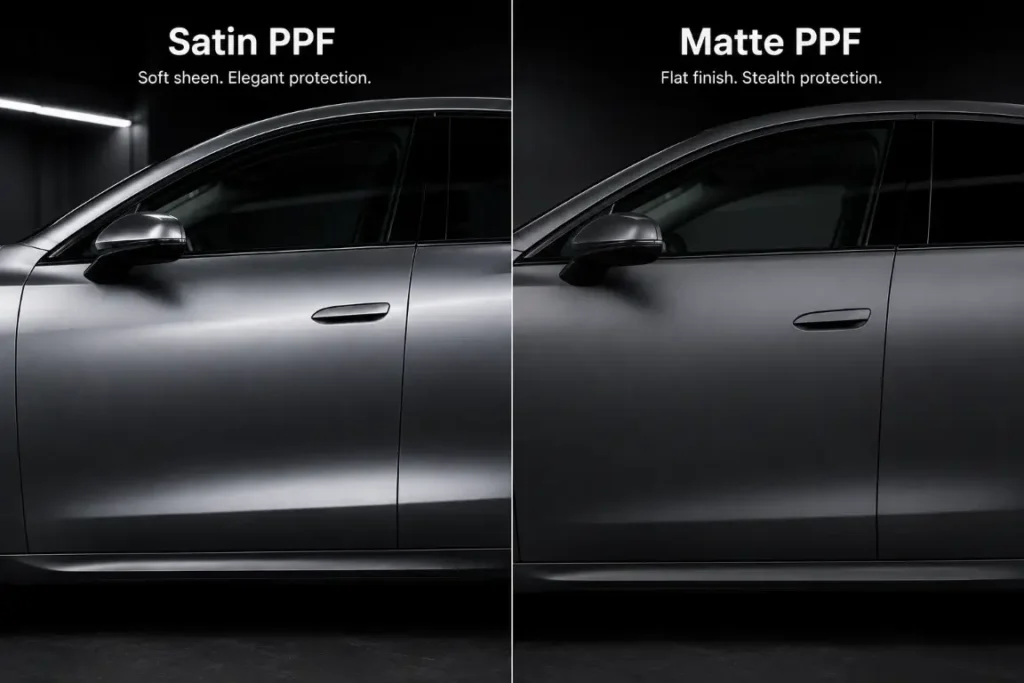
Matte PPF is the fastest-growing finish category, and it’s easy to see why. A matte-wrapped sports car or SUV has presence. The non-reflective, satin-like surface masks dust and minor water spots, meaning the car looks cleaner longer between washes.
What the marketing skips: matte PPF’s surface roughness (Ra ≈ 0.5–1.5 μm, versus < 0.05 μm for gloss) creates the look — and the vulnerability. When something scratches a matte surface, it flattens the micro-texture at that spot. The flattened area becomes locally glossy. Against the surrounding matte background, that tiny glossy scratch screams white. You can’t polish it out because polishing would flatten more texture, making the problem larger. The fix is replacing the panel.
Matte PPF costs 15–25% more than equivalent gloss, and the maintenance philosophy is fundamentally different. With gloss, you maintain. With matte, you accept — scratches are terminal events, not maintenance items. For a weekend car that sees careful handling, matte works beautifully. For a daily commuter on highway miles with stone chips, it’s an expensive exercise in frustration.
- Scratches are permanent — no polish fix exists
- Costs 15–25% more than equivalent gloss
Ceramic-Infused and Self-Healing Top Coats — The New Standard
The most significant PPF innovation of the last three years isn’t a new material or finish category. It’s the integration of ceramic properties directly into the top coat at the manufacturing stage.
Traditional PPF plus aftermarket ceramic coating is a two-product system: the film protects against impact, the liquid ceramic coating adds hydrophobicity on top. But that ceramic layer wears off in 12–24 months and needs reapplication. Ceramic-infused PPF embeds the hydrophobic chemistry — typically nano-SiO2 particles in the 20–50nm range — directly into the top coat during manufacturing. The result is a single product where the water-repelling surface lasts as long as the film itself. Contact angle exceeds 110° (ASTM D7334), hitting the superhydrophobic threshold where water beads and rolls off, carrying dirt with it.
Self-healing has also crossed a threshold. Early TPU films needed 50°C+ heat — hot water, a heat gun, or brutal summer sun — to trigger scratch recovery. The 2025 generation of top-tier films heals at 20–30°C, meaning ambient warmth from a parked car is enough. Recovery rates exceed 95% under ASTM D968 abrasion testing.
Embedded ceramic hydrophobicity and room-temperature self-healing are rapidly becoming the baseline for any PPF calling itself “premium.” If a film advertises “self-healing” but can’t tell you at what temperature or what recovery rate, it’s a marketing claim without an engineering document.
05 How to Choose the Right PPF Type — A Practical Decision Framework
Everything above reduces to a few practical choices. Here’s the decision matrix:
| User Profile | Recommended Material | Recommended Finish | Key Priority | Budget Level |
|---|---|---|---|---|
| Long-term owner (5+ years) | Aliphatic TPU, 8–10 mil | Gloss or Matte (preference) | Yellowing resistance + self-healing + 10-year warranty | High |
| Short-term / lease owner (2–3 years) | TPU (aliphatic or aromatic) | Gloss | Basic protection + lease-return condition | Mid |
| Enthusiast / modified car | Aliphatic TPU | Matte or Colored PPF | Finish uniqueness + long-term clarity | High |
| Fleet manager | TPU (aromatic acceptable) | Gloss | Volume pricing + consistency + basic warranty | Mid |
| Distributor / shop evaluating product lines | Aliphatic TPU, 8–10 mil | Gloss (flagship) + 1 specialty | Raw material provenance + warranty strength + OEM capability | Mid–High |
The table captures the common scenarios, but one principle overrides every row: installation quality matters more than which premium TPU brand you choose. A perfectly installed mid-tier aliphatic TPU will outperform a poorly installed top-tier film with visible seams, trapped debris, and edge lifting. The installer’s skill — prep, stretching technique, edge work — is the variable that no material spec sheet can compensate for.
If you walk away with one question to ask, make it two: “Is the TPU aliphatic?” and “Who’s installing it?” Get the first answer in writing. Get the second answer by looking at their previous work, not their website.
References
- Grand View Research. “Paint Protection Film Market Size, Share & Trends Analysis Report, 2024–2030.” 2024. grandviewresearch.com
- ASTM International. “ASTM G154-23: Standard Practice for Operating Fluorescent Ultraviolet (UV) Lamp Apparatus for Exposure of Materials.” 2023. astm.org
- FlexiPPF. “Paint Protection Films — Product Line.” flexippf.com
- FlexiPPF. “Home — Automotive & Architectural Film Manufacturer.” flexippf.com
 English
  Spanish
  Dutch
Dutch  Japanese
  Russian
  Arabic